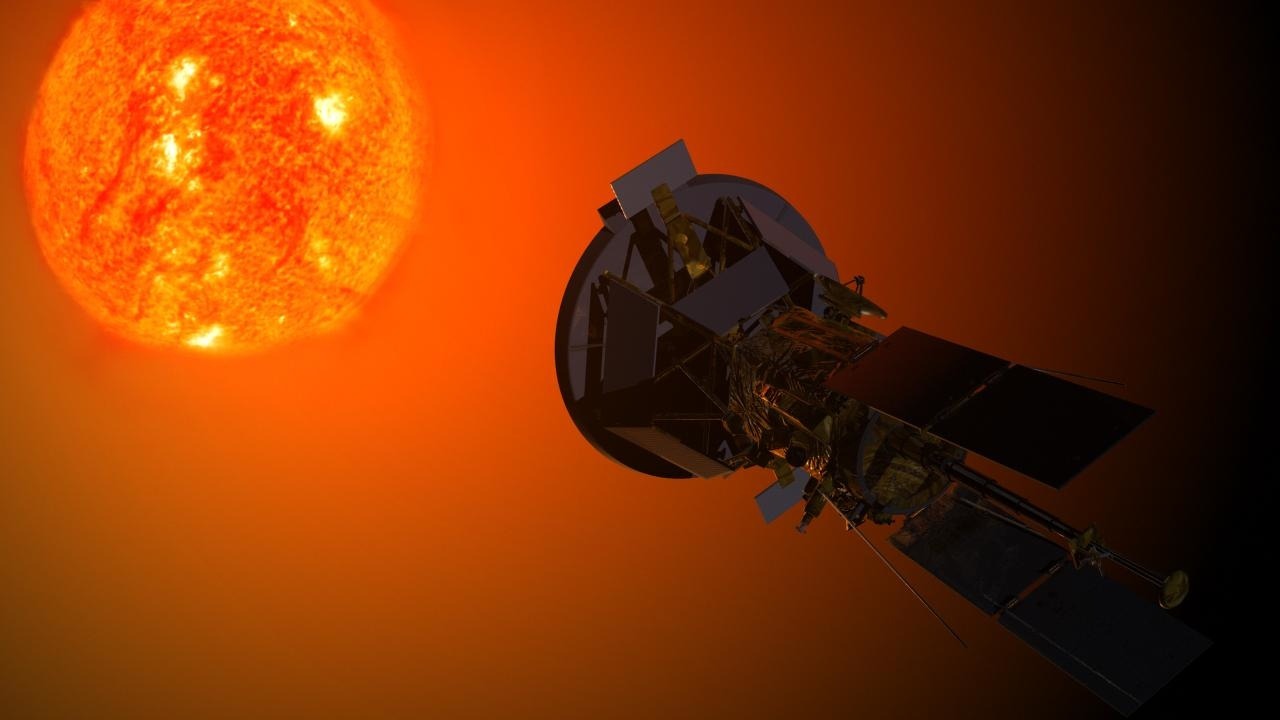

Nearly half a century after it left Earth, a battered spacecraft built with 1970s electronics is closing in on a frontier no human machine has ever crossed. The probe is not only venturing deeper into interstellar space, it is also forcing scientists to rethink how long a mission can survive, and what it means to keep hearing from a machine that should have fallen silent years ago.
As it drifts farther from the Sun, this aging traveler is entering a realm where the influence of our star fades into the background hum of the galaxy, a region that is less a boundary line than a slow fade from the familiar to the unknown. I see its journey as a live experiment in endurance, both for hardware that has lasted far beyond its design life and for the people still coaxing science from a signal that takes nearly a day to arrive.
The farthest human artifact keeps going
The most distant machine humanity has ever built is not a sleek new observatory but a small, spinning spacecraft launched when vinyl records and station wagons were still modern. That probe, Voyager 1, is, at present, the farthest man-made object from the Earth, farther away from our planet than any other human creation in the vacuum of space. Its distance is not just a trivia fact, it is a measure of how far our engineering and curiosity have physically reached into the galaxy.
That extreme separation also changes how I think about the word “contact.” When engineers send a command to Voyager 1, they are addressing a spacecraft that is not just beyond the planets but beyond the Sun’s protective bubble, operating in a region where the environment is set by the galaxy rather than our own star. Every bit of data that returns from that tiny transmitter is a sample from a place no other human craft has yet touched, and the fact that it still arrives at all is part of what makes this mission singular.
From grand tour to interstellar trailblazer
Voyager 1 did not start its life as an interstellar mission. It began as part of a pair, with Voyager 1 and Voyager 2 launched in 1977 to take advantage of a rare planetary alignment that allowed a “grand tour” of the outer planets. Highlights of that campaign included close flybys of Jupiter and Saturn that transformed our understanding of those worlds, their rings, and their moons. They were designed for a few years of work, not for a multi-decade odyssey into the space between the stars.
Yet the trajectory that flung Voyager 1 past Saturn also set it on a path out of the solar system, and mission planners quietly prepared for the possibility that the spacecraft would keep going. They knew that interstellar space begins at the edge of the heliosphere, the region dominated by the solar wind, and that if the spacecraft survived long enough it could become the first to cross that invisible boundary. The fact that They are now the only probes to have operated outside that bubble is a direct result of that early decision to build in more capability than the original planetary tour strictly required.
Crossing the heliosphere and entering a new medium
When I describe Voyager 1’s current location, I have to start with the heliosphere, the protective bubble of charged particles and magnetic fields that surrounds the Sun and planets. According to Voyager mission data, Voyager 1 and its twin Voyager 2 are the only spacecraft ever to operate outside the heliosphere, the protective bubble of particles and magnetic fields created by the Sun. That means the plasma and radiation they now encounter are shaped by the galaxy itself rather than by solar activity, a fundamental shift in environment.
Voyager 1 crossed the heliopause, the outer boundary of that bubble, first, with its twin reaching it in 2018, and both now sample what scientists call interstellar space. The instruments that remain active can measure the density of charged particles, the strength and direction of magnetic fields, and the flux of high-energy cosmic rays, all of which behave differently outside the Sun’s domain. Each new reading helps researchers refine models of how our heliosphere interacts with the surrounding medium, turning the spacecraft into weather stations on the edge of the Sun’s influence.
Approaching the one light-day milestone
The next symbolic threshold in Voyager 1’s journey is not a physical boundary but a distance benchmark that is easy to picture. In November, mission analysts expect the probe to reach roughly one light-day from Earth, meaning light from our planet will take about twenty-four hours to reach it. Reporting on Voyager 1 notes that NASA’s deep-space probe could soon become the first spacecraft to reach that historic milestone, traveling through space 15.8 billion miles away.
That figure, 15.8 billion miles, is more than a number on a mission status page. It means that every command sent from Earth must be planned with a built-in delay of nearly a day in each direction, and that any unexpected behavior cannot be corrected quickly. When I think about the spacecraft at that distance, I picture a car from the late 1970s, something like a 1977 Oldsmobile Cutlass, still running on its original engine after driving the equivalent of hundreds of millions of road trips around the planet, with mechanics who can only send instructions by mail and wait days for a reply.
Forty-seven years of survival beyond expectations
What makes Voyager 1’s current status even more striking is how long it has been operating. It has been more than 47 years since NASA sent two historic spacecraft on their way to the outer planets, and yet both are still returning data from beyond the heliosphere. The mission was never guaranteed to last this long; engineers originally planned for a much shorter primary phase focused on planetary flybys, with extended operations treated as a bonus if the hardware survived.
Over those 47 years, the spacecraft have endured radiation belts, micrometeoroid impacts, and the slow decay of their power sources, yet they continue to function with careful power management and creative workarounds. The fact that NASA can still communicate with them, using antennas on Earth that were upgraded long after launch, underscores how ground systems have evolved to keep pace with a mission that outlived its original infrastructure. I see that longevity as a quiet rebuke to the idea that space hardware must be disposable, and as a reminder that conservative engineering can pay dividends decades later.
A probe thought lost, then heard again
The fragility of that long-distance link became clear when Voyager 1 appeared to fall silent after a computer glitch garbled its telemetry. For a time, engineers could tell the spacecraft was still there, but the data stream was unintelligible, raising the possibility that the mission might end not with a power failure but with a software problem that could not be fixed from Earth. The situation changed when, On April 20, 2024, a message came through confirming that Voyager 1 had successfully implemented a patch.
That update, sent across roughly 24 billion kilometers, restored the probe’s ability to send back science data and status information. Not only was the code reset, the spacecraft resumed transmitting information about the environment around it and continued to carry the golden record of sounds and messages from Earth. Not every mission gets a second chance after such a failure, and I read this recovery as proof that even at the edge of interstellar space, careful troubleshooting and a deep understanding of the original design can still make the difference between silence and a working spacecraft.
What “no human craft has seen” really means
When I say Voyager 1 is nearing a region no human craft has seen, I am not describing a sharp border like a fence line. Instead, the spacecraft is moving through a gradient where the density, temperature, and magnetic structure of the interstellar medium slowly change with distance from the heliosphere. The data it returns help scientists map how the Sun’s influence tapers off and how the surrounding galactic environment behaves on scales that were previously accessible only through theory and indirect observation.
In practical terms, that means Voyager 1 is sampling cosmic rays and plasma that have not been filtered by the heliosphere, providing a direct look at conditions that future interstellar probes, and perhaps one day crewed starships, would have to navigate. Each additional astronomical unit of distance adds to a baseline record of how the interstellar medium varies over time, something no other mission can yet provide. I see this as the spacecraft’s final scientific gift: a long, continuous profile of the space between the stars, built up one slow bit of telemetry at a time.
The twin path of Voyager 2
Voyager 2, often overshadowed by its sibling’s distance record, has followed a different but equally important trajectory. While Voyager 1 headed north of the plane of the planets after Saturn, Voyager 2 took a path that carried it past Uranus and Neptune, making it the only spacecraft to have visited those ice giants up close. Its route through the outer solar system gave scientists a broader sampling of planetary environments before it, too, crossed into interstellar space, with its own instruments now measuring conditions beyond the heliosphere.
Current tracking places Voyager 2 in the constellation of Andromeda, a detail highlighted in coverage that asks Where Are NASA‘s Voyagers Now and What Happens to Them Next. That sky position is more than a point on a star chart; it reflects the fact that the two spacecraft are now sampling different directions in the local interstellar medium, giving researchers a way to compare how the heliosphere interacts with its surroundings in multiple directions. I think of them as two weather buoys drifting away from the same harbor, each reporting on a different patch of the same ocean.
Power, aging hardware, and the slow fade
Even as Voyager 1 approaches the one light-day mark, its remaining lifetime is limited by its power source. Both Voyagers rely on radioisotope thermoelectric generators that convert the heat from decaying plutonium into electricity, and that output drops steadily over time. Mission controllers have already turned off several instruments and heaters to conserve power, prioritizing those sensors that provide the most valuable interstellar measurements while keeping the spacecraft’s core systems alive as long as possible.
The trade-offs are stark. Shutting down a heater might save enough power to keep a science instrument running, but it also exposes aging electronics to colder temperatures than they were designed to handle. Each year, the team must decide which functions to sacrifice, knowing that every switch-off is likely permanent. I see this as a slow, deliberate triage process, one that mirrors decisions in other long-lived systems, from aging airliners to legacy software platforms that companies keep running long after their original support has ended.
What happens when the signal finally stops
Eventually, the Voyagers will fall silent, either because their power drops below the level needed to run the transmitter or because some component fails in a way that cannot be worked around. When that happens, the spacecraft will continue to coast through the galaxy, their trajectories unchanged, carrying their instruments and the golden records but no longer able to report back. They will become, in effect, inert artifacts, still moving but no longer part of an active experiment.
Yet even in that quiet phase, their existence will matter. The golden records, attached to each spacecraft, encode sounds and messages from Earth that were chosen to represent the diversity of life and culture on our planet at the time of launch. If another civilization ever encounters them, those records will be the first direct introduction to humanity, a role that extends far beyond the missions’ original scientific goals. I find it striking that a project conceived to study Jupiter and Saturn has become, by virtue of its longevity and trajectory, our first physical emissary to the wider galaxy.
Why this distant probe still matters on Earth
For all the technical detail, the emotional core of the Voyager story lies in how it connects people on Earth to a place they will never visit. When students learn that Voyager 1 is now more than 15.8 billion miles away and still sending back data, they are not just absorbing a fact about space, they are encountering a concrete example of how long-term thinking can pay off. The mission spans generations of engineers and scientists, with younger team members now maintaining systems designed by people who have retired, or in some cases passed away, a continuity that is rare in any field.
That continuity also shapes how I think about future exploration. If a spacecraft built with 1970s technology can survive for 47 years and operate outside the heliosphere, then probes designed today, with more efficient power systems and radiation-hardened electronics, could plausibly last even longer and travel even farther. The aging probe nearing a region no human craft has seen is not just a symbol of past achievement, it is a benchmark for what comes next, a reminder that the galaxy is not an abstract backdrop but a place we are already, slowly, beginning to explore.
More from MorningOverview