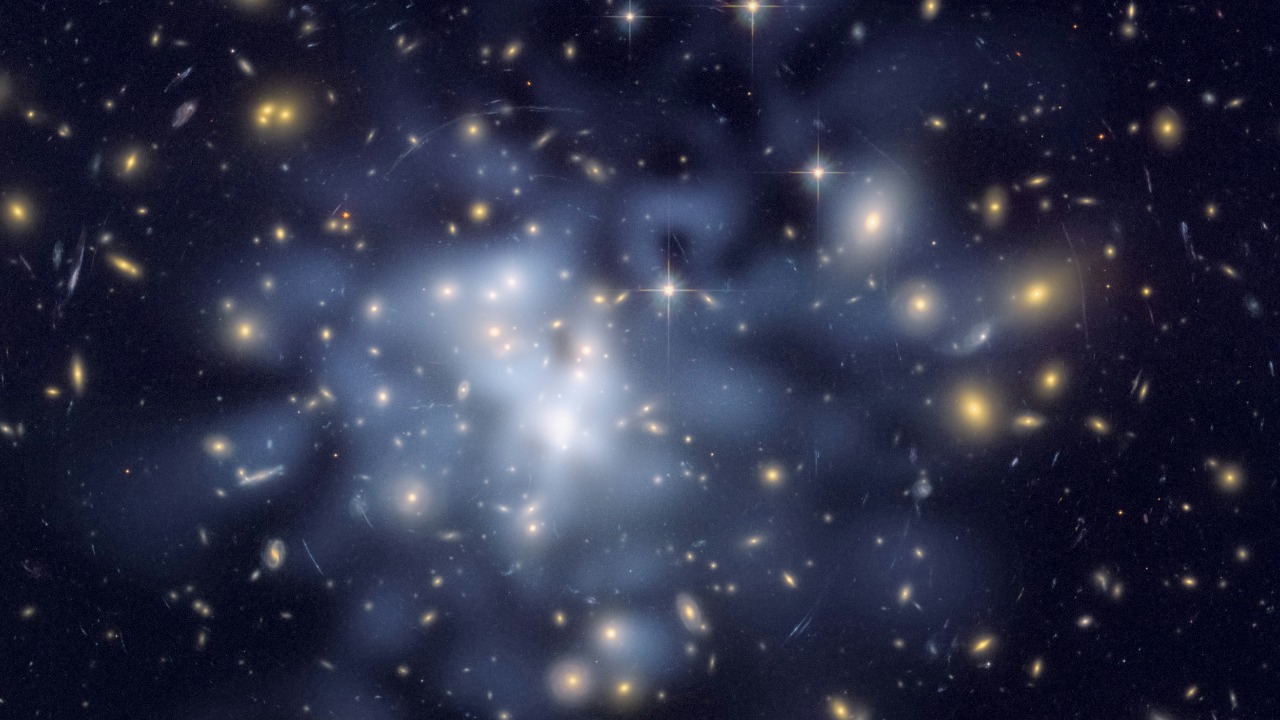

For a quarter century, cosmologists have treated dark energy as a fixed, featureless pressure that steadily drives galaxies apart. Now a convergence of massive sky surveys and giant computer models is pointing to a more unsettling possibility: the force that dominates the cosmos may itself be evolving over time. If that is true, the story of the universe’s past and its ultimate fate will need to be rewritten from the ground up.
Instead of a simple “cosmological constant,” new measurements and simulations hint at a dark energy that weakens, shifts, or even changes character as the universe ages. I see a field in transition, where once‑esoteric ideas about dynamic dark energy are suddenly colliding with hard data and high‑resolution simulations, forcing theorists and observers to test how far they can stretch the standard model of cosmology before it breaks.
From Einstein’s constant to a restless cosmos
Modern dark energy theory began with a surprise. When astronomers first mapped distant supernovae in the late twentieth century, they found that cosmic expansion was speeding up instead of slowing down, a result that led to the idea of a uniform energy component filling space. In the standard ΛCDM picture, that component is Einstein’s cosmological constant, a fixed term that behaves the same way at every moment and in every corner of the universe, and it has been the backbone of precision cosmology for decades.
Yet even that “standard” picture was born as a patch to a deeper puzzle. As NASA’s overview of dark energy explains, the original supernova observations revealed a problem: gravity alone could not account for the observed acceleration, so cosmologists added a constant energy density to the equations. A related description of the same discovery notes that these observations revealed a problem with the simple expectation that the expansion should be slowing, and that the fix was to introduce a repulsive component in the form of a cosmological constant, a move that has guided theory and observation ever since.
Surveys that see dark energy wobble
The most direct challenges to a rigid cosmological constant are coming from enormous galaxy surveys that trace how structure has grown over billions of years. By measuring how galaxies cluster and how cosmic expansion has changed with time, these projects can test whether dark energy behaves identically across cosmic history or whether its influence has shifted. I see these surveys as the first large‑scale stress tests of ΛCDM, and the early results are starting to show hairline cracks.
One key effort uses a detailed survey of galaxies to map how dark energy’s influence may have varied, with Apr reporting that New findings from this Major project hint that dark energy is not consistent across all epochs. A separate analysis of New data from another massive survey suggests that dark energy may be evolving and weakening over time, implying that the acceleration of the universe’s expansion could be slowing compared with what a strict cosmological constant would predict.
Frozen sound waves and the case for change
Beyond simple galaxy counts, cosmologists are turning to more subtle relics of the early universe to probe dark energy’s behavior. One of the most powerful tools is the pattern of baryonic acoustic oscillations, the “frozen” sound waves from the hot plasma that filled the young cosmos. By measuring the scale of these ripples at different distances, researchers can reconstruct the expansion history and see whether it lines up with a constant dark energy or something more dynamic.
Recent work using these frozen patterns has produced some of the most provocative hints that dark energy might be changing. An analysis described as Rewriting Physics argues that the data suggest dark energy transforms over time, appearing slightly weaker today than it was in the distant past, a result that would challenge the foundation of a perfectly constant Λ. Another team examined baryonic acoustic oscillations, or BAOs, as patterns left behind by sound waves in the early Univer, and concluded that dark energy may be alive in the sense that its properties evolve, a claim that, if confirmed, would force cosmologists to rethink the foundation of modern cosmology.
Supercomputer simulations reveal a shifting dark energy
Observations alone cannot tell the whole story, because they must be interpreted through models that connect dark energy to the growth of structure. That is where giant numerical experiments come in. By running high‑resolution simulations of billions of particles under different dark energy prescriptions, researchers can see which scenarios produce a universe that looks like ours and which ones fail. I see these supercomputer runs as a kind of cosmic wind tunnel, where competing theories are blasted with realistic conditions to see which survive.
New research described under the banner Supercomputer Simulations Reveal uses a Simulation approach to show how a Shifting Dark Energy component could alter the distribution of galaxies and clusters compared with a pure cosmological constant. In that work, the authors ask What happens if New models of dark energy are allowed to vary with time, and they find that certain evolving scenarios can better match some observed features of large‑scale structure while still reproducing the overall acceleration that is thought to push galaxies apart.
Is Einstein’s cosmological constant wrong?
As the observational and simulation evidence accumulates, a once‑heretical question is moving closer to the mainstream: what if Einstein’s cosmological constant is simply not the right description of dark energy? The standard ΛCDM model has been remarkably successful, but it was always a phenomenological fix rather than a deep explanation. If dark energy is changing, then the constant Λ term in Einstein’s equations may be an approximation that only holds over a limited slice of cosmic time.
One line of reporting frames this shift bluntly, noting that Dark energy may be evolving and that astronomers are rethinking one of cosmology’s biggest mysteries, including the possibility that Einstein’s cosmic constant may be wrong. Another detailed discussion asks directly whether Einstein’s “Cosmological Constant” is wrong and presents New data that suggest dark energy is evolving, with one section titled What are the implications of these findings for understanding cosmic expansion, including whether the dark universe is headed for a Big Freeze or some more exotic finale.
Slowing expansion and the universe’s fate
If dark energy is not constant, then the long‑term forecast for the cosmos becomes far less certain. A truly constant dark energy leads to a simple picture in which expansion accelerates forever, galaxies drift apart, and the universe approaches a cold, dilute state. But if the repulsive effect weakens, stalls, or reverses, the future could range from a gentle slowdown to a catastrophic collapse. I find that the new data are forcing cosmologists to keep multiple endgames on the table at once.
Some of the latest observations hint that the universe’s expansion may already be changing course. One report notes that Nov observations hinted at the fact that dark energy may be weakening over time, indicating that the universe’s rate of expansion could be slowing, with one key example involving a supernova in the constellation Gemini and the DESI project’s findings being described as really important progress in cosmology. A separate account of New hints about mysterious dark energy explains that precise measurement of the expansion history could distinguish between a future Big Crunch, where gravity eventually wins, and a more open‑ended outcome, with one scientist stressing that “We want to see several different collaborations having similar measurements” at a gold standard before declaring that dark energy is truly changing.
Theoretical models: from quintessence to evolving fields
Behind the observational headlines lies a dense thicket of theory. If dark energy is not a constant, then it must be described by some field or mechanism that can change with time, such as quintessence, k‑essence, or more exotic modifications of gravity. These models introduce new parameters and behaviors, but they also offer a way to connect dark energy to the broader framework of particle physics and fields, rather than leaving it as an unexplained constant. I see theorists using the new data as a filter, discarding models that no longer fit and refining those that can.
A detailed discussion of evolving dark energy notes that the cosmic expansion history results are consistent with a range of models in which the dark energy component changes over time, and that the statistical significance of the deviation from a pure cosmological constant is modest but still significant enough to merit attention, as described in an analysis of Sep. Another report from the same group explores Dark Energy Spectroscopic Instrument and the Vera Rubin Observatory as near‑future surveys that could distinguish whether dark energy is truly evolving or if, instead, it really is constant, with the authors emphasizing that these theoretical models have testable predictions that upcoming data can confirm or rule out.
New instruments built for a changing dark energy
To move from hints to firm conclusions, cosmologists are betting on a new generation of observatories designed explicitly to probe dark energy. These facilities will map galaxies, supernovae, and gravitational lensing with unprecedented precision, turning the entire sky into a laboratory for cosmic acceleration. In my view, they represent a deliberate pivot: instead of assuming dark energy is simple, the field is now building instruments that can catch it misbehaving.
NASA’s plans for the Nancy Grace Roman Space Telescope describe how When Roman opens its eyes to the cosmos, it will join a coordinated effort in which Sep notes that Together, Roman, Rubin, and Euclid will usher in a new era of dark energy discovery, using wide‑field imaging and spectroscopy to test whether the acceleration history matches a constant or evolving component. On the ground, The Vera Rubin Observatory and Nancy Grace Roman Space Telescope are highlighted as twin engines of progress, with one analysis explaining that The Vera Rubin Observatory and Nancy Grace Roman Space Telescope will both contribute to our understanding of the elusive dark energy and are poised to generate some long‑sought answers about whether its strength has changed over cosmic time.
Rewriting the standard model of cosmology
All of these developments converge on a single, uncomfortable point: the standard ΛCDM model may be an approximation that is starting to fray at the edges. For years, it has provided a remarkably compact description of the universe using just a handful of parameters, but tensions in measurements of the Hubble constant and the growth of structure have already hinted that something is missing. If dark energy is indeed evolving, then the “Λ” in ΛCDM will need to be replaced with a more flexible ingredient, and the rest of the model will have to adjust around it.
Several recent syntheses make this prospect explicit. One overview begins by noting that Since the early 20th century, scientists have gathered compelling evidence that the Universe is expanding at an accelerating rate, but it goes on to argue that new data may be deviating from the standard ΛCDM model in ways that point to evolving dark energy. A separate discussion framed as a podcast episode titled Nov Universe Is Slowing Down? New Study Challenges Dark … on the Weon platform explores how these findings could force a rethinking of dark energy’s role, with the conversation emphasizing that welcome to the Weon. podcast where we explore fascinating stories and ideas from various fields, including how a changing dark energy might reshape the standard picture of cosmic history.
Why the stakes extend far beyond cosmology
It is tempting to treat dark energy as an abstract curiosity, but the stakes reach into fundamental physics and even philosophy. A changing dark energy would hint at new fields or forces that sit alongside the particles in the Standard Model, potentially connecting cosmology to high‑energy physics in ways that laboratory experiments cannot yet reach. It would also reshape our sense of cosmic time, replacing the tidy narrative of a universe gliding toward a predictable end with a more volatile story in which the rules themselves can shift.
NASA’s broader dark energy program underscores this point by tying the mystery to questions about the ultimate fate of the cosmos and the nature of space itself, while discussions of evolving models, such as those asking What the implications are for a dark universe headed toward a Big Freeze or some other destiny, highlight how even small shifts in dark energy’s behavior can lead to radically different futures. As more data arrive from surveys, simulations, and new observatories, I expect the quiet phrase “dark energy may be changing” to become a central test of how well we truly understand the universe we inhabit.
More from MorningOverview