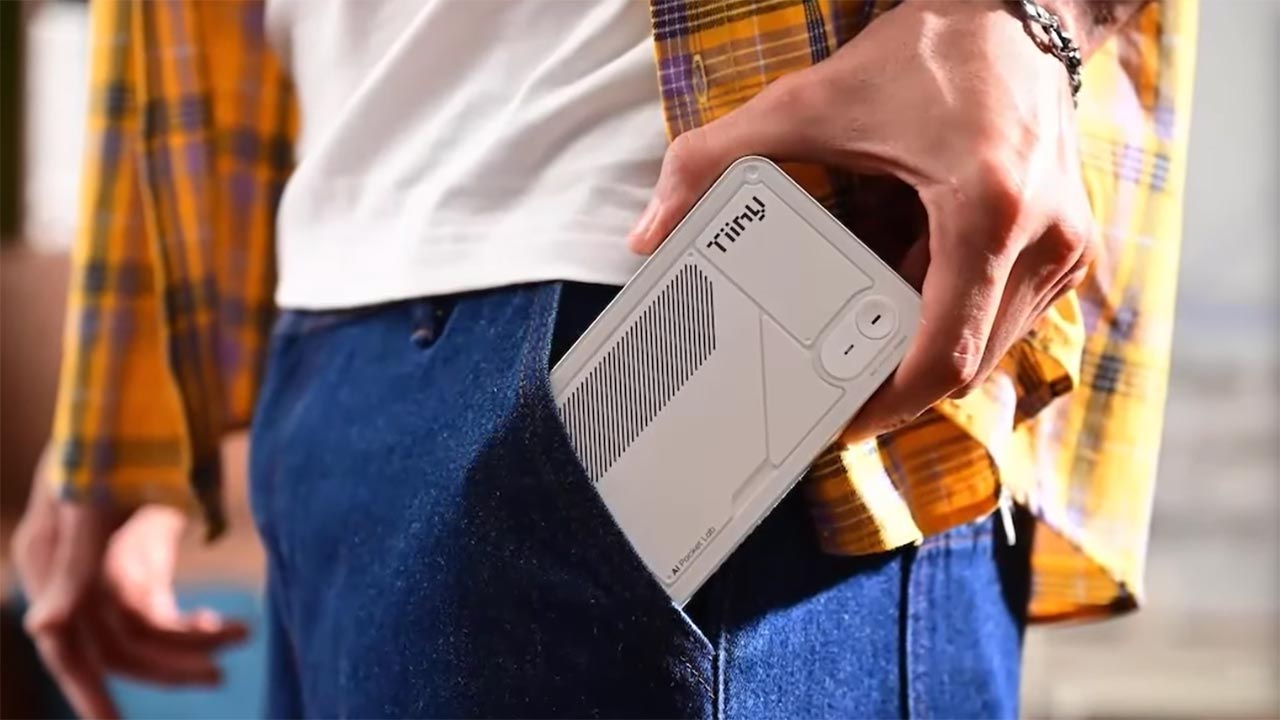

The Tiiny AI Pocket Lab shrinks what used to fill a server rack into something that looks and feels like a chunky power bank, yet it is described as a personal AI supercomputer that can run models up to 120 billion parameters. By putting that kind of capability in a palm-sized shell, it turns high‑end AI from a cloud service into a physical object you can toss in a backpack, with major implications for how and where advanced models run.
Instead of renting time on distant GPUs, Pocket Lab invites developers, researchers, and even hobbyists to treat AI like a piece of personal hardware, closer to a laptop than a login. That shift is not just about convenience, it is about energy use, privacy, and who gets to experiment with the most powerful models in the first place.
From cloud clusters to a palm-sized box
The core promise of the Tiiny AI Pocket Lab is simple but radical: take workloads that once demanded a data center and compress them into a device the size of a power bank. Reporting describes it as a tiny personal AI supercomputer that fits in one hand yet can run 120B AI models, a scale that traditionally required multi‑GPU rigs and aggressive cooling, not a gadget that can share a pocket with a phone. That physical downsizing matters because it turns AI compute from an abstract cloud resource into something tangible and portable, which changes how people think about deploying and owning it.
What makes this shift more than a party trick is the claim that Pocket Lab delivers that performance at a fraction of the energy and carbon footprint of traditional GPU‑based systems, which have become notorious for their power draw and heat. Instead of spinning up remote clusters every time a model needs to run, a user can keep inference local, cutting out the network overhead and the hidden environmental cost of always‑on server farms, according to the description of Tiiny AI’s Pocket Lab.
A Guinness World Record in your backpack
Miniaturization is not just a marketing line for this device, it is formally recognized. The Tiiny AI Pocket Lab holds the Guinness World Record for the world’s smallest personal AI supercomputer capable of running large models locally, a title that underscores how aggressively the company has pushed the limits of form factor. That recognition signals that we are not looking at a slightly smaller workstation, but at a new category of hardware where supercomputer‑class workloads coexist with consumer‑grade portability.
By earning that Guinness World Record for the smallest personal AI supercomputer, The Tiiny AI Pocket Lab also plants a flag in a crowded landscape of accelerators and edge devices that usually compromise on model size or performance. Instead of assuming that serious AI must live in the cloud, the company positions this record‑holding box as proof that high‑end inference does not have to live in remote racks anymore, a point highlighted in the description of The Tiiny AI Pocket Lab.
Why 120B-parameter models at the edge matter
Running a 120B parameter model on a device that looks like a power bank is not just a flex, it changes what kinds of AI experiences can be delivered without a network connection. Models at that scale can handle complex language understanding, multimodal reasoning, and high‑fidelity generation that smaller edge‑optimized networks often struggle with, especially in niche domains like legal analysis, scientific code generation, or multi‑step planning. When that capability sits on a desk or in a backpack, it becomes feasible to build applications that assume high‑end inference is always available, even in places with poor connectivity.
There is also a control dimension to this. Developers who want to fine‑tune or experiment with large models often face quotas, rate limits, or policy constraints when they rely on cloud APIs. A personal AI supercomputer that can run 120B AI models locally gives them a sandbox where they can iterate on prompts, adapters, or small fine‑tunes without waiting for remote jobs to spin up or worrying about sending sensitive data off‑site, a capability that is central to the positioning of this tiny personal AI supercomputer.
Design: a supercomputer in a power bank shell
One of the most striking aspects of Pocket Lab is how deliberately it hides its complexity behind a familiar silhouette. Descriptions emphasize that Tiiny Ai Pocket Lab is the size of a power bank, a palm‑sized machine that can sit next to a phone on a café table without drawing attention. That choice is not just aesthetic, it signals that high‑end AI hardware is moving out of labs and server rooms and into the same physical category as everyday accessories, which lowers the psychological barrier to experimenting with it.
Community reactions have latched onto that contrast between appearance and capability, with posts describing the world’s smallest AI supercomputer as a Tiiny Ai Pocket Lab the size of a power bank, a palm‑sized machine that runs a 120B model. That framing captures the cognitive dissonance of holding something that looks like a battery pack yet behaves like a cluster, and it hints at a future where carrying a personal inference engine is as unremarkable as carrying a charger, a theme that surfaces in the discussion of the World’s smallest AI supercomputer.
How Pocket Lab compares to NVIDIA’s experimental mini-supercomputers
Pocket Lab does not exist in a vacuum, it arrives alongside a wave of compact AI systems that try to shrink data center ideas into desk‑friendly boxes. In that context, it is often mentioned in the same breath as small supercomputers like NVIDIA’s Proj, experimental platforms that explore how far GPU vendors can push edge and developer hardware. The difference is that Pocket Lab leans into being a finished, pocket‑sized product rather than a reference design or a dev kit, which makes it more immediately relevant to individual users rather than only to labs and OEMs.
Reporting that introduces Pocket Lab as the world’s smallest, pocket‑sized AI supercomputer explicitly sets it against those NVIDIA efforts, noting that in tow of Pocket Lab’s AI supercomputer are small supercomputers like NVIDIA’s Proj that still tend to assume a more traditional workstation footprint. By contrast, Tiiny AI’s Pocket Lab is framed as a device that fits in a pocket while still delivering supercomputer‑class AI performance, a distinction that highlights how aggressively it targets portability compared with other pocket-sized AI supercomputers.
Energy, carbon, and the cost of always-on AI
As AI models scale, the environmental cost of running them has become harder to ignore, especially when inference is handled by sprawling GPU farms that draw power around the clock. Pocket Lab’s pitch leans directly into that concern, presenting itself as a way to achieve massive AI model performance at a fraction of the energy and carbon footprint of traditional GPU‑based systems. That claim matters because it reframes high‑end AI not as an inherently resource‑hungry activity, but as something that can be optimized through smarter hardware and local execution.
In practical terms, a device that can run 120B AI models locally without the overhead of a full data center can reduce the need to keep remote clusters idling for intermittent workloads like code assistants, research agents, or creative tools. Instead of every query bouncing through a network to a distant rack, inference can happen on a desk, with power draw that is closer to a laptop than a server, according to the positioning of Tiiny AI’s Pocket Lab. That does not eliminate AI’s environmental footprint, but it offers a path to decouple advanced inference from the most energy‑intensive infrastructure.
Privacy, sovereignty, and life beyond the cloud
Running powerful models on a personal device is not just about speed or cost, it is about who controls the data and the compute. The Tiiny AI Pocket Lab is explicitly framed as a way to reduce the reliance on cloud services, which means sensitive workloads can stay on hardware that the user owns and physically controls. For sectors like healthcare, law, or finance, where data residency and confidentiality are non‑negotiable, that shift can make the difference between being able to use advanced AI at all or being forced to sit on the sidelines.
There is also a sovereignty angle when organizations or individuals in regions with fragile connectivity or strict data regulations want to run state‑of‑the‑art models without routing everything through foreign data centers. By positioning Tiiny AI’s Pocket Lab as a pocket‑sized AI supercomputer that cuts the reliance on cloud services, the device becomes a tool for local autonomy as much as for convenience, a point underscored in coverage that describes how Pocket Lab reduces cloud dependence.
Who Pocket Lab is really for
On paper, a palm‑sized AI supercomputer sounds like a gadget for enthusiasts, but the use cases stretch far beyond hobbyist tinkering. Developers who build AI‑heavy applications can use Pocket Lab as a local inference engine for testing and demos, avoiding the latency and unpredictability of shared cloud environments when they are iterating on features. Researchers can treat it as a portable lab, running experiments on large models in the field, whether that means a climate scientist analyzing sensor data on site or a linguist testing language models in regions with limited connectivity.
There is also a clear appeal for startups and small teams that cannot justify or access full data center deployments but still want to work with 120B‑scale models. For them, a device described as the world’s smallest AI supercomputer, Tiiny Ai Pocket Lab, the size of a power bank and a palm‑sized machine that runs a 120B model, offers a way to prototype ambitious products without immediately committing to expensive cloud contracts, as highlighted in community discussions of the Tiiny Ai Pocket Lab.
The next phase of personal computing
Seen in isolation, Pocket Lab is a clever piece of hardware that squeezes a lot of compute into a small box. In context, it looks more like an early glimpse of a new layer in the personal computing stack, where AI accelerators sit alongside laptops and phones as standard equipment. If a device the size of a power bank can already run 120B AI models, it is not hard to imagine future iterations baked directly into ultrabooks, workstations, or even high‑end tablets, turning local AI into a default expectation rather than a specialized add‑on.
That trajectory would echo the way GPUs moved from niche cards for 3D rendering into ubiquitous components that quietly power everything from video playback to machine learning. The Tiiny AI Pocket Lab, with its Guinness World Record for the smallest personal AI supercomputer and its focus on reducing reliance on cloud services, suggests that AI compute is following a similar path, shrinking in size while expanding in reach, and turning what used to be a remote resource into something that lives, quite literally, in the palm of a hand, as captured in the portrayal of The Tiiny AI Pocket Lab.
More from MorningOverview