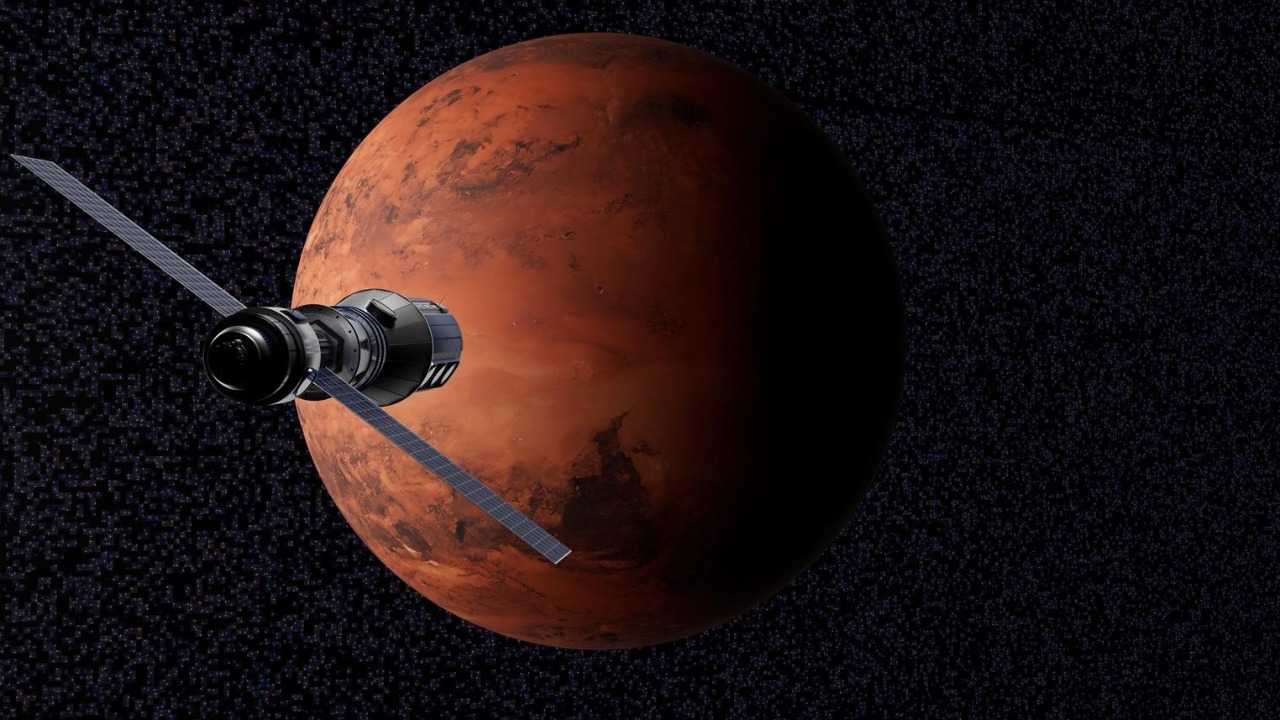

NASA is racing to understand why one of its most seasoned Mars orbiters suddenly fell silent, cutting off a critical scientific and communications lifeline around the Red Planet. The Mars Atmosphere and Volatile EvolutioN spacecraft, better known as MAVEN, had been operating normally before an unexplained anomaly left mission controllers listening to static.
The loss of contact with such a central Mars asset is more than a technical hiccup, it is a stress test of how resilient the entire Martian exploration network really is. As engineers work to reestablish a signal, the episode is exposing just how much of the modern Mars program depends on a single veteran spacecraft that was never meant to carry this much of the load for this long.
How a routine pass behind Mars turned into radio silence
According to NASA, the trouble began during what should have been a routine orbital maneuver, as MAVEN slipped behind Mars and temporarily out of view from Earth. The spacecraft had been operating normally before that occultation, but when it emerged back into line of sight, the agency’s Deep Space Network did not pick up the expected carrier tone and instead registered a disquieting absence of any signal at all. In the language of mission control, an “anomaly” had occurred, and the orbiter that had faithfully circled Mars for more than a decade was suddenly not answering its calls.
NASA has described the event as a sudden loss of contact with a spacecraft orbiting Mars, triggered by an unspecified anomaly that interrupted communications just after the planet blocked the line of sight, a sequence echoed in multiple accounts of the sudden signal loss. The agency’s own description of the incident emphasizes that MAVEN was healthy going into the blackout, which narrows the likely failure modes to something that happened during or immediately after the occultation, such as a power, attitude control, or onboard computer fault that prevented the spacecraft from reorienting its antenna back toward Earth.
NASA’s “anomaly” language and what it really signals
When NASA publicly labels an event as an “anomaly,” it is signaling both uncertainty and seriousness, a way of acknowledging that something has gone wrong without prematurely naming the cause. In this case, the agency has said that an anomaly has led to a sudden signal loss with one of its spacecraft orbiting Mars, a carefully chosen phrase that leaves room for everything from a recoverable software glitch to a catastrophic hardware failure. The wording also reflects a standard crisis posture inside mission operations, where teams are trained to avoid speculation until telemetry confirms what actually happened.
In its early statements, NASA has stressed that the spacecraft and operations teams are investigating the anomaly and working to address the situation, language that underscores how the loss of contact is being treated as an urgent but still potentially solvable problem. Descriptions of the event note that an anomaly led to the loss of signal from the MAVEN Mars orbiter and that teams are actively troubleshooting, a reminder that in deep space operations, “anomaly” is not a euphemism for failure so much as a placeholder while engineers work through a disciplined fault tree.
MAVEN’s decade of work around Mars
MAVEN is not just another spacecraft in the Martian sky, it is the mission that has spent more than ten years dissecting how the planet’s upper atmosphere behaves and how Mars lost much of its air over time. The spacecraft’s full name, Mars Atmosphere and Volatile EvolutioN, captures its core purpose: to measure the composition and escape of gases from the Martian atmosphere and to understand how that process transformed a once wetter world into the cold, thin-aired planet we see today. To do that, MAVEN carries a suite of in situ and remote sensing instruments that sample particles, fields, and ultraviolet emissions high above the surface.
Technical descriptions of the mission emphasize that MAVEN, short for Mars Atmosphere and Volatile EvolutioN, is dedicated to exploring all aspects of the Martian upper atmosphere, composition, and structure using coordinated in situ and remote sensing instrument packages that can, for example, map the planet’s oxygen corona and track how it changes with solar activity. One detailed study of the mission’s early work on the oxygen corona notes how MAVEN ( Mars Atmosphere and Volatile EvolutioN ) has been used to compare three dimensional model predictions with actual ultraviolet observations, illustrating how deeply the mission is woven into our current scientific picture of Mars.
A workhorse link for Curiosity and Perseverance
Beyond its science, MAVEN has quietly become one of the main communications hubs for surface missions, relaying data between Earth and the rovers that are crawling across the Martian terrain. As other orbiters have aged or been retired, this veteran spacecraft has taken on a growing share of the job of passing commands down to the Curiosity and Perseverance rovers and beaming their images and measurements back home. That relay role is not glamorous, but it is essential, because direct-to-Earth links from the surface are slow and power hungry compared with bouncing signals through a high orbiting relay.
Reports on the current outage describe MAVEN as one of NASA’s workhorse spacecraft in orbit around Mars and note that it is one of the key links that support the Curiosity and Perseverance rovers, a reminder that the orbiter’s silence has immediate operational consequences for surface exploration. One account of the loss of contact points out that one of NASA’s workhorse spacecraft is now offline, and that this particular vehicle is part of a small group of orbiters that handle the bulk of the data traffic between Earth and Mars, which means any extended outage forces mission planners to reshuffle how they talk to their robots on the ground.
Why this blackout hits the Mars network so hard
The sudden loss of MAVEN is a stress fracture in a network that was already operating with little redundancy, because only a handful of orbiters are equipped to serve as high bandwidth relays for surface missions. As Scientific American has noted, MAVEN is one of four spacecraft that perform this job, alongside assets operated by the European Space Agency, so taking even one of them offline compresses the available communications windows and forces hard choices about which data gets prioritized. In practical terms, that can mean fewer images per day from Curiosity and Perseverance, delayed uploads of new driving plans, and tighter margins for time critical science campaigns.
Analyses of the outage highlight that, as Scientific American points out, MAVEN is one of four spacecraft that handle relay duties for Mars, a group that includes orbiters from the European Space Agency, and that losing one of NASA’s longtime Mars orbiters immediately forces the agency to replan how it supports its surface fleet. Another report frames the situation bluntly, noting that NASA has lost contact with one of its longtime Mars spacecraft and is now scrambling to reestablish communication with Maven, a description that captures both the operational urgency and the broader stakes for the Mars relay network.
Inside the scramble to regain contact
In the hours and days after the signal vanished, NASA’s response followed a familiar but high pressure script: cycle through backup antennas, adjust pointing strategies, and send blind commands in the hope that the spacecraft is still listening even if it cannot talk back. Engineers on the ground are effectively working through a checklist of possible failure modes, from a misaligned high gain antenna to a safe mode that has turned the spacecraft away from Earth, each with its own set of recovery commands and timing constraints. The Deep Space Network, which tracks and communicates with interplanetary probes, has been tasked with repeated listening sessions whenever Mars is above the horizon, searching for even a faint whisper from the orbiter.
NASA has said that its spacecraft and operations teams are investigating the anomaly and working to address the situation, and that the Deep Space Network did not observe a signal after the spacecraft emerged from behind Mars, a detail that underscores how quickly the mission shifted from routine operations to emergency troubleshooting. One account of the incident notes that after the spacecraft emerged from behind Mars, NASA’s Deep Space Network did not observe a signal, and that for over a decade the mission has been a mainstay of both science and data relay, which is why the operations team is now throwing every available diagnostic tool at the problem.
A veteran spacecraft with a history of close calls
MAVEN is no stranger to technical scares, and that history is part of why engineers remain cautiously hopeful that this latest anomaly might still be reversible. The spacecraft launched in November 2013 and entered orbit around Mars less than a year later, and over the ensuing decade it has weathered solar storms, aging hardware, and software updates that occasionally pushed it into safe mode. Each time, the mission team has managed to coax the orbiter back into normal operations, a track record that suggests the spacecraft has some resilience built into both its design and its ground procedures.
Coverage of the current blackout points out that this is not the first time MAVEN has experienced a serious issue, noting that earlier problems required new software to be uploaded to the spacecraft and that the mission has already survived at least one extended stint in safe mode. One detailed account of the orbiter’s past challenges explains that this isn’t the first time MAVEN has had trouble, and that in a previous incident engineers had to develop and send new software to the spacecraft to restore full functionality, a reminder that even long lived missions can sometimes be patched and revived if the underlying hardware is still intact.
What NASA is saying, and not saying, about the risk
Publicly, NASA is walking a careful line between acknowledging the seriousness of the situation and avoiding alarmist language that could be read as a premature obituary for the mission. The agency has confirmed that an anomaly has led to sudden signal loss with one of its spacecraft orbiting Mars and that teams are working to reestablish contact, but it has not yet detailed which subsystem is suspected or how likely a full recovery might be. That restraint is standard practice in the early stages of a spacecraft emergency, when incomplete data can easily mislead both engineers and the public.
In its statements, NASA has used phrases like “anomaly” and “sudden signal loss” to describe what happened, and has emphasized that more information will be shared as it becomes available, a formulation that signals both transparency and caution. One report quotes the agency explaining that NASA Says an “Anomaly” Has Led to Sudden Signal Loss with one of its spacecraft orbiting Mars and that the agency will provide updates as more information becomes available, a reminder that in deep space operations, even the communications about a crisis are carefully engineered.
The science and data that hang in the balance
Every day that MAVEN remains offline is a day of lost atmospheric measurements and reduced data return from the surface, and over time those gaps can erode the continuity that long baseline studies depend on. The mission has been tracking how the Martian atmosphere responds to solar activity, seasonal changes, and dust storms, building a record that helps scientists understand how the planet’s climate has evolved. Interruptions in that record complicate efforts to compare one Martian year to another, and if the spacecraft cannot be recovered, some planned investigations will simply never be carried out.
NASA has highlighted that MAVEN, short for Mars Atmosphere and Volatile EvolutioN, has been central to understanding how Mars lost much of its atmosphere over time and that, in addition to its scientific role, it has served as a communications relay for Mars missions for more than 20 years of combined operations across the network. One detailed summary of the mission notes that MAVEN, short for Mars Atmosphere and Volatile EvolutioN, has been used to study how Mars lost much of its atmosphere over time and that its relay duties have supported Mars missions for more than 20 years, which is why the current silence is being felt across both the science and operations communities.
What this crisis reveals about Mars exploration strategy
The MAVEN blackout is not just a story about one spacecraft, it is a case study in how tightly coupled the Mars exploration architecture has become and how vulnerable it is to the loss of a single node. For years, NASA has leaned on a small fleet of aging orbiters to provide both science and communications, postponing decisions about replacements while squeezing more life out of hardware that has already exceeded its original design lifetimes. The current scramble to reroute data and preserve rover operations is a preview of the choices the agency will face more often if it does not invest in a more robust and redundant relay infrastructure around Mars.
Analysts have pointed out that NASA has lost contact with one of its longtime Mars spacecraft and that the agency is now working urgently to reestablish communication with Maven, a situation that underscores how much of the Mars program depends on a handful of veteran orbiters. One report on the anomaly notes that NASA says Maven spacecraft that was orbiting Mars has gone silent and that the orbiter has been a key relay for the Mars rovers Curiosity and Perseverance, a reminder that the agency’s future plans for Mars, from sample return to eventual human missions, will require a communications backbone that can survive the loss of any single spacecraft.
The long view: resilience, risk, and the next Mars decade
In the long run, the fate of MAVEN will shape how NASA and its partners think about risk management in deep space, especially as ambitions at Mars expand from robotic exploration to potential human presence. If engineers manage to restore contact, the episode will likely accelerate plans to diversify the relay fleet and to design future orbiters with even more autonomous fault management. If the spacecraft is lost, it will stand as a stark reminder that every mission has a finite lifespan and that relying on aging hardware for critical functions is a gamble that eventually comes due.
NASA’s own framing of the event, describing how an anomaly has led to sudden signal loss with one of its spacecraft orbiting Mars and how teams are working to address the situation, hints at a broader recognition that resilience has to be built into the architecture, not improvised in a crisis. One analysis of the situation notes that NASA Says an “Anomaly” Has Led to Sudden Signal Loss with one of its spacecraft orbiting Mars at the same time that other ambitious space projects are moving closer to becoming a reality, a juxtaposition that captures the central tension of this moment: even as space agencies push toward bolder missions, they are still learning, sometimes painfully, how to keep the infrastructure that supports those missions resilient in the harsh environment between worlds.
The human factor behind the technical drama
Behind the acronyms and engineering jargon, there is a human story unfolding in control rooms and conference calls, as teams who have spent years caring for this spacecraft confront the possibility that it may never speak again. Many of the engineers and scientists on MAVEN have built their careers around its data, and for them the orbiter is not just a piece of hardware but a trusted partner that has delivered discovery after discovery. The emotional whiplash of shifting from routine operations to emergency response is real, even if it is rarely visible in the carefully worded public statements.
Accounts of the current situation describe how NASA has lost contact with one of its longtime Mars spacecraft and how the agency is scrambling to reestablish communication with Maven, a phrase that hints at the intensity of the effort now underway. One report captures that urgency by noting that NASA Says an “Anomaly” Has Led to Sudden Signal Loss with one of its spacecraft orbiting Mars and that teams are working to reestablish communication, a reminder that every line of code sent across the void is written and checked by people who know that the next command could be the one that brings a beloved mission back to life, or confirms that its long service has finally come to an end.
More from MorningOverview