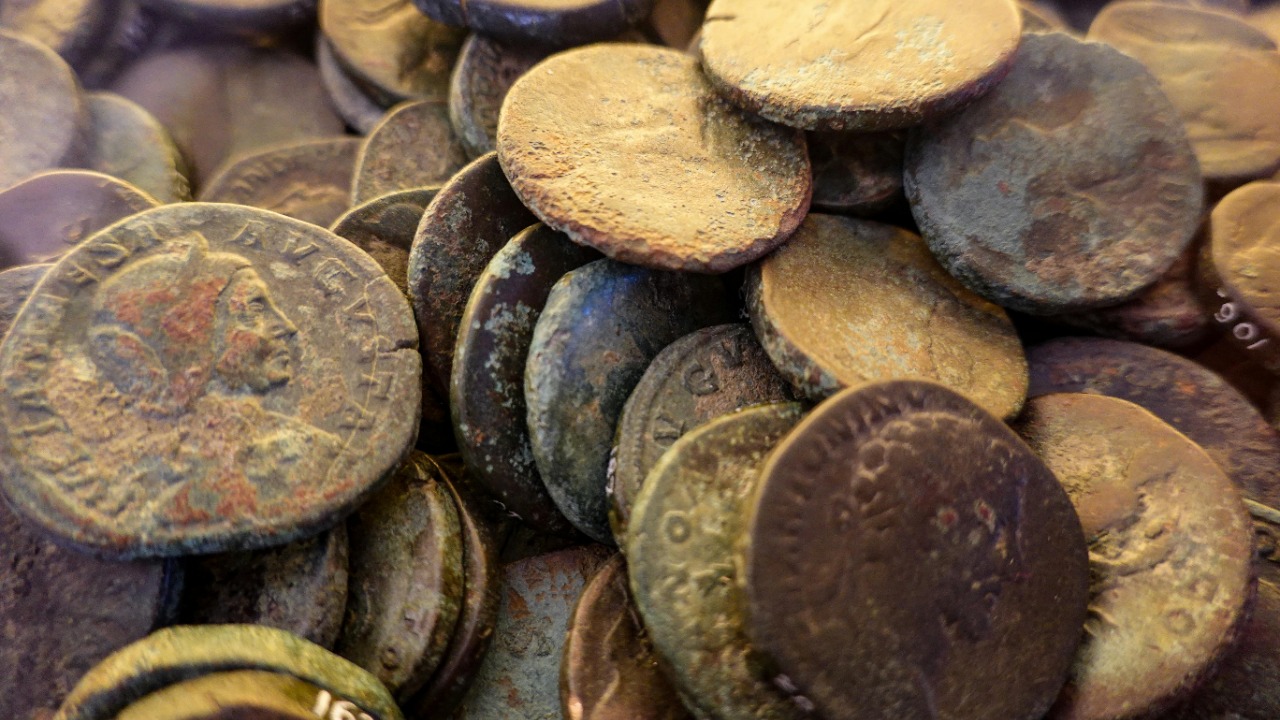

Archaeologists in a small French village have uncovered a buried jar packed with tens of thousands of Roman coins, a discovery that turns an ordinary storage vessel into a frozen snapshot of everyday wealth in the ancient world. The hoard, part of a cluster of coin-filled containers, offers a rare look at how people on the fringes of empire tried to safeguard their savings in an era of political turmoil and local disaster.
What might sound like a simple treasure find is in fact a layered story about risk, resilience and the way money moved through a provincial community nearly two millennia ago. By tracing how these coins were hidden, stacked and ultimately abandoned, I can follow the contours of a settlement that flourished under Roman rule, then vanished in fire, leaving its “piggy banks” sealed in ash and soil.
The village where a fortune slept underground
The discovery unfolded in the village of Senon in northern France, where a modern development project triggered a preventive dig that peeled back the topsoil on a forgotten Roman-era settlement. As archaeologists opened trenches across what had once been a bustling neighborhood, they found the outlines of houses, storage buildings and workshops that had been buried and then overwritten by centuries of rural life. The quiet fields around Senon turned out to be sitting on top of a community that had once been tightly plugged into the economic circuits of the Roman world.
Excavators working with the National Institute for Preventive Arc were not looking for treasure so much as context, yet the context they uncovered was dramatic. The team identified a settlement that had been destroyed by a fire in the 4th century C.E., a blaze that collapsed roofs, charred beams and sealed entire rooms under debris. Within that burned layer, they found storage spaces where one jar was filled with tens of thousands of coins and two other containers held smaller but still substantial stashes, all preserved in the same catastrophic event that erased the town from the map.
Three jars, one blazing catastrophe
The heart of the find is a trio of ceramic containers that functioned as what archaeologists have described as ancient “piggy banks,” each one a deliberate attempt to store and conceal money inside a domestic or storage setting. These were not decorative vases but sturdy jugs, known as amphorae, that had been repurposed from their usual role in transporting goods into secure vaults for cash. One of the amphorae was packed so densely that it held more than 40,000 Roman coins, a volume that transforms a simple jar into a kind of household treasury.
All three containers were discovered in close proximity, suggesting that the people who hid them were responding to the same pressures and fears. Excavations at the site have shown that the settlement was lost to a fire in the 4th century C.E., and the coin hoards were trapped in that destruction layer, which means the owners never returned to reclaim their savings. The jars were found in what appears to have been a storage area, a logical place for someone to tuck away wealth in a hurry, and the fact that they remained sealed under rubble indicates that the blaze and its aftermath were so severe that recovery was impossible.
How old money became “1,800-year-old” piggy banks
Numismatists examining the coins have dated the bulk of the hoard to roughly the 3rd and early 4th centuries C.E., a period when the Roman Empire was wrestling with internal strife, breakaway regimes and currency reforms. The coins in the largest jar, which number in the tens of thousands, cluster around issues that are about 1,800 years old, a span that aligns with the later phases of Roman rule in Gaul. That age estimate is not a rough guess but a reflection of the emperors and inscriptions stamped into the metal, which anchor the hoard in a specific slice of imperial history.
The description of the jars as “1,800-year-old” piggy banks captures both their antiquity and their function as savings devices. One report on the excavation notes that these three jugs, known as amphorae, were uncovered during excavations run by the National Institute for Preventive Arc and that the largest vessel alone contained more than 40,000 Roman coins, a figure that underlines just how much value could be crammed into a single container. Another account of the find refers to ROMAN PIGGY BANKS FILLED WITH 1,800-YEAR-OLD COINS DISCOVERED IN FRANCE, a phrase that distills the technical dating work into a vivid shorthand for readers who may never have handled an ancient coin but understand the idea of a savings jar.
From everyday savings to buried treasure
What makes this hoard so compelling is not only its size but also what it reveals about how ordinary people in Roman Gaul managed their money. The coins in the jars were not ceremonial offerings or a ruler’s tax revenue, they were the accumulated savings of individuals or families who chose to convert surplus goods or wages into hard currency and then hide that currency in their own buildings. The use of amphorae, containers normally associated with bulk goods like wine or oil, suggests a practical mindset: when a sturdy jar was available, it became a bank vault.
Archaeologists have described the jars as “piggy banks” because they mirror the logic of a modern child’s coin box, a place where small deposits over time build into a significant reserve. One report on the excavation in a small French village notes that three jars with thousands of coins were unearthed and that the largest of these held tens of thousands of pieces, a scale that points to long-term accumulation rather than a single windfall. Another account emphasizes that these were storage jars filled with thousands of Roman coins from 1,700 years ago, a reminder that the habit of stashing cash at home is as old as money itself.
A settlement frozen in the moment of disaster
The context of the hoard is as revealing as the coins themselves, because the jars were not buried in a remote field but embedded in the ruins of a settlement that had been abruptly destroyed. Excavations in France have shown that this community was wiped out by a fire in the 4th century C.E., a blaze that left behind a layer of ash, collapsed masonry and charred timbers. Within that destruction layer, archaeologists found the coin-filled jars still in situ, which means the fire struck after the savings had been hidden but before anyone could retrieve them.
One detailed account of the dig explains that while excavating a settlement that was lost to a fire in the 4th century C.E., researchers found one storage jar filled with tens of thousands of coins and two additional containers with smaller hoards, all preserved under the same blanket of debris. Another report notes that these ancient Roman treasures date to the time of the emperor Postumus and his successors, during the Gallic Empire, which situates the settlement in a frontier region that experienced both prosperity and instability. The combination of a sudden local disaster and a broader climate of political uncertainty helps explain why so much wealth ended up trapped underground.
What the coins say about power and crisis
Beyond their sheer number, the coins in the Senon hoard carry portraits and inscriptions that map the shifting political landscape of the Roman world. Many of the pieces date to the reigns of emperors associated with the Gallic Empire, a breakaway state that controlled parts of modern France and neighboring regions during the 3rd century C.E. The presence of these issues in such quantity indicates that the settlement was deeply integrated into the monetary system of that splinter regime, even as it remained physically distant from Rome itself.
Reports on the excavation highlight that the coins span the third and early fourth centuries, a period marked by frequent changes of ruler, military upheavals and attempts to stabilize the currency. One account notes that the hoard includes issues from the time of Postumus and other leaders of the Gallic Empire, which helps narrow the window during which the savings were accumulated. Another description of the find emphasizes that the jars were filled with 1,800-YEAR-OLD coins, a phrase that underscores how long these tokens of imperial authority have lain untouched while the political entities they represented have vanished.
Why preventive digs keep rewriting local history
The Senon hoard also illustrates the quiet power of preventive archaeology, the kind of excavation that happens not because someone is chasing treasure but because modern construction threatens to erase what lies beneath. In this case, the National Institute for Preventive Arc was conducting a systematic survey ahead of development, a process that involves mapping, test trenches and full-scale digs when promising remains appear. Without that legal and logistical framework, the jar packed with tens of thousands of coins would likely have been shattered by heavy machinery and its contents scattered or lost.
One report on the discovery notes that these three jugs, known as amphorae, were uncovered during excavations run by the National Institute for Preventive Arc, a detail that highlights how institutional mandates can safeguard heritage that no one knew was there. Another account explains that the excavation in a small French village revealed three jars with thousands of coins, a find that instantly transformed local understanding of the area’s past. What had seemed like an ordinary patch of countryside is now recognized as the site of a Roman-era settlement with direct ties to imperial politics and long-distance trade.
From trench to lab: what happens to 40,000 coins
Once the jars were lifted from the ground, the work shifted from shovels and trowels to conservation labs and microscopes, where each coin must be cleaned, cataloged and analyzed. Handling more than 40,000 Roman coins is a logistical challenge as much as a scholarly one, because every piece carries information about minting practices, circulation patterns and the purchasing power of different denominations. Specialists will be looking for clusters of issues, rare types and signs of wear that might indicate how long a coin stayed in use before it was tucked into the jar.
Accounts of the find stress that one storage jar alone was filled with tens of thousands of coins, while two others contained smaller but still substantial hoards, which means the total number of pieces to be processed runs into the many tens of thousands. One detailed report on the excavation in a small French village notes that the largest amphora held more than 40,000 Roman coins, a figure that gives a sense of the scale of the lab work now underway. Another description of the discovery refers to ROMAN PIGGY BANKS FILLED WITH 1,800-YEAR-OLD COINS DISCOVERED IN FRANCE, a phrase that hints at the painstaking effort required to turn a mass of corroded metal into a coherent picture of ancient economic life.
How a buried hoard reshapes a village’s story
For the people of Senon, the revelation that their village sits atop a Roman settlement with a jar full of tens of thousands of coins is more than an archaeological curiosity, it is a redefinition of local identity. What had been a landscape of farms and modern houses is now also a palimpsest of ancient streets, storerooms and savings strategies, a reminder that the rhythms of daily life here stretch back at least 1,700 years. The hoard turns an abstract timeline into something tangible, a pile of coins that once passed from hand to hand in markets, workshops and tax offices before ending up in a jar that no one ever reopened.
Reports on the excavation emphasize that these storage jars were filled with thousands of Roman coins from 1,700 years ago and that the settlement itself was lost to a fire in the 4th century C.E., details that anchor the story in both deep time and a single catastrophic event. Another account notes that while excavating a settlement that was lost to a fire in the 4th century C.E., researchers found one storage jar filled with tens of thousands of coins, a discovery that instantly elevated the site from a routine dig to a headline-making find. For a small French community, that kind of attention can translate into new heritage trails, museum displays and a renewed sense of connection to a past that had literally been underfoot all along.
More from MorningOverview