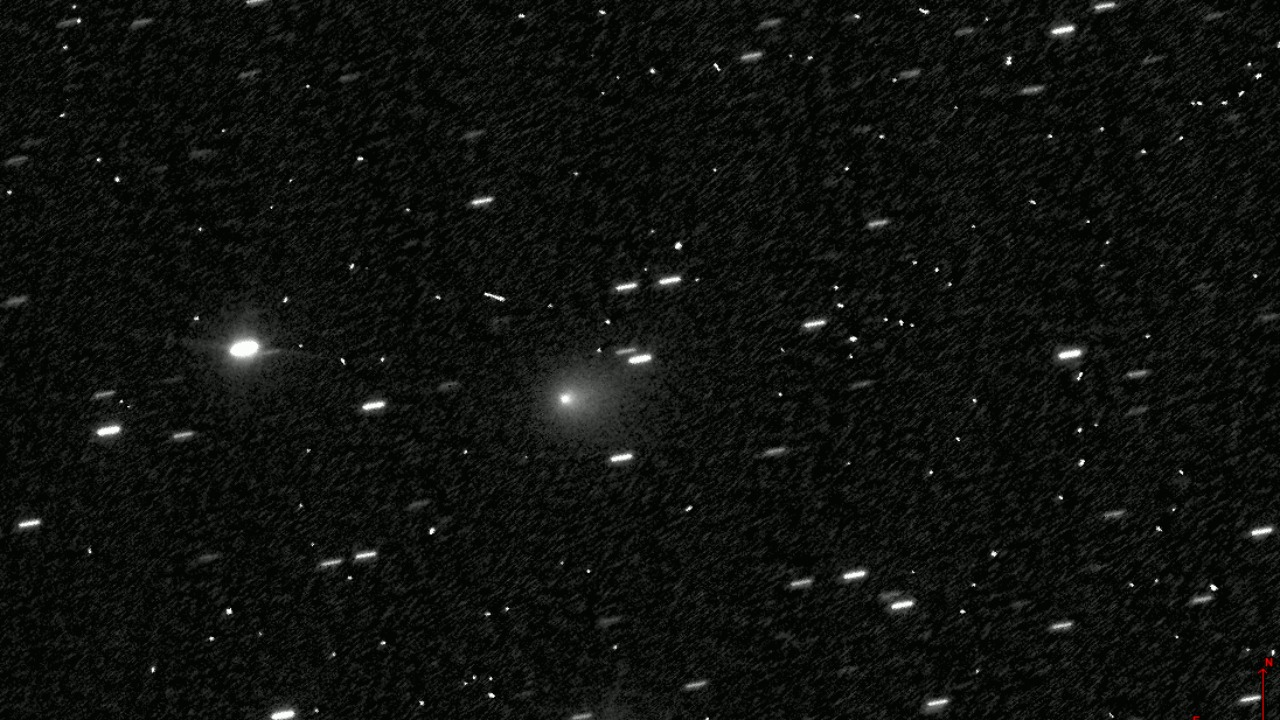

Interstellar comet 3I/ATLAS is racing into the inner solar system, a rare visitor from deep space that will swing past our planet at a safe distance yet still close enough to ignite scientific curiosity and public imagination. As it approaches, astronomers are probing whether this icy wanderer could help spread the chemical seeds of biology, even as some researchers float far more radical ideas about deliberate alien “seeding” missions. The debate over what 3I/ATLAS represents is quickly becoming a test case for how we think about life in the universe and our own place in it.
What makes 3I/ATLAS an interstellar wild card
Every confirmed interstellar object is a statistical shock, a reminder that our solar system is not isolated but immersed in a galactic traffic of rocks, ice and dust. 3I/ATLAS is only the third such visitor ever verified, which means each measurement of its path, brightness and activity carries outsized weight for theories about how planetary systems form and exchange material. I see this comet as a kind of natural probe from another neighborhood in the Milky Way, carrying a physical record of conditions that shaped worlds far beyond the reach of our spacecraft.
Initial tracking shows that the object’s trajectory is hyperbolic, a clear sign that it is not gravitationally bound to the Sun and therefore qualifies as an interstellar interloper. Observers have reported that the interloper has displayed “tentative signs of cometary activity,” including a surrounding cloud of gas and dust that fits expectations for a volatile rich body heating up as it nears the Sun, and those properties helped secure its designation through the International Astronomical Union’s Minor Planet Center as 3I/ATLAS. That combination of a foreign origin and active outgassing is exactly what makes it such a compelling test bed for ideas about how organic molecules and prebiotic chemistry might travel between stars.
How close 3I/ATLAS will really come to Earth
Whenever a new comet grabs headlines, the first public question is usually about danger, not discovery. In the case of 3I/ATLAS, the orbital math is reassuringly dull, which is precisely what planetary defense experts like to see. The object will pass through the inner solar system on a trajectory that brings it into our cosmic neighborhood but not anywhere near the kind of distance that would raise impact concerns.
According to detailed trajectory analysis, there is no danger of this interstellar object hitting Earth, even though its path brings it relatively close in astronomical terms, with a closest approach still on the order of hundreds of millions of kilometers. NASA’s own breakdown notes that although the trajectory of 3I/ATLAS brought it just into the inner solar system, it will remain about 1.8 astronomical units, or roughly 270 million kilometers, from Earth at its nearest point, a geometry that firmly rules out collision scenarios while still allowing telescopes to study the object in depth as it sweeps past Earth. That safe miss distance is what lets scientists focus on the comet’s scientific potential rather than emergency planning.
What skywatchers and space agencies hope to see
For the public, 3I/ATLAS is as much a spectacle as a scientific opportunity, and the object’s path offers at least a chance that backyard observers will be able to glimpse it with modest equipment. The comet’s brightness and visibility will depend on how vigorously it sheds gas and dust as it warms, but even a faint smudge in the eyepiece carries the thrill of watching something that was born around another star. I find that prospect, the idea of literally seeing another system’s debris with a home telescope, is part of what makes this encounter feel historic.
Guides for observers have already begun outlining how and when to look for the comet, explaining that 3I/ATLAS is heading toward Earth’s orbital region in a way that could make it accessible to amateur telescopes if conditions cooperate, and that interest has drawn in both casual stargazers and the world’s space agencies that are coordinating observations across multiple facilities to track the object as it approaches Earth and the Sun Earth and. Professional observatories will be watching even more closely, using spectroscopy and high resolution imaging to tease out the comet’s composition and structure, data that will feed directly into debates about whether such bodies can ferry complex chemistry between planetary systems.
NASA’s verdict: a natural comet, not an alien craft
As with the earlier interstellar visitor ‘Oumuamua, the arrival of 3I/ATLAS has quickly attracted speculation that it might be artificial, a probe or vehicle built by another civilization. That narrative has been amplified by social media and by the understandable human impulse to see intention in anything that looks unusual. Yet the scientists tasked with actually measuring the object’s behavior are converging on a far more prosaic explanation, one that still leaves plenty of room for wonder without invoking alien engineering.
In a detailed briefing, NASA scientists emphasized that 3I/ATLAS behaves like a standard comet, with outgassing, a developing coma and a trajectory that matches expectations for a natural body kicked out of another planetary system, and they explicitly described 3I/ATLAS as a comet while addressing and dismissing the more sensational alien rumors Comet. A separate explainer produced around the same time reinforces that message, walking through the comet’s discovery, its classification as an interstellar object and the evidence that its activity is consistent with volatile ices sublimating in sunlight rather than with any kind of propulsion system, a point that is underscored in a NASA video presentation that introduces the comet and shares images while noting that it is not an alien craft Nov. Taken together, those assessments frame 3I/ATLAS as a natural, if rare, sample of another star’s debris disk rather than a visiting machine.
The Harvard “seed ship” hypothesis and its critics
Even as NASA stresses the natural origin of 3I/ATLAS, a more provocative idea has emerged from within the academic community. A Harvard astrophysicist has argued that the comet’s unusual trajectory and physical characteristics could be consistent with a deliberate mission by an advanced civilization, designed to scatter biological material or its precursors across potentially habitable worlds. I see this as less a claim of proof and more an attempt to stretch the boundaries of what we are willing to consider when we talk about life in the universe.
In a widely discussed blog post, the Harvard scientist suggests that the peculiar interstellar comet 3I/ATLAS might have been sent by advanced civilizations to seed life on Earth, proposing that its path and properties could match a scenario in which an engineered object carries microbial spores or genetic templates to planets like Earth, and that argument has been summarized as a claim that the comet may be an alien seed ship sent to start life on Earth Harvard. A separate report on the same line of thought notes that the scientist describes 3I/ATLAS as a peculiar interstellar comet whose unusual trajectory and physical characteristics might indicate that it was sent by advanced civilizations to seed life on Earth, an idea that has been amplified by coverage referencing the New York Post and has helped turn ATLAS into a cultural flashpoint for debates about directed panspermia ATLAS. Critics counter that the same data can be explained by natural processes, and that extraordinary claims require far more than an intriguing orbit and a handful of anomalies.
From panspermia to “seed ships”: how life might spread
Behind the headlines about alien seed ships lies a much older scientific idea, the concept of panspermia, which holds that life or its building blocks can travel between worlds on natural carriers like comets and asteroids. In its most conservative form, panspermia does not require any intelligence at all, only that hardy molecules or microbes can survive the harsh conditions of space long enough to be delivered to a hospitable environment. Interstellar comets like 3I/ATLAS are central to that discussion because they physically connect different planetary systems, turning what might otherwise be isolated experiments in chemistry into a shared galactic laboratory.
Analyses of interstellar visitors have highlighted that every such object is a precious specimen from another system, and that only three have been verified so far, which makes each one a rare chance to test whether organic compounds or even prebiotic seeds can survive the journey between stars. One detailed overview of 3I/ATLAS explicitly frames the comet in those terms, noting that every interstellar interloper is a precious specimen from another system and that only three have been verified, before exploring the implications that such bodies might transport organic compounds or even prebiotic seeds between worlds, a possibility that is laid out in a section titled “The Implications” that connects these visitors to the broader question of how life might spread across the galaxy The Implications. In that light, 3I/ATLAS does not need to be artificial to matter for life’s story; its very existence supports the idea that planetary systems routinely exchange material that could influence biology elsewhere.
What the new images reveal about 3I/ATLAS
To move beyond speculation, astronomers are leaning heavily on images and spectra captured as 3I/ATLAS brightens. High resolution views can reveal whether its coma and tail behave like those of known comets, whether jets of gas erupt from specific regions, and how its dust reflects sunlight across different wavelengths. I see these images as the closest thing we have to a biopsy of an interstellar body, a way to read its physical structure and composition without ever sending a spacecraft.
NASA has already shared new images of Comet 3I/ATLAS, unveiling them at a press conference that showcased the interstellar object as it heads toward the Sun and inviting the public to follow along as more images are released, a rollout that underscores how seriously the agency is taking this rare opportunity to study an interstellar object comet Comet. Additional coverage of the observing campaign describes how astronomers have released stunning new images of the interstellar comet captured across multiple observatories and then uses those visuals to explain how interstellar comets connect to everyday questions about life and planets, linking the distant visitor to broader themes that reach from planetary formation to the ecosystems of birds and hedgehogs this winter How. Those images, and the analyses built on them, are steadily tightening the constraints on what 3I/ATLAS can and cannot be.
Viral videos, radio signals and the search for anomalies
In the age of TikTok and YouTube, no major space event unfolds without a parallel wave of viral content, and 3I/ATLAS is no exception. A mysterious video purporting to show the interstellar comet has circulated widely online, feeding a swirl of speculation about strange maneuvers, unexplained flares and even encoded messages. I see this as the cultural flip side of the scientific campaign, a reminder that our hunger for cosmic meaning often outpaces the data.
Reports on the viral clip describe how the video showing the 3I/ATLAS interstellar comet quickly spread online, raising questions about its origin and sparking global interest as scientists looked to explain alleged anomalies, including unusual behavior and radio signals that some commentators tried to link to an artificial object, even as researchers using facilities such as South Africa’s MeerKAT radio telescope emphasized that the behavior and radio signals have natural explanations and that there is no communication evidence pointing to an alien spacecraft ATLAS. That pattern, in which sensational claims surge ahead of sober analysis, is familiar from previous interstellar visitors and underscores the need to separate the genuine search for anomalies from the gravitational pull of online rumor.
Why scientists are so protective of the “comet” label
Behind the public fascination with alien seed ships and mysterious videos lies a quieter but crucial scientific debate about classification. Calling 3I/ATLAS a comet is not just a matter of semantics; it encodes a set of expectations about composition, behavior and origin that shape how researchers design their observations. I find that the insistence on the comet label reflects a desire to ground the conversation in measurable physics rather than in speculative narratives.
Technical briefings on 3I/ATLAS emphasize that the object shows the hallmarks of a comet, including a bright coma and signs of outgassing, and that its status as an interstellar comet has been reinforced by multiple observing campaigns that track its activity as it approaches the Sun, a point that is echoed in a detailed explainer that walks through everything we know about the new interstellar visitor and its tentative signs of cometary activity interloper. Another report on NASA’s response to alien rumors underscores this framing by quoting mission scientists who state plainly that “3I/ATLAS is a comet” while presenting a gallery of images and describing how the object has grown more active ahead of its close encounter with Earth, a narrative that reinforces the view that its behavior fits comfortably within the known spectrum of cometary physics rather than requiring exotic explanations ATLAS. That consensus does not rule out the possibility that comets can carry complex chemistry, but it does push back against attempts to recast every anomaly as evidence of technology.
A rare chance to test ideas about life between the stars
What makes 3I/ATLAS so compelling is not any single anomaly or headline grabbing claim, but the convergence of several threads: a confirmed interstellar origin, active cometary behavior, a safe but relatively close pass by Earth and an ongoing debate about how life might move through the cosmos. For planetary scientists and astrobiologists, this is a live experiment in how material from one star system can interact with another, unfolding in real time rather than in computer models. I see it as a reminder that the story of life on Earth may be entangled with events that began far beyond our Sun.
One detailed overview of the comet’s journey notes that the interstellar comet 3I/ATLAS is heading toward Earth in a way that has prompted coordinated observation plans from Dec to perihelion, with Here, ATLAS, Earth and Eri all appearing in the technical tracking and public outreach that surround the object’s approach, a reflection of how global the response has become as agencies and observatories race to capture as much data as possible before the comet recedes back into interstellar space Dec. Another analysis of interstellar comets more broadly argues that such visitors link to bigger themes that reach far beyond astronomy, connecting questions about how planets form and how life emerges to everyday concerns about the environments we inhabit, a perspective that is echoed in discussions of how interstellar comets connect to everyday questions about life and planets and even to the seasonal rhythms of birds and hedgehogs this winter Interstellar. Whether 3I/ATLAS ultimately proves to be a mundane chunk of ice or a carrier of complex organics, it is already forcing us to confront the possibility that the seeds of life, or at least the ingredients, may not respect the boundaries between stars.
More from MorningOverview