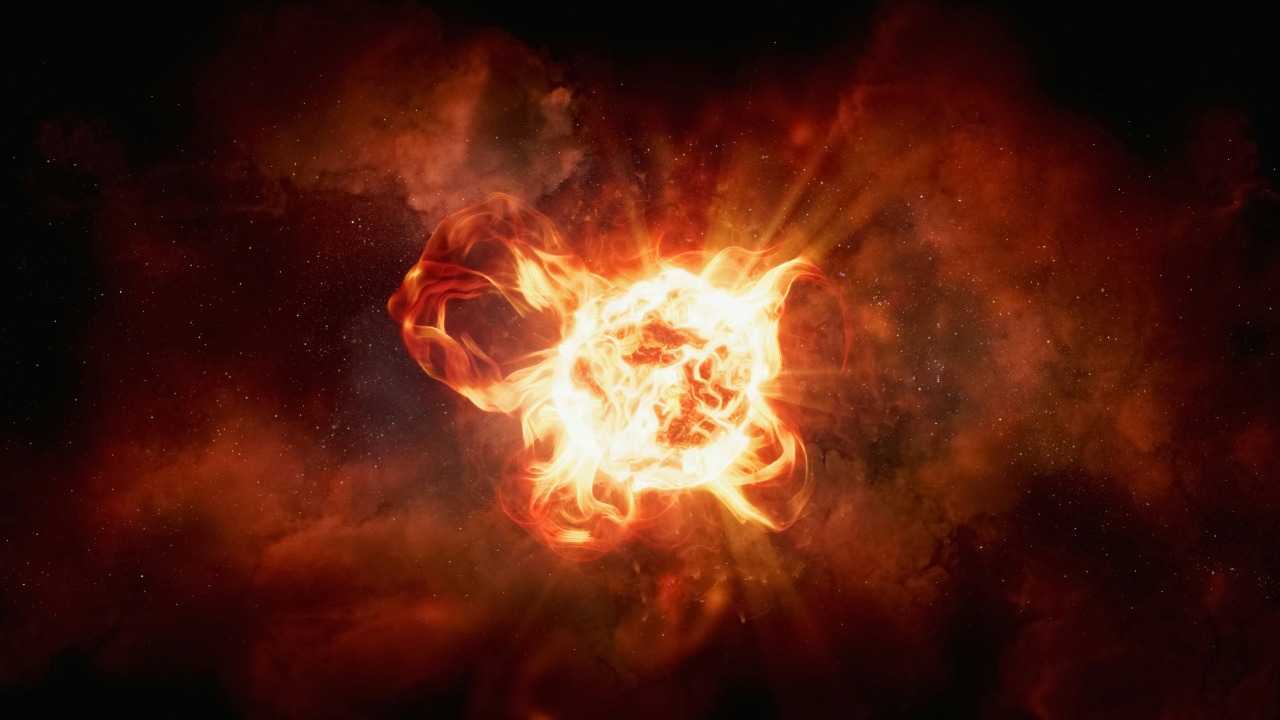

A violent stellar explosion has just given astronomers their clearest look yet at how some of the raw ingredients for biology are forged in space. By dissecting the debris of a recent supernova and comparing it with pristine material from an ancient asteroid, researchers are starting to piece together a cosmic recipe that links dying stars, drifting rocks and the chemistry that eventually leads to life.
What emerges is not a single eureka moment but a chain of discoveries that connect extreme physics to fragile molecules. I see a story in which a high-energy blast, a Japanese-led X-ray observatory and a cache of asteroid dust all point to the same conclusion: the universe is far more efficient at seeding planets with life-related elements and compounds than scientists once assumed.
The supernova that turned into a chemical laboratory
When a massive star tears itself apart, the spectacle is easy to appreciate and hard to interpret. The recent event that astronomers targeted with the X-ray Imaging and Spectroscopy Mission, known as XRISM, was treated less as a fireworks show and more as a laboratory bench, a place to measure exactly which elements a dying star can manufacture. I see that shift in attitude as crucial, because it turns a one-off explosion into a controlled experiment in how nature assembles the periodic table.
In this case, the blast’s expanding cloud of gas and dust became a backlit screen, with high-energy radiation tracing the fingerprints of individual atoms. Researchers reported that the results showed clear X-ray emission lines of both chlorine and potassium, a pair of elements that had been difficult to pin down in such environments before, and they used those signatures to argue that the supernova was actively forging some of the building blocks of life. That conclusion rests on detailed spectra that, according to Dec XRISM Offers, were precise enough for corresponding author Toshiki Sato and colleagues to separate those lines from the surrounding cosmic noise and to frame them explicitly as “blocks of life.”
XRISM’s high-precision X-rays and the “hidden” elements of habitability
What makes this particular observation stand out is not just what was seen, but how sharply it came into focus. XRISM was designed to capture high-precision X-ray data, and in this supernova remnant it revealed unusually strong signatures of chlorine and potassium that earlier instruments would have blurred together or missed entirely. From my perspective, that technical leap matters because it turns vague hints into quantitative evidence about how much of these elements a single massive star can produce.
Those measurements feed directly into models of how planets form and what they are made of. Chlorine and potassium are not as headline-grabbing as carbon or oxygen, yet they influence everything from the salinity of oceans to the way cells maintain electrical balance. The reporting on XRISM’s observations notes that its high-resolution spectra showed that massive stars forge far more of these life-related elements than expected, and that this enrichment helps explain how rocky planets and their atmospheres acquire the ingredients they need. That argument is grounded in the claim that Evidence That Supernovae Produce Life Related Elements shows XRISM’s high-precision X-ray data revealed unusually strong signatures of these atoms in the remnant, reshaping estimates of how planets and life were created.
From stellar blast to planetary pantry
Once a supernova has minted its cargo of heavy elements, the question becomes how that material ends up in places where chemistry can slow down and get interesting. I see the new XRISM results as a missing link in that chain, because they quantify the output of a single explosion and, by extension, the contribution of generations of such blasts to the broader galaxy. If one dying star can flood its surroundings with chlorine and potassium, then a whole population of them can steadily enrich the interstellar medium that future solar systems inherit.
That enrichment is not just an abstract concept. The same reports that detail XRISM’s findings emphasize that massive stars forge far more life-related elements than earlier models predicted, which means that protoplanetary disks are likely to start out with a richer pantry of ingredients. In practical terms, that suggests that when dust grains clump into planetesimals and then into full-fledged planets, they are already laced with the salts and reactive species that will later circulate through oceans and atmospheres. The description of how an exploding star changed what we know about the origins of life underlines that XRISM uncovered this enhanced production and tied it directly to the formation of planets, a connection highlighted in the analysis of An Exploding Star Just Changed What We Know About the Origins of Life XRISM.
Asteroid Bennu as a time capsule of early solar system chemistry
If supernovae are the factories, asteroids are the shipping containers that deliver their products to young planets. That is why the samples from asteroid Bennu, collected by NASA’s OSIRIS-REx mission and recently opened on Earth, have become so central to the story of life’s origins. I see Bennu as a time capsule that preserves the chemistry of the early solar system, including whatever stellar debris was mixed into the cloud of gas and dust that formed the Sun and its planets.
Scientists led by Yoshihiro Furukawa, described as a team of Japanese and US researchers, reported that they have discovered the bio-essential sugars ribose and glucose in samples of asteroid Bennu, along with other complex organic material. Those findings indicate that some of the molecules needed for RNA and basic metabolism were present in space long before Earth finished forming, and that they survived the journey inside a small, carbon-rich body. The report on these Bennu samples notes that these sugars, along with a sticky, polymer-like material nicknamed “space gum,” were identified in the returned grains, and that they provide direct evidence that such compounds can form and persist in cold, airless environments. That conclusion is anchored in the description that Dec Japanese and US scientists have shown ribose and glucose, key sugars for RNA, are present in Bennu.
NASA’s asteroid sample and the sharpened picture of life’s building blocks
The Bennu samples do more than add a few exotic molecules to an inventory. They sharpen the picture of how the solar system assembled the toolkit for biology by revealing which compounds were available, in what combinations, and in what physical settings. NASA’s analysis of the returned material has uncovered new chemical evidence that, in my view, makes the scenario of life’s ingredients arriving via asteroids far more concrete than it was when scientists relied on meteorites that had already been contaminated by Earth’s environment.
According to the reporting on NASA’s work, the asteroid sample contains not only sugars but also amino acids and other organic molecules that can be used to make proteins and genetic material, all preserved in a matrix of fine-grained dust and rock. That combination suggests that Bennu, and objects like it, acted as both storage and delivery systems for a diverse set of prebiotic compounds. The description of NASA’s findings emphasizes that this pristine material, collected directly from the asteroid’s surface, offers a cleaner view of early solar system chemistry than meteorites that have fallen through the atmosphere. That point is underscored in the account that Dec NASA reports NASA’s asteroid sample has revealed new chemical evidence, including molecules that can make proteins and genetic material.
“Space gum,” Bennu and the sticky side of prebiotic chemistry
Among the more vivid details to emerge from Bennu is the discovery of a strange, sticky substance that researchers have likened to gum. I see that “space gum” as more than a colorful nickname, because it hints at polymer-like materials that could have played a role in concentrating and protecting delicate molecules in the harsh environment of space. If sugars and amino acids were embedded in or associated with such a matrix, they might have been shielded from radiation and mechanical disruption during their long journey.
The reporting on Bennu notes that NASA finds life-linked sugars and this gum-like material on the asteroid, and that NASA’s astonishing find on asteroid Bennu includes compounds that had only been seen in a few meteorites before. That detail suggests that Bennu is not an outlier but part of a broader population of bodies that carry similar chemistry, and that the sticky material may be a common feature of carbon-rich asteroids. The description of these results highlights that the presence of such gum, alongside ribose and glucose, strengthens the case that asteroids can deliver not just isolated molecules but complex, structured mixtures. This perspective is grounded in the account that Dec NASA Bennu New York Post describes NASA’s astonishing find on asteroid Bennu, where life-linked sugars and “space gum” have been identified, similar to material seen in only a few meteorites before.
Connecting stellar forges to asteroid archives
Put side by side, the XRISM supernova data and the Bennu sample results trace a path from violent stellar death to the quiet chemistry of rocks. I see a coherent narrative emerging: massive stars explode and enrich their surroundings with elements like chlorine and potassium, that enriched gas collapses into new solar systems, and within those systems, asteroids like Bennu lock away and transport complex organic molecules that build on that elemental foundation. The two lines of evidence, one rooted in high-energy astrophysics and the other in laboratory geochemistry, converge on the idea that life’s prerequisites are assembled in stages across cosmic time.
In that sense, the “hidden recipe” revealed by the supernova is not a single list of ingredients but a sequence of processes. First, nuclear reactions in stars create heavy elements, then supernovae distribute them, then cold chemistry in interstellar clouds and protoplanetary disks turns them into sugars, amino acids and polymers, and finally asteroids deliver those compounds to young planets. The recent findings show that each step is more efficient than many models had assumed, with XRISM indicating that massive stars forge far more life-related elements than expected and Bennu demonstrating that those elements can be assembled into sophisticated molecules and preserved for billions of years.
What this means for life beyond Earth
For anyone wondering how common life might be in the universe, these discoveries shift the odds. If supernovae routinely flood their surroundings with chlorine, potassium and other life-related elements, and if asteroids commonly carry ribose, glucose and gum-like polymers, then the basic ingredients for biology may be widespread wherever stars and planets form. I interpret that as a quiet but profound change in the baseline assumptions that underlie the search for habitable worlds.
Instead of asking whether the right elements and molecules exist elsewhere, the focus can move toward how often they are assembled into environments that stay stable long enough for life to emerge. The violent star blast that XRISM dissected and the ancient dust from Bennu both suggest that the universe is generous with its chemistry, even if it remains selective about where that chemistry crosses the threshold into biology. As more supernova remnants are mapped with high-precision X-ray instruments and more asteroid samples are returned and analyzed, I expect that picture to sharpen further, revealing not just a recipe for life’s ingredients but a clearer sense of how often that recipe is followed across the cosmos.
More from MorningOverview