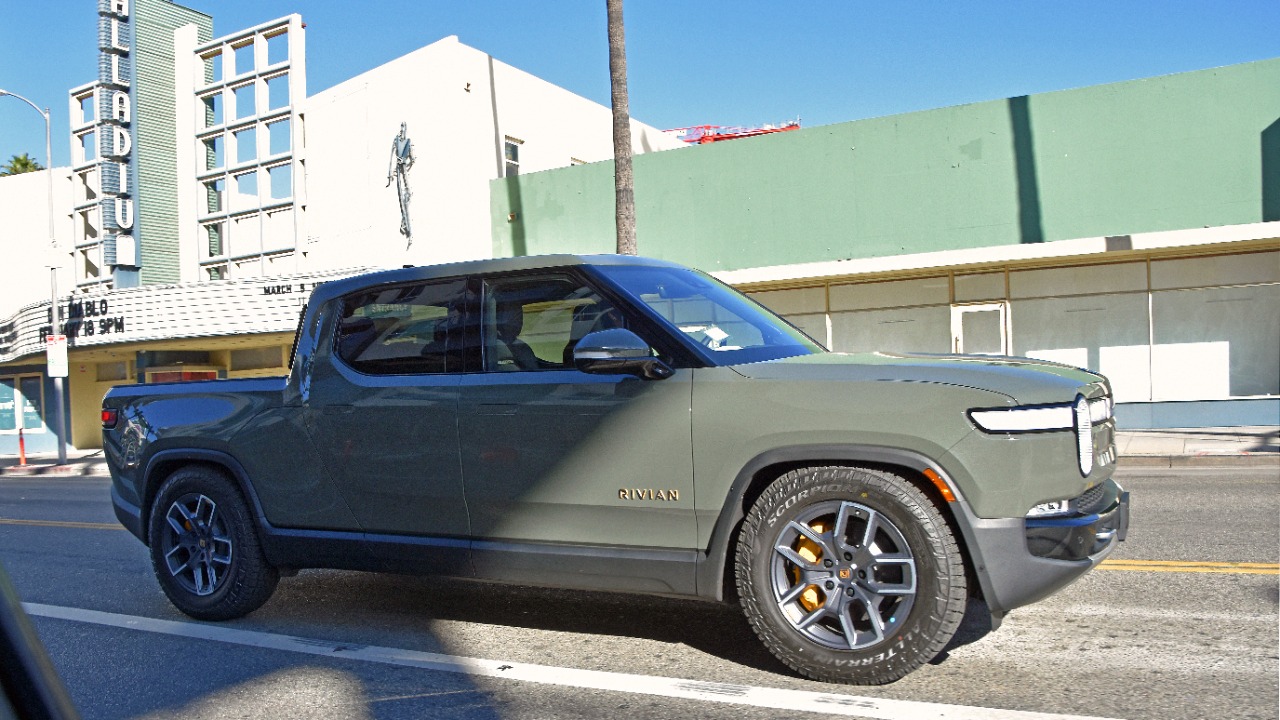

Electric pickup trucks were supposed to make range anxiety worse, not erase it. Yet a modified Rivian R1T has now pushed past the psychological barrier of 600 miles on a single charge, turning a niche efficiency experiment into a headline-grabbing proof of concept for long-distance electric travel. The achievement does not rewrite Rivian’s official specifications, but it does show how far the platform can be stretched when battery capacity, driving strategy, and charging discipline all line up.
For anyone who still thinks an electric truck cannot handle serious cross-country work, this ultra-long-range R1T is a direct challenge. It builds on a factory package that already prioritizes adventure and capability, then layers in extreme energy storage and careful planning to cover distances that used to belong exclusively to diesel pickups and big-tank SUVs.
How a Rivian R1T ended up with more than 600 miles of range
The starting point for this story is simple: an owner took a Rivian R1T and turned it into a rolling demonstration of just how far an electric truck can go when range is the only priority. According to reporting on the project, the truck was configured to deliver over 600 Miles of usable driving between charges, a figure that dwarfs the official estimates for any current production R1T. That number is not a lab fantasy, it was validated in real-world highway use, where the truck was driven continuously over long stretches rather than in a controlled test loop.
The benchmark chosen for this experiment was not a casual Sunday drive but the kind of route that has long been used to test combustion cars: a roughly 2,800-mile journey modeled on The Cannonball Run from New York City to the West Coast. By attempting a Cannonball-style trip in an electric pickup, the team behind this R1T was not just chasing a big number on a dashboard. They were trying to prove that a battery-powered truck could keep pace with the rhythms of traditional long-haul driving, even when the route stretches from New York City across the continent.
The Cannonball Run as an EV proving ground
Using The Cannonball Run as a template matters because it is a route built around speed, distance, and minimal downtime. When an electric truck with a pack sized for more than 600 Miles takes on that kind of challenge, it is effectively entering a combustion-dominated arena and asking to be judged by the same standards. The fact that this R1T could string together legs long enough to make a roughly 2,800-mile crossing without constant charging interruptions shows how much the technology has matured since the earliest highway-capable EVs.
In that context, the choice of a Rivian R1T is telling. The truck was designed from the outset as a long-distance adventure platform rather than a city commuter, and its architecture leaves room for large battery packs and robust cooling. When an owner pushes that envelope to Cannonball territory, they are not fighting the vehicle’s basic design. They are exploiting it, turning a truck that already thrives on remote trails into a machine that can cross the country with the kind of confidence usually reserved for big-tank gasoline pickups.
What Rivian officially promises on range and price
To understand how radical a 600-plus mile R1T really is, it helps to look at Rivian’s own numbers. The company’s current lineup starts with the R1T Dual Standard configuration, which is listed from $72,990 with an estimated monthly payment of $799. That Dual Standard pack is rated for a Range of 270 miles, a figure that already puts the truck in competitive territory for an electric pickup but sits far below the custom build that cracked the 600 Miles mark.
Rivian’s own messaging around the R1T leans heavily on the idea that it is “Designed to get out there” and that even the Dual Standard configuration is “Anything but standard.” Those phrases are not just marketing gloss. They reflect a platform that was engineered for long-distance travel, with multiple drive modes and a chassis tuned for both on-road comfort and off-road control. The official 270-mile Range for the entry pack is a baseline, not a ceiling, and the company’s pricing structure around $72,990 and $799 per month signals that it expects buyers to treat the truck as a primary vehicle rather than a weekend toy.
From 410 miles to 600: stretching the R1T platform
Even before anyone attempted a 600-plus mile build, Rivian had already pushed the R1T into territory that would have seemed ambitious a few years ago. The company’s Max Pack option, paired with a Dual Motor setup, delivers an EPA-estimated 400-mile club performance, with the R1T rated at 410 miles per charge. That figure already puts the truck among the longest-range EVs on sale, and it comes from a factory configuration that any buyer can order rather than a one-off experiment.
Independent testing and reviews have reinforced that trajectory. One detailed evaluation of the 2025 lineup notes that the Rivian R1T Adventure Dual Max With a starting price of $83,900 is the most range-efficient configuration, and that the Adventure Dual Max brings the estimated range to 420 miles. When a factory truck is already touching 410 and 420 miles, the leap to more than 600 Miles starts to look less like science fiction and more like a logical extension of the same hardware with a much larger battery and a more disciplined driving strategy.
How owners are calculating energy use and charging time
The 600-mile R1T did not get there by accident. Owners and enthusiasts have been running the numbers on what it would take to stretch the platform, and their back-of-the-envelope math helps explain how the Cannonball-style build works in practice. One widely shared calculation starts with a pack size of 174 kWh and assumes that 72% of that capacity is usable between fast-charging stops, which yields about 125 kWh of energy per leg. If the truck can hold a charging speed near 150 kW, that translates to roughly 50 minutes of charging per stop to refill that 125 kWh slice.
Those figures, laid out as 72%, 174 k, 125 k, 150 k, 50 m, show how a high-capacity pack changes the rhythm of a long trip. Instead of stopping every 150 or 200 miles, a driver can run much longer legs, then accept a single 50-minute break to restore a huge chunk of range. On a Cannonball-style route, that means fewer interruptions and more time spent at highway speed, which is exactly what the 600 Miles R1T was built to demonstrate.
Rivian’s evolving battery packs and range options
Rivian has been steadily expanding its battery menu, which helps explain how the R1T became such a flexible platform for range experiments. Earlier this year, the company announced that There are now even more choices for customers to join the Rivian adventure, introducing two new range choices for its trucks and SUVs. Those additions sit alongside the existing Standard, Large, and Max packs, giving buyers a clearer ladder from entry-level capability to long-haul endurance.
The official story around these packs emphasizes that Rivian is trying to balance cost, weight, and performance rather than simply chasing the biggest possible battery. In that context, the company’s note that There are now more Standard pack options is significant. It shows that Rivian is not just building halo trucks for Cannonball-style runs but also refining the everyday configurations that most buyers will choose, while still leaving room at the top of the range for Max Pack builds that can approach or exceed 400-mile real-world performance.
How the R1T fits into Rivian’s broader lineup
The R1T does not exist in isolation. It shares its core architecture with the R1S SUV, and improvements to one often spill over to the other. Recent updates to the Max Pack, for example, have pushed the R1S to 420 miles of rated range and the R1T to 410 miles. That kind of incremental improvement shows how Rivian is using software, thermal management, and pack tuning to squeeze more distance out of the same basic hardware, which in turn makes extreme builds like the 600 Miles truck more plausible.
At the same time, Rivian has been careful about how it pairs battery packs with drive systems. The company has explained that Rivian’s new range options are only available with specific drive systems, and that The Standard and Standard+ is an option with particular motor configurations. By tying certain packs to certain drivetrains, Rivian can control weight, performance, and efficiency, ensuring that even the most affordable R1T still feels like a Rivian while the top-spec versions deliver the kind of range that makes cross-country trips feel routine.
The R1T’s core identity as an electric truck
Underneath all the range talk, the R1T remains a very specific kind of vehicle. The Rivian R1T is a battery electric mid-size light duty luxury pickup truck produced by the American company Rivian, and it was initially conceived as a go-anywhere adventure machine that could operate even where no charging infrastructure is available. That heritage matters, because it means the truck was built from day one to carry large battery packs, manage heavy loads, and maintain stability and comfort over long distances.
Every 2025 Rivian R1T comes with AWD, and there are three motor configurations. Dual-motor models are available with Standard, Large, and Max packs, while the highest output setups are offered only with the Max pack. That structure, laid out in detail in Every overview of the lineup, shows how Rivian has tied its most capable drivetrains to its largest batteries. It is a natural foundation for a 600-plus mile build, because the truck’s chassis and power electronics are already designed to handle the demands of a big pack and sustained highway speeds.
Real-world efficiency: wheels, tires, and cold weather
Range on paper is one thing, range on the road is another. Detailed road tests of the 2025 R1T have underscored that selecting bigger wheels or all-terrain tires will reduce the truck’s range, sometimes significantly. A new heat pump and other efficiency tweaks have been added to improve real-world range in cold weather too, which is critical for owners who plan to use their trucks year-round in northern climates where winter can sap battery performance.
Those observations, drawn from a comprehensive road test, help explain why the 600 Miles R1T was able to post such a big number. To reach that kind of distance, the builders would have needed to optimize every variable they could control, from tire choice and wheel size to driving speed and climate control use. The same physics that trim range when an owner bolts on aggressive off-road tires can be turned in the other direction when the goal is to glide across the country with minimal energy loss.
Why this 600-mile R1T matters for the EV conversation
For all the technical detail, the significance of this ultra-long-range R1T is straightforward. It shows that an electric pickup can not only match but exceed the highway legs of many combustion trucks, provided it carries enough battery and uses the charging network intelligently. That matters for buyers who want a single vehicle that can tow, haul, and still handle a cross-country family trip without turning every day into a charging scavenger hunt.
It also reframes the way I look at Rivian’s official numbers. When the company talks about a Dual Standard pack at $72,990 with a Range of 270 miles, or a Max Pack R1T at 410 miles, those figures now feel like conservative baselines rather than hard limits. The 600 Miles build is not a configuration most people will buy, and it relies on trade-offs that would not make sense for every driver. But as a proof of what the platform can do, it pushes the conversation forward, from whether an electric truck can go the distance to how far owners want to go before they stop for a break.
The media moment and what comes next
The 600-mile R1T has not just lived on spec sheets and forum posts. Video coverage has amplified its impact, with one widely shared clip framed around the idea that a Rivian R1T with 600-plus mile range “breaks limits” and highlights how far the technology has come. That coverage, tagged with a Dec reference in its metadata, has helped turn a niche engineering exercise into a broader talking point about the future of electric trucks.
As more owners experiment with large packs and as Rivian continues to refine its Standard, Large, and Max offerings, I expect the gap between official ratings and real-world potential to keep narrowing. The company’s own site already positions the R1T as Designed for adventure and Anything but standard, and its evolving range options show that Rivian is willing to push the envelope while still keeping an eye on practicality. The 600 Miles Cannonball-style truck may remain an outlier, but it has already done its job by proving that the ceiling for electric pickup range is far higher than most people assumed.
Supporting sources: Rivian R1T and R1S get two new range options.
More from MorningOverview