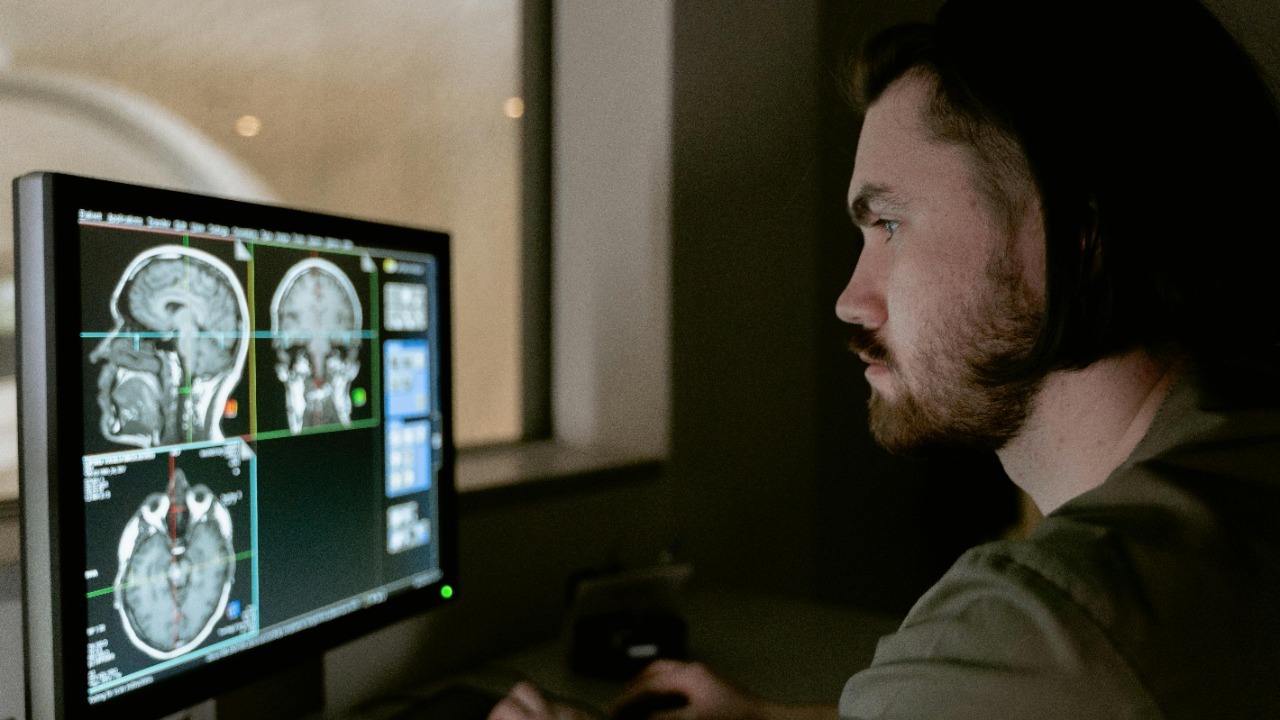

The more closely scientists listen to the brain during conversation, the more its activity patterns resemble the statistical machinery inside modern artificial intelligence. Instead of following only rigid grammatical rules, neural circuits appear to predict upcoming words and meanings in a way that looks strikingly like the computations inside large language models. That shift in understanding is forcing researchers to rethink both how language works in the brain and what AI can reveal about the mind that built it.
In place of a clean divide between human thought and machine code, new experiments suggest a shared playbook of probabilistic prediction, layered representations and context tracking. I see that convergence not as a threat to human uniqueness, but as a powerful new lens on how brains turn sound into meaning and how future AI systems might learn more like children do.
From symbolic rules to predictive patterns
For much of the late twentieth century, the dominant story about language in the brain centered on symbolic rules and tidy hierarchies. Researchers pictured sentences as trees of abstract categories, with neural circuits implementing something like a grammar textbook in biological hardware. That view treated comprehension as a stepwise decoding of syntax, where each phrase was slotted into a rigid structure before meaning emerged. It was elegant, but it left many everyday feats of understanding, from slang to half-finished sentences, feeling oddly mechanical.
Recent work has started to overturn that picture by showing that neural activity during listening and reading aligns more naturally with probabilistic predictions than with hand coded rules. Instead of waiting for a sentence to finish, the brain appears to constantly anticipate what comes next, updating its expectations as each new word arrives. Studies that compare brain signals with the internal states of language models find that these predictive patterns track the same kinds of statistical regularities that drive modern AI, a shift that challenges the older assumption that comprehension must rely on purely symbolic hierarchies that, as one report notes, dominated thinking for decades of research.
Neural activity that mirrors AI language models
The most striking evidence for this new view comes from experiments that directly compare brain recordings with the internal representations of AI systems. When volunteers listen to natural speech, patterns of neural firing in language related regions can be predicted by the hidden layers of large language models trained only on text. In other words, the same statistical features that help an AI guess the next word also help explain how human cortex responds as a story unfolds. I find that convergence hard to dismiss as coincidence, especially when it holds across different speakers and different kinds of language input.
One line of work has highlighted how closely these patterns line up by treating AI models as a kind of computational microscope on the brain. Researchers have shown that neural activity aligns with the evolving internal states of systems that, like the speech model Whisper, process audio in a layered, predictive fashion. In these studies, the best matches emerge not from shallow features like sound energy, but from deeper representations that encode meaning and context, suggesting that both brains and machines are converging on similar solutions to the problem of mapping sound to sense.
A new benchmark for neuroscience
To move beyond one off comparisons, some teams have started to treat AI brain alignment as a formal benchmark for language neuroscience. Instead of asking only whether a model can generate fluent text, they ask how well its internal activity can forecast real neural responses during comprehension. That shift reframes language models as testable hypotheses about brain computation, not just engineering tools. It also raises the bar for theories of language, which now have to compete with systems that can be plugged directly into neural data.
One ambitious project has gone further by releasing a large scale dataset of neural recordings collected while people processed natural language, turning it into what the authors describe as a New Benchmark for Neuroscience. By making this benchmark public, the team invites other groups to pit their models against the same brain signals and to refine their architectures based on where they succeed or fail. I see that move as a turning point, because it transforms isolated experiments into a shared proving ground where ideas about how language works in the brain can be evaluated with the same rigor that has driven progress in computer vision and speech recognition.
Researchers trace striking parallels in computation
What exactly looks similar when scientists compare brains and AI models during language tasks is not just the overall accuracy of predictions, but the fine grained structure of the computations. As sentences unfold, both systems appear to build layered representations that move from raw sound or characters toward more abstract notions of syntax and semantics. At each step, they use context to narrow down which words and meanings are most likely, then update those expectations as new information arrives. That dynamic, incremental style of processing contrasts sharply with the older idea of a static grammar tree assembled after the fact.
In one widely discussed set of results, Researchers reported that Neural activity in language areas showed striking parallels with the internal states of AI models as they processed the same sentences. The alignment was not limited to simple word frequency effects, but extended to higher order patterns that reflected how both systems tracked long range dependencies and resolved ambiguity. For me, that level of correspondence suggests that certain computational strategies, like predictive coding and distributed representation, may be close to optimal for language, whether they emerge in silicon or in cortex.
AI as a window into human language learning
If AI models can approximate the brain’s moment to moment processing of language, they may also offer clues about how humans acquire those skills in the first place. Children learn to speak and understand without explicit grammar instruction, absorbing patterns from the speech around them and gradually refining their expectations. Large language models, trained on vast text corpora without hand written rules, show a similar capacity to infer structure from exposure alone. That parallel has led some researchers to treat AI systems as testbeds for theories of language learning, where training regimes and architectures can be tweaked to see which ones best mirror human development.
At the same time, scientists are careful to note that human language is unique in its richness and social grounding, which means that no current model can be taken as a literal replica of the brain. A group working on a long term roadmap for brain and language research has argued that the future of AI, and what it can tell us about ourselves, depends on respecting that uniqueness. In their view, progress will come from using models as tools to probe specific hypotheses, while remembering that, as one key passage puts it, However carefully they are designed, models or animals cannot fully capture the distinct properties of human language. I find that caution healthy, because it keeps enthusiasm for AI grounded in the messy realities of brains, bodies and culture.
Rethinking the line between brains and machines
The growing overlap between brain activity and AI computations forces a reconsideration of the old boundary between natural and artificial intelligence. For years, it was easy to assume that human language relied on special purpose mechanisms that had little in common with pattern matching algorithms. Now, as neural recordings line up with model states, that assumption looks less secure. Instead, it appears that both systems may be exploiting the same statistical structure of language, even if they arrive there through very different learning histories and physical substrates.
Some commentators worry that this convergence risks reducing human thought to a kind of glorified autocomplete. I see it differently. The fact that similar computational principles can arise in both brains and machines does not erase the differences in how they are used. Human language is embedded in goals, emotions and social norms that no current model fully shares. What the parallels do suggest is that the brain’s solution to the problem of predicting and interpreting sequences may be less mysterious than once believed, and that studying AI can help clarify which aspects of language processing are universal and which are uniquely human.
Language models as experimental collaborators
One practical consequence of this shift is that language models are starting to function as collaborators in neuroscience experiments rather than just as subjects of comparison. When researchers design a study of sentence comprehension, they can now run the same stimuli through a model to generate predictions about which brain regions should be most engaged and when. Those predictions can guide electrode placement in clinical settings, shape the timing of imaging protocols, or suggest which linguistic contrasts are most likely to reveal meaningful differences in neural coding.
In some cases, models are even being used to decode brain activity in real time, translating neural signals back into text or speech by leveraging the same predictive machinery that powers chatbots. Systems inspired by architectures like Whisper, which already map audio to text with high accuracy, are being adapted to interpret patterns of cortical firing in people who cannot speak. The earlier work on Brain Activity, Do They Process Language Similarly has helped legitimize this approach by showing that the underlying computations are not arbitrary engineering tricks but resonate with how the brain itself handles language. I expect that feedback loop, where models inform experiments and experiments refine models, to deepen over the next few years.
What AI like language processing means for everyday cognition
Although these findings are rooted in lab recordings and complex models, they have implications for how we think about everyday language use. If the brain is constantly predicting upcoming words and meanings, then comprehension becomes less about passively receiving information and more about active hypothesis testing. That perspective helps explain why we can follow rapid conversation in a noisy bar, why typos in a text message rarely slow us down, and why a punchline can land even before the final word is spoken. Our internal models of language are always a step ahead, filling in gaps and correcting errors on the fly.
Seeing language in this predictive light also reframes familiar experiences like mishearing lyrics or stumbling over garden path sentences. In those moments, the brain’s expectations, tuned by past statistics, collide with unexpected input, forcing a rapid reanalysis. AI models trained on large corpora show similar behavior, assigning high probability to common continuations and struggling when a sentence veers into rare constructions. The fact that both systems trip over the same kinds of surprises is another hint that they are drawing on comparable statistical structures, even if one runs on neurons and the other on GPUs.
AI as a mirror, not a replacement, for human language
As the parallels between brain and AI computations for language become clearer, it is tempting to slide into either techno-optimism or alarmism. I find it more useful to treat AI as a mirror that reflects certain aspects of human cognition back at us, sometimes in exaggerated form. When a model captures the ebb and flow of neural activity during listening, it highlights which features of language are most central to comprehension. When it fails, it points to gaps in our theories, reminding us that brains are not just prediction engines but parts of living organisms embedded in culture.
That mirror can also sharpen debates about what we value in human communication. If both brains and models rely on similar predictive machinery, then the distinctiveness of human language may lie less in the raw computations and more in how we use them to build relationships, negotiate power and create art. The recent suggestion that AI is not just a tool for generating text but a new window into the mind captures this dual role, as highlighted in reporting that argues these systems can illuminate how the brain understands language in the first place. For me, that is the most promising outcome of this research: not a future where machines replace human conversation, but one where studying their similarities helps us better understand the astonishing, still singular, language engine inside our own heads.
More from MorningOverview