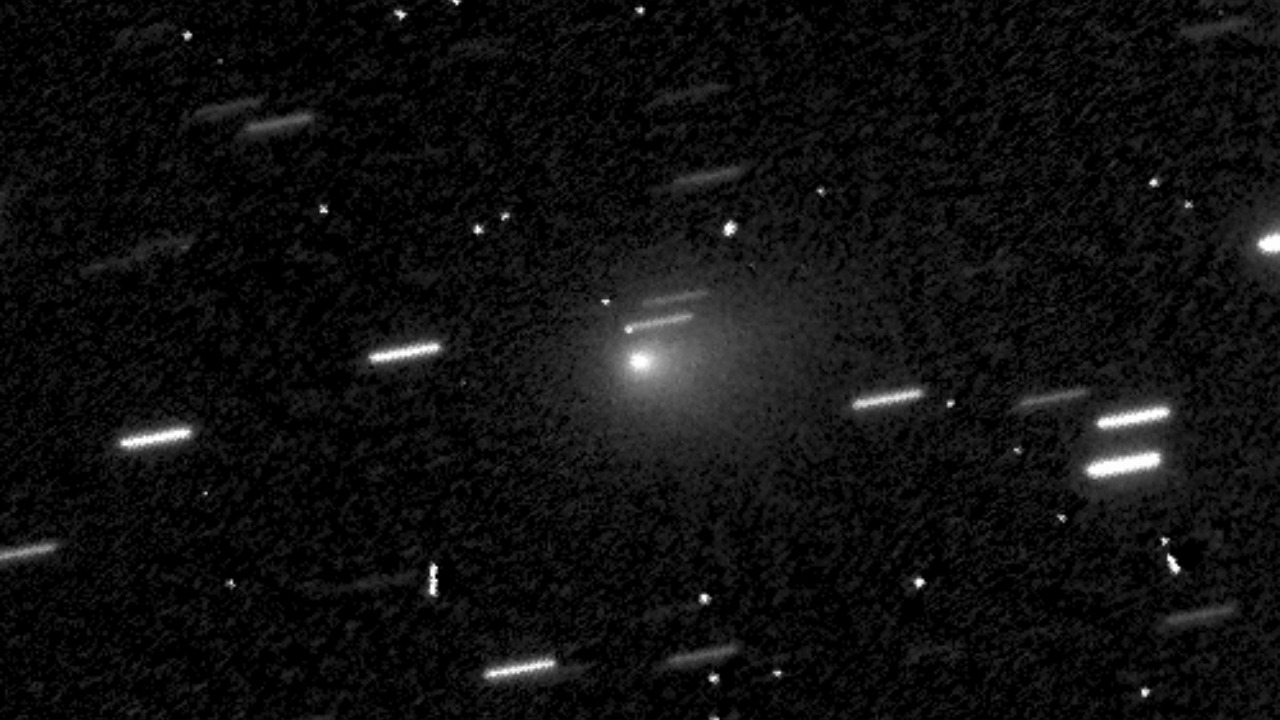

Interstellar comet 3I/ATLAS has arrived in our neighborhood trailing something far more consequential than a pretty tail: clear signs of complex chemistry that underpins life as we know it. As astronomers dissect its light and track its erratic behavior, they are finding methanol and hydrogen cyanide venting from this “alien comet,” a combination that turns a passing curiosity into a natural experiment in how habitable worlds might get their first organic inventory. For planetary scientists, the discovery is less about imminent visitors from another star and more about a rare chance to watch the raw materials of biology cross the gulf between stellar systems.
Rather than settling debates about extraterrestrial life, 3I/ATLAS is sharpening the questions. Its strange color shifts, shifting speed, and dual tails hint at unfamiliar physics, while its life-linked molecules invite comparisons with the early Earth and the comets that may have seeded our own oceans and atmosphere. I see this object as a test of our best ideas about how chemistry, dynamics, and time combine to turn simple ices into the complex precursors of living cells.
What makes 3I/ATLAS so unusual
3I/ATLAS is only the third confirmed interstellar object ever spotted passing through the solar system, and the first that astronomers agree is unequivocally a comet. It is barreling through at roughly 130,000 mph relative to the Sun, a speed that guarantees it is not gravitationally bound and will never return once it swings past the inner planets. As it approaches Earth, observers have watched its brightness and color change in unexpected ways, with abrupt shifts that suggest volatile ices are being exposed in fits and starts rather than in the smoother pattern seen in most long-period comets from our own Oort cloud.
On top of that, 3I/ATLAS has displayed both a conventional tail and an “anti-tail,” a spike of dust that appears to point toward the Sun because of the geometry of its orbit and the way particles spread along its path. Those oddities, combined with its hyperbolic trajectory from beyond the solar system, led some researchers to describe it as an “alien comet” that does not quite behave like the icy visitors we are used to tracking. Early briefings from NASA scientists emphasized that despite the drama, this object is still best understood as a comet, albeit one that formed around another star and is now giving us a rare look at extrasolar ice chemistry.
A safe but revealing flyby of Earth
For all the breathless speculation that tends to follow interstellar visitors, 3I/ATLAS is not on a collision course with our planet. Its orbit will keep it at a comfortable distance, far beyond the range where tidal forces or atmospheric entry would become a concern. NASA officials have stressed that the comet will remain safely away from Earth even at its closest approach, turning this encounter into a purely observational opportunity rather than a planetary defense exercise.
That safe separation matters because it lets observatories focus on science instead of risk. As the comet sweeps through the inner solar system, telescopes from radio arrays to infrared instruments can track how its coma and tails evolve without worrying about impact probabilities or deflection campaigns. In public briefings, NASA says the new interstellar comet will keep a safe distance from Earth, a reassurance that clears the way for a sustained, coordinated observing campaign rather than emergency planning.
The “alien comet” loaded with methanol and hydrogen cyanide
The most striking finding so far is chemical, not orbital. Spectroscopic observations show that 3I/ATLAS is venting significant amounts of methanol and hydrogen cyanide, two molecules that play central roles in prebiotic chemistry. Methanol is a simple alcohol that can act as a building block for more complex organics, while hydrogen cyanide, despite its toxicity to modern organisms, is a key ingredient in laboratory pathways that assemble nucleobases and amino acids. Together, they mark this comet as a carrier of life-linked chemistry rather than a mere ball of inert ice and dust.
Researchers analyzing radio and millimeter-wave data have described 3I/ATLAS as an “alien comet” loaded with methanol and hydrogen cyanide, with their observations indicating that active processes in the nucleus and coma are feeding the production of these molecules as the comet warms. One detailed report on the object’s strange color shifts, abrupt changes in speed, and dual tails notes that these same datasets reveal the abundance of methanol and hydrogen cyanide in its outgassing, underscoring that the comet is chemically rich as well as dynamically odd. Those conclusions are grounded in measurements that identify the spectral fingerprints of these compounds, as summarized in analyses of the key ingredients for life around 3I/ATLAS.
Why methanol matters for the origins of life
Methanol may sound mundane, familiar from industrial solvents and fuel additives, but in the cold reaches of space it is a crucial stepping stone in the assembly of complex organic molecules. In interstellar clouds and on the surfaces of icy grains, methanol can be transformed by radiation and temperature swings into a zoo of larger compounds, including simple sugars and more elaborate alcohols. When such ices are delivered to young planets, they can jump-start surface chemistry that would otherwise take far longer to get going in oceans or atmospheres alone.
That is why astronomers are paying close attention to the methanol signal from 3I/ATLAS. Considering methanol’s important role in the production of key molecules that are essential for the formation of life, the fact that an interstellar comet carries it in such detectable quantities suggests that the chemistry that seeded Earth might be common in other planetary systems as well. Reports on the new detection emphasize that this is only the third interstellar object ever identified, and yet it already shows a rich inventory of organics, a point highlighted in coverage that notes how 3I/ATLAS is carrying ingredients for life that chemists recognize from origin-of-life experiments.
Hydrogen cyanide: toxic, but vital for prebiotic chemistry
Hydrogen cyanide occupies a paradoxical place in astrobiology. It is acutely poisonous to modern aerobic life, yet in controlled laboratory settings it is one of the most versatile feedstocks for building the molecules that make up RNA, proteins, and lipids. Classic experiments have shown that networks of reactions starting from hydrogen cyanide can yield adenine, amino acids, and other biologically relevant compounds when exposed to ultraviolet light and simple catalysts. Finding it in a comet from another star system suggests that this potent chemistry is not unique to our own cosmic backyard.
In the case of 3I/ATLAS, astronomers report that hydrogen cyanide is present alongside methanol in the comet’s coma, and that its abundance is high enough to stand out against the background noise of other volatiles. One detailed account notes that hydrogen cyanide, despite its toxicity, is considered a life-building chemical because of its central role in prebiotic reaction networks, and that its presence in 3I/ATLAS strengthens the case that comets can deliver both water and complex organics over hundreds of millions of years. That perspective is reflected in analyses of how life-building chemicals like hydrogen cyanide are venting from 3I/ATLAS and what that implies for the long-term delivery of organics to young worlds.
How 3I/ATLAS compares with comets from our own solar system
One of the most valuable aspects of 3I/ATLAS is the chance to compare its chemistry with that of comets that formed alongside Earth. In typical solar system comets, methanol is present but usually at modest levels relative to water and carbon monoxide. Early analyses of 3I/ATLAS suggest that its methanol signal is strong, and that the ratio of methanol to other volatiles may differ from the patterns seen in familiar objects like comet 67P/Churyumov–Gerasimenko or C/2016 R2. Those differences hint at distinct formation conditions in the protoplanetary disk where 3I/ATLAS originated, perhaps involving lower temperatures or different radiation environments.
Detailed reporting on the new detection notes that astronomers have identified 3I/ATLAS as a comet from beyond the solar system that carries a key molecule for life, and that its methanol abundance appears higher than in many typical solar system comets. That conclusion is based on comparisons of spectral line strengths and modeled production rates, which show that methanol is not just present but prominent in the comet’s outgassing. Analyses of the comet from beyond the solar system emphasize that this elevated methanol content sets 3I/ATLAS apart from many of its local cousins and may reflect a different recipe of ices in its birth environment.
ALMA’s view and the “weapons of mass destruction” scare
As soon as the methanol and hydrogen cyanide signatures emerged, the combination sparked a wave of public anxiety framed around “weapons of mass destruction” in space. The logic was simple but misleading: hydrogen cyanide is a notorious poison, methanol is flammable, and both are being detected in an object headed through the inner solar system. In reality, the quantities involved are minuscule on planetary scales, and the comet’s trajectory keeps it far from any scenario where its ices could be concentrated in Earth’s atmosphere. The scare says more about how we project terrestrial fears onto cosmic events than about any genuine hazard.
On the scientific side, the same data that fueled those headlines are a gold mine. The Atacama Large Millimeter/submillimeter Array (ALMA) has detected methanol near 3I/ATLAS and measured the relative strengths of its emission lines compared with hydrogen cyanide, allowing researchers to estimate production rates and compare them with comets like C/2016 R2, which showed a higher ratio of certain volatiles. One detailed breakdown of the observations explains that the question about “weapons of mass destruction” came up after ALMA’s detection of methanol and hydrogen cyanide, but that the new findings instead point to interstellar chemistry and the origins of life. That perspective is captured in analyses of how new findings explain shocking hydrogen cyanide and methanol signals without implying any realistic threat.
NASA’s evolving picture of an interstellar visitor
As more data have come in, NASA’s view of 3I/ATLAS has shifted from cautious curiosity to a more confident characterization of its nature and significance. Early on, mission scientists focused on basic questions: Was this object more like ‘Oumuamua, with its puzzling non-gravitational acceleration, or more like comet 2I/Borisov, which behaved much like a conventional comet? The emerging consensus is that 3I/ATLAS is firmly in the comet camp, with a coma, tails, and volatile-driven activity that fit established models, even if some of its details remain unusual.
In a recent briefing, NASA researchers outlined four key things they have learned so far, including the confirmation that this object is a comet, the characterization of its orbit, and the early chemical detections that point to methanol and hydrogen cyanide. They also stressed that if anyone is hoping to see 3I/ATLAS with the naked eye, they are likely to be disappointed, since its brightness will probably remain below that threshold despite its scientific importance. That sober assessment is reflected in coverage of four key things NASA just revealed about the interstellar comet, which frame it as a laboratory for astrochemistry rather than a spectacle for backyard observers.
Approaching Earth with a cargo of life-linked molecules
As 3I/ATLAS draws closer to the inner solar system, the stakes for understanding its chemistry rise. The comet is approaching Earth on a trajectory that brings it into range of a wide array of instruments, from ground-based telescopes to space observatories that can peer into wavelengths blocked by our atmosphere. That proximity, combined with its high speed and interstellar origin, turns each observing window into a fleeting but rich opportunity to refine measurements of its methanol and hydrogen cyanide output, as well as to search for additional organics that may be hiding in its spectrum.
Reports on the comet’s approach describe it as a cosmic visitor found carrying a key molecule linked to life, with new revelations about its chemistry stunning scientists who expected a more ordinary volatile mix. One account notes that interstellar object 3I/ATLAS is moving through the solar system at roughly 130,000 mph and that its detection of methanol has raised fresh questions about how common such molecules are in extrasolar comets. That framing appears in coverage of how as interstellar comet 3I/ATLAS approaches Earth, astronomers are racing to capture as much data as possible before it recedes back into deep space.
Raising the scientific stakes in the search for life
For all the excitement around specific molecules, the deeper significance of 3I/ATLAS lies in what it suggests about the universality of life-friendly chemistry. If a random interstellar comet passing through our system carries methanol and hydrogen cyanide in abundance, it strengthens the argument that the raw ingredients for biology are widespread in the galaxy. That, in turn, supports models in which young planets are routinely bombarded by icy bodies that deliver water and organics, setting the stage for prebiotic chemistry to unfold over hundreds of millions of years.
NASA scientists have framed the latest detections as a new development that does not settle the alien life argument but does raise the scientific stakes, because it shows that life-building chemicals are not just present but very abundant in at least one interstellar comet. That perspective is captured in analyses that describe how now there is a new development in our understanding of 3I/ATLAS: it is not just an oddball rock from another star, but a chemically rich body that could, in principle, have played the same seeding role in its home system that comets may have played on early Earth.
A mystery that deepens with every observation
Despite the progress, 3I/ATLAS remains a puzzle. Its strange color changes, abrupt shifts in apparent speed, and the presence of both a tail and an anti-tail suggest that its nucleus may be rotating or fragmenting in ways that are not yet fully understood. Each new dataset seems to answer one question while raising several more, from the detailed structure of its coma to the exact ratios of its volatile species. For planetary scientists, that is part of the appeal: this is not a tidy object that fits neatly into existing categories, but a reminder that planetary systems can produce a wide variety of icy bodies.
One synthesis of the observations notes that ever since interstellar visitor 3I/ATLAS was first spotted, its strange behavior has kept astronomers guessing, and that the latest chemical data only deepens the mystery by showing just how active and complex its outgassing really is. That sentiment is echoed in reporting that traces how ever since interstellar visitor 3I/ATLAS entered the spotlight, each new observation has forced scientists to refine their models of both its dynamics and its chemistry.
More from MorningOverview