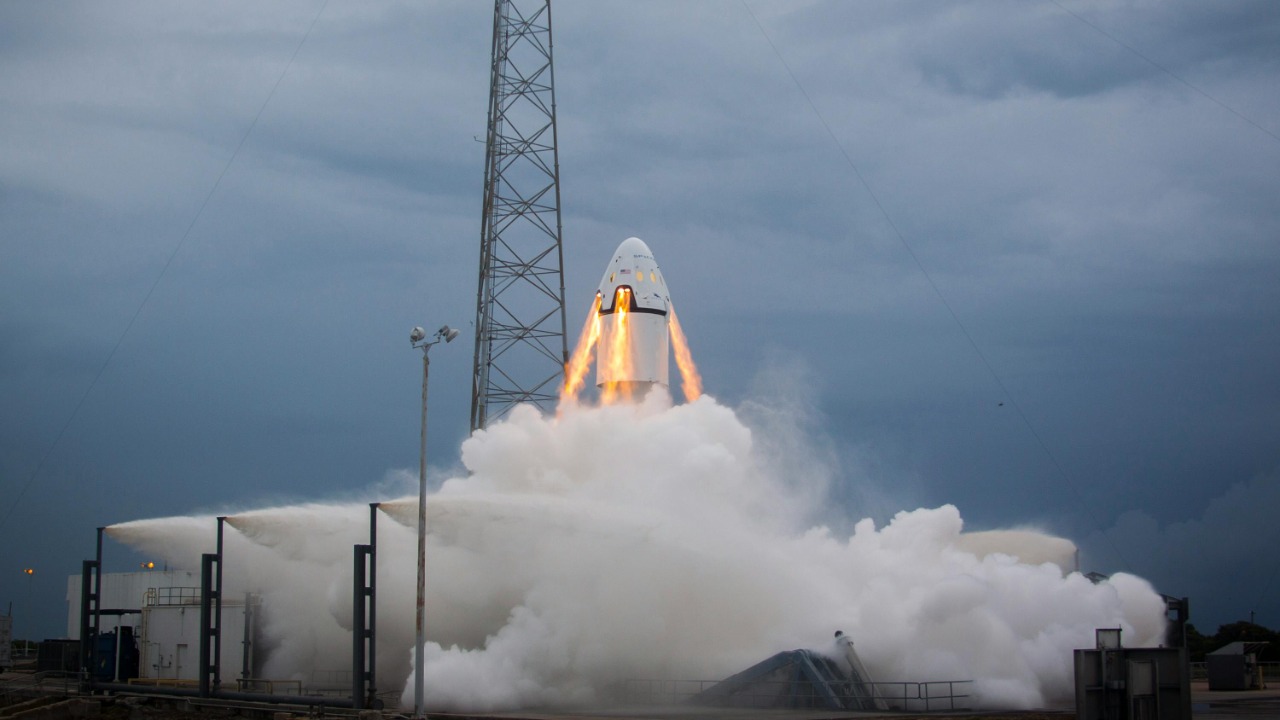

Artificial intelligence is moving from the control room into the engine bell, reshaping how rockets are designed, steered and powered. Instead of treating propulsion as a fixed piece of hardware, engineers are starting to treat it as a living system that can learn, adapt and squeeze more performance out of every kilogram of propellant.
If that shift holds, the payoff is obvious: faster trips to the moon and Mars, safer launches from Earth and a new generation of propulsion concepts that would have been too complex to manage with human intuition alone. The race now is to turn promising algorithms into flight‑ready systems that can survive vacuum, radiation and the unforgiving math of orbital mechanics.
AI as the new brain of spacecraft propulsion
The most immediate change I see is that propulsion is no longer just about chemistry or materials, it is about computation. Instead of designing a rocket engine once and flying it the same way for decades, teams are using AI to constantly adjust how propellant flows, how thrust is vectored and how engines respond to changing conditions in flight. That turns propulsion into a dynamic control problem, where software can hunt for tiny efficiency gains that add up to major speed and range improvements over long missions.
Researchers working on advanced engines describe AI as a tool that can determine the best way to burn fuel inside a rocket, then keep that burn in the sweet spot even as pressures, temperatures and loads shift during ascent. By learning how to manage the complex physics inside a combustion chamber, AI can help run the engine more efficiently and more safely, which is exactly the kind of incremental performance boost that interplanetary missions need to cut travel times and reduce risk, as recent work on spacecraft propulsion efficiency makes clear.
Designing faster rockets with intelligent optimization
Before any engine fires, the real battle is fought on the design screen, where engineers juggle speed, fuel consumption, weight, safety and cost. Traditional methods rely on simplified models and a limited number of simulations, which means many promising configurations never get explored. AI is changing that balance by scanning huge design spaces, spotting patterns humans might miss and proposing unconventional shapes or internal layouts that deliver more thrust for the same mass of propellant.
In aerospace, that shift is especially visible in how teams approach trade‑offs like nozzle geometry, tank placement and structural reinforcement. Instead of tweaking one variable at a time, engineers can now let algorithms search thousands of combinations and converge on designs that hit multiple targets at once, from lower drag to better thermal performance. One detailed analysis of Designing aerospace systems shows how AI‑driven optimization is already redefining intelligent controls and structural layouts, a foundation that directly feeds into faster, more efficient launch vehicles.
Reinforcement learning as a propulsion game‑changer
Once a rocket leaves the pad, the problem shifts from design to control, and this is where reinforcement learning is starting to matter. In simple terms, reinforcement learning treats the rocket as an agent in a game, constantly trying actions, receiving feedback and updating its strategy to maximize a reward, such as fuel efficiency or trajectory accuracy. Instead of relying on a fixed guidance table, the system can adapt to unexpected winds, engine performance variations or minor hardware faults in real time.
Applied to propulsion, that means AI can learn how to throttle engines, gimbal nozzles and sequence burns in ways that squeeze more delta‑v out of the same hardware. Reporting on AI‑driven reinforcement learning highlights how these techniques are opening the door to faster, more efficient propulsion systems and even making nuclear‑powered rockets a realistic target. The key is that the algorithm does not need a perfect model of the rocket or its environment; it simply needs enough data to learn which control strategies deliver the best performance under real‑world conditions.
Nuclear‑powered rockets and the AI control problem
Nuclear propulsion has long been the holy grail for deep space travel, promising much higher exhaust velocities than chemical engines and therefore dramatically shorter trip times to Mars or the outer planets. The catch is that nuclear thermal or nuclear electric systems are far more complex to manage, with tight safety margins and intricate interactions between reactors, heat exchangers and propellant flows. That complexity is exactly where AI can earn its keep, by monitoring thousands of parameters at once and adjusting operations faster than any human team could.
Engineers working on nuclear concepts argue that AI can help determine the best way to route heat, regulate reactor output and manage propellant in real time, keeping the system within safe limits while still pushing it close to its performance ceiling. Analyses of nuclear‑powered rockets stress that without advanced control software, many of these designs would be too risky or unwieldy to fly. With AI in the loop, nuclear propulsion starts to look less like science fiction and more like a manageable engineering challenge for the coming decades.
Autonomous Navigation and Landing to match smarter engines
Faster propulsion only pays off if spacecraft can navigate and land with the same level of intelligence. As engines become more responsive and trajectories more aggressive, guidance systems need to react in milliseconds, not minutes, which rules out constant human supervision from Earth. That is why Autonomous Navigation and Landing has become a central focus, with AI handling everything from hazard detection to last‑second course corrections during descent.
In practice, that means onboard systems are learning to read terrain, identify safe landing zones and adjust thrust profiles on the fly, even in environments where GPS is unavailable and communication delays are significant. Detailed reporting on Autonomous Navigation and Landing shows how human‑AI collaboration is already revolutionizing these critical phases, with AI not only steering spacecraft but also managing onboard systems and inventory items through fully automated processes. The result is a tighter integration between propulsion and navigation, where engines and guidance software work as a single, adaptive system.
Pushing boundaries with AI in space exploration
Behind these technical advances sits a broader institutional shift, as space agencies build dedicated teams to explore how AI can support everything from propulsion to mission planning. One prominent example is The AI Lab, which is part of a larger group focused on advanced technologies like robotics, quantum computing and new materials. The goal is not just to bolt AI onto existing systems, but to rethink how missions are conceived, simulated and operated when machine learning is available from day one.
Within that context, AI is being used to predict failures, assess risks and maintain spacecraft systems autonomously, a crucial capability for missions that travel far beyond the reach of real‑time human control. As one program framed it, Pushing boundaries with AI is not optional for future deep space exploration, it is indispensable, because the distances involved make traditional decision‑making from Earth impractical. That same logic applies directly to propulsion, where engines on a months‑long mission must be able to diagnose their own problems and adjust their behavior without waiting for instructions from a ground controller.
AI in launch vehicle design and development
The impact of AI is just as visible on the ground, particularly in how launch vehicles are conceived, built and tested. In the Design and Development phase, machine learning tools are being used to streamline manufacturing, predict defects and optimize the layout of components inside a rocket. Instead of relying solely on static CAD models, engineers can feed real production data back into their simulations, allowing the design to evolve in response to how hardware actually behaves on the factory floor.
Companies working on new rockets describe clear Advantages of AI in Space Exploration, especially when it comes to Design and Development. AI helps automate quality checks, schedule maintenance and even plan launch campaigns, reducing downtime and improving the safety of launch endeavours. Once in space, the same systems can take over routine monitoring of propulsion and other subsystems, freeing human teams to focus on strategic decisions rather than constant telemetry triage.
Human‑AI collaboration as the safety net for faster travel
As propulsion and navigation grow more autonomous, the question is not whether humans will be replaced, but how responsibilities will be divided. I see the emerging model as a layered safety net: AI handles the high‑frequency control tasks that demand instant reactions, while human operators set goals, define constraints and intervene when something falls outside the system’s training. That division is especially important for propulsion, where a single misjudged burn can mean the difference between a successful mission and a lost spacecraft.
Evidence from current missions suggests that this human‑AI partnership is already reshaping workflows. Systems that once required teams of controllers now run largely on their own, with humans stepping in mainly for anomalies or major trajectory changes. Reporting on Human‑AI collaboration underscores how automation is taking over routine monitoring and inventory management, while people focus on oversight and strategy. Applied to propulsion, that same pattern should make faster, more complex missions safer rather than more fragile, provided the underlying algorithms are transparent, well tested and rigorously validated.
The road ahead: from experimental algorithms to standard flight hardware
The gap between a promising AI model in a lab and a certified flight system on a rocket is still wide. Space hardware must survive radiation, extreme temperatures and the unforgiving consequences of any software bug, which means AI tools need to be explainable, testable and robust under conditions that are hard to replicate on Earth. I expect the next few years to be dominated by hybrid approaches, where conventional control systems run in parallel with AI, each checking the other and providing redundancy.
Even with those constraints, the trajectory is clear. From intelligent design tools that reshape rocket structures, to reinforcement learning controllers that fine‑tune burns, to nuclear propulsion concepts that rely on AI to stay within safe operating envelopes, the technology stack behind space travel is being rebuilt around learning systems. As programs like The AI Lab continue to refine these methods and launch providers deepen their use of AI in Design and Development, the idea of AI‑guided, high‑efficiency propulsion will move from experimental demo to standard expectation, shortening journeys across the solar system and redefining what counts as a reachable destination.
More from MorningOverview