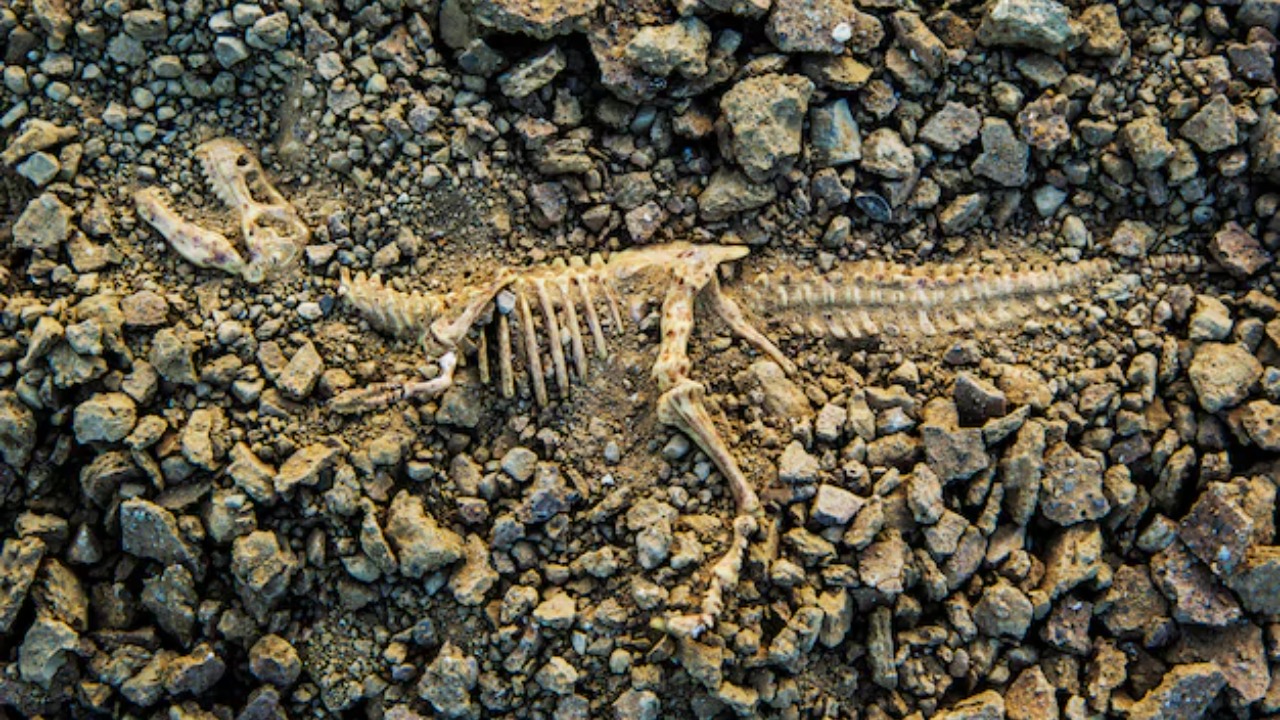

The discovery of a rare dinosaur “mummy” in the Badlands of North Dakota is now reshaping scientific life in Minnesota, where the fossil has arrived for intensive study. The specimen, an Edmontosaurus nicknamed “Medusa,” preserves large areas of skin and soft tissue, giving researchers in Winona an unprecedented window into the final days of the dinosaurs.
Although the animal was unearthed far from the Mississippi River bluffs, its journey to Winona State University has turned a regional field find into a statewide scientific event. I see the fossil’s move into a Minnesota lab as the moment this story shifts from a remarkable discovery in the field to a long‑term research project that could refine how we imagine dinosaur biology, behavior, and extinction.
From Badlands discovery to Minnesota showcase
The core of this story begins not in Minnesota but in the rugged Badlands, where a field team uncovered the fossilized remains of an Edmontosaurus with extensive skin still wrapped around its skeleton. The animal, later nicknamed Medusa, was entombed in rock with patches of preserved tissue and bones protruding from the surface, a combination that immediately suggested a rare “dinosaur mummy” rather than a typical skeleton. Reports describe Medusa as an Edmontosaurus fossil with skin tissue that was carefully excavated from the Badlands, a region long known for yielding Late Cretaceous fossils, before any decision was made about where it would ultimately be studied and displayed, and that origin in the Badlands of North Dakota is the factual starting point for the specimen’s journey, not Minnesota itself, which corrects the implication that the unearthing happened inside the state.
Only after the fieldwork wrapped up did Medusa’s story become a Minnesota story, as the fossil was transferred to Winona for research and public engagement. The move reflects a deliberate choice to place the specimen in a setting where students, faculty, and visiting scientists can work directly with the preserved skin and bones while the broader community gains access to a once‑in‑a‑generation fossil. In that sense, the Badlands provided the rock and the dinosaur, but Minnesota now provides the laboratory, the classrooms, and the steady stream of visitors who will encounter Medusa as more than a headline about a dinosaur mummy.
Why Medusa is being called a “dinosaur mummy”
Scientists and educators are using the phrase “dinosaur mummy” because Medusa preserves more than just a jumble of bones. The fossil includes large areas of skin that appear to drape over the skeleton, creating the impression of a body frozen in time rather than a disarticulated frame. In paleontology, that kind of preservation is extraordinarily rare, since soft tissues usually decay long before mineralization can lock them into stone. The description of Medusa as an Edmontosaurus fossil with skin tissue, with visible bones protruding from the rock, underscores why researchers are comfortable invoking the mummy analogy for this animal from the Badlands.
The term also signals the scientific potential of the find. Skin impressions and soft tissue remnants can reveal scale patterns, body contours, and even hints of musculature that standard skeletons cannot provide. For an herbivorous dinosaur like Edmontosaurus, that means new clues about how the animal moved, how thick its hide might have been, and how it interacted with its environment. By framing Medusa as a dinosaur mummy, researchers are not just branding the fossil for public interest, they are highlighting the unusual level of anatomical detail that could emerge from careful study of the preserved skin and surrounding rock matrix.
Winona State University steps into the spotlight
Once Medusa left the Badlands, Winona State University became the focal point for the fossil’s next chapter. The specimen is now set to be studied on campus, where faculty and students will work with the dinosaur mummy in a controlled laboratory environment. Coverage of the transfer notes that the fossil is being prepared for research and eventual display at Winona State University, with local reporting describing how the “dinosaur mummy” fossil is slated to become a centerpiece for both scientific work and public outreach in Winona. That shift from field site to university lab is what turns a remote discovery into a sustained Minnesota‑based research program.
The university’s role is not limited to housing the fossil in a back room. Plans call for Medusa to be integrated into teaching, with students gaining hands‑on experience in fossil preparation, documentation, and analysis. Reports explain that the dinosaur mummy is expected to be installed inside a campus facility once preparation work allows, giving visitors a chance to see the Edmontosaurus up close while researchers continue to study it. By anchoring Medusa at Winona State University, the project effectively turns a regional public institution into a hub for cutting‑edge dinosaur research that would typically be associated with much larger museums or research centers.
A rare fossil arrives in Winona
The arrival of Medusa in Winona marked a turning point in how the fossil is perceived, both locally and within the broader scientific community. When the specimen reached campus, it was described as a rare dinosaur mummy fossil arriving at Winona State University for study, with coverage emphasizing that the fossil had traveled from one of the most prolific fossil‑producing regions in the Badlands to a Midwestern university town. That framing underscores how unusual it is for a campus like Winona’s to receive a specimen of this caliber, especially one that preserves skin and soft tissue in addition to bone.
Local reporting also highlighted the institutional context around the fossil’s debut. The coverage, which carried a clear COPYRIGHT notice and described the fossil’s journey from the Badlands, stressed that Medusa’s presence in Winona reflects years of field experience and collaboration rather than a one‑off stroke of luck. By the time the crate was opened on campus, the Edmontosaurus had already become a symbol of how regional universities can participate directly in high‑impact paleontological research, not just consume it from afar.
The field team behind the Badlands discovery
Behind Medusa’s journey from the Badlands to Minnesota is a field crew rooted in Winona State University itself. A team of faculty and alumni from the university is credited with discovering a massive 66‑million‑year‑old fossil of an Edmontosauru in the Badlands of North Dakota, a detail that underscores how closely the find is tied to the institution now housing it. That 66‑million‑year figure situates the animal at the very end of the Cretaceous period, just before the mass extinction that wiped out non‑avian dinosaurs, which makes the fossil particularly valuable for understanding life on the brink of that global catastrophe.
The fact that the discovery was made by a team linked directly to Winona State University also helps explain why the fossil ultimately came to Minnesota rather than to a larger coastal museum. The field crew’s connection to the campus created a natural pipeline from the Badlands excavation site to the university’s labs and teaching spaces. A video report describes how a team of Winona State University faculty and alumni discovered the massive 66‑million‑year Edmontosauru fossil in North Dakota and then arranged for its transport to Winona, reinforcing that the same people who dug Medusa out of the ground are now helping to study and interpret it for students and the public.
“Once‑in‑a‑lifetime” science for WSU students
For students at WSU, Medusa is more than a museum‑grade specimen, it is a once‑in‑a‑lifetime training opportunity. Local coverage describes the fossil’s arrival as a “once‑in‑a‑lifetime” find that has now reached WSU, with the Edmontosaurus’ skin and bones providing a tangible link between classroom theory and real‑world research. That language reflects how unusual it is for undergraduates to work directly with a dinosaur mummy, rather than viewing such fossils behind glass in distant institutions.
Faculty members have emphasized that the Edmontosaurus will be used to spark interest in science and to give students practical experience in paleontology, geology, and related fields. One report notes that the Edmontosaurus’ skin and bones are expected to inspire students to become more interested and to pursue science, a goal that aligns with the broader mission of a regional public university. By framing Medusa as a teaching tool as well as a research specimen, WSU is positioning the fossil as a catalyst for student engagement rather than a static display, and the description of the dinosaur hunter’s “once‑in‑a‑lifetime” find arriving at WSU captures that dual purpose clearly.
What makes Medusa scientifically important
From a scientific standpoint, Medusa stands out because it combines excellent skeletal preservation with extensive skin and soft tissue, all from a well‑dated moment near the end of the dinosaur era. The fossil is described as approximately 12 feet long and 7 feet wide, the preserved remains of an Edmontos that offers researchers a large surface area of skin to study. That size, combined with the 66‑million‑year age, gives scientists a rare chance to examine the external anatomy of a sizable herbivore that lived just before the asteroid impact that ended the Cretaceous.
Researchers are particularly interested in how Medusa can help them understand environmental change and extinction dynamics. Reports note that the fossil is expected to help scientists better understand environmental change today by providing a detailed snapshot of a species that lived through major climatic and ecological shifts before the final extinction event. The description of the specimen as approximately 12 feet long and 7 feet wide, preserved remains of an Edmontos that can be used to understand environmental change, highlights why the fossil is more than a curiosity. It is a data‑rich record of how a large animal’s body responded to the pressures of its time, and that record is now accessible to scientists working in Minnesota through coverage such as the Photo Courtesy report credited to KAALTV.
How the Badlands shaped Medusa’s preservation
The Badlands of North Dakota are central to understanding why Medusa is so well preserved, even if the fossil’s current home is in Minnesota. The region’s sedimentary rocks, carved into steep gullies and buttes, have long been recognized as one of the most prolific fossil‑producing regions for Late Cretaceous dinosaurs. Reports on Medusa’s journey emphasize that the fossil originated in the Badlands, where the combination of rapid burial, fine‑grained sediments, and relatively stable geologic conditions can sometimes preserve delicate features like skin and soft tissue that would normally decay.
In Medusa’s case, the Badlands setting appears to have created a natural tomb that shielded the Edmontosaurus from scavengers and weathering long enough for mineralization to capture the outlines of its skin and body. The description of the dinosaur as the fossil of an Edmontosaurus with skin tissue, discovered in the Badlands with bones protruding from the rock, underscores how the landscape itself contributed to the fossil’s unique state. By the time the field team from Winona State University arrived on site, the Badlands had already done much of the preservation work, leaving the scientists to carefully extract a specimen that had been locked in stone for roughly 66 million years, as described in the Medusa coverage.
Medusa’s journey from North Dakota to Winona
The logistics of moving a dinosaur mummy from the Badlands to Minnesota are almost as intricate as the excavation itself. Once the Edmontosaurus was identified and documented in the field, the team encased key portions of the fossil in protective jackets, stabilized the exposed skin and bones, and coordinated transport out of the remote North Dakota site. A video report explains that a team of Winona State University faculty and alumni discovered the massive 66‑million‑year Edmontosauru fossil in North Dakota and then oversaw its transfer to Winona, highlighting how the same group that uncovered Medusa also managed the delicate process of getting it safely to campus.
That journey underscores the cross‑state nature of the project. The fossil’s scientific story begins in North Dakota, where the Badlands preserved the dinosaur for tens of millions of years, but its research and educational story now unfolds in Minnesota, where students and faculty can study the specimen in detail. The description of the team’s work in North Dakota, shared through a NorthDakota‑tagged video, makes clear that Medusa’s origin lies across the state line, even as its future is now firmly tied to Winona’s labs and galleries.
What comes next for Medusa in Minnesota
With Medusa now in Winona, the focus shifts from excavation and transport to preparation, analysis, and public engagement. Technicians and students will spend months, and likely years, carefully removing rock from around the skin and bones, documenting every new detail that emerges. The fossil is expected to be installed inside a campus facility once enough preparation has been completed, allowing visitors to see the dinosaur mummy while research continues behind the scenes. Reports describing how the “dinosaur mummy” fossil is set to be studied at Winona State University explain that the specimen will serve both as a research subject and as a public exhibit, a dual role that will keep Medusa in the spotlight for years to come.
For Minnesota, that means the state has become a key node in the global effort to understand how dinosaurs lived and died at the end of the Cretaceous. The Edmontosaurus from the Badlands will inform studies of dinosaur skin, growth, and environmental adaptation, while also drawing school groups, families, and visiting scholars to Winona. Coverage of the fossil’s future notes that the dinosaur mummy could be installed inside a campus space where the public can view it, a plan that reflects the broader goal of turning Medusa into a bridge between cutting‑edge science and community curiosity, as described in the report on the Dinosaur mummy Edmontosaurus at Winona State University.
More from MorningOverview