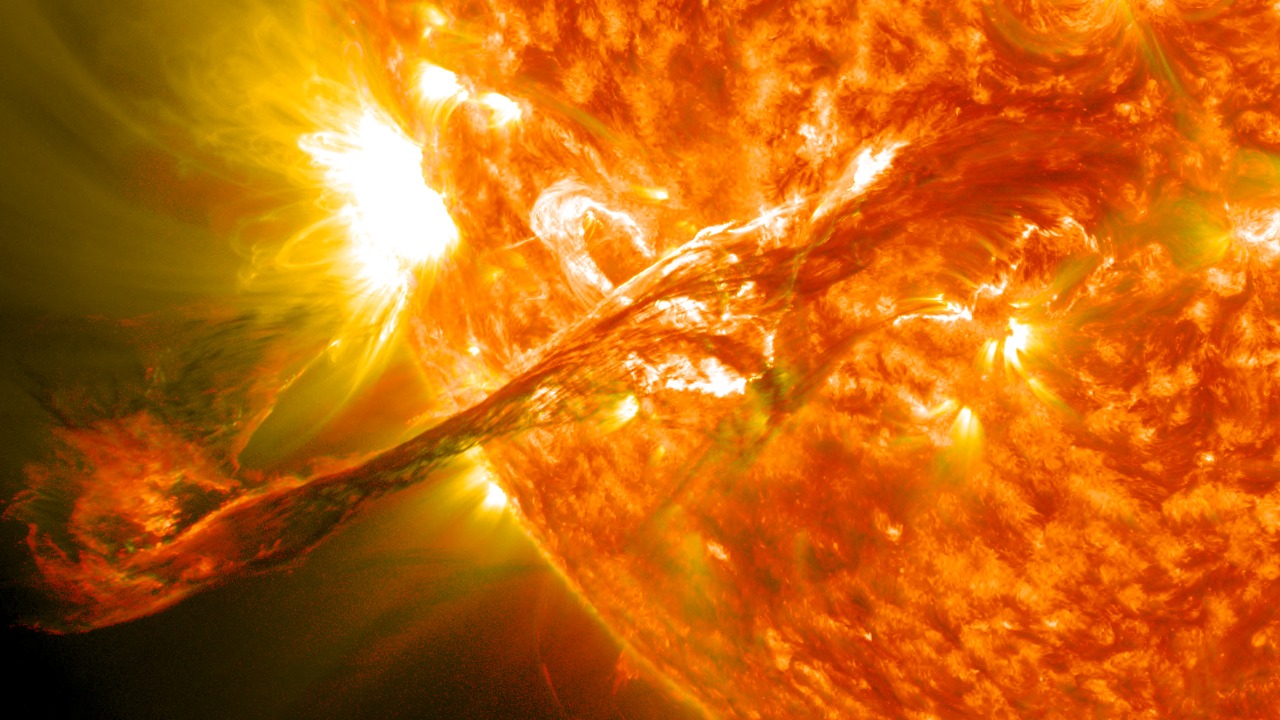

The Sun has just delivered one of its most forceful reminders that space weather is not an abstract concept but a real-world disruptor. An intense X-class solar flare blasted the dayside of Earth, plunging large swaths of high-frequency radio communications across Australia into sudden silence and rattling aviation, maritime and emergency networks that depend on clear signals. The eruption arrived without the drama of visible fire in the sky, yet for pilots, radio operators and forecasters, it was as jarring as a power outage in the middle of a live broadcast.
What unfolded over Australia was a textbook example of how a burst of energy from the Sun can ripple through modern infrastructure in minutes, even when no one on the ground can see it. As the flare’s radiation slammed into the upper atmosphere, it scrambled the ionized layers that carry radio waves, leaving operators to ride out a blackout that underscored how tightly our technology is tied to the moods of our star.
How the X-class flare hit Australia’s airwaves
The latest eruption was classified as an X-class flare, the most powerful category in the standard scale, and it arrived with enough intensity to trigger strong radio blackouts across the Australian continent. As the burst of X-ray and extreme ultraviolet radiation reached Earth at the speed of light, it rapidly altered the ionosphere above the sunlit side of the planet, degrading and in some cases completely cutting high-frequency links that aviation and maritime operators rely on for long-distance communication. For crews flying over or approaching Australia, the disruption was not theoretical, it was a sudden loss of clarity in the cockpit.
Observers tracking the event watched the Sun hurl out what was measured as an X1.1 class flare, a level that sits comfortably in the “major” category and is well known for causing radio blackouts on the dayside of Earth. The disturbance over Australia fit that pattern, with the strongest impacts concentrated where the Sun was high in the sky and the ionosphere most energized. Space weather monitors described the event as a strong radio blackout, consistent with the kind of X-class activity that has been building as the solar cycle approaches its peak, and the blackout reports from the region matched what forecasters expect when such a flare erupts directly facing Earth.
Inside the eruption: what made this flare so intense
To understand why this particular flare packed such a punch, it helps to look at how such eruptions form. Solar physicists describe flares like this as the result of twisted magnetic fields in the Sun’s atmosphere that suddenly snap and reconnect, releasing pent-up energy in a violent flash. In this case, the flare’s classification as an X1.1 event signals that the energy output was at the top of the standard scale, a level that can flood near-Earth space with radiation in minutes and drive the kind of ionospheric disturbance that knocked out radios over Australia. The flare’s intensity was not an outlier for an active Sun, but it was more than enough to overwhelm the delicate balance that keeps high-frequency signals bouncing cleanly around the globe.
Visuals of the eruption captured the moment the Sun’s bright active region unleashed the X-class burst, with instruments recording a sharp spike in X-ray output that marked the flare’s peak. Space weather analysts noted that the event was part of a broader pattern of heightened activity, with the Sun producing multiple strong flares as it moves through the most energetic phase of its roughly eleven year cycle. The combination of a direct line of sight to Earth and the flare’s X1.1 strength made this eruption particularly effective at disrupting communications, even though it did not produce the kind of spectacular auroral displays that often accompany other types of solar storms.
Flares, CMEs and what did – and did not – hit Earth
One of the first questions after any major flare is whether it launched a coronal mass ejection, or CME, in Earth’s direction. CMEs are huge clouds of solar plasma and magnetic field that can take days to arrive and can drive geomagnetic storms that affect power grids and satellites. In this case, early analysis indicated that while the flare was intense, the associated CME was not directed squarely at Earth, which significantly reduced the risk of a severe geomagnetic storm even as radio blackouts unfolded on the dayside. That distinction between immediate radiation effects and slower moving plasma impacts is central to how forecasters gauge the broader threat from a given eruption.
Space weather centers routinely track both flares and CMEs because they pose different kinds of hazards. During CMEs, solar material and magnetic fields erupt from the Sun and can buffet Earth’s magnetic shield, raising the risk to spacecraft and astronauts and potentially inducing currents in long power lines that can stress electrical infrastructure. The latest X-class event showed how a flare alone can be enough to disrupt communications, while the absence of a direct CME impact spared power systems the kind of geomagnetic storm that has prompted storm watches in other recent events. That split outcome is a reminder that not every dramatic flare translates into a full spectrum space weather crisis.
Why X-class flares are in a league of their own
Solar scientists classify flares into five main categories, labeled A, B, C, M and X, based on their X-ray brightness, with each step representing a tenfold increase in intensity. At the top of that ladder, X-class flares are at least ten times stronger than M-class events and can be more than one hundred times more intense than the modest C-class bursts that pepper the Sun’s surface on a typical day. The National Oceanic and Atmospheric Administration, often referred to as The National Oceanic and Atmospheric Administration and abbreviated as NOAA, uses this scale to communicate how much energy is involved and what kind of impacts might follow.
Within the X-class, the number that follows, such as X1.1, gives a more precise sense of strength, with higher numbers indicating even more powerful blasts. An X1.1 flare like the one that hit Australia sits at the lower end of the X range but still represents a major release of energy that can cause strong radio blackouts on the sunlit side of Earth. By contrast, an M5 flare is roughly ten times weaker, yet even that level has been linked to noticeable communication disruptions in past events. The scale is logarithmic, so each step up represents a significant jump in potential impact, which is why forecasters pay such close attention when an active region on the Sun starts producing X-class activity.
What NOAA’s forecasts say about the days ahead
While the immediate radio blackout over Australia unfolded in minutes, the broader space weather story plays out over days, and that is where official forecasts come in. NOAA’s Space Weather Prediction Center issues a rolling three day outlook that tracks the likelihood of additional flares, CMEs and geomagnetic storms, giving operators a crucial heads up when the Sun is in a volatile mood. The current 3 day forecast reflects elevated solar activity consistent with a Sun near the peak of its cycle, with forecasters watching for further X-class eruptions that could repeat or even exceed the impact seen over Australia.
Those forecasts are not just academic exercises, they feed directly into planning for airlines, satellite operators and grid managers who need to know when space weather might complicate their operations. Earlier this year, NOAA highlighted how strong geomagnetic storms can light up the Northern Lights, also called aurora borealis, far from their usual haunts, with displays reaching places like Johnston, Iowa, after a series of eruptions. In that context, the latest X-class flare is part of a broader pattern of heightened solar activity that could bring both more radio blackouts and more auroral shows in the months ahead, even when a specific CME is not aimed squarely at Earth.
From cockpit to coast: who felt the blackout in Australia
On the ground and in the air, the most immediate effects of the flare were felt by those who depend on high-frequency radio to bridge long distances. Long haul pilots flying routes that cross remote stretches of ocean near Australia rely on HF links to communicate with air traffic control when line of sight VHF coverage is not available, and those are precisely the frequencies that suffer when the ionosphere is flooded with X-ray and ultraviolet energy from a major flare. Maritime operators, from cargo ships to fishing vessels, also lean on HF for beyond horizon contact, and they too would have seen signals fade or vanish as the blackout peaked.
Emergency services and remote communities that still use HF as a backup or primary channel can also be caught in the crossfire when the Sun behaves badly. In parts of inland Australia where satellite coverage can be patchy and cellular networks thin, HF remains a lifeline, and a sudden loss of propagation can complicate everything from routine check ins to urgent calls for assistance. The blackout triggered by the X1.1 flare was temporary, lasting minutes to perhaps an hour at its worst, but it was a stark reminder that even short lived disruptions can have outsized consequences when they intersect with critical operations in sparsely connected regions.
How this flare fits into a year of solar surprises
The X-class blast that darkened radios over Australia did not arrive in isolation, it is part of a year marked by a string of powerful eruptions as the Sun ramps up toward solar maximum. Earlier in the season, another powerful X1 flare erupted and was notable enough that coverage highlighted how such events can knock out radio communications and raise concerns about additional impacts if a CME is involved. That earlier episode underscored that X-class activity is no longer a rarity in the current cycle, and each new flare adds to a growing dataset that helps scientists refine their understanding of how active regions evolve and how often they produce major outbursts.
In parallel, forecasters have been issuing geomagnetic storm watches when CMEs are expected to reach Earth, warning that such impacts can disturb the magnetosphere and drive auroras to lower latitudes. One recent watch followed a powerful solar flare that launched a CME, with experts explaining that during CMEs, solar material and magnetic fields erupt from the Sun and can pose a risk to spacecraft and astronauts as well as to ground based systems. Against that backdrop, the latest X1.1 flare stands out for its immediate communication impact rather than for any long duration geomagnetic storm, but it still fits the broader pattern of a restless star keeping space weather teams busy.
Lessons from past blackouts and what scientists watch for next
Space weather researchers have been here before, and they have learned to treat each major flare as both a hazard and a data point. When an M5 level flare earlier in the cycle caused unexpected radio blackouts, analysts dug into the details to understand why a mid range event produced outsized effects, and they pointed to the geometry of the eruption and the state of the ionosphere at the time. That experience sharpened the focus on how even modest flares can cause trouble under the right conditions, and it set the stage for a more nuanced reading of the latest X1.1 event over Australia, where the strength of the flare and the direct line of sight combined to produce a textbook blackout.
Scientists also pay close attention to whether a flare is accompanied by a CME, because that combination can turn a short lived radio disturbance into a multi day geomagnetic storm. In a notable case from earlier in the cycle, experts highlighted how they would continue to monitor if there was a coronal mass ejection, often shortened to CME, from a strong eruption, since such a large expulsion of plasma can have a different set of consequences than the flare itself. The same logic applies now, with teams scanning coronagraph images and solar wind data to confirm that the latest X-class blast did not send a significant CME directly toward Earth, even as they log the radio blackout as a clear example of flare driven disruption.
Why the Sun’s magnetic contortions matter for life on Earth
At the heart of every flare is a story about magnetic fields twisting, tangling and finally snapping in the Sun’s atmosphere. Solar flares like this erupt when the Sun’s twisted magnetic fields snap and release energy at the speed of light, a process that converts magnetic stress into radiation that races across space and slams into Earth’s upper atmosphere. That chain of events is invisible to the naked eye, yet it is the reason a storm on the Sun can silence radios, disturb satellite orbits and, in more extreme cases, threaten power grids and navigation systems that underpin daily life.
Images and videos of the latest eruption captured the drama of those magnetic contortions, with bright loops and flashes marking the moment when stored energy was unleashed. For scientists, each such event is a chance to test models of how magnetic fields evolve on the Sun and how those changes translate into space weather at Earth. For everyone else, the blackout over Australia is a reminder that our planet sits in the outer atmosphere of a variable star, and that the same processes that create beautiful auroras can, under the right conditions, disrupt the technologies that knit modern societies together.
Preparing for the next flare in an increasingly connected world
The X-class flare that disrupted communications over Australia will not be the last major eruption of this solar cycle, and the stakes are only growing as more systems depend on uninterrupted connectivity. Airlines are refining procedures for rerouting flights or switching to alternative communication channels when HF links fail, while satellite operators are hardening spacecraft against radiation spikes and planning for safe modes during severe storms. Grid managers are also paying closer attention to geomagnetic storm forecasts, knowing that a well aimed CME can induce currents in long transmission lines and transformers, even if the latest event spared them that particular test.
For the public, the most visible side of heightened solar activity may be the prospect of seeing auroras at lower latitudes, as happened when the Northern Lights illuminated skies as far south as Johnston, Iowa, after a strong storm earlier this year. Yet the less visible impacts, from radio blackouts to satellite navigation glitches, are just as important to track. As I look at the pattern of recent eruptions, including the X1.1 flare that darkened radios over Australia and earlier events that prompted strong geomagnetic storm forecasts, it is clear that living with a dynamic Sun means treating space weather as a core part of our risk landscape, not a niche curiosity reserved for astronomers.
How coverage and public awareness are evolving with the Sun
One striking feature of the latest flare is how quickly images, animations and expert commentary spread across platforms, turning a technical space weather event into a widely discussed moment. Detailed posts highlighted how the Solar flare erupted from a complex active region on the Sun, explaining in accessible language how twisted magnetic fields can snap and release energy that races outward at the speed of light. That kind of real time storytelling helps bridge the gap between specialized forecasts and the lived experience of a pilot hearing static on the radio or a ham operator watching signals fade.
At the same time, more traditional coverage has begun to weave space weather into broader narratives about infrastructure resilience and climate era risk. Reports on strong geomagnetic storm forecasts have emphasized not just the chance to see auroras but also the potential for impacts on satellites, power systems and communication networks. In that context, the X-class flare that sparked radio blackouts across Australia is part of a larger shift in how we talk about the Sun, moving from occasional curiosity to a regular character in stories about how a wired, wireless and increasingly space dependent civilization copes with the whims of its nearest star.
Why this blackout will not be the last – and what I will watch for
The blackout over Australia is already fading into the background noise of a busy solar cycle, but it leaves behind a set of questions that will shape how I follow the next round of eruptions. I will be watching how quickly operators adapt procedures when NOAA’s forecasts flag elevated flare risks, and whether airlines and maritime services treat such alerts as triggers for concrete steps rather than background information. I will also be paying attention to how often X-class flares arrive without Earth directed CMEs, as happened here, and how that pattern influences the balance of concern between short lived radio disruptions and longer duration geomagnetic storms.
Most of all, I will be looking at how public understanding of space weather evolves as events like this become more common in the news cycle. The combination of vivid imagery, clear explanations of processes like CMEs and flares, and concrete examples of impacts, from radio blackouts to auroral displays, has the potential to turn what once felt like distant astrophysics into a familiar part of the daily forecast. The Sun will continue to unleash powerful flares, some of them X-class, and as it does, the blackout that swept across Australia will stand as a vivid case study in how a burst of energy from 150 million kilometers away can, for a few tense minutes, quiet the airwaves over an entire continent.
To see how the Sun’s current activity compares with other recent eruptions that caused radio blackouts, I have also looked at coverage of earlier X-class events that knocked out communications and prompted questions about whether a CME was involved. One such report described how a powerful X1 flare erupted and raised concerns about additional impacts, noting that when you buy through links on some articles, Future and its syndication partners may earn a commission, a reminder that even space weather coverage sits within a broader media ecosystem. Another account emphasized how scientists will also continue to monitor if there was a CME from the eruption, underscoring that experts track both the immediate flare and any associated plasma cloud when assessing potential risks.
For readers interested in a closer look at the specific X1.1 flare that triggered the blackout over Australia, detailed coverage invites you to Watch the Sun hurl out the colossal eruption and traces how the resulting radiation stormed through the ionosphere. Additional reporting on strong geomagnetic storm forecasts has highlighted how, as recently as early Monday in one case, forecasters warned that the sunlit side of Earth could face radio disruptions as part of a broader pattern of heightened activity. Together, these accounts paint a picture of a Sun that is anything but quiet, and of a planet whose technological systems are learning, sometimes the hard way, to live with the consequences.
In some write ups of earlier flares, there is a reminder that when you buy through links on certain articles, Future and its syndication partners may earn a commission, a small disclosure tucked into coverage of a powerful X1 event that nonetheless underscores how commercial and scientific narratives often intersect. Other detailed explainers have walked through how Scientists will also continue to monitor if there was a CME from a given eruption, noting that such a large expulsion of plasma can have a different set of consequences than the flare itself. For a more visual take, one social media post framed the story under the banner Sun’s Intense X-class Solar Flare Erupts, Radio Blackouts, tying together the Solar physics, the behavior of the Sun and the very human experience of hearing nothing but static when a call matters most.
More from MorningOverview