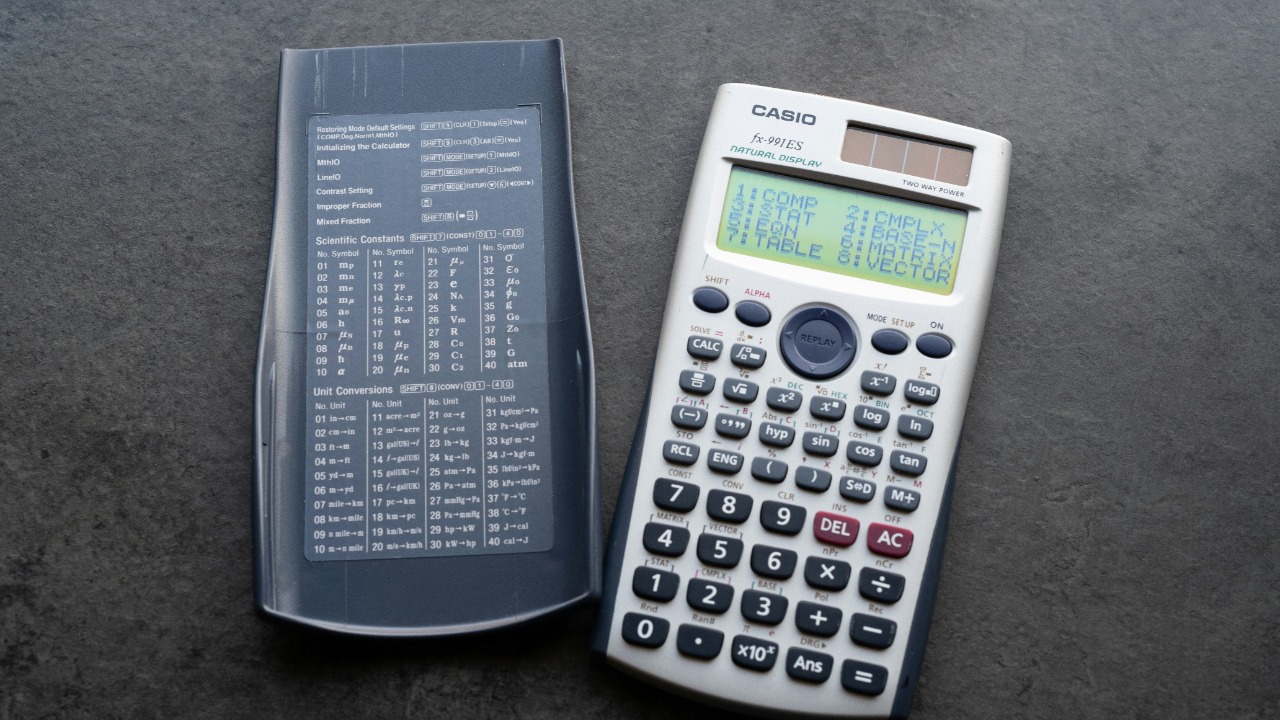

Casio is quietly thriving in a corner of consumer tech that was supposed to be obsolete. Even as artificial intelligence floods classrooms and offices, the company is still shipping tens of millions of dedicated calculators to students, teachers and professionals who want something simpler, stricter and more reliable than a smartphone app.
Far from being a nostalgic relic, the calculator has become a kind of counterweight to the chaos of modern computing, a single-purpose device that does one job well and, crucially, is still trusted by exam boards and institutions. That trust, combined with Casio’s global reach and focus on durability, helps explain why the red LED of the calculator display has not yet dimmed in the age of AI.
Casio’s calculator business is bigger than it looks
When people talk about consumer electronics, they tend to focus on smartphones, laptops or smartwatches, not the humble calculator. Yet Casio’s numbers show that this supposedly low-tech category is still a serious global business. In the year to March 2025, the company sold 39 m calculators, both general and scientific, across around 100 countries. For a product category that predates the internet, that scale is remarkable, and it undercuts the idea that calculators are a niche holdover from a pre-digital era.
Those figures also highlight how deeply calculators are embedded in everyday infrastructure. From school exam halls to factory floors and small retail counters, Casio’s devices are still part of the basic toolkit. The company’s ability to move tens of millions of units annually suggests not just lingering loyalty but a steady stream of new users, especially students entering secondary and higher education who are required to buy a specific model rather than rely on a phone or laptop.
Why AI has not killed the calculator
Artificial intelligence can solve equations, graph functions and even explain step-by-step reasoning, yet that power is exactly why it is unwelcome in most formal assessments. Exam regulators want tools that help with arithmetic and standard functions but cannot quietly connect to the internet or store unauthorized notes. That is where the calculator’s limitations become a strength, creating a controlled environment that AI-enabled devices cannot match.
Specific calculator models are often mandated in mathematics courses and standardized tests, and the rules are explicit about what is allowed. Specific devices are approved precisely because they are powerful enough for coursework but constrained enough that they cannot be used for illegal assistance in exams. Their design, from memory limits to connectivity restrictions, is shaped by that regulatory logic, which keeps AI-heavy smartphones and laptops firmly outside the exam hall.
Education keeps the calculator market alive
Classrooms remain the beating heart of the calculator economy. Schools and universities need a device that every student can afford, that teachers can standardize around and that exam boards can police. That combination of affordability, uniformity and control is difficult to replicate with laptops or tablets, especially in systems where not every family can provide a personal computer for each child.
Market analysts point out that the education sector is one of the primary consumers of desktop and handheld devices, and that this pattern is expected to continue. Calculators are still widely used in educational institutions for exams and classroom activities, not as a nostalgic choice but as a practical standard that keeps lessons and assessments aligned. As long as curricula and testing frameworks are built around these devices, demand for Casio’s core products will remain resilient.
Exam rules lock in demand, especially in Asia and Europe
Beyond individual schools, national and regional exam policies play a decisive role in keeping calculators relevant. High-stakes tests in mathematics, physics and engineering often specify exactly which functions are allowed, and they tend to favor standalone devices over multi-purpose gadgets. That regulatory detail translates directly into sales for manufacturers that can meet the approved specifications.
Research on the scientific calculator segment notes that Many high school and college exams, particularly in Asia and Europe, require scientific calculators that meet strict standards. By excluding smartphones and AI-enabled alternatives, this regulatory framework encourages continued use of dedicated devices and effectively guarantees a baseline of demand for brands like Casio that have long catered to exam boards.
Casio’s strategy: affordable, durable, single-purpose tools
Casio’s enduring success in calculators is not an accident, it is the result of a deliberate strategy to dominate the affordable end of the market with reliable, well-protected designs. While luxury watchmakers chase status and exclusivity, Casio has built its business on mass-market accessibility and robust intellectual property around low-cost electronics. That positioning has allowed the company to treat calculators as a volume game rather than a prestige product.
Analysts describe Casio, Dominating the Affordable Market Through Innovation and IP This as a stark contrast to Rolex and Cas, which occupy vastly different market positioning and target demographics. In calculators, that same philosophy translates into devices that are cheap enough for bulk school purchases yet sophisticated enough for advanced coursework, a balance that keeps Casio deeply embedded in education systems around the world.
Design that prioritizes clarity and toughness
In an era of glossy touchscreens, calculator design can look almost stubbornly utilitarian, but that is part of its appeal. Students and professionals want keys they can press without looking, displays they can read under fluorescent lights and devices that survive being tossed into a backpack. Casio leans into that brief, focusing on clarity and durability rather than flashy features that might complicate classroom use.
Product descriptions emphasize that users should Spend less time deciphering complicated button layouts and more time on the task at hand, with layouts that are intuitive even under exam pressure. Devices are Built to withstand the rigors of daily use, with robust construction that ensures long-lasting performance. That focus on physical resilience and ergonomic simplicity is a quiet but powerful differentiator in a world where most gadgets feel fragile and overcomplicated.
Scientific calculators as everyday workhorses
For many students, the first serious piece of personal tech they own is not a laptop but a scientific calculator. These devices sit at the intersection of affordability and capability, handling trigonometry, logarithms and statistical functions without the distractions of a full computer. They are also small enough to live on a desk or in a pencil case, which makes them a constant companion through years of schooling.
Retailers highlight that Casio provides high-performing scientific calculators that are ideal for students and professionals alike, with large display screens and designs that prioritize convenience. That combination of performance and ease of use turns the calculator into a daily workhorse, not just a tool pulled out for exams, and it reinforces habits that keep users loyal to the format even as AI-powered apps proliferate.
Why institutions still prefer buttons over apps
Institutions have their own reasons for clinging to physical calculators. Standardizing on a handful of approved models makes it easier to train teachers, write exam questions and enforce rules. It also reduces the risk of technical glitches that could derail a test, since a battery-powered calculator is far less likely to crash or lose connectivity than a tablet or laptop.
That institutional conservatism is not just inertia, it is a risk calculation. When a national exam depends on millions of students solving problems under identical conditions, the simplicity of a calculator becomes a feature, not a bug. Regulators know that a device with no operating system updates, no background apps and no network access is far easier to supervise than a smartphone running AI tools, and that logic keeps Casio’s core products firmly in the official toolkit.
The calculator’s future in an AI-saturated world
Looking ahead, the calculator is unlikely to compete with AI on raw intelligence, and it does not need to. Its value lies in being a trusted, bounded environment where students can demonstrate what they know without algorithmic help. As AI becomes more pervasive, that kind of controlled space may become even more important, not less, for both education and professional certification.
Casio’s challenge will be to keep refining its devices without crossing the line that exam boards draw around connectivity and programmability. Incremental improvements in display quality, energy efficiency and ergonomics are all compatible with strict rules, while any move toward networked or AI-enhanced calculators would risk regulatory pushback. For now, the company’s steady sales and deep integration into school systems suggest that the simple, single-purpose calculator still has a long life ahead, even as the rest of our devices grow smarter and more complicated.
More from MorningOverview