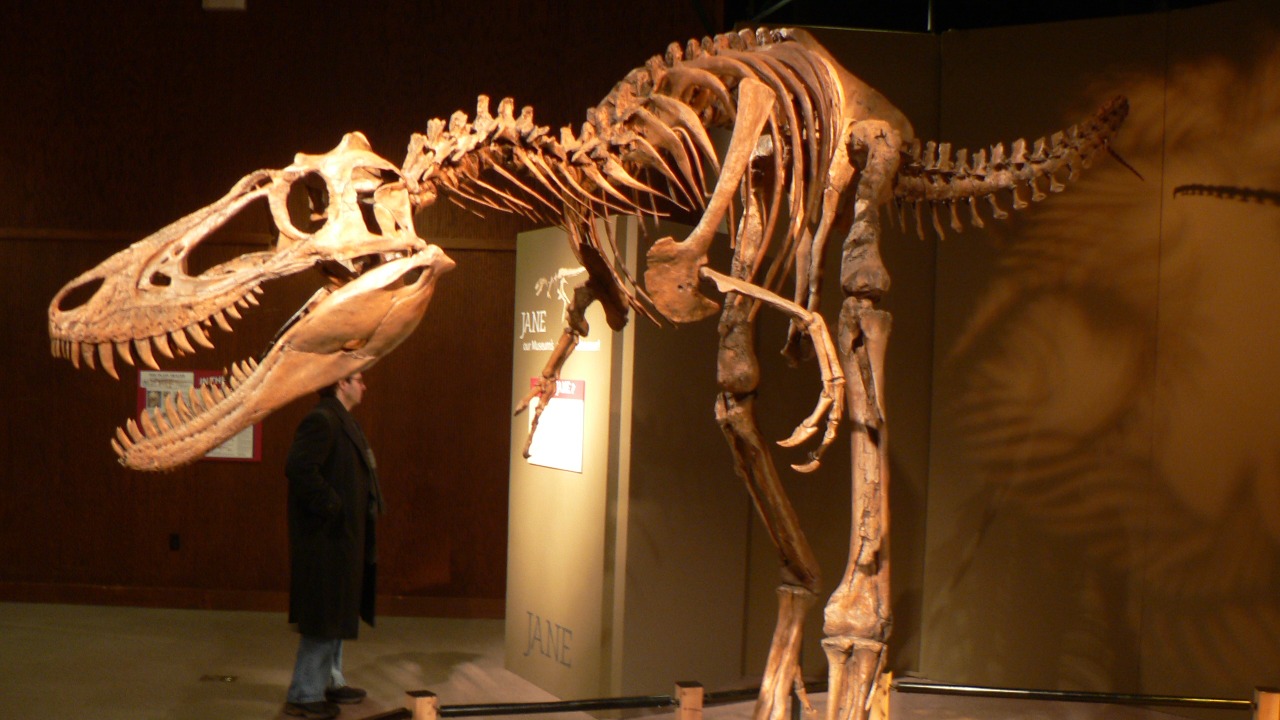

For decades, a small tyrannosaur skull has divided paleontologists over whether it belonged to a separate species or a teenage Tyrannosaurus rex. New research anchored in the spectacular “Dueling Dinosaurs” fossil now closes that argument, showing that Nanotyrannus was a fully grown predator in its own right rather than a baby T. rex. The finding does more than tidy up a taxonomic dispute, it forces a rethink of how the Late Cretaceous food web worked and how fast the tyrant kings grew up.
The new work combines painstaking bone histology, a rare death‑pose fossil and a sweeping comparison of tyrannosaur skeletons to demonstrate that the animal long labeled a “mini T. rex” had already reached adulthood. By confirming that Nanotyrannus was mature when it died, the studies strip away the last major support for the juvenile hypothesis and elevate this lean, long‑legged hunter to full species status alongside Tyrannosaurus.
The fossil that finally broke the stalemate
The turning point in the Nanotyrannus debate is a single, extraordinary specimen: the intertwined remains of a tyrannosaur and a horned dinosaur locked together in what looks like a final struggle. Known as the Dueling Dinosaurs, the fossil preserves a Triceratops and a smaller tyrannosaur in exquisite detail, from skull bones to delicate throat structures. For years, that tyrannosaur was cataloged as a young T. rex, a convenient fit for the idea that all small tyrannosaurids from this time and place were simply kids on their way to becoming giants.
When researchers finally cut into the bones, however, the growth story written in the microscopic structure told a different tale. The tyrannosaur’s skeleton showed growth rings that had slowed and then plateaued, indicating that the animal had effectively STOPPED growing by the time it died. That pattern is what paleontologists expect in adults, not in teenagers still racing toward the massive size of Tyrannosaurus. Once the growth curve was clear, the “teen rex” label could no longer be squared with the evidence.
From “teen rex” to independent predator
For more than thirty years, the default explanation for small, slender tyrannosaur fossils from the Hell Creek region was that they represented immature Tyrannosaurus. That view leaned heavily on the idea that tyrannosaurs passed through a long‑legged, lightly built phase before bulking up into bone‑crushing adults. The new analyses flip that logic, showing that the Dueling Dinosaurs tyrannosaur had already reached skeletal maturity while still retaining a gracile frame, a key sign that it was not on a trajectory toward T. rex proportions but belonged to a different species altogether.
Researchers at the North Carolina Museum of Natural Sciences describe how they examined over 200 tyrannosaur fossils to place the Dueling Dinosaurs animal in context, a scale of comparison that allowed them to separate true juveniles from small‑bodied adults. In that broader dataset, the bones of the Dueling Dinosaurs tyrannosaur consistently matched the adult end of the spectrum for its size, reinforcing the conclusion that it was an independent predator rather than a waystation on the road to Tyrannosaurus. The museum has since framed the find as Nanotyrannus confirmed, a concise verdict on a long‑running argument.
How Zanno and Napoli dismantled the juvenile hypothesis
The shift from suspicion to certainty did not rest on a single spectacular fossil alone. Paleontologists Oct, Zanno and Napoli built their case by combining the Dueling Dinosaurs specimen with a systematic survey of tyrannosaur material from across the Late Cretaceous. They scrutinized limb proportions, skull shapes and bone microstructure, looking for consistent patterns that would either tie the small animals to Tyrannosaurus growth stages or separate them into their own lineage. The result was a suite of anatomical traits that clustered together in the small‑bodied form and did not blend smoothly into known T. rex juveniles.
In their work, Zanno and Napoli emphasized that They had examined over 200 tyrannosaur fossils to test whether Nanotyrannus really fit inside the growth curve of Tyrannosaurus. The more specimens they added, the clearer the separation became, with Nanotyrannus showing a consistently narrower snout, longer lower legs and a different pattern of bone thickening. Those differences, combined with the adult growth signal in the Dueling Dinosaurs individual, undercut the idea that the animal was simply a lanky adolescent on its way to becoming a bulked‑up T. rex.
A “short tyrant king” returns to the family tree
While the North Carolina team was building the growth and anatomy case, another group was re‑evaluating classic Nanotyrannus material and fresh specimens from museum collections. Their work framed the animal as a compact counterpart to Tyrannosaurus, a “short tyrant king” that occupied a different ecological niche. By tracking how tyrannosaur bones change from hatchling to adult, they showed that the supposed Nanotyrannus traits do not match any known juvenile stage of T. rex, but instead remain stable across multiple small‑bodied individuals.
That argument is laid out in detail in a study highlighted as the Return of the Short tyrant, which presents Nanotyrannus as a distinct species rather than a wayward teenager. A companion release describes how this New Paper by a Dinosaur Institute Researcher Shows Nanotyrannus Was Not a juvenile T. rex, and uses that conclusion to refine estimates of how quickly Tyrannosaurus itself reached its enormous size. If Nanotyrannus is removed from the T. rex growth series, then the growth curve for the true tyrant king becomes steeper, with fewer medium‑sized stages than previously thought.
Bone histology and the tiny throat clue
One of the most persuasive lines of evidence for Nanotyrannus as a separate species comes from bone histology, the microscopic study of how bone tissue grows and remodels over an animal’s life. In the Dueling Dinosaurs tyrannosaur, growth rings in the limb bones show a clear slowdown and eventual plateau, a pattern that matches other adult dinosaurs rather than juveniles. That same adult‑style signature appears in additional small tyrannosaur specimens that share Nanotyrannus‑like proportions, strengthening the case that these animals had finished growing while still relatively small.
Researchers also seized on a delicate anatomical feature that almost never survives fossilization: a tiny throat bone that helps support the tongue and larynx. In one key specimen, this structure preserved enough detail to be compared directly with both known Tyrannosaurus material and the Dueling Dinosaurs tyrannosaur. The throat element showed a distinctive shape that did not match the expected juvenile T. rex pattern, instead lining up with the proportions of the small‑bodied adult. That discovery is summarized in a report titled Tiny Throat Bone Confirms Nanotyrannus as its Own Species, Adding Another Predator to the Late Cretaceous, and it underscores how even the smallest bones can tip a major scientific debate.
Rewriting the Late Cretaceous food web
Once Nanotyrannus is recognized as an adult predator, the Late Cretaceous landscape looks more crowded and complex. Instead of a single tyrannosaur species dominating every large carnivore niche, the Hell Creek ecosystem appears to have hosted both the massive Tyrannosaurus and a smaller, faster hunter. The new work describes Nanotyrannus as a more gracile animal that likely relied on speed and agility, a contrast to the bone‑crushing bite and heavy build of T. rex. That division of labor suggests that the two predators could have coexisted without directly competing for the same prey most of the time.
One synthesis of the new findings puts it bluntly, noting that what were once thought to be “baby rexes” were actually adult hunters with their own distinct skull shapes and limb proportions, traits that define a distinct species. That perspective is captured in a feature titled Nanotyrannus Returns, which emphasizes that the recognition of a second tyrannosaur predator forces paleontologists to redraw predator‑prey diagrams for the Hell Creek ecosystem. With Nanotyrannus added to the roster, smaller and more agile herbivores may have faced a different kind of threat than the one posed by the lumbering Tyrannosaurus.
Why growth series and museum collections mattered
Part of what kept the Nanotyrannus debate alive for so long was the genuine difficulty of telling young and adult dinosaurs apart, especially in species that grew quickly. Earlier work on tyrannosaurs had shown that juveniles could look dramatically different from adults, with longer legs, narrower skulls and lighter builds. Exhibits that trace the growth of giant dinosaurs, including displays in Share installations in Los Angeles, have helped the public see how extreme those transformations can be. That background made it plausible that a small tyrannosaur might simply be a teenager, even if it looked quite different from the adult form.
The new Nanotyrannus work shows the value of building complete growth series from hatchling to adult and of revisiting old specimens with fresh techniques. By slicing bones for histology and comparing dozens of skeletons across sizes, researchers could separate traits that change with age from those that remain stable and therefore signal species identity. Museum collections were crucial in this process, providing the raw material for studies like the Teen rex no more analysis, which agrees that Nanotyrannus is a distinct species of its own and not just a growth stage of Tyrannosaurus.
Multiple teams, one converging conclusion
What makes the new consensus on Nanotyrannus compelling is that it does not rest on a single lab or method. Independent groups working with different fossils and approaches have arrived at the same answer, that the small tyrannosaur is a separate species. One line of work, highlighted in a feature on Paleontology Plot Twist, describes how New Research Shows Nanotyrannus Is Separate Species, Not a Juvenile T. rex, and stresses that Nanotyrannus was a smaller, longer‑legged predator that hunted alongside Tyrannosaurus rather than growing into it.
Another thread comes from social media announcements tied to peer‑reviewed papers, such as a post celebrating the Return of the Short Tyrant King, which summarizes key findings of Napoli and Zanno’s work and notes that Nanotyrannus is now recognized as a unique, coexisting genus. Together with the Dueling Dinosaurs analyses and the throat bone study, these efforts converge on the same picture: a lean tyrant that shared the stage with T. rex rather than foreshadowing it.
How the “mini T. rex” myth took hold
To understand why the Nanotyrannus debate was so persistent, it helps to look back at how the “mini T. rex” narrative formed. Early on, paleontologists had only a handful of small tyrannosaur skulls and partial skeletons from the right time and place to be Tyrannosaurus. With limited comparative material, it was reasonable to slot those specimens into the juvenile category, especially given what was known about rapid dinosaur growth. The label stuck, and for years museum displays and popular books described these fossils as snapshots of T. rex in its teenage years.
Recent coverage has unpacked how that story unraveled once the Dueling Dinosaurs specimen and broader comparative work came into play. One analysis framed the shift under the banner of Dueling Dinosaurs Fossil Solves the Mystery of a Mini tyrannosaur, explaining that the specimen showed a predator that hunted alongside Tyrannosaurus rather than growing into it. Another synthesis, introduced with the phrase As Scientific American highlighted in its Nanotyrannus coverage, notes that many fossils previously used to chart the growth of T. rex actually belong to Nanotyrannus, which in turn reshapes how scientists reconstruct the Hell Creek ecosystem.
What this means for T. rex and future research
Recognizing Nanotyrannus as an adult species has immediate consequences for how paleontologists interpret Tyrannosaurus itself. Growth curves that once included small, slender specimens now need to be redrawn using only confirmed T. rex material, which tends to be bulkier even at relatively young ages. That revision suggests that Tyrannosaurus may have spent less time as a mid‑sized predator than previously thought, growing more rapidly into its top‑tier role. It also means that some classic “teen rex” skeletons in museum halls will likely be relabeled, a visible sign of how quickly science can change long‑standing stories.
The new consensus also opens fresh lines of inquiry. With Nanotyrannus established as a separate predator, researchers can start asking detailed questions about its hunting style, social behavior and geographic range, rather than treating it as a developmental phase. I expect future work to focus on bite‑mark patterns, limb biomechanics and isotopic studies that could reveal whether Nanotyrannus targeted different prey or habitats than Tyrannosaurus. As Scientists involved in the Fossil Solves One of Paleontology Biggest Debates project have noted, the Dueling Dinosaurs material will keep yielding insights for years, and Nanotyrannus is likely only the first of several long‑standing puzzles it helps resolve.
More from MorningOverview