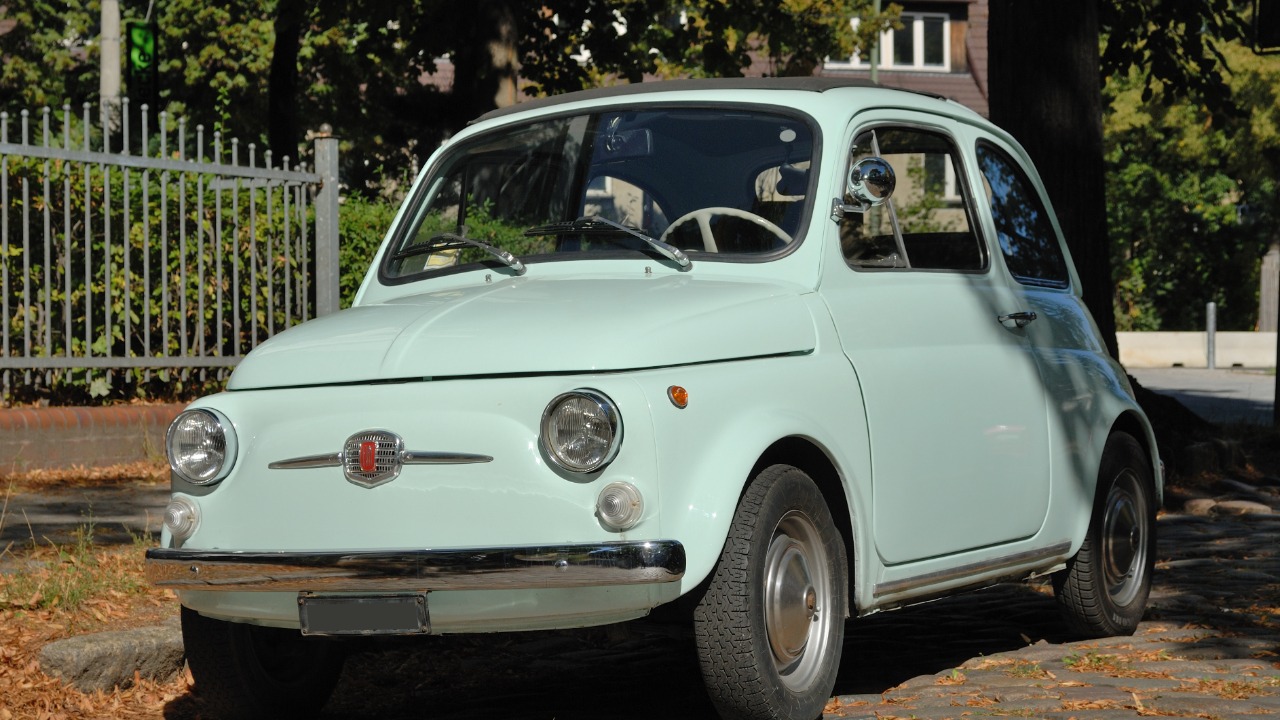

Stellantis is about to test how much American drivers have really changed by bringing a tiny electric city car to a market built around full-size pickups and three-row SUVs. The company is preparing to launch the Fiat Topolino in the United States, only days after President Donald Trump publicly praised small “tiny cars” and said he had approved them for production in the country.
I see the move as more than a quirky product announcement. It is a revealing collision of politics, regulation and shifting consumer tastes, with Stellantis betting that a micro-sized electric vehicle can carve out a niche in a landscape still dominated by Jeep and Ram.
The tiny Topolino and Stellantis’s big U.S. bet
Stellantis is positioning the Fiat Topolino as a micro electric vehicle tailored for dense cities and short trips, not as a direct rival to mainstream sedans or crossovers. The company has said it will begin selling this micro-EV in the United States in 2026, signaling that it sees room in the market for a radically smaller, slower and cheaper form of electric mobility alongside its existing Jeep and Ram lineups. The Topolino is already available in Europe, and Stellantis is effectively importing that concept into a country where the average new vehicle is closer to a rolling living room than a compact runabout.
In its U.S. rollout plan, Stellantis has described the Topolino as a limited-speed urban vehicle, with the American launch expected to follow the pattern of the European version that is capped at neighborhood-friendly speeds and optimized for short-range commuting. The company’s parent role and timing are clear in its own description of a tiny electric Fiat Topolino that Fiat’s parent company Stellantis plans to sell in the U.S. in 2026, and in a related summary that frames the car as a US micro-EV with a limited-speed rollout.
From “cute” curiosity to U.S. product strategy
What Stellantis is really selling with the Topolino is not just efficiency but charm. The design leans into a deliberately playful, almost toy-like aesthetic that stands in sharp contrast to the aggressive styling of many American trucks and SUVs. That visual dissonance is part of the strategy: a way to make a radically small vehicle feel like a lifestyle accessory rather than a compromise, and to appeal to drivers who might never have considered a microcar if it looked purely utilitarian.
That positioning is reflected in coverage that describes the Topolino as “adorable,” “small” and likely “inexpensive,” emphasizing that it is coming to U.S. roads as a “cute, tiny” option rather than a stripped-down econobox. The same reporting notes that its compact footprint is especially suited to locations with limited access roads, which hints at a target market of crowded urban neighborhoods, resort communities and college towns where parking is scarce and speed limits are low.
Trump’s praise and the politics of “tiny cars”
The timing of Stellantis’s move has drawn attention because it follows a very public endorsement of small vehicles from President Donald Trump. During a White House appearance, Trump praised Japan’s small “Kei” cars, describing them as “really cute” and highlighting their efficiency and compact size. He framed these vehicles as a model for what could be built in the United States, signaling political support for automakers that want to experiment with smaller formats after years of policy focus on larger, heavier vehicles.
Trump’s comments were not abstract musings. He explicitly said he had approved “tiny cars” for U.S. production, likening one such vehicle to how the Beetle used to be with the Volkswagen and stressing that “they’re really cute” as he talked about Japan’s Kei segment during a White House discussion of Kei cars. That kind of presidential endorsement does not rewrite safety or emissions rules on its own, but it does send a clear signal that the political climate is more open to micro-sized vehicles than it has been in years.
Stellantis moves “after Trump said he was a fan”
Stellantis’s decision to bring the Topolino to the United States landed almost immediately after Trump’s remarks, which has fueled the perception that the company is responding directly to the president’s enthusiasm. The automaker, which owns Jeep and Ram, is now preparing to sell one of the smallest vehicles on the market in the same country where it has long made its money on some of the largest. That juxtaposition underscores how quickly corporate strategy can pivot when political winds and regulatory expectations shift.
Reporting on the announcement has explicitly linked the timing to Trump’s comments, noting that Jeep and Ram owner Stellantis is bringing tiny cars to the U.S. after Trump said he was a fan of such vehicles. Those accounts point out that the Topolino is already available throughout Europe and that Stellantis is now planning to have the Topolino coming to the US, effectively importing a European quadricycle concept into a market where Kei-style cars have never taken off.
What the Topolino actually is: a quadricycle, not a car
Part of the confusion around the Topolino comes from calling it a “car” when, in regulatory terms, it is something else. Stellantis itself has described the tiny Topolino as an all-electric quadricycle, a category that in Europe sits below conventional passenger cars in size, speed and crash requirements. That classification helps explain why the vehicle can be so small and light, and why its performance figures look modest compared with even the most basic subcompact sold in the United States.
In practice, that means the Topolino is designed for short urban hops rather than highway cruising, and it is likely to be restricted to lower-speed roads in the U.S. as well. The quadricycle label is not just a technicality; it shapes everything from how the vehicle is insured to where it can legally operate. Stellantis has leaned into that distinction by emphasizing that the tiny Topolino is actually not a car but is categorized as an all-electric quadricycle, and by signaling that it will share more details and updates as the U.S. debut approaches.
Speed, range and the 28 MPH question
For American drivers used to highway speeds, the Topolino’s performance numbers will be jarring. The U.S. version is expected to have a top speed of about 28 miles per hour, which firmly places it in the neighborhood electric vehicle category rather than the mainstream passenger car segment. That limited speed is not a bug but a feature, allowing Stellantis to keep the vehicle light, inexpensive and compliant with a different set of rules than full-speed EVs, while targeting short urban commutes, campus travel and resort-town errands.
Fiat USA has framed the product accordingly, presenting it as a tiny EV with a 28 MPH top speed and a roughly 150 mile range that is meant for city streets, not interstates. The company’s own description of the launch notes that Fiat Will Sell Tiny EV in the U.S. With a 28 MPH Top Speed, underscoring that the Topolino’s appeal will hinge on whether Americans can accept a vehicle that is intentionally slow in exchange for simplicity and efficiency.
Fiat leadership and the global Topolino play
Inside Stellantis, the Topolino is not a side project but a strategic experiment championed by Fiat’s leadership. Fiat CEO Olivier François has been a visible advocate for the car, presenting it as a way to extend the brand’s urban-friendly identity into the electric era. By backing a micro-EV that is closer in spirit to a scooter with doors than to a traditional hatchback, François is betting that Fiat can differentiate itself within the Stellantis portfolio and attract younger, city-based buyers who might otherwise skip car ownership entirely.
The company has been explicit that Stellantis will sell the tiny electric Fiat Topolino city car in the U.S., and that Fiat CEO Olivier François is the executive fronting that push. In outlining the plan, Stellantis has said that Stellantis has announced it will sell the tiny electric Fiat Topolino city car in the U.S. and that Fiat CEO Olivier François is leading the effort to sell the Topolino here, reinforcing that this is a top-level brand decision rather than a tentative pilot.
Japan’s Kei cars and the policy backdrop
Trump’s praise for tiny cars did not emerge in a vacuum. He was explicitly referencing Japan’s Kei segment, a long-standing category of small, tax-advantaged vehicles that have become a fixture of Japanese streets. Kei cars are defined by strict limits on size and engine displacement, and they have historically been rewarded with lower taxes and insurance costs, which helped them grow from a niche into a major share of the Japanese market. By invoking Kei cars, Trump was effectively pointing to a foreign policy model that uses regulation and incentives to push the market toward smaller, more efficient vehicles.
The Stellantis announcement followed shortly after Trump’s comments about Kei cars during a White House meeting with Japanese officials, where he praised Japan’s small vehicles and linked them to potential U.S. production. Reporting on the Topolino launch has noted that this news follows shortly after President Donald Trump praised Japan’s small Kei cars during a White House discussion, underscoring how closely the political and corporate timelines have aligned.
Can a micro-EV crack America’s big-car culture?
The open question is whether a vehicle like the Topolino can find more than a novelty niche in a country where full-size pickups routinely top the sales charts. On one hand, urban congestion, rising insurance costs and the spread of low-speed zones create natural habitats for micro-EVs. On the other, American buyers have historically equated size with safety and status, and even many EV shoppers have gravitated toward larger crossovers rather than downsizing. The Topolino will test whether a combination of cuteness, low operating costs and political tailwinds can overcome those ingrained preferences.
Stellantis appears to be hedging its bets by framing the Topolino as a complement to, not a replacement for, its core U.S. products. The company continues to lean heavily on Jeep and Ram for profits, even as it experiments with a tiny Fiat-branded quadricycle at the opposite end of the spectrum. In that sense, the Topolino’s U.S. debut is less a wholesale pivot than a live experiment in whether American drivers are ready to embrace a vehicle that looks more like a European city pod than a traditional car, a move that began when Stellantis first confirmed it would begin selling a micro-EV in the U.S. in 2026 and has now been amplified by Trump’s very public enthusiasm for tiny cars.
More from MorningOverview