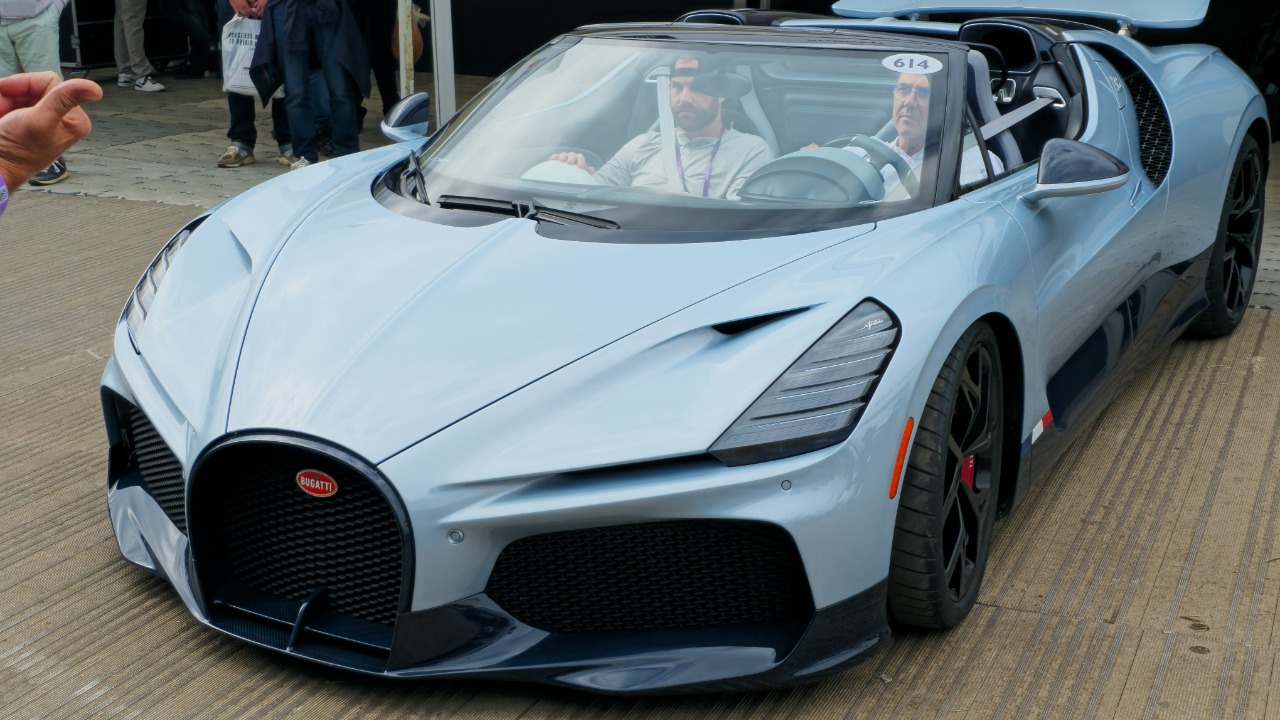

The last Bugatti Bolide is more than a customer delivery, it is the closing chapter of one of the most audacious engine stories in automotive history. With this car, Bugatti draws a firm line under two decades of quad‑turbo 8.0‑litre W16 excess and pivots toward a new era of electrified V16 performance. I see the final Bolide as both a farewell letter to internal‑combustion extremism and a mission statement for what comes next.
The last Bolide and the official goodbye to the W16
Bugatti has now delivered the final Bolide, and with it has officially said goodbye to its legendary 8.0‑litre W16 engine in its most extreme form. The company framed this car as the ultimate expression of that powerplant, a track‑only machine that exists purely to chase lap times and top speed rather than road‑car compromises, and the last Bolide marks the moment when that philosophy reaches its natural limit. In its own communications, Bugatti has been explicit that this car closes the book on the W16 in its wildest specification, confirming that the final Bolide is the exclamation point at the end of a 20‑year sentence of excess, as highlighted in a recent Dec update from the brand.
That farewell is not just sentimental branding, it is a structural shift in how Bugatti defines performance. The W16 has powered the company’s most outrageous creations since the Veyron, but the final Bolide is the first time the engine has been freed entirely from road‑legal constraints and built solely for the circuit. By choosing this car as the official send‑off, Bugatti signals that the W16 story ends not with a comfortable grand tourer but with a raw, uncompromising track weapon, a decision that sets the tone for how the company wants this era to be remembered.
Production wraps in Molsheim on Bugatti’s wildest track car
With the last example completed, production of the Bolide has ended at Bugatti’s historic home in Molsheim, drawing a clear line under the project. The car was always conceived as a limited, track‑only experiment in pushing the W16 to its outer limits, and the final unit rolling out of the atelier confirms that the experiment is complete. Reporting on the end of the run notes that the last Bolide to leave Molsheim is a 1,600-horsepower statement of intent, a car that exists purely to demonstrate what happens when Bugatti removes every filter between engine and asphalt.
That 1,600-horsepower figure is central to understanding why the Bolide matters. It is not simply a re‑bodied Chiron, it is a re‑imagining of what the W16 can do when the only job is to go faster, corner harder, and brake later than anything else in Bugatti’s 116‑year history. By ending production now, the company avoids diluting that message with incremental variants and instead preserves the Bolide as a single, focused idea: the most extreme track car Bugatti has ever built, and the last of its kind to rely solely on the W16 for its drama.
From design sketch to “vision becomes legacy”
The Bolide’s journey from radical concept to finished production car was unusually compressed for a machine this complex, and that speed underlines how clearly Bugatti saw its role in the brand’s story. The design of the Bolide was finalized in 2022, with engineering completed in early 2023, a timeline that shows how quickly the company moved once the vision crystallized. Bugatti has described this process as a case of a “vision becoming legacy,” a phrase that captures how the car was always intended to be both a technical showcase and a historical bookend, as detailed in its own Bolide development account.
What stands out to me is how deliberately Bugatti framed the Bolide as a bridge between pure concept and real‑world performance. The company did not treat it as a static showpiece, but as a fully engineered track car tested in real‑world conditions, which meant translating the wild proportions and aero of the original idea into something that could withstand repeated high‑load laps. That process, completed in just a few years, turned the Bolide from a speculative sketch into a tangible legacy project, one that would carry the W16’s reputation into the future long after the last engine is built.
Bugatti’s “First Modern Trackday Car” and what made it different
Bugatti has built fast cars for the circuit before, but the Bolide occupies a different category inside the brand’s own hierarchy. It has been described as Bugatti’s First Modern Trackday Car, a label that matters because it signals a shift from ultra‑fast road cars that can visit a track to a machine that exists primarily for track use. The Bolide strips away the luxury cues that define the Chiron and its derivatives and replaces them with a cockpit and bodywork that look more like a prototype racer than a grand tourer, even as it still carries the unmistakable Bugatti design language.
That “First Modern Trackday Car” positioning also hints at how Bugatti sees its wealthiest clients using the Bolide. This is not a car for a quick blast down a coastal highway, it is a tool for private track events, curated factory programs, and perhaps appearances at high‑profile circuits where owners can explore its limits in a controlled environment. By building a car that sits closer to the world of endurance racing than boulevard cruising, Bugatti has effectively created a new rung in its own ladder, one that future track‑focused models could climb even as the powertrain philosophy evolves beyond the W16.
A curated three‑car story: Type 35, Veyron, Bolide
The final Bolide does not disappear into anonymity, it joins a carefully assembled private collection that turns Bugatti history into a three‑act play. The car wears historic Bugatti blue paint as a tribute to the legendary Type 35 grand prix car, and it will sit alongside a final‑edition Veyron Grand Sport and an actual Type 35. That trio creates a narrative arc that runs from 1920s racing dominance through the rebirth of the brand with the Veyron to the modern hypercar era capped by the Bolide, a story the company itself has highlighted in a detailed look at the final car.
I see that collection as more than a wealthy owner’s indulgence, it is a physical timeline of Bugatti engineering priorities. The Type 35 represents lightweight agility and mechanical purity, the Veyron Grand Sport stands for the return of Bugatti as a technological powerhouse with the W16, and the Bolide closes the loop by taking that same engine to its most uncompromising track‑only form. By placing these three cars together, the collector and the brand effectively curate a museum‑grade exhibit that explains how Bugatti moved from wire‑wheeled racers to carbon‑tub hypercars without losing its core obsession with speed.
Performance numbers that justify the legend
For all the symbolism, the Bolide’s numbers still have the power to shock, even in a world saturated with hypercar statistics. The car uses a quad‑turbocharged 8.0‑liter W16 that produces 1,578 horsepower and 1,180 lb‑ft of torque, yet it keeps dry weight under 3,200 pounds, a figure that would have sounded implausible for a Bugatti not long ago. That combination delivers a 0‑62 mph time of 2.17 seconds and a theoretical top speed of 310 mph, figures that place the Bolide in a performance bracket that only a handful of experimental machines can approach, as laid out in Bugatti’s own performance summary.
Those numbers are not just marketing claims, they are backed by serious track work. The Bolide completed a lap of the full Le Mans circuit in 3:07.1 minutes with test driver Andy Wallace hitting 217 mph down the Mulsanne straight, a benchmark that places it in the realm of top‑tier prototype racers. When I look at those figures alongside the 1,600-horsepower rating cited for the final production car in independent coverage, the throughline is clear: the Bolide is not a styling exercise, it is a fully realized track machine whose performance validates its role as the W16’s ultimate showcase.
The W16 era is ending, but not quite over
Even as Bugatti celebrates the final Bolide as the symbolic end of the W16’s wildest chapter, the engine’s story is not entirely finished. Customer deliveries of the Mistral continue, and that car keeps the W16 alive on the road for a little longer. The Mistral is Limited to 99 units, a figure that underlines how carefully Bugatti is managing the final stretch of W16 production and how tightly it is controlling access to the last road‑going expressions of this powerplant, as confirmed in recent reporting on the Mistral.
I read that strategy as a way for Bugatti to give its most loyal clients a final taste of W16 road‑car drama while keeping the narrative focus on the Bolide as the engine’s ultimate expression. The Mistral offers open‑top grand touring with the familiar quad‑turbo soundtrack, while the Bolide represents the distilled, track‑only essence of the same hardware. Together, they form a two‑car farewell tour that allows Bugatti to phase out the W16 with both a luxurious send‑off and a hardcore finale, even as the company’s engineering resources pivot toward the next generation of powertrains.
The V16 hybrid future takes shape
Bugatti is not walking away from internal combustion, it is reshaping it around a new architecture that pairs a V16 with hybrid assistance. Earlier this year, the company confirmed that its next‑generation hypercar will use a V16 Hybrid powertrain, a configuration that signals both continuity and change. The new engine layout preserves the drama of a multi‑cylinder, high‑revving combustion unit while acknowledging that future performance must be augmented by electrification, a direction outlined in detail when the Bugatti Chiron successor was discussed.
That move fits into a broader shift across the performance‑car world, but Bugatti is keen to frame it on its own terms. The company has already unveiled a new V‑16 engine for its next hypercar, emphasizing that it is ready to evolve but at its own pace, and that the new powerplant will sit at the heart of a hybrid system rather than being replaced outright by electric motors. Coverage of the reveal notes that Bryan Hood included the engine in his Most Recent Stories on how the French brand is approaching this transition, underscoring that Bugatti wants to carry its combustion heritage into the hybrid age rather than abandon it.
Why a V16 Hybrid replaces the W16
The decision to replace the W16 with a V16 Hybrid is not just about emissions or regulations, it is about redefining how Bugatti delivers its signature sense of occasion. A V16 Hybrid allows the company to maintain the theatrical qualities of a large, multi‑cylinder engine while using electric assistance to fill torque gaps, sharpen response, and meet future efficiency targets. Reporting on the shift makes clear that Bugatti will replace its W16 with a V16 Hybrid, a move that aligns the brand with the broader trend of electrified hypercars while preserving a combustion‑led identity, as outlined in a detailed analysis of the powertrain change.
I see this as a pragmatic evolution rather than a radical break. The W16 was always a statement of excess, but it was also a packaging and cooling challenge that became harder to justify as performance expectations and regulatory pressures increased. A V16 Hybrid can deliver similar or greater power with more flexibility in how that power is deployed, especially if electric motors handle low‑speed and partial‑load duties while the combustion engine focuses on high‑rpm drama. By making this shift now, as the Bolide and Mistral close out the W16 era, Bugatti gives itself room to experiment with new forms of performance without losing the mechanical theater that defines its cars.
How the Bolide frames Bugatti’s next chapter
As Bugatti transitions to hybrid V16 power, the Bolide becomes a reference point for what the brand considers “uncompromised” performance. The car’s extreme power‑to‑weight ratio, its track‑only focus, and its willingness to sacrifice comfort for speed all set a benchmark that future models will be measured against, even if they use very different hardware. In that sense, the Bolide is not just the last W16 track monster, it is a manifesto about what Bugatti believes a hypercar should be when freed from everyday usability constraints, a manifesto that will inevitably influence how engineers calibrate the balance between combustion and electric power in the next generation.
At the same time, the Bolide’s role in a curated three‑car collection alongside a Type 35 and a Veyron Grand Sport shows how Bugatti wants its future to be read in light of its past. The new V16 Hybrid cars will not emerge in a vacuum, they will be judged against the lineage that runs from early grand prix racers through the W16 era to this final track‑only experiment. By ending the W16 story with a car as focused and as symbolically loaded as the Bolide, Bugatti ensures that when the first V16 Hybrid hypercar arrives, it will be seen not as a break with tradition but as the next chapter in a story that has always been about pushing the limits of speed, technology, and spectacle.
More from MorningOverview