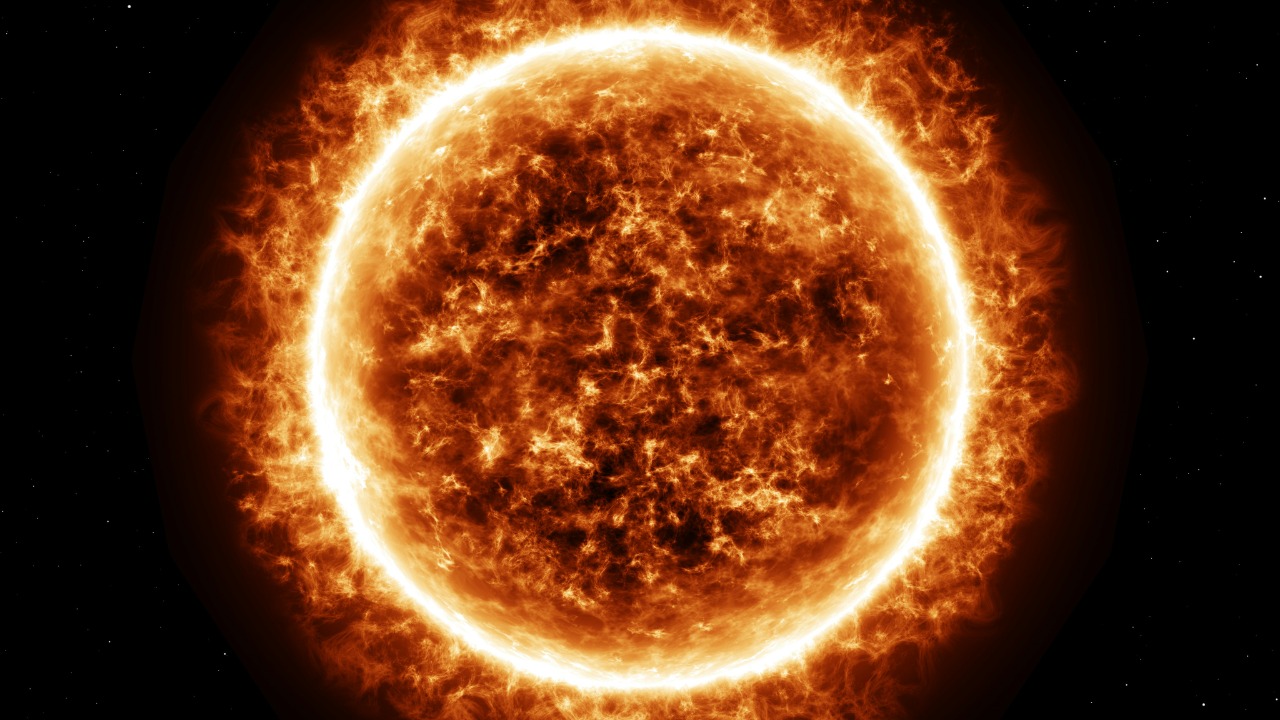

The Sun has shifted into a more explosive mood, hurling multiple bursts of energy and plasma into space that now appear to be converging on Earth. Forecasters are watching closely as one particularly fast eruption races to overtake earlier ones, a setup that can produce a so‑called “cannibal” coronal mass ejection with the power to supercharge a geomagnetic storm.
Instead of a single, tidy impact, Earth may be facing a stacked sequence of solar hits that merge into a larger, more complex disturbance in our magnetic field. That kind of event can light up the sky with auroras at unusually low latitudes while also testing the resilience of satellites, power grids, and radio systems that quietly underpin daily life.
The Sun’s restless week in context
Solar activity has been building in recent days, with several active regions on the Sun firing off significant flares and associated eruptions. One of the headline events was a powerful X1.1 flare from sunspot region AR4298 that peaked at 4:49 UTC, a level of energy that typically signals a serious disturbance in the solar atmosphere and often coincides with a substantial coronal mass ejection, or CME, racing outward into space.
At nearly the same time, another large region, AR4299, produced an M8.1 flare that launched what observers simply call The CME, a dense cloud of magnetized plasma that appears to be aimed squarely at Earth. Enthusiasts tracking coronagraph imagery have suggested this eruption is “pretty good” and could be strong enough to drive a geomagnetic disturbance in the G4 range if conditions line up, underscoring how quickly the Sun’s surface has shifted from relative calm to a barrage of Earth-directed blasts.
Why forecasters are talking about a “cannibal” CME
When solar eruptions come in rapid succession, the faster ones can catch up to slower predecessors, sweeping them up into a single, larger structure. Earlier research into these events has shown that When the second CME catches up to the first, it can engulf that earlier cloud, creating a single, massive wave of plasma that barrels through the inner solar system. Space physicists have taken to calling these merged structures “cannibal” CMEs because the later eruption effectively devours the one in front of it.
That cannibal behavior matters because the merged CME often carries a stronger, more tangled magnetic field and can travel at higher speeds than either of its components alone. Past events have shown that such combined eruptions can slam into Earth’s magnetosphere at nearly 2 million miles per hour, as described in earlier analyses of a cannibal coronal mass ejection from The Sun that was tracked racing toward our planet. When that kind of combined shock front arrives, it can compress Earth’s magnetic field more abruptly and drive a stronger geomagnetic storm than forecasters would expect from any single eruption.
Multiple CMEs line up on an Earthward trajectory
What makes the current setup so intriguing is not just one eruption but the apparent train of CMEs that have been launched in close succession. Space weather watchers have flagged that there are at least four distinct CMEs with some potential to intersect Earth’s orbit, with one of them, tied to the M8.1 flare from AR4299, singled out as the most promising candidate for a direct hit. As one observer put it, Here is the most promising of the CMEs headed for us now, launched from a region that was squarely in the Earth-strike zone when it erupted.
That geometry matters because CMEs that erupt from near the center of the solar disk, as seen from Earth, are more likely to be “halo” events that envelop our planet rather than glancing blows that skim past. The combination of a strong X1.1 flare from AR4298 and the M8.1 event from AR4299, both occurring while those regions were well placed, raises the odds that at least one of the resulting CMEs will connect solidly with Earth’s magnetic field. If the faster eruption from AR4299 catches up to an earlier, slower cloud on the way, the stage is set for a merged, cannibal-like structure to arrive instead of a series of neatly separated impacts.
Official alerts and what they actually signal
Behind the scenes, the first sign that the Sun has shifted into a more volatile phase often shows up in the technical bulletins issued by space weather agencies. One such alert, labeled with the Space Weather Message Code ALTXMF, carries the Serial Number 505 and notes that the X-ray flux has exceeded the M5 threshold, a clear marker that the Sun has produced a major flare. The Issue Time is recorded in early Dec in UTC, and the alert is part of a stream of operational messages cataloged in the alerts, watches and warnings that forecasters rely on to track evolving solar conditions.
These technical codes may sound arcane, but they are the backbone of how grid operators, satellite controllers, and aviation planners get early notice that something significant is brewing on the Sun. The same system feeds into public-facing forecasts and dashboards maintained by the Space Weather Prediction Center, where users can see at a glance whether solar radiation, geomagnetic activity, or radio blackouts are trending toward levels that warrant concern. When those alerts start stacking up around strong flares and Earth-directed CMEs, it is a signal that the risk of a notable geomagnetic storm is rising.
From model runs to storm warnings
Once a CME is spotted leaving the Sun, the next challenge is to estimate its speed, direction, and eventual impact on Earth. That is where sophisticated numerical models come in, allowing agencies to simulate how a giant cloud of plasma and magnetic fields will propagate through the solar wind. In the current case, NASA and NOAA have been using these tools to monitor a particularly large cloud en route to Earth, with the goal of predicting whether it will trigger geomagnetic disturbances that are manageable and correctable rather than catastrophic. Those modeling efforts underpin the geomagnetic storm warning that has been circulating as the latest eruptions unfold.
Forecasts are inherently probabilistic, especially when multiple CMEs are involved and the possibility of a cannibal merger complicates the picture. Still, the consensus emerging from these model runs is that a strong disturbance is likely, with the potential to reach levels that space weather scales classify as severe. Independent trackers have echoed that assessment, noting that a STRONG GEOMAGNETIC STORM PREDICTED banner has appeared in community updates that describe a CME heading straight for Earth and highlight the risk of a significant impact, as reflected in the latest outlooks on space weather forecasts.
What a severe geomagnetic storm can do
When a CME slams into Earth’s magnetic field, the resulting geomagnetic storm can have cascading effects across modern infrastructure. The official scales used by forecasters spell out that Satellite operations may experience memory device problems and noise on imaging systems, and that star-tracker issues can cause orientation errors that operators must correct. At higher storm levels, repeated impacts over several days are likely, and the same guidance warns that radiation hazard avoidance is recommended for certain flights, with navigation position errors and degraded high-frequency radio in the polar regions also on the list of concerns, all detailed in the NOAA space weather scales.
On the ground, strong geomagnetic storms can induce currents in long conductors such as power lines and pipelines, stressing transformers and control systems in ways that utilities must manage carefully. While the current warnings emphasize that expected impacts should be within the range of what operators can handle with proper preparation, history shows that poorly managed events can lead to voltage instability or even regional blackouts. For everyday users, the more visible effects may be intermittent GPS glitches, patchy shortwave radio, and, for those lucky enough to be under clear skies, auroras that spill far beyond their usual polar haunts.
Auroras, flares, and the spectacle overhead
For all the operational headaches they can cause, geomagnetic storms also deliver some of the most spectacular natural light shows on Earth. The same X1.1 flare from AR4298 that signaled a serious solar eruption has already prompted forecasters to flag the possibility of auroras reaching into mid-latitudes, with updates noting that Sun news for early Dec includes a burst from that region at 4:49 UTC that could translate into vivid displays once the associated CME arrives. Those watching the evolving situation have been tracking imagery from solar observatories that show the flare’s bright flash and the expanding cloud of plasma lifting off the solar limb, as summarized in recent Sun activity updates.
If a cannibal CME does materialize, the merged structure’s stronger magnetic field could further enhance auroral intensity and push the lights deeper into populated regions. That is because the key ingredient for a vivid storm is not just speed but the orientation of the magnetic field embedded in the CME; when it points southward relative to Earth’s field, it opens the door for more energy to pour into the magnetosphere. In practical terms, that means skywatchers from northern tier U.S. states, parts of central Europe, and similar latitudes in the Southern Hemisphere may have a better-than-usual chance of seeing curtains of green and red light ripple overhead if the forecasted storm hits at full strength.
How this fits into Solar Cycle 25
The current burst of activity is not happening in isolation but against the backdrop of a broader upswing in the Sun’s 11-year cycle. As Solar Cycle 25 has matured, scientists have been expecting more frequent and more intense flares and CMEs, a pattern that appears to be playing out as multiple active regions rotate across the solar disk. For those trying to keep tabs on the broader trend, official guidance has long pointed to the national space weather authority as the go-to source, with advisories noting that For the latest space weather forecast, users should visit the NOAA Space Weather Prediction Center for alerts, watches, warnings, and advisories, as outlined in the agency’s overview of Solar Cycle 25.
As the cycle approaches its peak, clusters of sunspots like AR4298 and AR4299 become more common, and with them, the odds of complex, interacting CMEs rise. That is why forecasters are particularly attuned to sequences like the one unfolding now, where multiple eruptions in quick succession raise the specter of cannibal events that can deliver outsized impacts. The current episode is a reminder that the Sun’s variability is not just an abstract scientific curiosity but a driver of real-world risks that ebb and flow with the solar cycle’s rhythm.
Preparing for impact without panic
For all the dramatic language that terms like “cannibal CME” invite, the practical response on Earth is more about preparation than alarm. Grid operators can adjust load flows and bring additional resources online to handle potential geomagnetically induced currents, while satellite operators can place spacecraft in safer configurations, tweak orbits, or delay sensitive maneuvers until the storm passes. Aviation planners, particularly those routing flights over polar regions, can adjust paths or altitudes to reduce exposure to elevated radiation levels and to avoid areas where high-frequency radio might be unreliable.
For individuals, the most tangible steps are straightforward: keeping an eye on official forecasts, understanding that minor disruptions to GPS or radio are possible, and, for those in favorable locations, planning a late-night look at the sky in case auroras materialize. The same agencies that issue the technical alerts and model-based warnings also provide public dashboards and notifications, and as the current wave of CMEs races outward, those channels will be the first place any shift in expected storm strength or timing will show up. In the meantime, the unfolding drama between the erupting Sun and Earth’s magnetic shield offers a vivid reminder of how dynamic our star can be, and how closely our wired world is tied to its moods.
More from MorningOverview