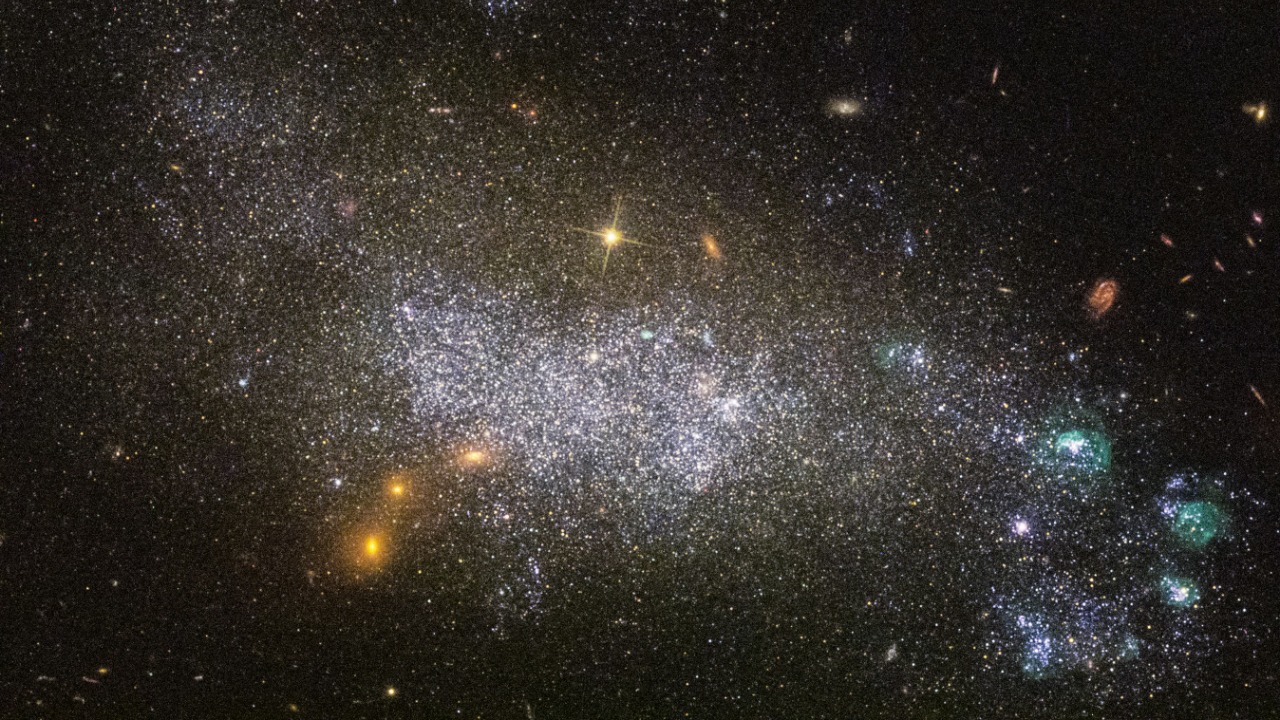

Everything humanity has ever touched, measured, or imagined as “normal” matter is a tiny sliver of reality. Less than 5 percent of the known cosmos is made of the atoms that build stars, smartphones, and subway cars, while the remaining 95 percent hides in forms we cannot see directly. I find that gap between what we experience and what actually exists not just humbling, but deeply energizing, because it shows how much of the story of the universe is still waiting to be told.
The unsettling math of a mostly invisible universe
When I say that 95 percent of the universe is unseen, I am not reaching for a metaphor. Cosmologists mean it literally: everything ever observed with telescopes, from the brightest galaxies to the faintest interstellar gas, adds up to less than 5 percent of the total cosmic budget. The rest is locked up in dark matter and dark energy, two components that shape the evolution of space yet do not shine, reflect, or absorb light in any way we can easily detect.
That means every star, every planet, and every person belongs to a minority share of reality, a visible fringe wrapped inside a much larger invisible framework. In that sense, everything ever seen is a kind of cosmic surface detail, a thin coat of paint on a structure whose beams and foundations we can only infer from their gravitational pull.
How we learned that “Everything” is only 5 percent
For most of human history, it was natural to assume that what we see is what exists. Only in the last century did the numbers begin to betray that intuition. As astronomers mapped galaxies and measured how fast they spin, they realized that the visible stars did not provide enough gravity to keep those systems from flying apart. The math demanded extra mass, something that did not glow but still exerted a powerful tug, and that missing ingredient became the first clue that the cosmos is dominated by the unseen.
Those calculations now feed into a broader picture in which the familiar atoms that make up “Everything we know” are just a small fraction of the total. In modern cosmology, the matter we can see and touch accounts for roughly 5 percent of the Universe, while the remaining 95 percent sits in categories that do not fit our everyday experience at all. I find that contrast striking, because it means our entire scientific tradition grew up studying a minority component without realizing it.
Dark matter: the invisible scaffolding
Dark matter is the name researchers give to the hidden mass that holds galaxies together. It does not emit light, it does not reflect it, and it does not interact with ordinary atoms in any obvious way, yet its gravity is unmistakable. When astronomers look at clusters of galaxies and watch how their light bends as it passes through space, they see patterns that only make sense if a vast halo of unseen material is warping the surrounding region like a lens.
Those distortions are now treated as direct evidence that this mysterious component is real, even if no one has caught a dark matter particle in a detector on Earth. In that work, Researchers map where the invisible mass must be in order to explain the motions of galaxies and the bending of light, then compare those maps to simulations of how structure should grow in a universe filled with such material. The match is close enough that dark matter has become a central pillar of modern cosmology, even as its true nature remains out of reach.
Dark energy: the quiet driver of expansion
If dark matter is the scaffolding, dark energy is the quiet force that pushes the whole structure apart. Observations of distant supernovae and the large scale distribution of galaxies show that the expansion of the universe is not slowing down under gravity, but speeding up. To account for that acceleration, cosmologists introduce a component that behaves very differently from matter, one that seems to be woven into the fabric of space itself and exerts a kind of negative pressure.
In the standard picture, dark energy dominates the cosmic budget, with dark matter in second place and ordinary matter trailing far behind. One detailed breakdown notes that dark matter makes up 27 percent of the universe and dark energy makes up 68%, leaving only a small remainder for the atoms we know. I find that hierarchy astonishing, because it means the long term fate of everything we can see is being decided by a component we cannot observe directly and barely understand.
Why the 95 percent gap feels so psychologically huge
On paper, the statement that 95 percent of the universe is invisible is a simple accounting exercise. Emotionally, it lands very differently. I grew up with the sense that the night sky, crowded with stars and galaxies, represented the full grandeur of the cosmos. Learning that all of that spectacle is just the visible tip of a much larger, darker iceberg forces a kind of cognitive reset, a recognition that our senses and our instruments are tuned to a narrow slice of reality.
There is also a deeper discomfort in realizing that the categories we use in everyday life, like “matter” and “energy,” are not enough to describe most of what exists. When I read that “Everything we know” is only 5 percent of the total, I hear an invitation to intellectual humility. The fact that the remaining 95 percent is a total mystery is not a failure of science, it is a reminder that we are still novices in a universe that is far more intricate than our current theories suggest.
How scientists study what they cannot see
One of the most inspiring aspects of this story, to me, is the way scientists have learned to study the invisible using indirect clues. Dark matter reveals itself through gravity, so researchers watch how galaxies rotate, how clusters move, and how light from distant objects bends as it passes through massive regions. By comparing those observations to computer models, they can infer where the unseen mass must be and how it is distributed, even if no telescope can photograph it directly.
Dark energy is even more elusive, yet its fingerprints show up in the way the expansion rate of the universe changes over time. Astronomers measure the brightness and redshift of supernovae, map the large scale clustering of galaxies, and analyze the subtle ripples in the cosmic microwave background. From those patterns, they extract constraints on how strongly this component pushes on space and how its influence might evolve. The work is painstaking, but it demonstrates that even when 95 percent of reality is hidden, careful measurement and theory can still bring it into focus.
Why this cosmic ignorance is oddly comforting
At first glance, learning that most of the universe is unknown might seem bleak, as if we are adrift in a reality we barely grasp. I feel almost the opposite. The fact that there is so much left to discover means that physics and astronomy are not closing chapters, but opening new ones. Instead of facing a finished textbook, we are standing at the edge of a vast research frontier where the next generation of telescopes, detectors, and theories could overturn assumptions we have held for decades.
There is also a kind of democratic optimism in the idea that we are all living at a time when the biggest questions are still on the table. The same sky that revealed dark matter and dark energy to professional astronomers is available to anyone with a backyard telescope or a smartphone app. Knowing that 95 percent of the cosmos is still in the “to be determined” column makes curiosity feel less like a hobby and more like a shared human responsibility.
What the unseen universe means for our place in it
When I think about the 95 percent we cannot see, I keep coming back to how it reframes our sense of importance. On one level, it shrinks us. If ordinary matter is a minor component and Earth is a small planet around a typical star, then our familiar world is clearly not the central feature of the cosmos. The structures that really shape the universe, from the web of dark matter to the pressure of dark energy, operate on scales and through mechanisms that have nothing to do with human concerns.
On another level, that same realization can be strangely empowering. We are part of the tiny fraction of the universe that has become self aware, capable of building instruments, writing equations, and asking why there is something rather than nothing. The fact that “Everything ever seen” is such a small share of reality does not diminish its value. It highlights how remarkable it is that a species made of that visible matter can even begin to infer the existence of the rest.
The amazement that keeps the questions alive
In the end, what amazes me most is not just the existence of dark matter and dark energy, but the way they force us to hold two ideas at once. We live in a universe that is rigorously mapped and measured, where numbers like 27 percent and 68 percent describe the composition of everything, yet we also inhabit a reality where the dominant components are still nameless in any everyday sense. That tension between precision and mystery is where modern cosmology does its most exciting work.
As I watch that work unfold, I am struck by how the simple statement that 95 percent of the universe is unseen can carry so much weight. It is a scientific fact, a philosophical provocation, and a narrative hook all at once. It tells us that the story of the cosmos is far from finished, and that our role in it is not to stand at the center, but to keep asking better questions about the vast, invisible majority that surrounds us.
More from MorningOverview