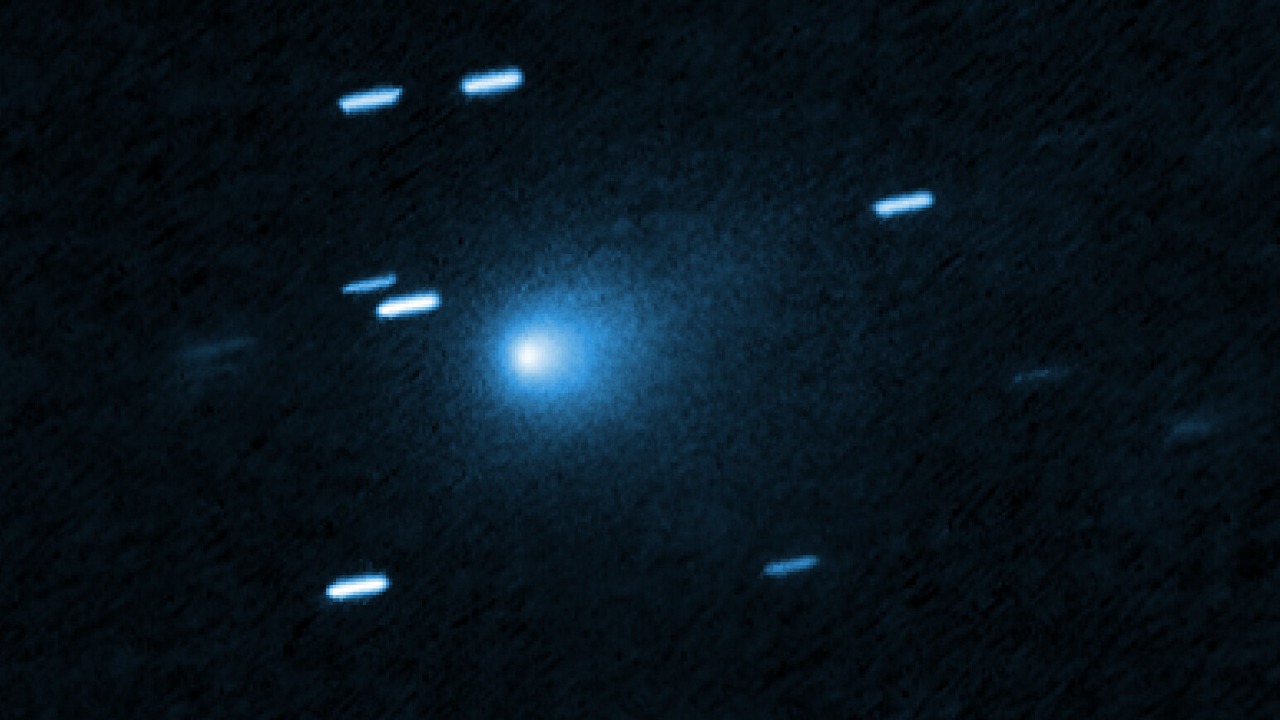

Interstellar visitor 3I/ATLAS has returned to Hubble’s field of view, and the fresh images are forcing astronomers to rethink what they thought they knew about comets from other stars. Instead of behaving like a scaled-up version of familiar icy wanderers, this object is revealing a stranger chemistry, a more complex tail, and a history that may stretch back to the earliest days of planet formation in the galaxy.
The new observations are sharpening estimates of 3I/ATLAS’s size and age, exposing unexpected structure in its tail, and turning a single comet into a test case for how future surveys will hunt for interstellar debris. They also underline a more philosophical point: every spectrum and pixel from this object is a rare message from another planetary system, written in ice and dust rather than ink.
Why 3I/ATLAS matters more than a typical comet
From the start, 3I/ATLAS has stood out as more than a photogenic streak in the sky, because it is only the third confirmed interstellar object and the first of its kind to behave like a classic comet. Its trajectory through the solar system is not bound to the Sun, which means it arrived from deep space and will leave again, carrying clues about the environment where it formed. The path it follows, including a close approach that brought it within tens of millions of miles of The Sun, marks it as a visitor rather than a native, and that status turns every measurement into a rare sample of another star’s debris disk.
Researchers see 3I/ATLAS as a bridge between the earlier interstellar discoveries and the flood of objects that next-generation surveys are expected to find. One analysis argues that the discovery of 3I suggests that prospects for Rubin may now be more optimistic, and that astronomers may find about 50 objects of this kind once the Rubin Observatory begins its wide survey. In that context, 3I/ATLAS is not just a curiosity, it is a template for how scientists will interpret a whole new population of interstellar comets in the coming years.
Hubble’s second look and what changed
When the Hubble Space Telescope turned back to 3I/ATLAS for a second look, astronomers were not simply repeating an earlier snapshot, they were catching the comet at a different stage of its solar encounter. As it moved away from its closest approach, the balance between gas and dust in its coma shifted, and the geometry of its tail relative to Earth changed, revealing finer structure that had been blurred or hidden before. The new images show a more extended and dynamic ion tail, hinting at ongoing interactions with the solar wind that are still unfolding as the comet recedes.
The latest campaign has also drawn in a wider community of observers, including astrophotographers who have been tracking the comet’s evolution from the ground. One detailed report highlights how Soumyadeep Mukherjee, an award-winning astrophotographer from India who holds a doctorate degree in Linguistics, has been documenting the changing appearance of 3I/ATLAS while Hubble refines its measurements of the nucleus in orbit, a collaboration that is captured in a recent overview of the Hubble revisit. That pairing of professional and advanced amateur data is giving scientists a more continuous record of how the comet responds to sunlight over time.
A bizarre trajectory and a sprint through interstellar space
The path 3I/ATLAS is carving through the solar system is not the gentle loop of a long-period comet but a sharp, hyperbolic swing that betrays its origin in interstellar space. Its incoming speed and angle relative to the planetary plane show that it has not been gravitationally bound to our star, and that it is only briefly cutting through the inner system before heading back out. The trajectory of 3I/ATLAS, including a closest approach that brought it within roughly 27 million miles of Earth in early October, underscores how narrowly we are catching this object before it disappears into the dark again, a detail that is documented in orbital reconstructions of its path.
That steep, fast track is not just a geometric curiosity, it is evidence that the comet has been drifting through interstellar space for many billions of years before this brief encounter. One mission-focused analysis describes this breathtaking sprint as a sign that 3I/ATLAS has been traveling far from any star, its orbit only slightly perturbed until it wandered close enough to be deflected by the Sun’s gravity and pass within about 27 million miles from the Sun. The same work uses Hubble data to refine the comet’s size, showing how the combination of its speed and brightness constrains the nucleus in a way that only a high resolution instrument can, a result summarized in a technical overview of the Hubble size estimate.
Oldest comet ever seen and what that implies
One of the most striking claims to emerge from the recent studies is that 3I/ATLAS may be the oldest comet ever observed, at least in terms of how long it has been wandering between stars. If it was ejected from its home system early in that system’s history, then it has spent billions of years exposed to the thin gas and radiation of interstellar space, preserving a record of primordial ices that predate many of the planets in our own neighborhood. That possibility turns the comet into a kind of time capsule, offering a look at the raw materials that built rocky worlds long before Earth finished forming.
The suggestion that 3I/ATLAS may be the oldest comet ever seen comes from detailed modeling of its orbit and physical properties, which indicate that it has likely been unbound from any star for a vast span of time. The same analysis that projects Rubin could find about 50 similar objects also argues that 3I/ATLAS’s discovery hints at a large, ancient population of interstellar comets that have been drifting through the galaxy since the early days of planet formation, a conclusion laid out in depth in the discussion of its potential age. If that interpretation holds, then 3I/ATLAS is not just old, it is a representative of a hidden archive of icy bodies that have been circulating between stars since the galaxy was young.
A growing ion tail and the mystery of a possible swarm
As 3I/ATLAS has moved through the inner solar system, its tail has become one of the most puzzling aspects of its behavior. Instead of a simple, smooth streamer of gas and dust, the ion tail appears to be growing in both length and complexity, with hints of knots and substructures that suggest variable outgassing or interactions with the solar wind. Astronomers tracking the comet’s return to view have emphasized that its expanding ion tail offers direct evidence of how icy bodies form and evolve around other stars, and that 3I/ATLAS is being treated as a sample of exoplanetary building blocks that could influence how future searches operate, a perspective laid out in a detailed look at its growing ion tail.
The tail has also sparked a more speculative line of inquiry, as some researchers have suggested that its structure might be consistent with a swarm of objects rather than a single, intact nucleus. One widely discussed interpretation notes that Comet 3I/ATLAS has displayed a variety of atypical traits, from its bizarre trajectory through our solar system to a complex tail that could be comprised of a swarm of objects, raising questions about whether it might be a fragmented body or a loose collection of debris. That idea, which has been associated with a Harvard scientist’s comments on a possible swarm of unknown objects, is outlined in a report on the mystery of the tail. While that scenario remains unproven, the very fact that it is on the table shows how far 3I/ATLAS has pushed observers beyond the standard comet playbook.
Water, OH, and the “message in a bottle” from another star
Beyond its shape and motion, what makes 3I/ATLAS scientifically precious is its chemistry, especially the presence of water and related molecules that can be traced through their ultraviolet signatures. When astronomers detect water, or even its faint ultraviolet echo in the form of OH, from an interstellar comet, they are effectively reading a note from another planetary system about the conditions in the disk from which it was born. In that sense, every spectral line from 3I/ATLAS is a fragment of a longer story about how ices condensed, how organic molecules formed, and how those ingredients might seed planets elsewhere.
One astrochemistry-focused analysis frames this in vivid terms, arguing that when we detect water, or its OH echo, from an interstellar comet, we are uncorking a message in a bottle from another star, a metaphor that captures both the rarity and the richness of the data. The same work emphasizes that these measurements help scientists compare the chemistry of 3I/ATLAS to that of comets in our own system, revealing whether the building blocks of planets are broadly similar across the galaxy or shaped by local quirks. That perspective is laid out in a discussion of how physicists are treating the comet’s spectrum as a message in a bottle, and it underscores why Hubble’s revisit, with its sensitivity to faint emissions, is so valuable.
Color, controversy, and what the comet is not
As images of 3I/ATLAS have spread online, some observers have claimed that the comet appears to be changing color, feeding a cycle of speculation that ranges from exotic chemistry to more sensational ideas. Professional astronomers, however, have pushed back on that narrative, pointing out that apparent color shifts can arise from differences in filters, exposure times, and processing choices rather than any real physical change in the object. One detailed clarification notes that the comet has been the subject of claims about dramatic color changes, but that careful analysis shows no evidence that its intrinsic color has altered as it has moved from about 170 million miles (270 million km) from Earth toward its closer passes, a point laid out in a report explaining that it has not changed color.
The same dynamic has played out around more speculative ideas about the comet’s origin, including suggestions that its unusual tail or trajectory might hint at artificial or engineered properties. Popular explainers have taken pains to stress that while 3I/ATLAS is undeniably strange, the available data are consistent with natural processes, and that the object is not evidence of alien technology. One widely shared piece notes that it is understandable why every space mystery attracts an extraterrestrial hypothesis, but that 3I/ATLAS is not aliens, grounding that reassurance in the physics of cometary outgassing and solar wind interactions, a point made explicitly in a discussion of why the comet is not aliens. In both cases, the message is the same: the real story is already extraordinary enough without invoking speculative explanations.
NASA images, public fascination, and the Avi Loeb factor
The release of new imagery has amplified public interest in 3I/ATLAS, with NASA’s decision to share multiple processed views helping to anchor the conversation in data rather than rumor. A recent overview notes that 3I/ATLAS will remain observable through 2026, and that after that it will drift out of range and continue its journey back into interstellar space, a reminder that the current window for close study is limited. The same report highlights that NASA has shared eight new images of the comet, giving both scientists and the public a richer sense of its structure and evolution, a milestone described in coverage of the eight new images.
At the same time, the comet has drawn commentary from high profile figures in the debate over interstellar objects, including Avi Loeb, who has previously argued that some visitors might be artificial. In a recent discussion, Loeb said that he was told by two sources that in fact NASA plans to release images of 3I/ATLAS in a few days, a remark that underscored both the anticipation around the data and the way unofficial hints can fuel speculation. That exchange, captured in a video where he weighs an alien hypothesis and then acknowledges the need to see the actual images, is part of a broader conversation about how to interpret unusual signals from space, and it is documented in a recording of his comments on NASA’s planned images. The tension between open mindedness and rigorous skepticism is playing out in real time as each new Hubble frame arrives.
Ground-based eyes and the role of expert amateurs
While Hubble provides unmatched resolution from orbit, much of what we know about 3I/ATLAS’s day to day behavior comes from a global network of ground based observers. Astrophotographers and amateur astronomers have been tracking the comet’s brightness, tail length, and apparent structure, often catching subtle changes between professional observing runs. Soumyadeep Mukherjee, the award-winning astrophotographer from India with a doctorate degree in Linguistics, has become one of the most prominent chroniclers of the comet’s evolution, using long exposure imaging and careful processing to reveal details that complement Hubble’s snapshots, a contribution highlighted in the account of the Hubble revisit.
These expert amateurs are not just producing pretty pictures, they are feeding real data into the scientific pipeline. By measuring how the comet’s brightness changes over time, they help constrain models of its rotation and outgassing, and by comparing images taken with different filters, they can flag potential changes in the balance between dust and ionized gas. Reports that track the comet’s return to view with a growing ion tail, for example, rely on a mix of professional spectra and amateur imaging to show how the tail has lengthened and sharpened as 3I/ATLAS moved away from the Sun, a synthesis that is laid out in the discussion of its return to view. In that sense, the comet is also a case study in how modern astronomy blends space telescopes, large ground based observatories, and dedicated individuals with backyard setups into a single observing machine.
What 3I/ATLAS is teaching us about future interstellar visitors
As the data set on 3I/ATLAS grows, astronomers are already folding its lessons into plans for how to handle the next wave of interstellar objects. The Rubin Observatory’s projected haul of about 50 such visitors means that scientists will need triage strategies to decide which ones merit Hubble level follow up, and 3I/ATLAS is helping define the criteria. Its combination of a bright, active coma, a well placed trajectory, and a rich chemical signature makes it an ideal target, and those traits are likely to become a checklist for future campaigns that aim to capture both imaging and spectroscopy before an object slips away.
The comet is also reshaping expectations about what interstellar debris might look like. Instead of a single archetype, 3I/ATLAS suggests a spectrum that ranges from relatively intact, water rich comets to more fragmented, possibly swarm like structures, all shaped by billions of years of exposure to interstellar space. The detailed studies of its trajectory, its potential status as the oldest comet ever seen, its growing ion tail, and its water and OH signatures, as documented across analyses of its age and its chemistry, are giving researchers a richer playbook for interpreting whatever the sky delivers next. For now, Hubble’s latest look has turned one icy visitor into a surprisingly complex laboratory for understanding how planetary systems, including our own, are built and reshaped over cosmic time.
More from MorningOverview