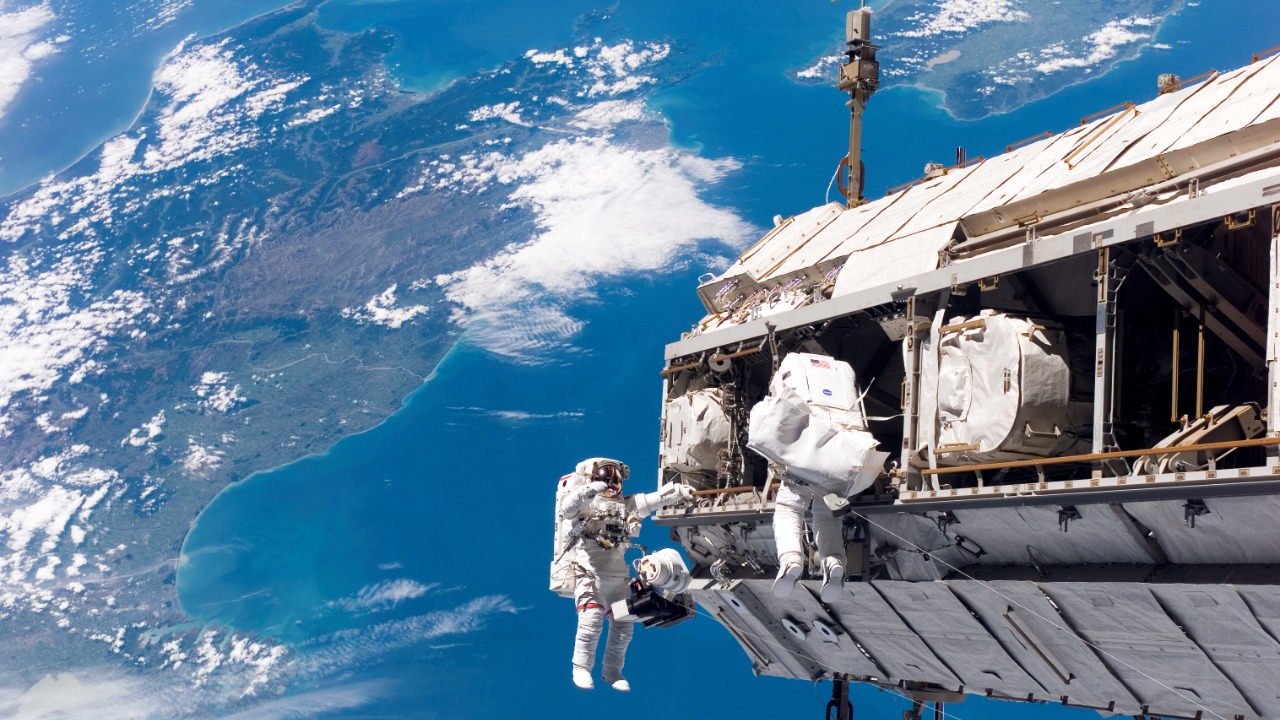

Human spaceflight is built on a simple paradox: the farther people travel from Earth, the more fragile their bodies and missions become. NASA has distilled that reality into five core hazards that define the biggest dangers of sending crews into orbit, to the Moon, and eventually to Mars. I will walk through each of these hazards, explaining how they threaten astronaut health and safety and why they now shape every serious plan for long-duration exploration.
1. The Perils of Space Radiation
The Perils of Space Radiation sit at the top of NASA’s list of human spaceflight dangers because crews leave behind the thick atmospheric and magnetic shielding that protects life on Earth. According to NASA’s Human Research Program, deep-space travelers are exposed to a mix of galactic cosmic rays and solar energetic particles that can damage DNA, trigger mutations, and raise lifetime risks of cancer, cardiovascular disease, and cognitive decline, making space radiation hazards a central design constraint for any mission to the Moon and Mars. These particles are energetic enough to pass through spacecraft walls and human tissue, so shielding is never absolute, and the risk profile changes with solar activity and mission duration. For a months-long journey to Mars, cumulative exposure could exceed what current occupational limits allow, especially for organs like the brain, heart, and bone marrow that are highly sensitive to ionizing radiation.
Researchers have identified specific health outcomes that illustrate why radiation is such a formidable barrier to routine human travel beyond low Earth orbit. A review of the highest priority human health risks for a mission to Mars highlights that space radiation can drive cancer, cardiovascular disease, and cognitive decrements as part of a broader set of threats that also includes Spaceflight, Associated Neuro effects, tying radiation exposure directly to long-term neurological performance and decision-making capacity for crews, as detailed in mission to Mars risk assessments. The stakes extend beyond individual astronauts: radiation limits how long vehicles can loiter in deep space, shapes where habitats can safely be placed on planetary surfaces, and influences which crew members are eligible to fly based on age and medical history. As agencies and commercial partners talk about permanent lunar bases or multi-year Mars expeditions, the unresolved challenge of shielding people from this invisible hazard will determine whether those ambitions remain conceptual or become sustainable programs.
2. Psychological Strain from Isolation and Confinement
Psychological Strain from Isolation and Confinement is another of the five biggest dangers of human spaceflight because long missions separate astronauts from their usual social networks, natural environments, and everyday autonomy. NASA’s hazard framework describes how crews on Exploration missions to the Moon and Mars will live in small, sealed habitats for months at a time, with limited privacy and repetitive routines that can erode mood and motivation, making Risks linked to isolation as mission-critical as any mechanical failure. Evidence from analog environments, such as polar stations and undersea labs, shows that confinement can fuel irritability, interpersonal conflict, and withdrawal, all of which can undermine teamwork during high-stakes operations like spacewalks or landings. For Mars-class expeditions, the knowledge that immediate evacuation is impossible can add a layer of existential stress that no training fully simulates.
NASA’s own standards for crew health and performance recognize that isolation is not just uncomfortable, it is a quantifiable hazard that must be engineered against. The NASA Space Flight Human-System Standard details how mission planners must account for depression, anxiety, sleep disturbances, and reduced performance as predictable outcomes of extended confinement, and it sets requirements for lighting, schedules, and behavioral health support to keep astronauts functional, embedding these expectations in the Space Flight Human-System Standard. Video explainers on Isolation and confinement in human spaceflight emphasize that these pressures are among the Big Risks for Mars Astronauts, where crews will face not only physical distance but also the psychological weight of being the only humans on an entire planet. For space agencies and private companies, the implication is clear: selecting technically brilliant astronauts is not enough. They must also invest in robust mental health care, thoughtful habitat design, and crew composition strategies that can withstand months of monotony, conflict, and uncertainty without degrading mission safety.
3. Challenges of Distance from Earth
Challenges of Distance from Earth become a defining danger once missions push beyond low Earth orbit, because physical separation quickly turns routine operations into high-risk endeavors. NASA’s hazard assessments point out that as spacecraft travel toward Mars, communication delays can stretch to roughly 20 minutes one way, which means a crew facing a critical systems failure or medical emergency cannot rely on real-time guidance, making delayed communication hazards a core operational constraint. That lag forces astronauts to become far more autonomous, handling complex troubleshooting, surgery-level medical procedures, and navigation decisions without immediate ground support. Even basic conversation with family becomes stilted and asynchronous, compounding the psychological strain already created by isolation and confinement.
Distance also magnifies logistical and medical risks that are manageable closer to home. When crews operate in low Earth orbit, cargo vehicles can deliver spare parts, fresh food, and scientific equipment on a regular cadence, and emergency evacuation to Earth is at least theoretically possible. In deep space, resupply windows are rare and tightly constrained by orbital mechanics, so any miscalculation in consumables or critical hardware can cascade into a life-threatening shortage, a reality underscored in discussions of top hazards for human spaceflight. Medical care faces similar limits: there is no rapid return option for a crew member with appendicitis or a serious trauma, so vehicles must carry more comprehensive medical kits and diagnostic tools, and astronauts must be trained to perform procedures that would normally be handled by specialists on Earth. For mission planners, these constraints drive a shift toward more robust onboard autonomy, including advanced decision-support systems and pre-positioned supplies on planetary surfaces, because the sheer distance from Earth removes the safety net that has underpinned human spaceflight since its earliest days.
4. Effects of Gravity Fields on the Body
Effects of Gravity Fields on the Body rank among the most thoroughly documented dangers of human spaceflight, yet they remain only partially solved. In microgravity, bodily fluids redistribute toward the head, muscles atrophy, and bones lose mineral density, creating a cascade of health issues that can compromise both short-term performance and long-term quality of life. NASA’s hazard documentation notes that these fluid shifts are linked to a condition formally described as Risk of Spaceflight, Induced Intracranial Hypertension and Vision Alterations, which was detailed in an evidence report from the Human Research Program and later examined in a chapter on Health Risks. Astronauts experiencing this syndrome can develop optic disc edema, globe flattening, and other structural eye changes that degrade visual acuity, a serious concern for tasks that demand precise hand-eye coordination. Cardiovascular deconditioning, where the heart and blood vessels adapt to lower workload in microgravity, can also leave crews vulnerable to fainting or reduced exercise capacity when they return to higher gravity environments.
Planetary gravity introduces a different set of challenges that mission designers must confront alongside microgravity effects. On the Moon and Mars, partial gravity may not be enough to fully counteract bone and muscle loss, yet it still requires astronauts to move, lift, and operate equipment in ways that strain joints and soft tissues unaccustomed to the new load. The NASA Space Flight Human-System Standard outlines how microgravity and altered gravity fields can impair balance, coordination, and cardiovascular stability, and it uses these findings to set requirements for exercise hardware, medical monitoring, and mission timelines, as captured in the hazard discussions for Moon and Mars exploration. For stakeholders planning commercial trips or long-term settlements, these physiological constraints translate into concrete design decisions: habitats may need centrifuge modules to simulate gravity, surface suits must support weakened musculoskeletal systems, and mission durations might be capped to keep cumulative damage within acceptable limits. Until countermeasures can fully offset these gravity-related changes, the human body itself will remain a limiting factor in how far and how long people can safely travel in space.
5. Risks in Hostile and Closed Environments
Risks in Hostile and Closed Environments capture the reality that spacecraft and off-world habitats are inherently unforgiving places to live. NASA’s hazard framework describes how these sealed systems must constantly manage air quality, temperature, pressure, water recycling, and waste processing, because any failure can quickly escalate into a life-threatening emergency, making hostile environment hazards as central to mission safety as launch and reentry. Toxic exposures from leaks, off-gassing materials, or combustion byproducts can accumulate in the confined volume, while limited medical facilities and close quarters increase the risk that a single infection could spread rapidly through the crew. The same closed-loop systems that make long-duration missions possible also create tight coupling between hardware performance and human health, leaving little margin for error when something breaks or behaves unexpectedly.
Beyond the walls of a habitat, the surrounding space environment adds another layer of danger that planners must factor into every trajectory and station-keeping decision. In a letter to regulators, NASA outlined concerns that large satellite constellations, such as the next-generation Starlink system, could increase the probability of conjunctions and debris, complicating safe operations for crewed vehicles and orbital platforms, a warning detailed in concerns about Starlink. More objects in orbit raise the odds that a fragment or defunct satellite could threaten a spacecraft, forcing more frequent avoidance maneuvers and consuming precious fuel. Inside habitats, the same hostile and closed conditions that amplify technical failures also shape how crews respond to emergencies: fire, depressurization, or contamination events must be contained in minutes, often without external help. For agencies and commercial operators, these realities drive investment in redundant life support, rigorous materials testing, and traffic management policies that keep orbital pathways as clear as possible. As human spaceflight expands, the challenge will be to maintain safe, livable bubbles of Earth-like conditions within an environment that offers no natural backup if those systems falter.
More from MorningOverview