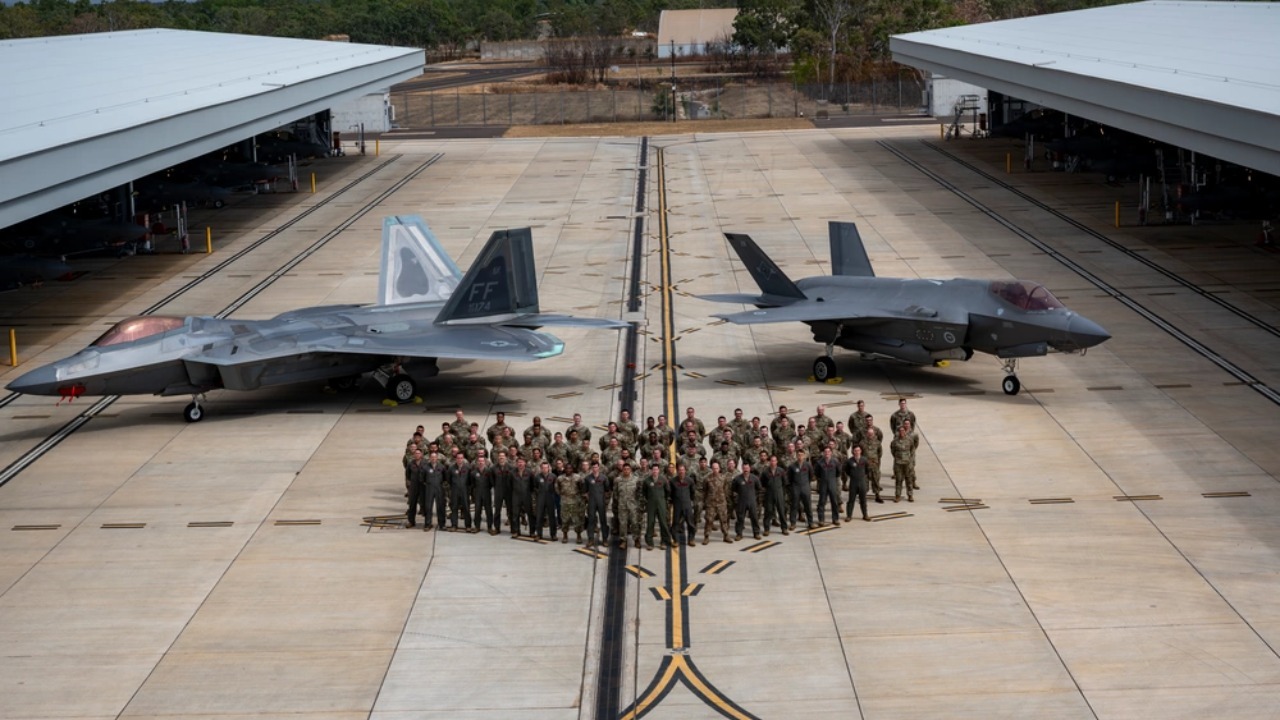

The US Air Force has spent years designing a Pacific war plan built on dispersing aircraft across remote islands, keeping them flying even as bases come under fire. Yet the entire concept rests on a fragile foundation: an airlift fleet that is smaller, older, and less ready than the strategy demands. If that backbone fails under pressure, the service’s survival scheme for a high-end fight with China could crack at the moment it is needed most.
The risk is not theoretical. Senior commanders, retired officers, and independent analysts are now warning that transport aircraft, crews, and logistics networks are already stretched thin in peacetime. In a conflict against a peer adversary like China, they argue, the gap between ambition and capacity could turn airlift from an enabler into a liability.
The Pacific survival concept depends on constant movement
The Air Force’s answer to growing missile threats in the Indo-Pacific is to avoid presenting a single, easy target. Instead of concentrating aircraft at a few large hubs, the service plans to scatter fighters, bombers, and support planes across a web of smaller airfields, moving them frequently and keeping them supplied under fire. That approach, often described as a way to survive bombardment in the Pacific, assumes that transport aircraft can shuttle fuel, munitions, spare parts, and personnel across long distances at a relentless tempo, even as runways and infrastructure are damaged.
Analysts who have examined how the Air Force is preparing to fight under bombardment in the Pacific note that this distributed posture only works if airlift can sustain it at scale, over time, and in contested airspace. Studies of how the service is adapting after the Cold War draw a direct line between survivability and logistics, emphasizing that the same transport squadrons already tasked with global missions would have to keep dispersed units alive while also responding to battle damage and humanitarian fallout.
Logistical and operational hurdles in a China fight
Even on paper, the logistics of a Pacific conflict are punishing. Distances between key bases, the limited number of suitable airfields, and the need to move heavy cargo all combine to create what one assessment describes as serious Logistical and Operational Hurdles for any plan that relies on rapid dispersion. While there seems to be a consensus that spreading out aircraft is essential, the same analysis warns that the infrastructure and lift capacity to support that dispersion are far from assured, especially once combat attrition and damaged runways are factored in.
Those challenges are magnified by the nature of a potential fight with China, where long-range precision weapons could strike airfields across the region in quick succession. While the Air Force can pre-position some supplies, the reality is that fuel bladders, munitions pallets, and maintenance teams will still need to move constantly to keep forward units operating. Without enough transport aircraft and crews to absorb losses and surge deliveries, the survival plan risks becoming a one-shot maneuver rather than a sustainable campaign.
A small, aging fleet already under strain
The Air Force is trying to execute this ambitious concept with a transport fleet that is shrinking and getting older. Reporting on The US Air Force highlights that the service’s aircraft inventory is steadily shrinking and aging, with growing gaps in readiness. Leaders have warned that while capacity, capability, and readiness are all under pressure, the force is at risk of being the least ready in its history at the very moment it faces mounting competition in the Indo-Pacific.
Transport platforms are at the heart of that concern. The same mobility aircraft that move troops and cargo for global operations would be expected to sustain a dispersed Pacific fight, even as maintenance demands rise and spare parts become harder to source. When a fleet is already described as small and aging in peacetime, it is difficult to see how it could absorb combat losses, surge sorties, and still meet the daily demands of a worldwide posture without breaking.
Airlift flagged as a potential Achilles’ heel
Warnings about airlift are no longer confined to internal planning documents. A new paper from a retired Air Force colonel, highlighted in coverage that describes how The US airlift fleet has a readiness problem for a modern war, argues that the size, age, and condition of the transport force could leave it unprepared for a high-end conflict. The author contends that the very aircraft meant to keep dispersed units supplied may themselves be the weak link, especially if they are forced to operate from damaged or austere airfields under threat of attack.
That critique has been amplified in reporting that frames the airlift fleet as a major problem in a potential war with China. One account notes that in a new Mitchell Institute paper, an airpower expert warns that the current transport force is not ready for a high-end war and that its limitations could undermine broader operational plans in a fight with China war. The implication is stark: if airlift falters, the entire concept of surviving by dispersing forces may unravel.
Commanders acknowledge enduring Indo-Pacific challenges
Senior leaders in the region are candid that the Indo-Pacific remains a demanding theater even as the geopolitical landscape shifts. The commander of Pacific Air Forces, Gen. Kevin Schneider, has emphasized that, while the strategic environment has evolved, certain challenges remain constant, including the tyranny of distance and the need to protect vulnerable bases. In remarks at Osan Air Base Indo-Pacific, Schneider highlighted both the opportunities and the persistent risks that come with operating so far from the continental United States.
Those comments underscore a central tension in the Air Force’s survival plan. Dispersing aircraft across the Pacific may reduce the risk of a single catastrophic strike, but it also multiplies the number of locations that must be supplied and defended. When a four-star commander points out that some challenges are enduring, he is implicitly acknowledging that logistics, basing, and airlift will remain hard problems even as new technologies and tactics are introduced.
Pacific bases and aircraft are highly exposed
The vulnerability of US Pacific bases is not an abstract war game scenario. Lawmakers have warned that Military aircraft are exposed on airfields and in easily detectable and identifiable hangars, with active defenses insufficient to guarantee their survival against a large salvo of missiles. Facilities that routinely host American bombers are singled out as particularly at risk, given their prominence and the strategic value of the aircraft they house.
In that environment, airlift assets themselves become high-value targets. Transport aircraft parked on open ramps or operating from predictable hubs could be struck early in a conflict, reducing the very capacity needed to move forces to safer locations. The more the Air Force relies on rapid movement to survive, the more it must protect the mobility fleet that makes that movement possible, a requirement that adds yet another layer of complexity to an already strained defense posture.
Industrial base and sealift limits compound the risk
Even if the Air Force could shield its transport aircraft from initial attacks, the broader logistics system that feeds those planes is under strain. One recent assessment of the defense industrial base notes that over 90 percent of US military supplies still move by sea, yet the nation accounts for just 0.1 percent of global shipbuilding. That imbalance leaves the United States heavily dependent on vulnerable maritime routes and foreign industrial capacity, even as it contemplates a major conflict in the Western Pacific.
For the Air Force, those figures translate into a hard ceiling on what airlift can achieve. Transport aircraft can move critical items quickly, but they cannot replace the bulk throughput of sealift, especially when the underlying industrial base struggles to replenish munitions and spare parts at wartime rates. If ships are delayed, damaged, or insufficient in number, airlift will be asked to fill gaps it was never designed to cover, stretching an already limited fleet even thinner.
Mitchell Institute and policy voices push for investment
Recognizing these vulnerabilities, airpower advocates are urging a significant reinvestment in transport capacity. A detailed policy paper from The Mitchell Institute for Aerospace Studies argues that current and future airlift must be enhanced to meet emerging demands, warning that the existing fleet is not aligned with the scale of potential conflicts. The analysis stresses that mobility aircraft are not just support assets but central to deterrence and warfighting, especially in a theater where geography and adversary capabilities magnify every logistics shortfall.
In a related announcement from Arlington, the institute framed the issue as one that places the entire American military at risk if left unaddressed. By calling attention to the gap between strategic ambition and mobility resources, these policy voices are effectively warning that without new investment, the Air Force’s survival plan in the Pacific could be undermined before the first shot is fired.
Inside the airlift readiness problem
Reporting that follows Follow Chris Panella has brought the airlift readiness debate into sharper public focus. These accounts describe how, in a potential war with China, the transport fleet’s current state could limit the Air Force’s ability to execute its own concepts. Every time Chris publishes a story on this topic, the picture that emerges is of a mobility enterprise already stretched by routine missions, humanitarian responses, and global commitments, with little slack left for a sudden, large-scale surge in the Indo-Pacific.
The underlying Mitchell Institute paper, which Panella highlights, points to specific readiness issues such as aircraft availability, maintenance backlogs, and crew training. When combined with the age and size of the fleet, these factors suggest that the Air Force might struggle to generate the sortie rates required for a high-end conflict. In a fight where timing and tempo could decide whether dispersed units survive or are cut off, such constraints are not marginal details but central strategic risks.
Connectivity, command, and control for mobility forces
Even if more aircraft and crews were available, the Air Force would still face the challenge of orchestrating complex mobility operations across a contested theater. Air Mobility Command has identified digital networks and data sharing as critical enablers, with leaders noting that Better connectivity has been a goal for AMC for several years. However, the command recently fell short of its own target to have every aircraft connected, underscoring how difficult it is to modernize a large, aging fleet while it is in constant use.
Without robust connectivity, commanders may struggle to reroute transports around threats, prioritize urgent deliveries, or coordinate with dispersed units in real time. In a Pacific fight where bases could be hit with little warning and airspace could become contested quickly, the ability to see the entire mobility picture and adjust on the fly is as important as the number of aircraft available. Gaps in command and control therefore compound the physical limitations of the fleet, further weakening the foundation of the Air Force’s survival strategy.
Strategic choices ahead for airlift and deterrence
All of these threads point to a single conclusion: the Air Force’s plan to ride out a high-end conflict in the Pacific by dispersing and maneuvering its forces will only be as strong as the airlift system that supports it. From the structural vulnerabilities of Pacific bases and the exposure of American aircraft, to the industrial and sealift constraints that limit resupply, the evidence suggests that mobility is not a secondary concern but a central determinant of whether the strategy can work.
For the, Air Force, and civilian leaders, the choice is whether to treat airlift as a quiet background function or as a critical element of deterrence that demands sustained investment. If they heed the warnings from analysts, commanders, and policy experts, they may yet reinforce the transport fleet and the networks that guide it, turning a potential Achilles’ heel into a source of resilience. If they do not, the survival plan designed to keep the Air Force in the fight against a peer adversary could instead reveal how fragile American power projection has become.
More from MorningOverview