
Archaeologists have brought a stark message out of the ground, a literal warning from the Roman Empire that was meant to chill anyone who saw it. The find is not just a curiosity from a distant past, it is a reminder that power, violence, and public spectacle were once carved into stone to keep entire populations in line.
As I trace what this warning meant in its own time and what it suggests now, I keep coming back to how deliberately the Romans fused art, terror, and storytelling. The same impulse that produced intricate mosaics and finely carved heads also produced scenes of conquest designed to be unforgettable, and the new discovery forces us to look at that blend of beauty and brutality head on.
The Roman warning that refused to stay buried
The newly highlighted warning from the Roman Empire was never meant to be subtle. It was created as a public display of victory, a visual statement that anyone who challenged Roman authority could end up as part of a cautionary tableau. Archaeologists working with this material have emphasized that it was designed to be seen, remembered, and feared, a message that fused political propaganda with the everyday environment of a Roman settlement.
In the reporting on this discovery, the project is framed under the banner of Archaeologists Uncovered, and the phrase “Haunting Warning” is not an exaggeration. The material comes directly from the Roman Empire and was intended as a public display of victory, a combination that makes the find feel less like a relic and more like a message that has simply been delayed in transit.
How archaeologists pieced together the hidden story
What makes this warning so compelling is not only what it shows, but how it was reconstructed. Archaeologists had to move from scattered fragments and partial scenes to a coherent narrative about power and punishment. That process required careful excavation, close reading of iconography, and a willingness to see the piece not as isolated art but as part of a broader Roman strategy of control.
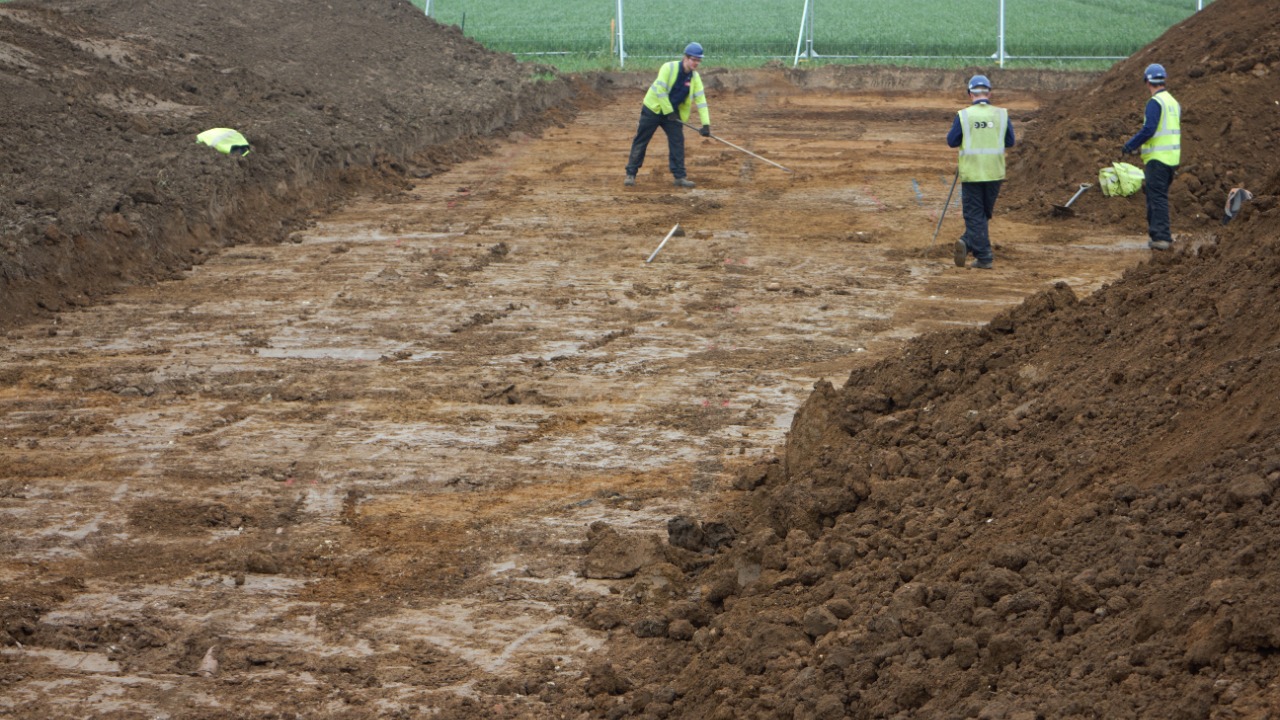
The reporting on the project describes how specialists used the framework of Archaeologists Uncovered to unlock the hidden story behind the imagery. The work is presented as a kind of decoding exercise, where the “Haunting Warning” from the Roman Empire is gradually revealed through the painstaking interpretation of a remarkable mosaic and related material that first came to light in a farmer’s field in 2020.
From farmer’s field to imperial spectacle
The journey of this warning from obscurity to global attention began in an unlikely place. What is now recognized as a sophisticated piece of Roman messaging lay for centuries beneath an ordinary farmer’s field, its significance masked by soil and routine agricultural work. Only when archaeologists were called in did the scale of the find become clear, and with it the realization that this was not just decoration but a carefully staged narrative of dominance.
According to the detailed account of the excavation, the field concealed a remarkable mosaic that became the centerpiece of the Haunting Warning narrative. The hidden story behind this mosaic, first recognized in 2020, shows how a seemingly quiet rural landscape can still hold the remains of an imperial spectacle that once demanded attention from everyone who walked across it.
Violence, victory, and the Roman imagination
At the heart of the warning is a Roman imagination that did not shy away from violence. Public displays of victory were not abstract celebrations, they were often graphic, filled with images of defeated enemies, bound captives, and looming execution. The newly highlighted material fits squarely in that tradition, using visual storytelling to make the cost of resistance unmistakable.
In the context of the Haunting Warning, the phrase “public display of victory” is not just a description of a ceremony, it is a literal account of how the Roman Empire embedded its triumphs into the built environment. The reporting on Haunting Warning makes clear that the imagery was meant to be unavoidable, a constant reminder that Rome’s victories were not just historical events but ongoing conditions that shaped daily life.
The unsettling gaze of ancient heads
The Roman warning uncovered in the mosaic is not the only recent find that leans on the power of a stare. Archaeologists and students have also been confronted with carved heads that seem to look back at the modern viewer, a different but related way of making the past feel uncomfortably present. These heads, with their slightly off expressions, show how ancient artists used human features to create a sense of presence that could be either protective or threatening.
One report describes how, while excavating at the ancient fort of La Loma in the northern Iberian Peninsula, a student uncovered a creepy ancient head carving that appears to stare directly at anyone who approaches. The account notes that While excavating at La Loma, the team found a slightly smiling head that was immediately described as an “exciting find,” precisely because its expression is so ambiguous and so hard to ignore.
La Loma and the psychology of being watched
The discovery at La Loma adds a psychological dimension to the Roman warning narrative. A carved head that seems to watch you can function as a guardian, a marker of status, or a silent enforcer of social norms. When that head is found in a military context, at an ancient fort, the sense of surveillance becomes even more pointed, as if the site itself is still under observation.
The reporting on the La Loma excavation, framed under the heading “Experts Stunned By Archaeology Student’s Discovery Of Ancient” and tagged with Aug and Here, underscores how the slightly smiling head is both eerie and instructive. The description of the creepy ancient head that stares out from La Loma shows how even a single carved face can carry a warning, or at least a reminder, that someone is always watching.
Reading fear in stone and mosaic
When I place the Haunting Warning from the Roman Empire alongside the La Loma head, a pattern emerges. Roman and related ancient communities were adept at encoding fear into durable materials, whether through sprawling mosaics of conquest or compact carvings that fix the viewer with a knowing look. These objects did not simply decorate spaces, they shaped behavior by making the consequences of disobedience feel immediate and personal.
The mosaic that became central to Haunting Warning and the carved head from La Loma, highlighted in the Aug report that begins with “Here” and “While,” both show how ancient artists used human figures and expressions to project authority. The slightly smiling head, the bound figures in a public display of victory, and the carefully staged scenes from the Roman Empire all work together to keep fear alive in stone and tile.
Why these discoveries feel so contemporary
Part of the chill that comes with these finds is how contemporary they feel. Modern societies still use images of power, from statues in public squares to viral videos of military parades, to send signals about who is in control. The Roman warning uncovered by archaeologists is a reminder that this strategy is not new, it is simply being updated with different media and technologies.
In the reporting on Archaeologists Uncovered, the Haunting Warning is presented as a lesson that still resonates. The Roman Empire used public displays of victory to project strength and suppress dissent, and the fact that these messages are resurfacing now, from a farmer’s field and from the soil of La Loma, invites a fresh look at how power communicates with the people who live under it.
The enduring echo of a chilling message
As I follow the trail from the remarkable mosaic in a rural landscape to the slightly smiling head at La Loma, the throughline is clear. Ancient authorities invested time, skill, and resources in crafting images that would outlast them, images that could keep speaking long after the original audience was gone. The chilling Roman warning that archaeologists have brought back into view is one of those images, a message that has finally reached a new set of eyes.
The specific phrases attached to these projects, from Dec and Archaeologists Uncovered to Haunting Warning, Roman Empire, Aug, Here, and While, capture how modern researchers are trying to make sense of what they have found. The work at La Loma and the decoding of the mosaic that lay hidden in a farmer’s field in 2020 both show that the past is not silent. It is full of carefully crafted signals, and when we uncover them, we are not just learning about history, we are being reminded of how power chooses to speak.
More from MorningOverview