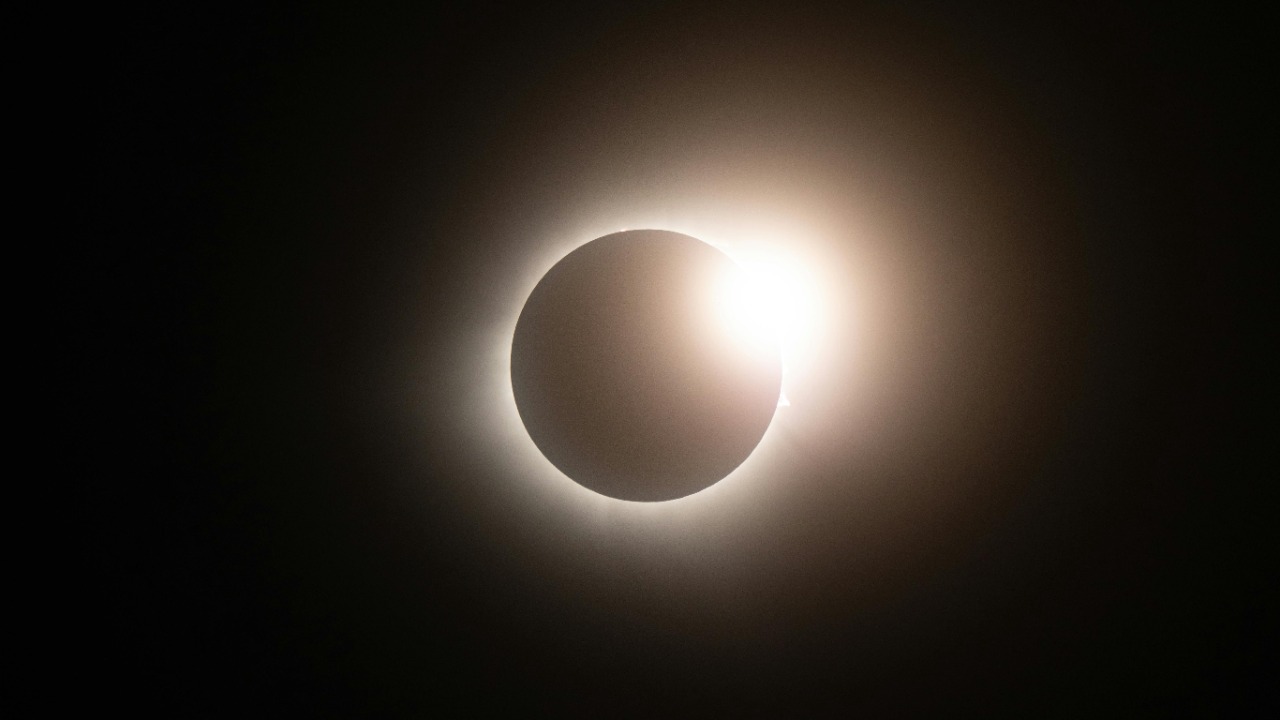

Long before modern observatories and spacecraft, court scribes in ancient China were quietly building one of humanity’s first datasets on the changing sky. Their terse notes on sudden daylight darkness now give researchers a rare way to test models of how the Earth and Moon have moved over thousands of years. By tracing those records back to their original context, I can see how a handful of carved characters and cracked bones are reshaping the story of the earliest known solar eclipses.
What emerges is not just a tale of celestial mechanics, but of politics, fear and scientific curiosity embedded in ritual. From oracle bones to bamboo annals, these early Chinese accounts help pin down which eclipse might truly be the first we can date, and why that question still matters to astronomers trying to understand our ancient solar system.
How a disappearing Sun became a scientific clue
For early imperial courts, a solar eclipse was never just a spectacle in the sky, it was a verdict on earthly rule. When the Sun vanished in daytime, rulers saw a warning that their mandate from heaven might be slipping, and they expected their astronomers to anticipate the danger. That pressure turned eclipse watching into a matter of state survival, which is why some of the oldest surviving descriptions of totality come from bureaucrats whose jobs, and sometimes lives, depended on getting the timing right.
Those same descriptions now give modern researchers a way to test how the Earth’s rotation and the Moon’s orbit have subtly shifted over millennia. By matching ancient reports of darkness, stars appearing and temperatures dropping to reconstructed eclipse paths, scientists can refine models of long term changes in day length and orbital dynamics, work that builds on detailed reconstructions of total solar eclipses seen from places as specific as France. The fact that court scribes were writing for emperors, not physicists, is precisely what makes their unembellished notes so valuable as raw data.
Oracle bones and the birth of Chinese sky watching
The trail of these eclipse clues begins with the earliest known Chinese writing, carved into animal scapulae and turtle plastrons used for divination. These oracle bones, many from the Shang Dynasty, record questions about harvests, warfare and omens, and they also capture how rulers interpreted strange events in the heavens. When cracks formed under heat, diviners read them as answers from ancestors, and they sometimes linked those answers to unusual solar behavior that frightened the court.
Archaeologists now see these fragments as more than ritual debris. The inscriptions preserve a snapshot of language, politics and cosmology that anchors later astronomical records in a clear cultural lineage. Excavations and epigraphic work have shown how such Discoveries illuminate the evolution of the Chinese writing system and the society that produced it, which in turn helps historians judge how reliable early eclipse references might be. When I read about these bones, I see the first step in a continuous record keeping tradition that would later treat the sky as a ledger of imperial fortune.
The legendary Oct. 22, 2137 B.C.E. eclipse
Among the most famous stories in this tradition is an eclipse said to have darkened the skies over ancient China in the twenty second century B.C.E. Later chronicles describe how royal astronomers failed to predict the event, leaving the court unprepared for the sudden loss of daylight. In the aftermath, the tale goes, those officials were executed for negligence, a brutal reminder that misreading the heavens could be fatal in a system that treated celestial order as a mirror of earthly rule.
Modern historians point to this event, dated to Oct. 22, 2137 B.C.E., as one of the earliest plausible solar eclipses tied to a specific culture and political crisis. The account is sparse, but its survival in the historical memory of China shows how deeply such events were woven into narratives of dynastic virtue and failure. For scientists, the story is a tantalizing candidate for an early eclipse record, even if the exact path and totality remain debated.
Competing claims about the “earliest” total eclipse
As compelling as that Chinese legend is, it is not the only contender for the first reliably recorded total eclipse. Astronomers working with global datasets have identified another event, dated to October 22, 2134 B.C., that may represent the Earliest Recorded Total Eclipse of the Sun. That reconstruction rests on calculations of when the Moon would have passed directly between Earth and the Sun in a way that produced complete darkness along a narrow track, and on matching that track to where ancient observers were likely to have been.
The result is a scholarly split between a narrative anchored in Chinese court history and a more abstract astronomical model that points to a slightly earlier date. Source material for the 2134 B.C. event is thinner on cultural detail, while the 2137 B.C.E. account is rich in political drama but harder to tie to a precise path in the sky. For now, I see the “first” eclipse as less a single moment than a cluster of early observations, each sharpening our view of how humans learned to treat the Sun’s disappearance as something that could be recorded, compared and eventually predicted.
From dragon myths to the “Six-Five Beat”
In many early cultures, eclipses were explained as cosmic monsters devouring the Sun, and China was no exception. Texts describe celestial dragons swallowing the light, prompting frantic rituals of drumming and shouting to scare the creature away. Those stories coexisted with a quieter, more mathematical effort by court astronomers to find patterns in when the Sun seemed most vulnerable, a duality that shows how myth and measurement often grew side by side.
Over time, those measurements led to sophisticated cycle counting. Scholars tracked how eclipses repeated in recognizable rhythms, including a pattern known as the Six and Five Beat that helped them anticipate when the Moon’s shadow might again cross the Sun. When I look at those cycles, I see a bridge between ritual responses to “The sun has been eaten” and the first stirrings of predictive astronomy, where eclipses became not just omens but tests of a theory about how the heavens moved.
The 709 BCE record and what it proves
The debate over the very first eclipse sometimes obscures a more concrete breakthrough: a Chinese account of a total solar event from 709 BCE that modern scientists have now verified. Researchers used radiocarbon analysis of tree rings and other environmental proxies to narrow down when a dramatic drop in sunlight would have occurred, then matched that window to orbital models that predict the path of the Moon’s shadow. The convergence between the textual description and the physical evidence gives this record unusual weight.
For me, the 709 BCE eclipse stands out because it ties together three strands: a written report from court observers, a physical signal in the environment and a modern reconstruction of celestial mechanics. The fact that Researchers could align those lines of evidence so precisely suggests that at least some early Chinese eclipse notes were not vague omens but careful observations of timing and darkness. That makes them powerful anchors for testing how accurate our long range eclipse models really are.
“2,700-Year-Old” data and the ancient solar system
When scientists talk about using ancient eclipses to probe the past, they often focus on a cluster of observations roughly 2,700 years old. Those records, including Chinese accounts, fall in a sweet spot where the historical documentation is detailed enough to locate observers on the ground, yet old enough that small errors in our models of Earth’s rotation and the Moon’s orbit become visible. By comparing where totality should have been to where witnesses said it was, researchers can refine estimates of how the length of the day has changed over time.
Recent work has highlighted how such 2,700-Year-Old eclipse observations feed into models of Earth’s rotation speed and long term solar cycles. The studies show that even small discrepancies between predicted and reported eclipse paths can reveal how tidal friction and other forces have subtly slowed the planet’s spin. When I connect those calculations back to the terse notes of court scribes, I see a collaboration across millennia, where their concern with ritual correctness now helps us understand Our Ancient Solar System in ways they could never have imagined.
Finding a “misplaced” ancient Chinese city in the shadow
Ancient eclipse records do not just refine orbital mechanics, they can also redraw maps. One recent study used the path of a very early total eclipse to narrow down the location of a long debated Chinese city whose exact site had been lost. By calculating where the Moon’s shadow would have fallen and comparing that to descriptions of darkness in surviving texts, researchers could rule out some proposed locations and strengthen the case for others.
The work shows how The Oldest Known Eclipse Record can be used for more than dating celestial events. By Shedding Light on Early Celestial Mysteries and Revealing the Location of a Misplaced settlement, the study turns a brief note about sudden darkness into a kind of celestial GPS. I find that crossover striking, it shows how carefully dated sky events can lock down where people actually lived, traded and governed, giving archaeologists a new tool to test competing site claims.
Why these ancient records still matter
When I step back from the technical debates, what stands out is how much modern science now depends on the diligence of people who never thought of themselves as scientists. Court scribes who wrote in Dec or carved characters into bone were trying to keep rulers informed and rituals on schedule, not to help future astronomers measure tidal friction. Yet their insistence on recording when the Sun vanished, how long darkness lasted and what the court did in response has become a backbone for studies of long term solar cycles and Earth’s changing spin.
Those same records also remind me that science rarely starts with a clean break from myth or politics. The story of Oct eclipses, dragon legends and executed astronomers shows how fear and power can drive more careful observation, even when the underlying theory is still wrapped in symbolism. As researchers continue to mine these texts, from Chinese oracle bones to bamboo annals, I expect the line between the “first” eclipse and the many that followed to keep shifting, not because the past is changing, but because we are finally learning to read what those ancient observers saw when daylight suddenly disappeared.
More from MorningOverview