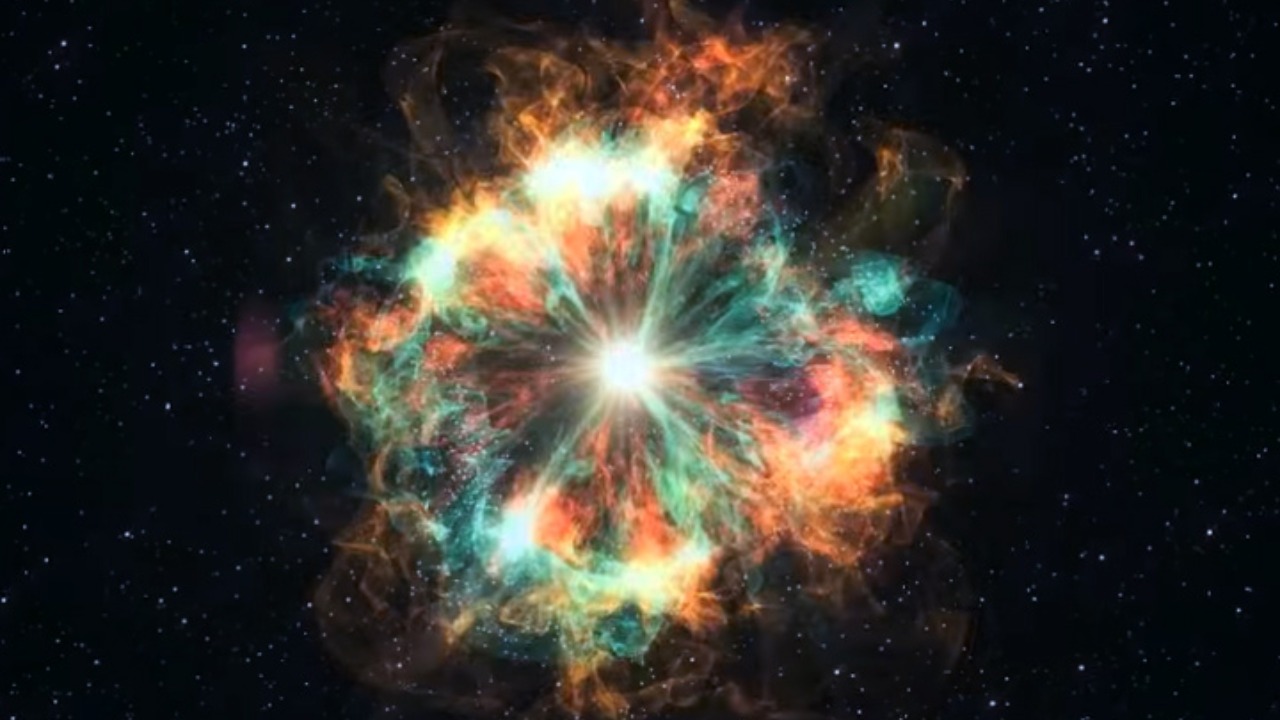

When a massive star dies, astronomers expect a familiar chemical script: hydrogen and helium on the outside, heavier elements buried deep within. The latest observations of a stellar explosion known as SN 2021yfj have ripped up that script, revealing a stripped-down blast whose light is laced with unexpected elements from the star’s inner layers. Instead of a tidy, textbook supernova, scientists are watching a chaotic finale that exposes the core of a dying stellar giant in real time.
The discovery is more than a curiosity. By catching this explosion early and tracking its evolving spectrum, researchers have opened a rare window into how the most massive stars live, shed material, and finally collapse. The surprising chemistry in the debris is forcing theorists to revisit long-held assumptions about how these stars lose their outer shells and how their final nuclear burning stages unfold.
A “New Kind of Supernova” with bare-bones chemistry
At the heart of the story is SN 2021yfj, a blast that an international collaboration has described as a new kind of supernova whose spectrum looks nothing like the standard categories astronomers have relied on for decades. Instead of the usual fingerprints of hydrogen or helium that dominate many stellar explosions, the light from this event is dominated by heavier elements that should have been buried deep inside the star. That bare-bones chemical profile suggests the outer layers were somehow peeled away before the star finally tore itself apart.
Researchers following this object over time found that the explosion’s visible light and spectral lines evolved in ways that do not match traditional models of how massive stars die. In the early days after the blast, the spectrum already hinted at inner layers, and as the debris expanded, those signatures only grew clearer, reinforcing the idea that SN 2021yfj is not just an oddball but a fundamentally different kind of stellar death. The result is a rare chance to study the exposed interior of a dying stellar giant, rather than inferring its structure from the usual, more opaque explosions.
How SN 2021yfj defies the textbook supernova playbook
In the standard picture, a massive star ends its life with a core-collapse supernova that still carries a thick envelope of hydrogen or helium, leaving astronomers to peer through those outer layers to guess what lies beneath. SN 2021yfj breaks that pattern so dramatically that one team has framed it as a New Kind of Supernova that reveals the inner layers of a dying stellar giant almost immediately. Instead of being veiled by gas, the explosion behaves like a direct X-ray of the star’s core, with the ejecta dominated by elements forged in the final stages of nuclear burning.
That behavior has forced astronomers to confront the limits of their existing classification schemes. The spectral lines and light curve of SN 2021yfj do not sit comfortably in the familiar Type II or stripped-envelope categories, and the early-time data show a chemical mix that suggests the star’s outer shells were removed in a way that standard stellar evolution models do not predict. The event has quickly become a benchmark case for how nature can produce explosions that sit outside the neat boxes in which astrophysicists have tried to place supernovae.
Inside the “hot, burning onion” of a massive star
To understand why the chemistry of SN 2021yfj is so startling, it helps to picture the progenitor star as a layered structure, often described as a hot, burning onion. Weighing in at 10 to 100 times heavier than our Sun, such a star builds shells of different elements as it ages, with hydrogen on the outside, helium beneath, and progressively heavier nuclei like carbon, oxygen, and silicon stacked toward the core. In a typical explosion, those inner layers remain hidden, their signatures diluted by the outer material that still clings to the star at the moment of collapse.
SN 2021yfj appears to have skipped that final cloak. The spectral fingerprints show that the explosion is dominated by material from deep inside the onion-like structure, suggesting that something stripped away the hydrogen and helium shells before the star died. That stripping could have been driven by extreme stellar winds, violent pulsations, or interactions with a companion, but the key point is that the blast is letting astronomers see the star’s inner composition directly. For theorists who have long relied on indirect clues, this is a rare laboratory for testing how nuclear fusion proceeds in the final instants before a massive star runs out of fuel.
Keck’s close-up of a stripped star’s final moments
The unusual chemistry of SN 2021yfj did not reveal itself by accident. High-resolution observations from large ground-based telescopes captured the explosion’s light in the crucial early days, when the shock wave was still plowing through the surrounding material. Those data, taken with instruments that can dissect starlight into its component colors, showed that the usual outer-layer elements were missing and that the spectrum was dominated by heavier species. The chemical signature was so starkly different that it immediately flagged the event as something extraordinary.
By following the supernova over time, astronomers could watch how those spectral lines shifted and faded, effectively tracking how the debris expanded and cooled. The persistence of inner-layer elements in the data confirmed that the star’s outer shells were not simply hidden but truly gone, leaving a bare core to explode. That time series has become a cornerstone for new models of how massive stars can lose mass in the final months or years before they die, and it underscores the value of catching such events as early as possible.
Northwestern’s team and the puzzle of extreme mass loss
The investigation into SN 2021yfj has been driven by an international collaboration led by astrophysicists at Northwestern University, who have framed the event as a direct challenge to long-standing theories of stellar evolution. Their analysis points to a progenitor that must have shed an enormous amount of material before the explosion, far more than standard models predict for a star of this mass and age. That conclusion raises a basic question: what physical process can peel away so much of a star’s outer layers so quickly?
One clue comes from the idea that massive stars can undergo violent pulsations in their final nuclear burning stages, with each pulse ejecting a shell of gas into space. The same team has highlighted how the extreme heat and density in the core can reignite nuclear fusion with such intensity that it triggers a pulse that sheds more material in each episode. If SN 2021yfj’s progenitor experienced a series of such eruptions, it could explain how the star arrived at its final collapse already stripped down to its inner layers.
“Like nothing anyone has ever seen before”
For observers who specialize in supernovae, the data from SN 2021yfj have an almost uncanny quality. The pattern of spectral lines and the way they evolve over time match the layered structure that theory has long predicted for massive stars, but rarely has that structure been exposed so clearly. New observations have provided striking confirmation of this model, with the layered structure predicted by theory now visible in the debris itself.
That match between theory and observation is both reassuring and unsettling. It reassures astrophysicists that their basic understanding of nuclear fusion in massive stars is on the right track, since the observed elements line up with what models say should be present in each shell. At the same time, it unsettles them because the very fact that those layers are visible implies a pre-explosion history of mass loss that current models do not capture. The event has quickly become a touchstone for discussions about how much more complex the late lives of massive stars may be than the tidy diagrams in textbooks suggest.
Is SN 2021yfj a whole new class of stellar death?
As the data have accumulated, a central debate has emerged: is SN 2021yfj an extreme example of a known type of explosion, or does it represent a genuinely new class of supernova? Some of the researchers involved have framed the question explicitly, asking whether Is SN 2021yfj a new type of supernova defined by a powerful process that stripped it of its outer layers. The answer carries real stakes for how astronomers classify explosions and interpret the chemical fingerprints they see across the universe.
Some of the team argue that the most plausible explanation is a massive eruption that preceded the supernova explosion, effectively carving away the star’s outer shells and leaving a bare core to collapse. If that scenario is correct, then SN 2021yfj could be the prototype for a new category of events in which extreme pre-explosion activity sets the stage for an unusually revealing blast. Others caution that more examples will be needed before astronomers redraw the classification map, but few dispute that this event has expanded the range of what a dying star can do.
Flash spectroscopy and the race to catch stars in the act
One reason SN 2021yfj has been so informative is that astronomers were able to observe it almost immediately after the explosion, using techniques designed to capture the fleeting signals from the shock wave as it slams into nearby material. This approach, known as flash spectroscopy, has become a powerful tool for probing the final days and weeks of a star’s life. As astrophysicist Wynn Jacobsen-Galán at Berkeley has emphasized, there is now an amalgam of observational evidence that massive stars undergo intense activity in the years and even months before they explode.
By capturing the brief flash of light that occurs when the supernova shock first hits the surrounding gas, astronomers can infer how much material the star shed and how recently it did so. In the case of SN 2021yfj, that early-time information has been crucial for reconstructing the star’s pre-explosion behavior and for confirming that the outer layers were already gone. The technique has also been applied to other events, such as SN 2020tlf, the first normal Type II-P/L supernova with clear pre-explosion emission, suggesting that extreme late-stage mass loss may be more common than previously thought.
What a medieval sky event can teach us about strange spectra
SN 2021yfj is not the first time astronomers have been confronted with a supernova whose spectrum looks nothing like the standard templates. Historical remnants can also carry the fingerprints of unusual explosions, and one of the most intriguing examples is a remnant linked to a bright event recorded in the year 1181. When modern astronomers studied the central star in that nebula, they found that It had a very odd spectrum, unlike stars in the centers of other remnants, which eventually led them to conclude that what they were seeing was a supernova remnant from that medieval outburst.
That case underscores how unusual spectral signatures can signal a fundamentally different kind of stellar death, even when the explosion itself is long past. In the 1181 remnant, the odd spectrum pointed to a rare type of event that did not fit neatly into the usual categories, much as SN 2021yfj now challenges modern classification schemes. Together, these examples highlight how the chemistry of supernova debris can preserve a record of the underlying physics, offering clues that stretch across centuries.
Nature’s new questions about supernovae
The broader implications of SN 2021yfj’s strange chemistry have been laid out in a recent analysis that frames the event as a first-of-its-kind explosion that raises fresh questions about how massive stars die. In a paper published in Nature, astronomers describe how they observed the event for more than a month and found that it exhibits the visible signatures of inner stellar layers almost from the onset of the explosion. That behavior is difficult to reconcile with models in which the star retains a substantial outer envelope until the moment of collapse.
The same work emphasizes that the event’s light curve and spectral evolution do not match the expectations for a standard core-collapse supernova, reinforcing the idea that some massive stars may follow a very different path to their final explosion. Instead of a quiet lead-up followed by a single catastrophic blast, the data point to a more drawn-out and violent prelude, with repeated eruptions and extreme mass loss setting the stage. For theorists, that means revisiting the late stages of stellar evolution and exploring new mechanisms that can drive such dramatic behavior.
Why the strangest supernova yet matters for the rest of the universe
For all its exotic details, SN 2021yfj is not just an astrophysical curiosity. The way massive stars die has direct consequences for how galaxies evolve, how elements are distributed through space, and how future generations of stars and planets form. Scientists have identified this event as a never-before-seen supernova that suggests massive stars can end their lives in more exotic ways than textbooks predict, which in turn affects how and when they release heavy elements into their surroundings.
If events like this are common, then a significant fraction of the universe’s chemical enrichment may come from explosions that do not look like the standard types astronomers have been using to calibrate their models. That possibility has implications for everything from the rates of certain kinds of gamma-ray bursts to the formation of compact remnants like neutron stars and black holes. SN 2021yfj, with its stripped-down chemistry and exposed inner layers, is a reminder that even in a field as mature as stellar astrophysics, nature still has surprises that can reshape the story of how the cosmos builds itself, one dying star at a time.
More from MorningOverview