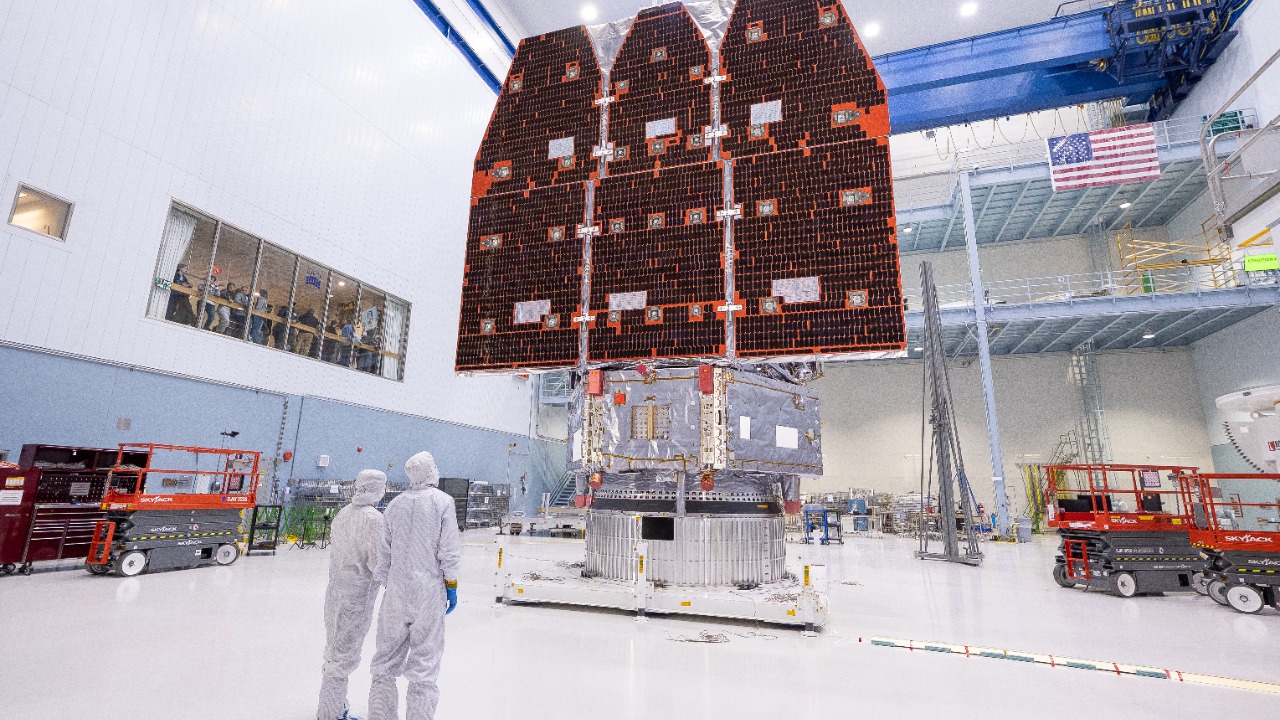

NASA has finished building the Nancy Grace Roman Space Telescope, completing assembly of the agency’s next flagship observatory and clearing the way for a final gauntlet of tests before launch. The fully integrated spacecraft is designed to transform how astronomers map the cosmos, hunt for exoplanets, and probe the mysterious forces of dark energy and dark matter.
With construction wrapped, Roman shifts from a decade of design and hardware work into the high‑stakes phase where engineers prove the observatory can survive launch and operate a million miles from Earth. I see this moment not just as a technical milestone, but as the point where a long‑promised new view of the universe starts to feel imminent rather than theoretical.
NASA’s new “big eye” on the cosmos comes together
The most immediate change is simple and profound: NASA’s next big eye on the cosmos is no longer a collection of subsystems scattered across clean rooms, it is a single, fully assembled observatory. Technicians recently joined the inner and outer portions of the spacecraft, completing the structural integration that turns Roman from a set of precision instruments into a flight‑ready telescope, a step NASA describes as the moment its “next big eye on the cosmos” became fully assembled in Roman construction.
That assembly milestone caps a long development arc that began when NASA formally approved the mission and later confirmed that construction on the observatory’s hardware would move forward. According to mission documentation, NASA noted that on 29 September 2021 it cleared the project to proceed and that technicians ultimately finished construction on 25 November 2025, a timeline that underscores how much of the past few years have been spent turning designs into flight hardware for the Nancy Grace Roman Space Telescope.
From assembly line to launch pad: what happens next
Completion of the build does not mean Roman is ready to fly tomorrow, and that gap between “finished” and “flight‑ready” is where the mission now lives. NASA has laid out a sequence in which the observatory enters final testing, including environmental trials that simulate the violence of launch and the harsh conditions of deep space, before it is cleared to travel to its operational orbit about a million miles from Earth, a destination described in mission updates that outline how, after final testing, Roman will cruise to a halo orbit roughly a million miles away in the direction opposite the Sun in Roman’s deep‑space orbit.
On the schedule side, NASA has long said the mission is scheduled to launch no later than May 2027, but officials now acknowledge that the hardware could be ready earlier. Internal planning still treats that no‑later‑than date as the formal commitment, yet recent briefings indicate the observatory might be prepared to fly as early as fall 2026, a possibility that has prompted discussion of whether the launch could move up if the rocket, ground systems, and budget all align, as reflected in agency statements that the mission is scheduled to launch no later than May 2027 but could be ready as early as fall 2026 in launch timing.
Why NASA built Roman in the first place
Roman is not just another space telescope, it is a mission built to tackle some of the most stubborn questions in modern cosmology and planetary science. NASA describes the observatory as a tool that will settle essential questions in the areas of dark energy, exoplanets, and astrophysics, a concise mission charter that captures how the telescope is meant to bridge the gap between precision cosmology and the booming field of planet hunting in Roman’s science goals.
The mission’s name itself signals its ambitions and heritage. The Nancy Grace Roman Space Telescope honors NASA’s first chief of astronomy, Nancy Grace Roman, whose advocacy helped make the Hubble Space Telescope possible and who pushed the agency toward large, space‑based observatories that could open up the infrared universe. By tying her name to a mission explicitly focused on dark energy, exoplanets, and infrared astrophysics, NASA is positioning Roman as both a scientific successor to Hubble and a philosophical continuation of the push for ever more powerful space observatories.
How Roman compares to Hubble and other observatories
Roman is often described as a kind of wide‑angle cousin to Hubble, and the comparison is not just rhetorical. NASA notes that the mission is scheduled to launch no later than May 2027 and will function as Hubble’s wide‑field counterpart, capturing enormous swaths of sky in each exposure so that a single Roman image can cover the same area as a mosaic of 100 pictures from Hubble, a scale difference that reshapes how astronomers plan surveys in Why Roman.
The raw survey power is even starker when framed in terms of speed. NASA emphasizes that with a field of view at least 100 times larger than Hubble’s, Roman will survey the sky 1,000 times faster than Hubble, a pair of metrics that underline why cosmologists are eager to use it to trace how galaxies form and develop over time and why exoplanet scientists see it as a way to dramatically expand their catch of distant worlds, as spelled out in the description of how Roman’s field of view is at least 100 and 1,000 times Hubble’s capabilities.
The Coronagraph Instrument and the CGI leap
Beyond its wide‑field camera, Roman carries a technology experiment that could redefine how we see exoplanets from space. The Coronagraph Instrument, known as CGI, is described as a high‑contrast, small field of view camera and spectrometer that operates in visible and near‑infrared light, a configuration designed to push the limits of how faint a planet can be relative to its host star and still be detected in The Coronagraph Instrument.
NASA’s own overview of the observatory highlights the coronagraph as a demonstration of technology that eliminates the glare of nearby stars and allows astronomers to see planets that are far fainter than their host star, a capability that, if it performs as expected, will set the stage for future missions designed explicitly to image Earth‑like worlds. In that framing, the coronagraph is less a side experiment and more a pathfinder that shows how to suppress starlight so that planets thousands or even millions of times dimmer can be studied directly, as described in the mission’s discussion of the Coronagraph.
Blocking starlight to reveal hidden worlds
The practical effect of that coronagraphic capability is to turn Roman into a testbed for direct imaging of exoplanets that would otherwise be lost in stellar glare. Reporting on the mission notes that by blocking starlight, the coronagraph will attempt to capture visible light images of older and colder giant planets, a class of worlds that are especially challenging to see because they emit little of their own light and sit close to bright stars, and that this work is expected to shape astronomy for decades by proving out techniques that future observatories can refine in blocking starlight.
In practice, that means Roman will not just count exoplanets through indirect methods, it will try to take actual pictures and spectra of some of them, even if the early targets are massive, cold giants rather than small rocky worlds. I see that as a crucial stepping stone: if CGI can reliably isolate the faint signal of such planets and tease out their atmospheric fingerprints, it will give mission planners confidence that a future telescope dedicated to imaging Earth analogs can build on proven hardware and algorithms rather than starting from scratch.
Roman’s role in the dark universe and exoplanet census
Roman’s wide‑field surveys are designed to attack the dark universe problem from several angles at once. Mission planners expect the telescope to map the distribution of galaxies and galaxy clusters across cosmic time, measure subtle distortions in their shapes caused by weak gravitational lensing, and track how structures grow, all in service of constraining the properties of dark energy and dark matter that govern the universe’s expansion and large‑scale architecture, a focus that is central to the mission description of how the observatory will investigate dark energy and dark matter in the Roman Space Telescope.
On the exoplanet side, Roman will lean on techniques like microlensing, where the gravity of a foreground star and its planets briefly magnifies a background star, to build a statistical census of planets that are hard to find with other methods. The same wide‑field imaging that makes Roman a powerful cosmology tool also lets it monitor dense star fields toward the center of the Milky Way for these fleeting microlensing events, turning the observatory into a kind of planetary surveyor that can fill in gaps left by missions like Kepler and TESS and help answer how common different types of planets are across the galaxy.
From final tests to a million‑mile vantage point
With the hardware complete, the mission’s next chapter is all about proving reliability before Roman ever sees the sky. Engineers will subject the observatory to vibration tests that mimic the shaking of launch, acoustic tests that reproduce the roar of the rocket, and thermal vacuum trials that cycle the spacecraft through the extreme temperatures and vacuum it will face in space, all part of the “final testing” NASA references when it explains that Roman will only head to its operational orbit after clearing this exhaustive qualification campaign in assembly of NASA’s Roman.
Once those tests are complete and the launch vehicle is ready, Roman will be sent to a gravitationally stable location roughly a million miles from Earth, where it can maintain a steady thermal environment and an unobstructed view of the universe. That vantage point, far beyond the orbit of the Moon, is what allows the telescope to operate with the stability and sensitivity its science demands, and it is the final destination NASA has in mind when it notes that after final testing, Roman will travel to an orbit about a million miles from Earth to begin its mission in Roman’s deep‑space orbit.
More from MorningOverview