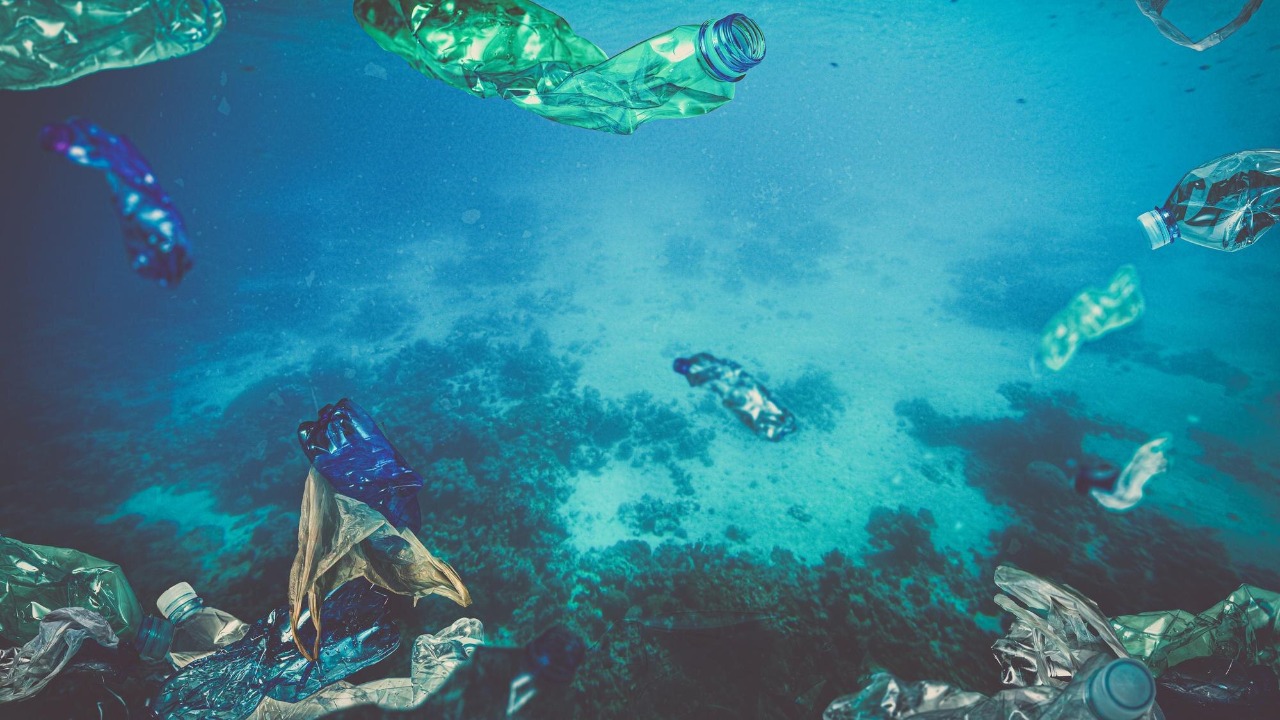

Far below the ocean’s surface, tiny plastic fragments are accumulating in thick, drifting clouds that rival any garbage patch at the top of the sea. What once looked like a surface litter problem is now emerging as a deep ocean crisis, with microplastics concentrating faster and spreading farther than early models ever anticipated. I see a pattern in the latest research that is hard to ignore: the seafloor is becoming the final sink for a plastic era that shows no sign of slowing.
The missing plastic was never missing at all
For years, scientists struggled to reconcile how much plastic humanity produces with how little they could actually find floating at the surface. The numbers did not add up, and the gap became known as the mystery of the “missing” plastic. A British scientist working with the journal Royal Society Open Science helped reframe that puzzle by showing that vast quantities of microplastic fibers had already sunk into some of the most remote places on Earth, revealing that the deep ocean had quietly become a major reservoir for this pollution and that the problem was never confined to what we could see from ships or satellites.
That early work has since been reinforced by global surveys that now detect thousands of microparticles from the surface to the ocean’s deepest layers, including the Mariana Trench, using extensive sampling networks. When I look across these findings, the throughline is clear: what once seemed like a surface scum of bottles and bags is only the visible fraction of a much larger, vertically distributed plastic load that has already infiltrated the full depth of the water column.
Deep-sea currents and avalanches are building plastic hotspots
The deep ocean is not a quiet, uniform graveyard for plastic; it is a dynamic landscape where powerful flows sort and stack microplastics into dense drifts. Apr research led by Scientists has shown that fast-moving underwater avalanches can drive deep-sea microplastic hotspots, with sediment-laden currents racing downslope and concentrating fragments in narrow bands on the seafloor. These findings, which track how fast flows behave in a real-world setting, suggest that microplastics are not simply raining down like dust but are being actively transported and trapped by the same forces that shape submarine canyons and fans.
Other work has found that these underwater avalanches can dump tons of Microplastics into the deep ocean in a single event, with Apr reporting that such Underwater flows in places like the Tyrrhenian Sea are already creating thick layers of plastic-laced sediment that are worse than was thought. When I connect these studies, I see a system where gravity-driven slides and contour currents are quietly building long-lived plastic deposits, turning certain deep basins and slopes into pollution hotspots that rival any coastal landfill, only hidden thousands of meters below the waves.
Global currents are spreading microplastics around the world
Beyond avalanches, the everyday circulation of the deep ocean is redistributing microplastics on a planetary scale. Earlier work on deep-sea currents showed that in some places the concentration of fragments becomes so high that the water resembles a cloudy soup, with microplastics of many shapes and sizes suspended in thick layers that follow the contours of the seabed. In that research, Jun observations linked the thickest piles of debris to energetic bottom currents, a pattern that helps explain why some canyons and ridges are far more contaminated than adjacent areas and why the deep ocean is patchy rather than evenly polluted, a point vividly illustrated in a Jun explainer on how these flows work.
More recent analysis has sharpened that picture by showing that, Previously, scientists assumed most microplastics on the seafloor simply sank from surface slicks near pollution sources, but detailed mapping now indicates that deep-sea currents are behind the ocean’s thickest piles and are actively spreading microplastics around the globe. The study that highlighted this shift used targeted poll techniques to trace how fragments are swept along deep boundary currents, suggesting that even remote abyssal plains are being fed by a conveyor belt of plastic that starts near shore and ends thousands of kilometers away.
Microplastics are now documented at all ocean depths
What once required inference is now directly measured: microplastics are present from the sunlit surface to the darkest trenches. A New NSF supported study reported that Researche teams have discovered microplastics at all ocean depths, using coordinated sampling to show that no layer of the water column is free from contamination. The work, which involved a professor at Northeastern University, underscores that the deep ocean is not just a passive sink but part of a continuous vertical pathway in which particles move up and down with currents, marine snow, and animal migrations, a pattern that complicates any attempt to isolate the problem to a single zone.
Complementing that, a decade of testing by Northeastern scientists has shown that Plastics are abundant at deep-sea levels, with professor Aron Stubbins noting that the sheer spread of fragments throughout the ocean is surprising given how little was initially detected at the surface. In that research, the team found that Plastics are not confined to coastal shelves or gyre centers but are woven into deep pelagic waters and sediments, reinforcing the conclusion that the entire ocean system is now threaded with synthetic debris.
The scale of the plastic load keeps rising
Even as deep surveys reveal how far microplastics have spread, surface counts show that the total load entering the ocean is still climbing. Jun analysis from advocates tracking ocean litter estimates that Roughly 170 trillion plastic particles, weighing 2.3 m metric tons, now circulate in surface waters alone, a figure that reflects decades of cumulative waste rather than a single spike in pollution. When I weigh that number against the deep ocean findings, it becomes clear that what floats at the top is only the leading edge of a much larger mass that will continue to fragment and sink for generations.
Earlier work had already warned that the number of tiny plastic pieces polluting the world’s oceans was vastly greater than thought, with Mar research using refined poll methods to show that microplastic counts in some regions were orders of magnitude higher than earlier net tows suggested. When I connect those warnings to the newer global sampling that finds thousands of microparticles even in the Mariana Trench, the conclusion is unavoidable: the ocean’s plastic burden is not just larger than expected, it is still accelerating, and the deep sea is absorbing a growing share of that load.
From surface trash to deep ocean food webs
Microplastics do not stop being a problem once they sink; they simply enter a different set of food webs. Studies of midwater and deep-sea organisms have shown that many species mistake plastic fragments for prey, ingesting fibers and shards that can clog their guts and reduce their ability to feed. As one synthesis put it, the material can clog their guts, and because the chemistry of plastic tends to attract pollutants in the ocean, contaminated fragments can become even more dangerous to eat, a dynamic highlighted in Jun reporting on how deep-diving predators accumulate these particles.
Closer to shore, ecologists have documented how Microplastics enter the food web when small organisms like zooplankton, shellfish, and larval fish ingest them, often resulting in their death or sublethal stress that ripples up the chain. As Plastic breaks down instead of biodegrading, it creates a steady supply of minuscule particles that are easily mistaken for food, a process described in detail by researchers tracking how Microplastics move from plankton to larger predators. When I consider that the same mechanisms operate in the deep ocean, where many animals feed by filtering or scavenging sediment, it becomes clear that seafloor plastic deposits are not inert; they are active sources of exposure for entire deep ecosystems.
Human health is now part of the deep ocean story
For a long time, the health conversation around microplastics focused on seafood and coastal pollution, but the emerging science is pushing that boundary. Research on the health impacts of microplastics in humans is just beginning, yet scientists have already found particles in multiple organs and tissues, including blood, lungs, and even a newborn’s first stool, according to Jan Research. While the clinical consequences are still being mapped, the simple fact that synthetic fragments are now detectable in such intimate parts of the body underscores how thoroughly plastic has permeated the systems that feed and sustain us.
The link to the deep ocean may seem indirect, but it is real. Many commercially important fish and invertebrates spend part of their life cycle at depth, feeding in waters and on sediments that are now known to be laced with microplastics at all ocean depths. As those animals move back toward the surface and into fisheries, they can carry ingested fragments and associated chemicals with them, tightening the feedback loop between deep ocean contamination and human exposure. When I connect the dots from deep-sea hotspots to supermarket seafood and then to microplastics in human tissue, the picture that emerges is not just an environmental issue but a public health question that will demand far more attention.
Why the deep ocean problem is worse than it looks
Part of what makes the deep ocean microplastic crisis so troubling is that it is largely invisible and effectively permanent on human timescales. Unlike surface slicks that can, at least in theory, be skimmed or intercepted, fragments buried in sediments or circulating in abyssal currents are practically impossible to remove. The Apr reports on underwater avalanches dumping tons of Microplastics into deep basins, combined with evidence that Underwater flows are still reshaping those deposits, suggest that each major event locks in a new layer of contamination that will persist for centuries, a pattern described in detail in the Microplastics crisis coverage.
On top of that, the deep ocean is still poorly monitored compared with coastal waters, which means that by the time we detect a new hotspot, it has often been building for years. The global Nature study that found thousands of microparticles even in the Mariana Trench, framed with the word However to emphasize how its results overturned earlier assumptions, relied on hundreds of sampling stations to reveal a pattern that had been hiding in plain sight. When I weigh that against the long-standing warnings from Royal Society Open Science work and other early deep surveys, I am left with a sobering conclusion: if anything, current estimates of deep ocean plastic are likely conservative, and the true scale of accumulation may only become clear as more ambitious expeditions probe the abyss.
What it will take to slow the deep ocean plastic tide
Given how entrenched microplastics already are in the deep sea, the most realistic strategy is to slow the flow at the source rather than fantasize about vacuuming the abyss. That means cutting the production and loss of disposable Plastic on land, redesigning packaging and textiles to shed fewer fibers, and improving waste systems so that fewer fragments ever reach rivers and coasts. The surface estimate of Roughly 170 trillion particles weighing 2.3 m metric tons is not just a statistic; it is a warning that every additional ton of unmanaged waste today is tomorrow’s deep ocean sediment layer, a connection made explicit in the Jun analysis of how microplastics are changing the oceans.
At the same time, I see a growing recognition among scientists and policymakers that any credible response must account for the full three-dimensional ocean, not just surface gyres. The New NSF supported work that documented microplastics at all depths, the Northeastern findings on deep-sea abundance, and the Apr studies on underwater avalanches together provide a roadmap for where monitoring and regulation need to focus next. If we treat the deep ocean as an out-of-sight dumping ground, the plastic tide will continue to build in silence; if we instead use these findings to tighten controls on pollution and invest in better tracking, we at least have a chance to keep the problem from getting dramatically worse than it already is.
More from MorningOverview