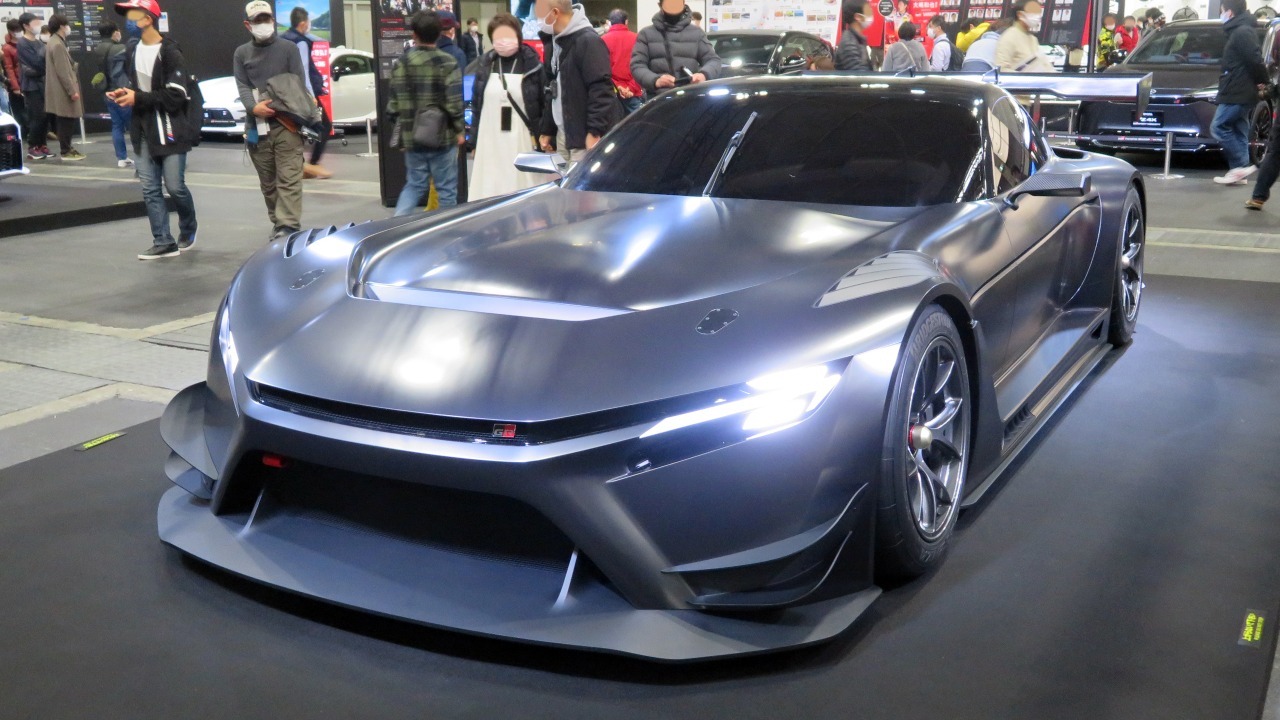

The Toyota GR GT arrives as a rare kind of halo car, one that pairs a twin-turbo V8 hybrid powertrain with proportions that look more like a concept sketch than a production compromise. It is Toyota’s most aggressive statement yet that electrification and emotion can coexist in a front-engined supercar aimed squarely at the world’s most exotic machinery. From its Batmobile-like stance to its motorsport-bred engineering, this is a first look at a machine designed to reset expectations of what a Toyota performance flagship can be.
Rather than chasing nostalgia or pure efficiency, the GR GT leans into drama, power and racing technology, then wraps it all in a package that is meant to be driven hard on road and track. The result is a V8 hybrid supercar that does not apologize for its size, its aero or its soundtrack, and that signals how Toyota Gazoo Racing intends to shape the next era of high-performance cars.
From GR GT3 concept to road-going GR GT
The GR GT did not appear out of thin air, it is the production realization of the GR GT3 concept that Toyota first showed nearly four years ago as a pure motorsport study. That earlier car previewed a long-hood, cab-backward silhouette and a front-engined layout that broke from the mid-engined orthodoxy dominating modern supercars, and Toyota has now confirmed that the GR GT carries that DNA into showrooms as a fully fledged road car. The company has finally let slip the name of its new supercar, positioning the GR GT as the bridge between its racing programs and its most ambitious street performance model.
In parallel with the road car, Toyota is also developing a competition version that traces directly back to the GR GT3 concept, reinforcing that this is not a styling exercise but a homologation-minded platform. Earlier teasers made clear that Toyota was preparing to unveil the GR GT as a production model born from that concept, while also acknowledging that the original show car used a V8 without confirmed hybrid hardware, a gap the finished GR GT now closes with its electrified drivetrain. That evolution from pure combustion prototype to V8 hybrid road and race package is central to how Toyota wants this car to be seen.
Batmobile stance and outrageous proportions
The first impression of the Toyota GR GT is visual shock, a front-engined coupe that looks more like a Batmobile than a traditional grand tourer. The car sits low and wide, with a prowling nose, a dramatically stretched hood and a cabin pushed far back toward the rear axle, creating a profile that reads like a long-distance racer adapted for the street. Its surfaces are taut rather than fussy, with sharp creases, deep cutouts and a rear section that appears almost cartoonishly muscular, all of which contribute to the sense that this is a supercar that hits as hard as it looks.
Underneath the drama, the proportions are carefully engineered, with a long wheelbase that stabilizes the chassis and allows the designers to carve out those extreme overhangs and flared haunches. The rear three-quarter view in particular shows how the bodywork swells over the driven wheels, emphasizing traction and power delivery while also housing serious aero elements and cooling hardware. It is a look that some will inevitably compare to comic-book hero cars, but the underlying message is clear: this is a front-engined supercar that embraces absurd proportions and race-driven packaging, a point underscored by the Lots of detail work visible in every panel.
V8 hybrid powertrain and performance targets
At the heart of the GR GT is a twin-turbocharged V8 hybrid system that signals Toyota’s intent to keep internal combustion at the center of its performance strategy, even as it layers in electrification. The engine itself is a front-mounted V8 that works with electric assistance to deliver a combined output of at least 641 hp, a figure that immediately places the car in contention with established European and American supercars. Rather than using the hybrid system as a token efficiency add-on, Toyota appears to have integrated it as a core performance tool, sharpening throttle response and filling in torque where the turbos might otherwise lag.
The platform and packaging are tailored around this powertrain, with the GR GT built on a dedicated architecture that supports its front-engine layout, long hood and 2724 mm (107.2-inch) wheelbase. That wheelbase length is not incidental, it helps balance high-speed stability with agility while also creating room for the hybrid hardware and cooling systems without compromising cabin space. The combination of a twin-turbo V8, electric boost and a chassis tuned for both track and road use suggests that Toyota is targeting acceleration and top-speed figures that match or exceed the current crop of front-engined exotics, a direction supported by early reporting that the car’s hybrid V8 delivers at least 641 hp in its initial specification, as detailed in coverage of the Toyota GR GT Looks Like powertrain.
Chassis, aero and motorsport-bred engineering
The GR GT’s dramatic bodywork is not just for show, it is the visible expression of a chassis and aero package that borrows heavily from Toyota’s racing programs. The long, low nose and sculpted front bumper channel air into radiators and brake ducts, while the side intakes and rear diffuser manage airflow around and under the car to generate meaningful downforce. The roofline and rear deck are shaped to keep the car stable at very high speeds, with the cabin’s position helping to centralize mass even though the engine sits ahead of the driver.
Under the skin, the structure is designed to be both stiff and relatively light, with extensive use of high-strength materials and a layout that prioritizes suspension geometry and packaging for the hybrid system. The suspension itself is expected to reflect motorsports-bred vehicle development techniques, with geometry and tuning informed by Toyota Gazoo Racing’s experience in GT and endurance competition. That connection is not accidental, and early impressions from Woven City in Japan, where the car was revealed alongside other Gazoo Racing projects, emphasize how the GR GT’s silhouette and stance feel like something out of a pit lane rather than a conventional showroom, a point highlighted in first-look coverage from Woven City, Japan for the debut.
Interior philosophy and driver focus
While the exterior grabs attention, the GR GT’s cabin is where Toyota has to reconcile its motorsport ambitions with the expectations of a modern supercar buyer. The driving position is likely to be low and snug, with the dashboard and controls oriented around the driver in a way that echoes GT racing cockpits more than luxury grand tourers. Materials will lean heavily on lightweight composites, Alcantara-style fabrics and exposed structural elements, signaling that this is a car built for serious driving rather than opulent cruising.
At the same time, Toyota understands that a flagship like this must function in the real world, so the interior will need to integrate contemporary digital interfaces, connectivity and at least a baseline of comfort features. Expect a compact steering wheel with integrated controls, a configurable digital instrument cluster and a central display that can surface performance data as readily as navigation or media. The balance will be delicate: too much tech and the car risks feeling like any other high-end coupe, too little and it could alienate buyers who want their supercar to double as a daily driver. The GR GT’s mission suggests that Toyota will err on the side of driver focus, with a cockpit that feels like an extension of the chassis rather than a rolling lounge.
Positioning within Toyota’s performance hierarchy
The arrival of the GR GT forces a reshuffle of Toyota’s performance ladder, sitting above the GR Supra, GR Yaris and GR Corolla as a true halo model. Where those cars translate motorsport lessons into relatively attainable packages, the GR GT is unapologetically exclusive, intended to showcase what Toyota Gazoo Racing can do when cost and volume are no longer the primary constraints. It also gives Toyota a direct answer to rival brands that have long used front-engined V8 or V12 flagships to define their performance image.
Crucially, the GR GT also reframes how Toyota approaches electrification in its performance lineup. Rather than debuting a pure battery-electric halo car, the company has chosen a V8 hybrid that keeps combustion at the center of the experience while using electric power as a performance enhancer. That decision aligns with Toyota’s broader strategy of offering multiple powertrain paths and suggests that future GR products could adopt similar hybridized setups. In that sense, the GR GT is not just a one-off statement piece, it is a template for how Toyota might blend internal combustion and electrification across its most serious driver’s cars.
How the GR GT stacks up against rival supercars
On paper, the GR GT’s combination of a twin-turbo V8 hybrid system and at least 641 hp places it in the same conversation as front-engined heavy hitters from Europe and America. Its long-hood, cab-backward layout invites comparison with cars like the Ferrari 812 and Aston Martin’s V12 flagships, while its hybrid assistance and likely all-wheel-drive capability echo the approach taken by some mid-engined rivals. Where the Toyota diverges is in its unapologetically aggressive styling and its explicit link to GT racing, which give it a more hardcore aura than many of the grand touring-oriented exotics it will inevitably be measured against.
Price and production numbers remain unverified based on available sources, but the GR GT’s positioning as a halo model suggests that Toyota is less concerned with undercutting rivals on cost than with matching or exceeding them on performance and presence. The car’s Batmobile-like stance, absurd proportions and motorsport-bred engineering give it a distinct identity that should resonate with buyers who want something more radical than a traditional luxury GT. In a segment where differentiation is everything, the GR GT’s blend of hybrid power, front-engined layout and race-inspired design could prove to be its most compelling advantage.
What the GR GT signals about Toyota’s future
The GR GT is more than a single model, it is a statement about where Toyota sees the intersection of performance, electrification and brand identity. By committing to a twin-turbo V8 hybrid supercar at a time when many manufacturers are pivoting to all-electric flagships, Toyota is signaling that it believes there is still room for combustion-powered emotion in the upper reaches of the market. The car’s development path, from GR GT3 concept to production GR GT with hybrid hardware, also shows how closely the company intends to tie its racing and road-car programs together.
Looking ahead, the technologies and philosophies embedded in the GR GT are likely to filter down into more accessible models, from hybridized drivetrains to aero and chassis solutions honed on track. The car’s presence at Woven City, alongside other advanced projects, hints at a future in which Toyota uses its performance flagships as rolling laboratories for new ideas that can eventually reach mainstream products. For now, though, the GR GT stands as a bold new benchmark, a V8 hybrid supercar that looks like a Batmobile, hits like a supercar and marks a decisive new chapter in Toyota’s performance story.
More from MorningOverview