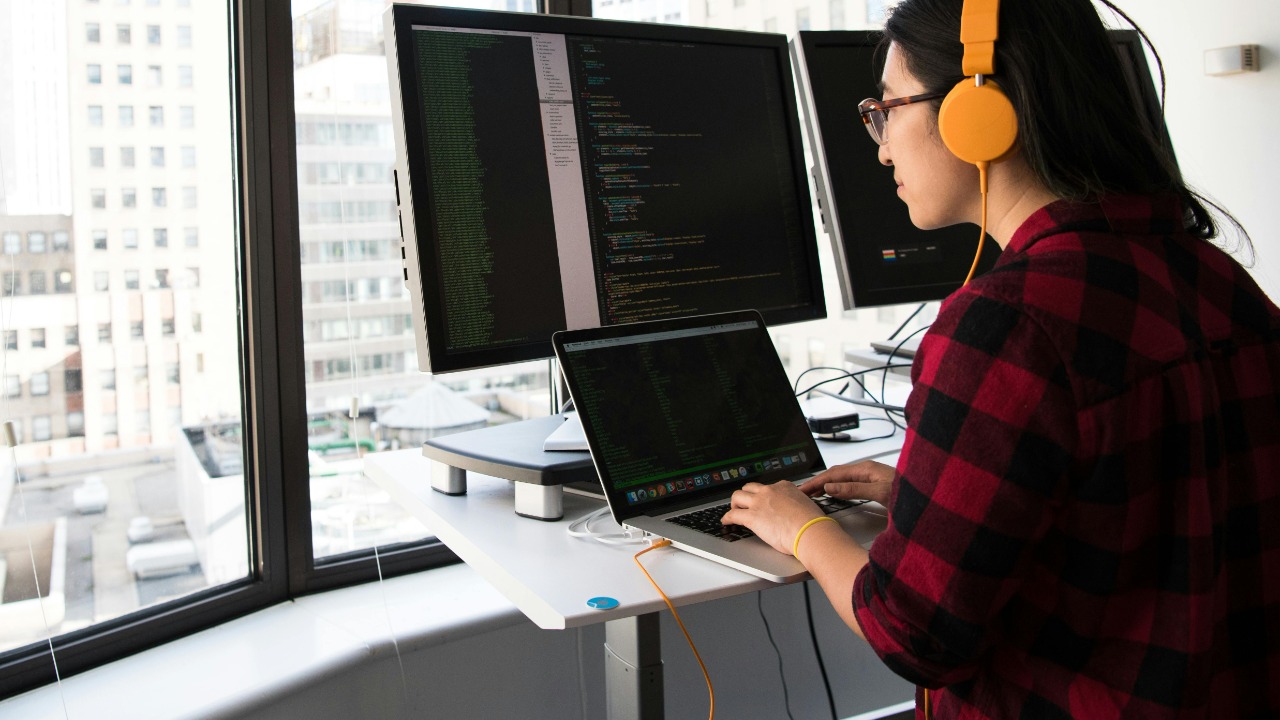

Quantum physics has a reputation for needing exotic hardware, from liquid-helium-cooled qubits to sprawling AI clusters, just to crunch through basic simulations. Now a new “physics shortcut” is quietly rewriting that assumption, letting ordinary laptops tackle quantum problems that once demanded supercomputers and bespoke machine learning pipelines.
By blending classical and quantum rules in a carefully controlled way, researchers have found a route to simulate complex quantum systems with far less computational muscle than before. The result is not a toy approximation but a practical method that could put serious quantum modeling within reach of graduate students, startup engineers, and even curious hobbyists armed with nothing more than a decent notebook.
How a semiclassical shortcut shrinks quantum down to laptop size
The core trick behind this leap is a family of techniques known as semiclassical physics, which treat some parts of a system with full quantum mechanics while handling others with simpler classical rules. Instead of tracking every possible quantum state, the method focuses on the pieces that matter most and lets the rest follow more familiar trajectories, which slashes the computational cost without throwing away the underlying physics. Physicists have now refined this approach into a shortcut that lets standard laptops model quantum behavior that used to be the exclusive domain of supercomputers and large AI models, a shift detailed in new work on a physics shortcut that lets laptops tackle quantum problems.
At the heart of this shortcut is a simple but powerful idea: most real-world quantum systems do not need to be simulated at full resolution all the time. By identifying which degrees of freedom must remain quantum and which can safely be treated classically, the algorithm trims the problem down to something a consumer CPU can handle. That is why Dec and other Physicists involved in the work emphasize that the advance is not about dumbing down quantum theory, but about using the structure of the equations to avoid unnecessary calculations that previously forced researchers to rely on specialized AI accelerators.
The Power of Semiclassical Physics TWA, updated for the laptop era
The new shortcut builds on a lineage of ideas that stretches back to The Power of Semiclassical Physics TWA, a method that dates to the 1970s and was originally designed to approximate quantum dynamics in systems where full solutions were out of reach. That earlier approach, known as the truncated Wigner approximation, treated quantum fluctuations as a kind of noise layered on top of classical motion, which worked well for certain isolated systems but struggled once interactions and energy exchange became more complicated. Researchers have now revisited that foundation with modern numerical techniques, extending it into regimes where energy is not perfectly conserved and where particles interact strongly, which is exactly where many of today’s quantum technology questions live.
By carefully generalizing The Power of Semiclassical Physics TWA to handle situations where no energy is gained or lost as well as those where dissipation and driving forces matter, the team has turned a once niche tool into a broadly useful engine for quantum simulation. Their updated framework can follow the evolution of many-body systems that would previously have required vast clusters, yet it still runs on a single machine, as described in new work on solving quantum mysteries without supercomputers. In practice, that means researchers can now explore quantum phase transitions, entanglement growth, and non-equilibrium dynamics with tools that fit on a lab bench instead of in a national computing center.
From supercomputers and AI clusters to ordinary laptops
For years, the standard path to serious quantum simulation ran through high performance computing centers and, more recently, AI infrastructure. Modeling even a modest lattice of interacting particles could require tracking an astronomical number of quantum states, which pushed scientists toward supercomputers with tens of thousands of cores or toward neural networks trained to approximate the underlying physics. The new shortcut changes that equation by compressing the problem into a form that an ordinary laptop can chew through, as highlighted in reports on a breakthrough physics shortcut that solves quantum problems on an ordinary laptop.
That shift is not just about convenience, it is about who gets to participate in frontier research. When only a handful of institutions can afford the necessary compute, the pace and diversity of ideas are limited by access. By contrast, if a graduate student can run a full quantum dynamics study on a midrange notebook, or a small startup can prototype quantum materials models without renting time on a supercomputer, the field opens up. The fact that a team of physicists from the Universit of Buffalo and collaborators can now demonstrate laptop-scale simulations that once demanded enormous computing power signals a broader democratization of quantum modeling that will ripple through both academia and industry.
University at Buffalo’s cost-saving expansion of quantum simulation
One of the clearest demonstrations of this new approach comes from a team at the University at Buffalo, which has expanded a cost effective method for simulating quantum systems so it no longer needs access to the largest machines. Their work shows that by reformulating the equations and leaning on semiclassical insights, they can handle complex many-body problems that used to demand enormous computing power, yet do so on hardware that fits in a typical office. The group’s results on how they have expanded a cost effective quantum simulation technique are detailed in a report on a team at the University at Buffalo that made it possible to simulate complex quantum systems without a supercomputer.
What stands out in the Buffalo work is not just the raw efficiency, but the way it reframes the trade off between accuracy and accessibility. Instead of treating high fidelity quantum simulation as something that must always live on national lab infrastructure, the researchers show that clever physics can substitute for brute force. By targeting the aspects of the system that drive observable behavior and trimming away redundant calculations, they preserve predictive power while slashing cost. That philosophy aligns closely with the broader semiclassical shortcut movement and hints at a future where universities and companies in Buffalo, not just in traditional tech hubs, can run cutting edge quantum studies on their own machines.
Inside the shortcut: how semiclassical physics balances quantum detail
At a technical level, the new method leans on the idea that not every part of a quantum system needs to be treated with the same level of mathematical rigor. Semiclassical physics involves treating parts of a system with classical equations of motion while still capturing the essential quantum fluctuations that drive interference and entanglement. By splitting the problem this way, the algorithm avoids the exponential explosion of states that plagues fully quantum approaches, yet it still reproduces the behavior of quantum systems with impressive fidelity, as explained in work describing how semiclassical physics involves treating parts of a system classically while capturing quantum behavior.
In practice, this means the shortcut can follow the evolution of large ensembles of particles by tracking a manageable number of classical trajectories, each seeded with quantum noise that encodes the uncertainty and correlations of the underlying state. The method then reconstructs observables by averaging over these trajectories, which is far cheaper than evolving a full quantum wavefunction. Because the approach is rooted in the structure of the equations rather than in a black box neural network, physicists can also inspect and refine the approximations, which gives them confidence when they apply the shortcut to new materials, cold atom experiments, or quantum information protocols.
Why averaging many simplified runs still captures quantum reality
One natural concern with any shortcut is whether it glosses over the very quantum effects that make these systems interesting. The researchers address that by running many simplified calculations, each one a slightly different classical realization of the same underlying quantum state, and then averaging the results. This ensemble approach recovers the statistical behavior of the full quantum system, including interference patterns and correlation functions, without ever needing to store the entire state vector, as described in work showing that by running these simplified calculations and averaging the results, researchers get a sufficient picture of how the quantum system behaves even when it is not completely isolated from outside forces.
The key is that the shortcut is designed to respect the conservation laws and symmetries that govern the real system, so the averaged outcome remains faithful to the physics. When the environment plays a role, the method can incorporate decoherence and dissipation by adjusting how the trajectories are sampled and weighted, which lets it handle systems that are not completely isolated from outside forces. That flexibility is crucial for modeling realistic devices, from quantum sensors operating in noisy labs to qubits embedded in solid state platforms, and it is a major reason why the shortcut is attracting attention beyond pure theory circles, as highlighted in reports on how averaging simplified calculations can capture quantum behavior even when systems are not isolated.
What this means for quantum hardware, AI, and NASA-scale problems
The immediate impact of this shortcut is on simulation, but the ripple effects reach into quantum hardware design and AI research. If engineers can model candidate qubit architectures or error correction schemes on laptops instead of waiting in line for supercomputer time, they can iterate faster and explore more designs. That agility matters for everything from superconducting circuits to trapped ion arrays, where subtle quantum interactions can make or break a platform. It also changes how AI is used in physics, shifting machine learning from a crutch for raw compute into a complementary tool that can refine or guide semiclassical models rather than replace them.
On the most ambitious front, the fact that NASA is studying these methods for its own quantum and space science problems underscores how far the shortcut can scale. When agencies that routinely work with planetary climate models and deep space navigation see value in a laptop friendly quantum tool, it signals that the technique is robust enough for mission critical questions. Reports on a breakthrough physics shortcut being studied by NASA describe how the same framework that helps a graduate student in a campus lab could also inform the design of quantum sensors for space missions or the analysis of exotic matter in astrophysical environments.
Democratizing quantum research for students, startups, and beyond
Perhaps the most transformative aspect of this development is how it lowers the barrier to entry for serious quantum work. When a decent consumer laptop can run simulations that once required a dedicated cluster, the pool of potential contributors expands dramatically. Students at smaller institutions, researchers in emerging tech ecosystems, and engineers at early stage startups can all test ideas without waiting for scarce compute allocations. That shift mirrors earlier moments in computing history, when tools that once lived only in elite labs migrated to desktops and then to smartphones, triggering waves of innovation that no central planner could have scripted.
There is also a cultural change that comes with this kind of accessibility. Quantum physics has long carried an aura of exclusivity, reinforced by the specialized hardware and opaque algorithms needed to do anything beyond textbook problems. A shortcut that runs on everyday machines chips away at that mystique and invites more people to treat quantum systems as something they can experiment with directly. As Dec and other Physicists refine these semiclassical tools and as groups like the University at Buffalo continue to expand cost effective methods, the line between “classical” and “quantum” computing in practice may blur, not because qubits have suddenly appeared in every laptop, but because clever physics has made quantum style thinking a routine part of everyday computation.
More from MorningOverview