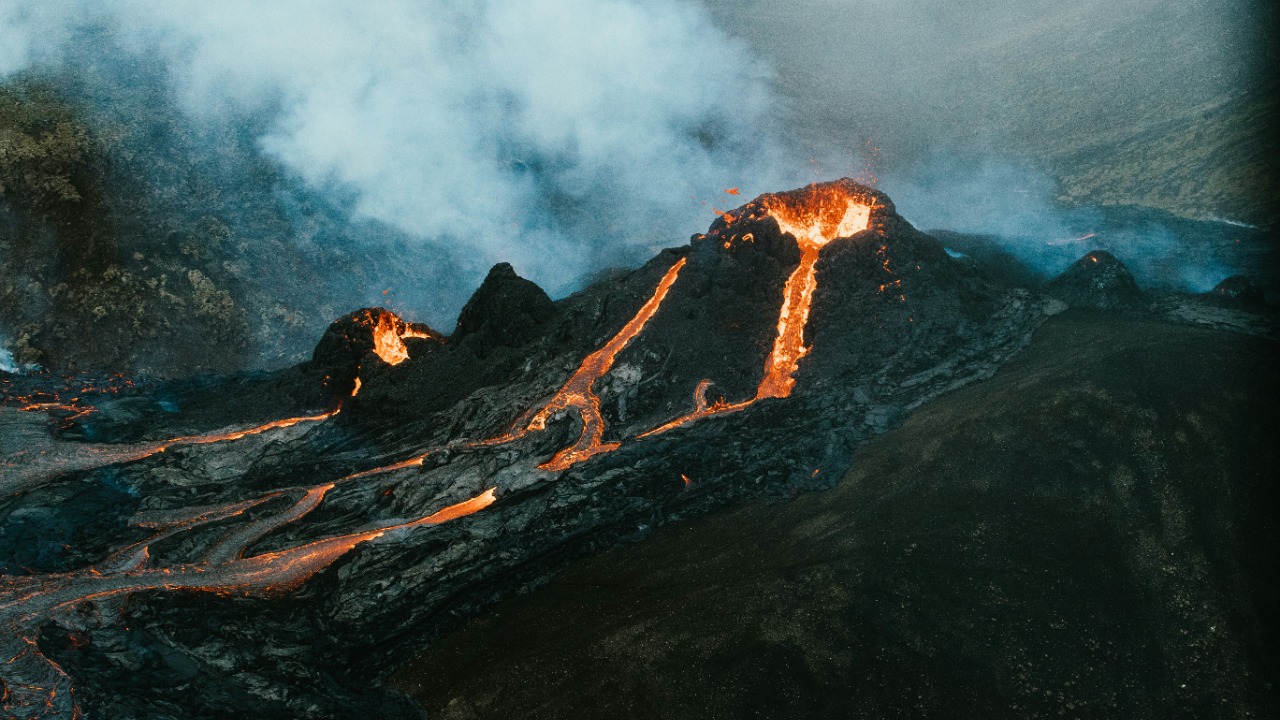

Far beneath the forests and hot springs of the American West, the continent’s largest active volcanic system is rumbling in ways scientists are only now beginning to fully resolve. New seismic discoveries, sharper images of the magma reservoir, and fresh public anxiety have converged to make Yellowstone’s buried supervolcano feel less like a distant abstraction and more like a live geologic engine that demands attention.
The emerging picture is not of an imminent doomsday blast, but of a restless system that is very much alive, slowly shifting and cracking the crust as magma moves below. As I sift through the latest research and official monitoring data, the story that emerges is one of subtle but significant stirring, paired with a scientific consensus that the odds of a catastrophic eruption in our lifetimes remain extremely low.
America’s hidden giant under Yellowstone National Park
To understand why any hint of activity at Yellowstone commands global headlines, I start with its sheer scale. The caldera sprawls across northwest Wyoming and into neighboring states, a buried scar from past eruptions that reshaped the landscape on a continental scale. Visitors who drive the loop roads and photograph bison rarely see the outline, but satellite views and geologic mapping reveal a vast depression beneath Beneath the steaming geysers and bubbling mud pots of Yellowstone National Park. That hidden basin is the surface expression of one of the largest magma systems on Earth, a reservoir that has powered some of the planet’s most dramatic volcanic events.
Geologists classify Yellowstone as a supervolcano because of the size of its past eruptions, not because it behaves differently from other volcanoes. Over roughly 2.1 m years, the system has produced at least three colossal outbursts, each one ejecting hundreds of cubic kilometers of ash and lava. One key analysis notes that Yellowstone has erupted three times in the last 2.1 m years, most recently about 640,000 years ago, a span that often gets misinterpreted as a ticking clock. In reality, those intervals are irregular, and the system has spent far more time quietly leaking heat and gas than exploding.
A restless history written in ash and rock
When I look at Yellowstone’s rock record, what stands out is not a neat pattern of eruptions, but a messy, episodic history. The three known supereruptions, including the one roughly 640,000 years ago, left thick sheets of ash that blanket much of North America and form welded tuffs across the region. These deposits, combined with lava flows and smaller explosive events, show that the system can shift from cataclysmic blasts to more modest outbursts and long pauses. The 2.1 m year timeline underscores that Yellowstone’s behavior is measured in geologic time, not human news cycles.
Between those giant eruptions, the volcano has vented through less dramatic but still powerful lava flows and hydrothermal explosions. The modern geyser basins, with their boiling pools and periodic jets, are the surface expression of this slow bleed of heat. Scientists studying place-based evidence around the caldera see a landscape that has been repeatedly uplifted, fractured, and flooded with ash, then slowly eroded and vegetated. That long view is essential context for interpreting any new signs of unrest today.
What the latest USGS updates really say
Public anxiety tends to spike whenever Yellowstone appears in official bulletins, so I pay close attention to how the monitoring agencies frame their updates. The U.S. Geological Survey maintains a dedicated page for volcano updates that tracks earthquakes, ground deformation, and changes in geyser activity. The language there is deliberately technical and measured, reflecting a network of seismometers, GPS stations, and gas sensors that feed continuous data into expert analysis. When the alert level is unchanged and the color code remains at its baseline, that is itself a significant statement: the system is active, but not escalating toward eruption.
One recent update highlights how precise this monitoring has become, down to coordinates and cataloged events. In a detailed notice, scientists describe activity at YELLOWSTONE (VNUM #325010) at 44°25’48” N 110°40’12” W, explicitly citing the figures 44 and 48 as part of the location reference. That same bulletin, issued on a Monday in early Dec and timestamped in both MST and UTC, notes that a period of elevated geyser activity that began in 2018 has probably ended, a reminder that surface changes can wax and wane without signaling deeper danger. The careful wording in that VNUM report is a counterweight to the more breathless social media chatter that often follows.
86,276 “secret” earthquakes and what they really mean
Perhaps the most headline-grabbing development this year has been the revelation of tens of thousands of previously undetected microquakes beneath Yellowstone. Using machine learning techniques, researchers combed through years of seismic data and identified a swarm of tiny tremors that standard methods had missed. The study reports that Using machine learning technology, a branch of AI, they found there were over 86,276 hidden earthquakes at Yello, a figure that sounds alarming until you understand the scale and sensitivity involved.
In practical terms, those 86,276 events are more like a stethoscope turned up to maximum volume than a sign of impending catastrophe. Most of the quakes are so small that no one at the surface would ever feel them, and they cluster along known fault zones and fluid pathways where magma and hot water are already expected to move. When I compare this AI-enhanced catalog to the long-term seismic record, what emerges is a more detailed picture of a system that has always been noisy. The discovery refines our understanding of how the crust creaks and adjusts above the magma reservoir, but it does not, on its own, indicate that a major eruption is close.
How scientists define real eruption “Precursors”
To separate background rumbling from genuine warning signs, volcanologists rely on a set of well-established criteria. Official guidance on Precursors to volcanic eruptions emphasizes strong earthquake swarms, rapid ground deformation, and significant changes in gas emissions as the key indicators that magma is moving toward the surface. These changes typically unfold over days to weeks before an eruption, and at a supervolcano they would likely be large enough to be unmistakable in the monitoring data. The AI-detected microquakes, by contrast, are scattered and low in magnitude, more consistent with routine adjustments in the crust.
Scientists also stress that Yellowstone is one of the most heavily instrumented volcanic systems on the planet, precisely because of its supervolcano status. Networks of GPS receivers track uplift and subsidence of the ground to within millimeters, while gas sensors sniff for shifts in carbon dioxide and sulfur dioxide that might signal fresh magma degassing. When I look at the combined record, I see fluctuations that reflect a living system, but not the kind of sustained, accelerating pattern that would match the textbook definition of eruption precursors. That distinction is crucial for interpreting any new tremor or geyser change that bubbles into the news cycle.
Inside the magma system: a sponge, not a ticking bomb
Beneath the caldera, the magma reservoir itself is more complex than the popular image of a single, giant chamber of molten rock. Recent imaging work suggests a patchwork of partially molten zones embedded in solid rock, with melt percentages that vary across depth and location. One study, highlighted earlier this year, explains that despite the large volume of magma pooling below the caldera, the rock behaves more like a sponge saturated with melt than a fully liquid lake. The analysis notes that Despite the large volume of magma, the caldera is not likely to erupt anytime soon because much of that melt is locked in a crystalline framework, like water in a sponge.
That “sponge” analogy matters because it reframes what it means for Yellowstone to be “full” of magma. A high melt fraction in a localized zone could feed smaller eruptions or vigorous hydrothermal activity without triggering a system-wide collapse. When I compare this nuanced picture to the more dramatic narratives that circulate online, the gap is stark. The latest imaging, combined with the AI-enhanced seismic catalog, points to a dynamic but mostly solid crust that is slowly evolving, not a pressurized balloon on the verge of bursting. Understanding that structure helps explain why official assessments continue to downplay the risk of a near-term supereruption even as they acknowledge ongoing unrest.
“Not about to end humanity”: what new studies actually conclude
Public fascination with Yellowstone often gravitates toward worst-case scenarios, so it is notable when new research explicitly pushes back on apocalyptic interpretations. A recent study that examined magma storage and eruption probabilities was widely mischaracterized in some corners of the internet as proof that a disaster was imminent. In reality, the authors and affiliated scientists emphasized that this was Not only not the focus of the new USGS study, but that the data collected came to nearly the opposite conclusion, reinforcing the view that the supervolcano still is not about to end humanity.
When I read those findings alongside the official monitoring statements, a consistent message emerges: Yellowstone is active, and it will erupt again someday, but the odds that this will happen on a human timescale, let alone in a civilization-ending way, are extremely low. The study’s careful framing underscores a broader challenge for scientists, who must communicate real uncertainty without feeding either complacency or panic. By clarifying that the research refines our understanding of magma storage rather than predicting a specific eruption window, the authors are trying to keep the public conversation anchored in evidence instead of fear.
What a true supereruption would mean for Earth and society
Even as I emphasize that a supereruption is unlikely in the near term, it is impossible to ignore the scale of the hazard if such an event did occur. Historical analogs and modeling suggest that ash from a Yellowstone-scale blast would blanket much of North America, disrupt agriculture, and ground air travel across multiple continents. One detailed scenario describes a planetary peril in which the devastation would spread far beyond the surrounding region, with a stone monument atop Semeru used as a reminder of how even smaller eruptions can leave lasting scars. In a true supereruption, millions could die directly from ash falls, pyroclastic flows, and toxic fumes.
Beyond the immediate blast zone, the climate effects would likely be profound. Sulfur-rich aerosols injected into the stratosphere could dim sunlight and cool global temperatures for years, disrupting monsoons and shortening growing seasons. One analysis of supervolcano impacts notes that an event as massive as a super-eruption would change the Earth and our society forever, with cascading effects on food systems, infrastructure, and geopolitics. These scenarios are not predictions for Yellowstone specifically, but they frame why scientists treat any signs of large-scale magma movement with such seriousness, even as they stress that current data do not point toward such an outcome.
Lessons from surprise eruptions and public mistrust
Part of the anxiety around Yellowstone stems from a broader fear that volcanoes can erupt without warning, leaving communities blindsided. Research into public reactions after the Mount Kusatsu-Shirane eruption in Japan illustrates how quickly trust can erode when people feel they were not adequately warned. In a content analysis of online comments, one study highlights how some readers seized on the phrase that Researchers reported that there were no precursory activities for the eruption, but do not lie to us! Say that we do not have any ability to detect a precursory eruption phenomenon. That raw skepticism reflects a fear that even the best instruments might miss the crucial signals.
When I map that mistrust onto Yellowstone, the stakes become clear. If people believe that scientists cannot reliably detect eruption precursors, they may either dismiss official reassurances or, conversely, ignore future warnings as just another false alarm. The Kusatsu-Shirane case shows how important it is for agencies to communicate both what they know and what remains uncertain, especially for complex systems like supervolcanoes. At Yellowstone, the dense monitoring network and transparent updates are designed in part to address that concern, but the emotional residue of past surprises elsewhere still colors how many Americans interpret any hint of unrest.
Living with a waking giant: risk, resilience, and reality
So is America’s largest supervolcano truly “waking up,” or are we simply learning to listen more closely to a system that has always been restless? The answer, as I see it, is both. The discovery of 86,276 hidden earthquakes, the refined images of a sponge-like magma reservoir, and the meticulous USGS updates all point to a volcano that is active and evolving. At the same time, the absence of strong, sustained eruption precursors, combined with studies that explicitly reject near-term doomsday scenarios, argues against the idea that Yellowstone is on the verge of a catastrophic blast.
For people who live downwind or who simply worry about global stability, that nuanced message can be hard to absorb. It is easier to latch onto either complacent reassurance or apocalyptic dread than to sit with the reality that Yellowstone is both dangerous in the abstract and unlikely to devastate our lives anytime soon. As I weigh the latest data and the long geologic record, I come back to a simple framing: we are sharing a continent with a powerful but slow-moving geologic engine. Our task is not to panic at every tremor, nor to shrug off the risk, but to keep investing in the monitoring, modeling, and communication that will give us the best possible chance to understand what is happening beneath our feet.
More from MorningOverview