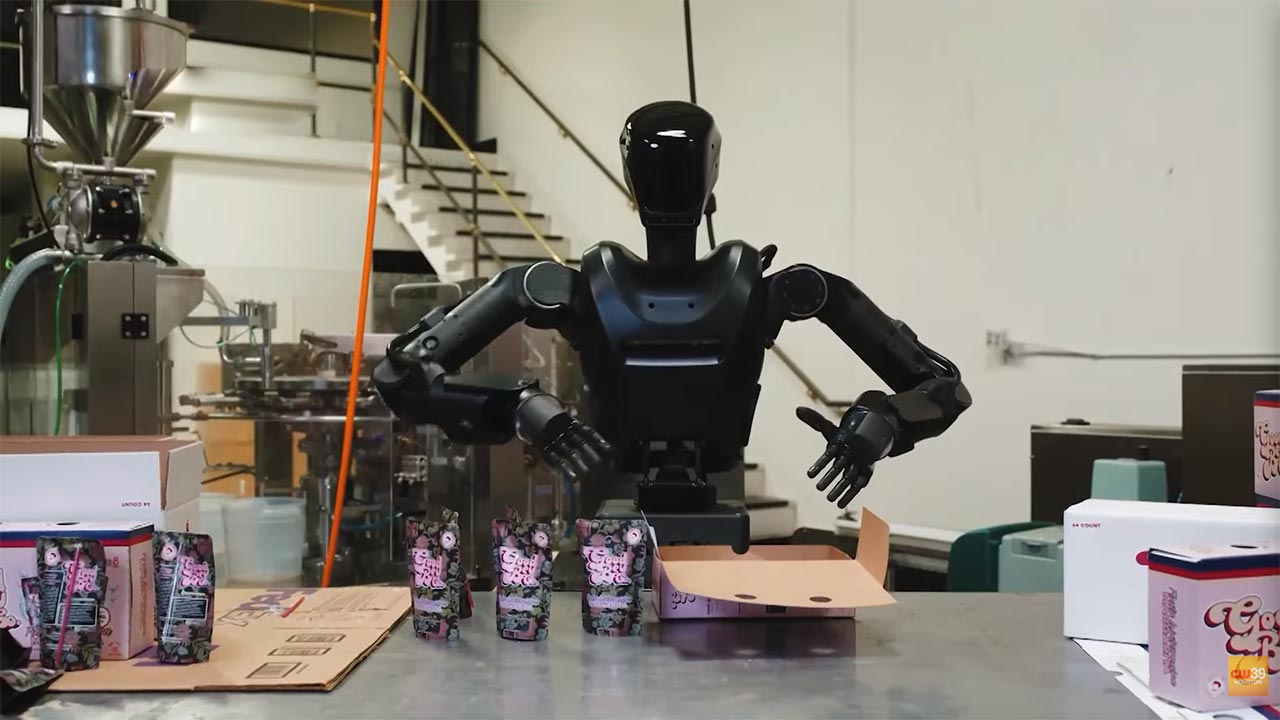

Humanoid robots have long been pitched as the next big leap in technology, but few have captured the public imagination as quickly as Phantom, a war‑ready machine that can just as easily work a nightclub crowd as a simulated battlefield. Built to move like a human and think with a blend of onboard intelligence and remote guidance, Phantom is emerging as a test case for how robots might slip into everyday life while reshaping the future of defense, labor and entertainment. I see Phantom less as a one‑off spectacle and more as an early glimpse of how human‑scale machines could become a standard part of the technological landscape.
From stealth project to breakout humanoid
Phantom did not arrive as a viral curiosity by accident, it is the flagship humanoid from Foundation, a robotics company that has deliberately targeted human environments rather than lab benches. In a detailed early look at the project, Foundation is described as a robotics company founded to build a Phantom Humanoid Betting Novel Actuators and Hybrid AI that can operate in factories, logistics hubs, potentially defense and space construction. That framing matters, because it signals that Phantom is not a research demo, it is a commercial product aimed at the same warehouses, plants and infrastructure sites that currently rely on human workers and traditional industrial robots.
Physically, Phantom is built to blend into those spaces. The Phantom MK1 variant is described as a camera‑first humanoid from Foundation that is Standing 175 cm and ~80 kg, which puts it squarely in the range of an average adult and allows it to use existing tools, doors and vehicles without custom hardware. That humanlike scale is paired with a hardware stack that centers on efficiency and perception, with multiple cameras and sensors designed to support both autonomous behaviors and supervised operation on the factory floor. In other words, Phantom is being engineered from the outset as a worker that can share space with people, not a distant machine locked behind safety cages.
The war robot that became a DJ
What vaulted Phantom into mainstream awareness was not a defense demo or a factory trial, it was a nightclub performance. Earlier this year, a humanoid war robot made headlines when it stepped into a San Francisco club booth and, instead of training for combat, delivered a full DJ set for a live audience. Video of the event shows a battle‑ready humanoid robot, identified as Watch Battle San Francisco Phantom, using its articulated arms and torso to execute smooth, controlled motions behind the decks. The choreography is not just for show, it demonstrates the same balance, dexterity and real‑time control that would be required to handle equipment in a high‑stress environment.
On the ground, the scene felt less like a weapons test and more like a cultural moment. SFGATE culture reporter Timothy Karoff Phantom watched Phantom perform for an enthusiastic crowd, describing how the robot became the center of attention rather than a background gimmick. Another account of the same event notes that Phantom, a humanoid robot created by Foundation Robotics Labs, was originally designed as a War robot Phantom for defense applications before being repurposed for the club. That juxtaposition, a machine built for conflict entertaining a dance floor, crystallizes the tension at the heart of modern robotics: the same capabilities that make a robot valuable in war zones can make it compelling in civilian life.
Inside Phantom MK1’s design
Strip away the nightclub lights and Phantom MK1 is a tightly engineered platform built around humanlike motion and machine perception. The Phantom MK1 guide describes it as a camera‑first humanoid from Foundation, with a hardware architecture that focuses on efficient actuators, robust joints and a sensor suite tuned for human spaces. At Phantom Foundation Standing 175 cm and ~80 kg, it can navigate stairs, doorways and corridors designed for people, while its weight and footprint are calibrated to keep it stable without becoming too heavy for standard flooring or transport systems. That balance of size and mass is not cosmetic, it is what allows Phantom to operate in warehouses, plants and public venues without extensive retrofitting.
On the control side, Foundation has been explicit that Phantom is built around a mix of novel actuators and hybrid AI, combining onboard autonomy with higher level guidance. Reporting on the company’s launch notes that Foundation Emerges With Phantom Humanoid Betting Novel Actuators and Hybrid AI to unlock tasks in logistics, manufacturing, defense and even space construction. In practice, that means Phantom can handle repetitive, structured work on its own, then hand off complex decisions or rare edge cases to human supervisors or more powerful cloud systems. It is a pragmatic approach that sidesteps the need for full general intelligence while still delivering useful autonomy in the field.
From sci‑fi battle droid to “First War Robot”
Phantom’s military ambitions are not subtle. In one detailed look at its battlefield role, the Phantom MK‑1 is described as a real‑life Star Wars Phantom MK style humanoid robot soldier that brings science fiction imagery directly into modern warfare. The same report notes that the system is designed to carry loads up to 44 pounds, a capacity that allows it to haul gear, ammunition or sensors across terrain that might be too risky for human troops. That load‑bearing ability, combined with its bipedal form, positions Phantom MK‑1 as a potential scout, porter or even weapons platform in environments where wheeled or tracked robots struggle.
Another analysis goes further, describing the platform as the World First War Robot Phantom MK Is Changing Warfare Forever Meet the Phantom MK, a bipedal system explicitly framed as changing warfare forever. That characterization underscores how defense observers see Phantom: not just as another drone or remote vehicle, but as a new class of war robot that can move through buildings, climb stairs and use cover in ways that mirror human soldiers. The same reporting points to a roadmap that would see these units ready for deployment, which raises immediate questions about doctrine, accountability and the rules of engagement when humanoid machines enter the battlefield alongside or even ahead of people.
How Phantom stacks up against other humanoids
Phantom is not the only humanoid vying for attention, but its trajectory looks different from the better known consumer and industrial projects. Tesla has been steadily promoting its own humanoid robot, with video showing Elon Musk Optimus Tesla Bot performing tasks like walking, manipulating objects and folding laundry. That system, branded Optimus or Tesla Bot, is pitched as a general purpose assistant that could eventually handle household chores and factory work, with Tesla emphasizing its ability to leverage existing automotive manufacturing and AI expertise. The focus there is on scale and cost, turning humanoids into a mass market product.
Another major player, Figure, is positioning itself as a groundbreaking AI robotics company forging a path to the first autonomous humanoid robot that can operate in new market territory. Figure’s pitch centers on full autonomy and commercial deployment in logistics and manufacturing, with less emphasis on defense. By contrast, Phantom is unapologetically dual use, with its creators highlighting both industrial and military scenarios. That dual identity, reinforced by its nightclub cameo and battlefield framing, gives Phantom a cultural profile that Optimus and Figure’s machines have not yet matched, even if those projects may be further along in some aspects of commercialization.
Funding, business model and the road to scale
Behind Phantom’s public performances is a startup that has already attracted significant early capital. Funding data shows that Valuation Funding Foundation Tribe Capital raised $11 million in a pre‑seed round in August 2024, led by Tribe Capital, with total funding now approximately $21 million. For a hardware‑heavy robotics company, that is still a modest war chest, but it is enough to build multiple prototypes, hire a core engineering team and run the kind of high‑profile demos that have put Phantom on the map. The presence of a lead investor like Tribe Capital also signals that institutional backers see a credible path to revenue, whether through defense contracts, industrial deployments or both.
Commercially, Phantom is already being positioned as a product rather than a research platform. A product listing describes the Phantom MK1 as a humanoid robot designed to work in human spaces, with a camera‑first design and efficient hardware tuned for factory floors and similar environments. That listing, surfaced through a product search, reinforces the idea that Phantom is being sold, or at least marketed, as a deployable system rather than a one‑off prototype. The business challenge now is to move from bespoke demonstrations to repeatable deployments, convincing customers that a 175 cm, ~80 kg humanoid can deliver enough value in logistics, inspection or security to justify its cost and complexity.
Meet Phantom MK1, the “Ultimate Warrior” candidate
Defense analysts have already begun to frame Phantom in superlative terms. One widely shared segment asks, Nov Could This Humanoid Robot Become the Military Ultimate Warrior Meet Phantom, and introduces Phantom MK1 as a 5‑foot‑9, 176‑pound humanoid. That 176‑pound figure, slightly heavier than the ~80 kg cited in other technical descriptions, underscores how close Phantom is to the build of a human soldier, which is precisely the point for a system meant to use existing gear, vehicles and infrastructure. The same report highlights scenarios in which Phantom could guard critical infrastructure, support troops in hazardous zones and even help defend infrastructure beyond Earth, hinting at lunar or orbital applications.
Those ambitions rest on Phantom’s ability to combine physical resilience with adaptable software. The “Ultimate Warrior” framing is not just about raw strength, it is about a platform that can be reconfigured for surveillance, logistics, combat support or disaster response through changes in payloads and code. In that sense, Phantom MK1 is less a single robot and more a chassis for a family of roles, from carrying supplies in a conflict zone to inspecting damaged buildings after an earthquake. The same hybrid AI approach that Foundation touts for industrial work, where autonomy handles routine tasks and humans oversee edge cases, could translate directly into military doctrine, with operators supervising squads of Phantom units from secure locations.
Culture shock: when a war robot hits the dance floor
For all the technical detail and defense analysis, Phantom’s most striking impact so far has been cultural. Watching a machine built for conflict entertain a crowd forces people to confront their own assumptions about what robots are for. In the San Francisco performance, the battle‑ready humanoid robot did not just move to the beat, it mirrored familiar human gestures, from head nods to arm sweeps, in a way that made the audience treat it less like a tool and more like a performer. That blurring of lines between worker, soldier and entertainer is part of why Phantom has become a talking point far beyond robotics circles.
Other coverage of the event emphasizes how the crowd responded not with fear but with curiosity and delight, even as they were told that Phantom was originally designed as a war robot. The description of the set as “a fun moment” for a machine built for defense captures the cognitive dissonance at play. It is one thing to read about a Battle ready robot executing smooth, controlled motions, it is another to see that same motion vocabulary applied to music instead of maneuvers. As more humanoids like Phantom leave labs and training grounds for public spaces, those kinds of encounters will shape how society negotiates the ethics and expectations around machines that can both fight and entertain.
What Phantom signals about the next decade of tech
Looking across Phantom’s short but eventful history, I see a pattern that extends far beyond a single robot. The same hardware that lets Phantom carry 44‑pound loads in a Star Wars‑style battle scenario can also stock shelves, move pallets or assist in disaster zones. The same hybrid AI that lets it navigate a factory floor can be tuned to patrol a base or perform on stage. That flexibility is what makes humanoids so attractive to investors and engineers, and it is why projects like Optimus, Figure and Phantom are drawing serious capital and attention at the same time.
Phantom’s emergence as both a war robot and a nightclub act crystallizes the stakes of this moment. If companies like Foundation can turn a 5‑foot‑9, 176‑pound humanoid into a reliable worker, soldier and performer, the boundary between software and physical labor will blur in ways that rival the impact of the smartphone or the commercial internet. The question is not whether machines like Phantom will enter our lives, they already have, it is how we choose to deploy them, regulate them and live alongside them as they quietly, and sometimes loudly from behind a DJ booth, redefine what technology looks like in human spaces.
More from MorningOverview