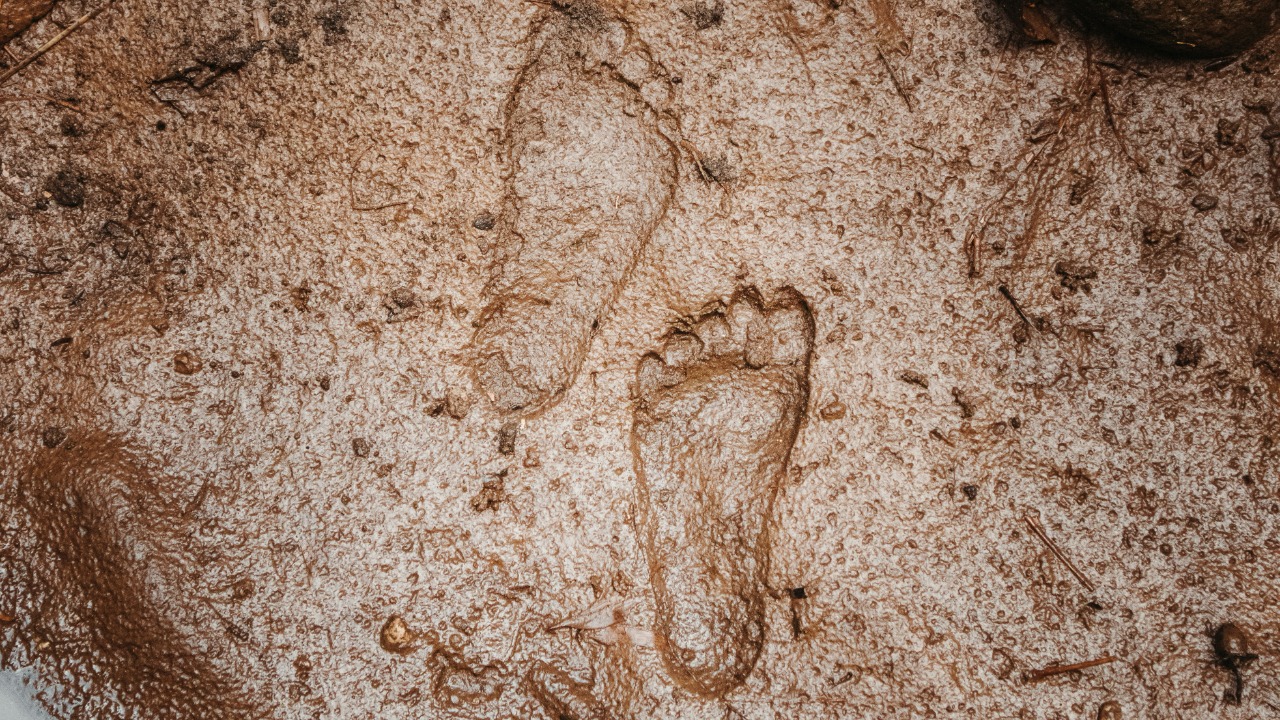

Fossilized human footprints in the Arabian Peninsula are forcing researchers to redraw the map of our species’ early journeys. Imprinted in what was once a lakeshore and is now desert, these tracks are dated to roughly 115,000 years ago, a time and place many experts long treated as a dead end for early migrants out of Africa. Instead, they now look like evidence of people moving through a landscape that was far greener and more inviting than the modern dunes suggest.
Rather than a marginal outpost, this part of Saudi Arabia appears to have been a crossroads where humans and large animals converged around freshwater, leaving behind a snapshot of life just before the deep chill of the Ice Age. The puzzle is not only that these footprints are so old, but that they sit in a region where, until recently, few expected to find such early traces of our kind.
Why 115,000-year-old footprints are such a shock
When I look at the reported age of these tracks, the figure itself is startling. At roughly 115,000-Year-Old, the prints belong to a chapter of human history that many researchers once assumed unfolded almost entirely within Africa and a few nearby corridors. Finding such ancient impressions in the Arabian interior, rather than along a coastal route or in the Levant, suggests that early people were exploring environments that had barely figured in older migration models.
The surprise is sharpened by the way these footprints were preserved. They are described as Fossilized traces pressed into sediments that once lined a lake in what is now Saudi Arabia, a region better known today for arid expanses than for standing water. Reports on how Archaeologists Found these Year Old Human Footprints Where They Shouldn be emphasize that the setting does not match the stereotype of early humans hugging wetter, more temperate zones far to the north or south.
A lakeshore in the desert: reconstructing Alathar
The site itself, identified as an ancient lake bed in the Arabian Peninsula, offers a vivid contrast between past and present. Today, the area sits within a desert landscape, but the footprint-bearing layers formed along the margins of a freshwater body where humans and animals alike came to drink. Analyses of the sediments and associated fossils indicate that this was not a fleeting puddle but a persistent lake that could support repeated visits by large mammals and the people who followed them.
Detailed coverage of the discovery at Alathar describes 115,000-year-old tracks pressed into the former shoreline of this lake, capturing a moment of Early human presence in the Arabian interior just before the onset of harsher Ice Age conditions. The combination of human footprints with those of other animals paints a picture of a shared watering hole, a place where species converged in a landscape that was far more hospitable than the modern dunes would suggest.
Arabia’s “green windows” and shifting climate
To make sense of why humans were in this region so early, I have to start with climate. The Arabian Peninsula has not always been the hyper-arid environment we see today. During certain intervals, monsoon systems shifted northward, bringing rainfall that filled basins and turned parts of the peninsula into grasslands dotted with lakes and wetlands. These so-called “green windows” would have opened corridors for animals and humans to move across what is now a formidable barrier of sand and rock.
Research on ancient lakes and fossil assemblages in Saudi Arabia shows that these wetter phases coincided with pulses of human and animal movement. The Alathar footprints fit neatly into this pattern, recording people walking along a lake at a time when the region supported enough vegetation and water to sustain them. Reconstructions of this environment, including work that situates the prints within a broader network of paleolakes, suggest that early migrants could have crossed Arabia in stages, following chains of freshwater rather than attempting a single, continuous trek through desert.
From 120,000 to 115,000 years: a growing footprint record
The Alathar tracks are not the first hint that humans reached Arabia early, but they deepen and refine that picture. Previous work documented human traces in the region that may be even older, with one study describing Human Footprints Found in Saudi Arabia May Be 120,000 Years Old. That work, highlighted as New Research, showed that people were present around lakes in Saudi Arabia during a similarly wet interval, reinforcing the idea that the peninsula was part of an early dispersal route rather than a late afterthought.
When I place the roughly 120,000 year signal alongside the 115,000-year-old impressions at Alathar, a pattern emerges. Instead of a single, brief incursion, the evidence points to repeated or sustained human use of Arabian lakeshores over several thousand years. The continuity between these sites suggests that early groups were not simply passing through but were adapting to local conditions, exploiting freshwater resources, and leaving behind a layered record of their presence in sediments that only now are being carefully exposed and dated.
Reading behavior from a trail of steps
Footprints are more than just proof that someone was there. They can reveal how fast people were moving, whether they were alone or in groups, and even how they interacted with the animals around them. At Alathar, the arrangement of the tracks suggests individuals walking along the lake margin rather than sprinting or clustering in a tight group, which hints at a routine visit to water rather than a chaotic escape or hunt. The coexistence of human and animal prints in the same layers points to a shared landscape where species overlapped in both time and space.
Earlier work on Arabian footprints has already shown how much behavior can be teased from such traces. A detailed study described in Science Advances interpreted similar tracks as a “snapshot” of early humans and animals converging on lakes for the purpose of slaking thirst and sating hunger. That work, highlighted in Sep, showed that the spacing and orientation of footprints can indicate whether people were traveling together, lingering at the water’s edge, or moving purposefully along a route, insights that now inform how researchers read the Alathar trail.
Who left the prints: modern humans or other hominins?
One of the most debated questions is who exactly made these footprints. At around 115,000 years ago, both early Homo sapiens and other hominins such as Neanderthals were present in parts of Eurasia, and the Arabian Peninsula sits at a crossroads between those populations. The size and shape of the tracks, along with the broader fossil record, are central to arguments about whether the Alathar prints belong to anatomically modern humans or to another branch of the human family tree.
Reporting on the discovery notes that researchers have compared the Alathar impressions with experimental footprints from living people and with known Neanderthal anatomy. One account of how Archaeologists Found these 115,000-Year-Old tracks explains that an “experimental study of modern” footprints was used to distinguish likely Homo sapiens from Homo neanderthalensis, a line of reasoning that underpins the argument that the Alathar prints were made by early members of our own species. That same coverage, appearing in Dec and associated with Hearst Magazines and Yahoo, underscores how much weight is being placed on subtle differences in foot anatomy and gait.
Saudi Arabia’s Nafu Desert and the shifting frontier
The broader region around Alathar, including the Nefud (also rendered as Nafu) Desert, has become a focal point for rethinking early human geography. What is now a harsh expanse of dunes once held a network of lakes and river systems that linked Africa, Arabia, and Eurasia. As researchers map these ancient waterways, they are finding more sites where humans left traces of their presence, from stone tools to footprints, in places that long seemed too remote or inhospitable to matter in the story of our origins.
Recent coverage of discoveries in this area highlights how new finds are pushing back the timeline for human arrival in the region. One report describes how 115k-year-old human footprints were discovered in Saudi Arabia’s Nafu Desert, explicitly noting that they “push back the date of human arrival in the region.” That summary, flagged in Jul, aligns with the Alathar evidence and reinforces the idea that the Arabian interior was not a peripheral zone but a key corridor that humans entered far earlier than many textbooks once suggested.
Why the footprints “shouldn’t” be there
The recurring phrase that these footprints are “where they shouldn’t be” reflects how strongly older models shaped expectations. For years, many reconstructions of early human dispersal favored narrow routes along the Levantine corridor or coastal paths hugging the Red Sea and Indian Ocean. In those scenarios, the deep interior of Arabia appeared as a climatic and ecological barrier, a place early migrants might skirt but not occupy in significant numbers, especially as far back as 115,000 years ago.
The Alathar tracks and related finds challenge that assumption by showing that humans were not only present but active in the heart of the peninsula during a relatively early phase of expansion. Coverage of the discovery emphasizes that these 115,000-Year-Old Old Human Footprints Where They Shouldn be sit in a landscape that was long written off as too dry and marginal for such early occupation. By documenting Fossilized human steps in this setting, the reports force a reconsideration of how flexible and opportunistic early Homo sapiens were in exploiting new environments, and how quickly they could move into regions that climate cycles periodically transformed.
What these tracks mean for the story of us
For me, the power of the Alathar footprints lies in how they humanize a distant past. It is one thing to talk about “dispersal events” and “migration waves,” and another to picture individuals walking along a lakeshore, leaving behind the impressions of their bare feet in wet sand. Those prints, now hardened into stone, capture a fleeting moment that connects directly to our own bodies and movements, even as the surrounding world has changed almost beyond recognition.
At the same time, the scientific stakes are substantial. By anchoring human presence in Arabia at around 115,000 years ago, and by linking those tracks to a broader pattern that includes sites with footprints that may be 120,000 Years Old, the evidence compels researchers to treat the peninsula as a central stage in early human history rather than a side corridor. As more lakeshores are surveyed and more Human Footprints Found, the map of our species’ early journeys is likely to become even more intricate, with Saudi Arabia and its once-green deserts occupying a prominent place in the narrative of how humans explored, adapted, and eventually spread across the globe.
More from MorningOverview