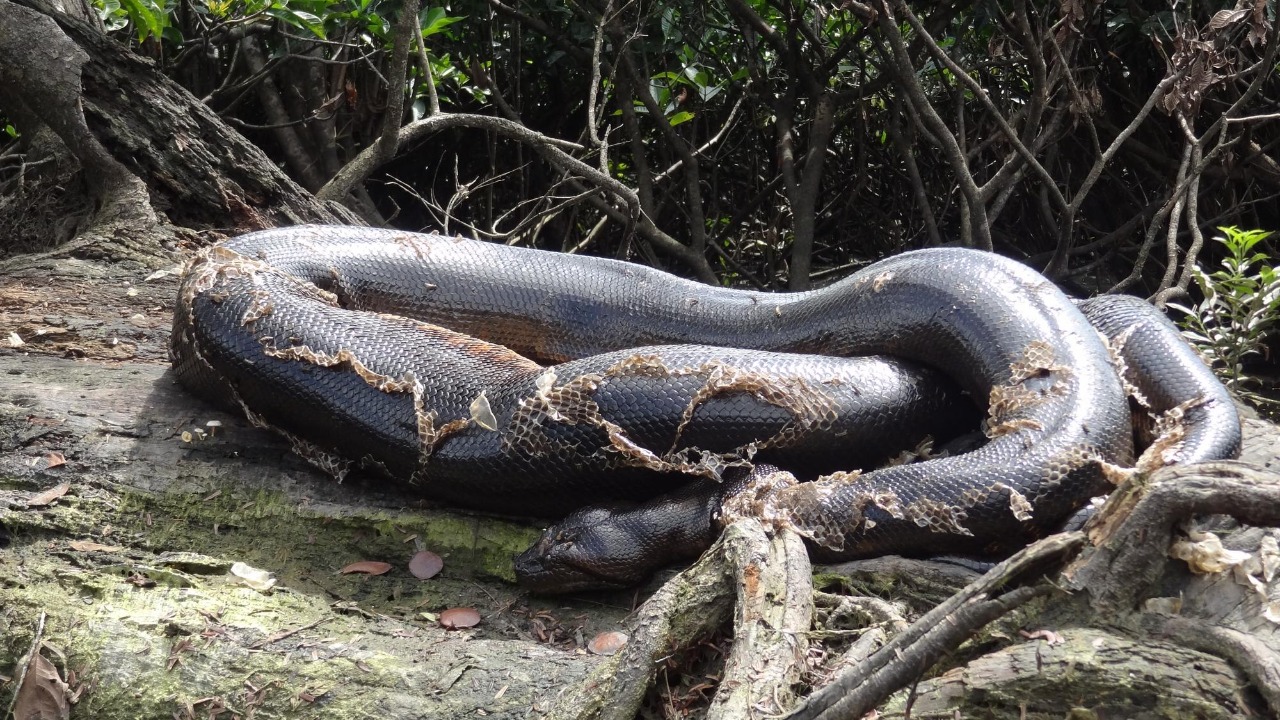

Deep inside Ecuador’s Amazon basin, a film crew and a team of biologists set out to capture a television moment and instead stumbled onto a scientific milestone: a colossal anaconda that may be the largest snake ever reliably documented. The animal, encountered during a shoot with Will Smith, is so massive that it is forcing researchers to redraw the boundaries of what they thought was possible for living snakes. I see this discovery not just as a viral spectacle from a TV set, but as a rare window into an ancient predator that has survived almost unchanged for millions of years while the forest around it rapidly transforms.
What began as a tightly planned expedition for a high-profile series has turned into a case study in how entertainment, Indigenous knowledge and formal science can intersect in the field. The encounter has already yielded evidence of a new Amazonian anaconda lineage, fresh data on snake gigantism and a renewed urgency around protecting the flooded forests that shelter these animals. It is a story about scale, both of the snake itself and of the environmental pressures now bearing down on its habitat.
How a TV shoot in the Amazon turned into a once-in-a-century find
The discovery unfolded during filming for a Will Smith project that sent Expeditioners deep into the flooded forests of the Amazon, where the crew expected drama but not a record-breaking reptile. While cameras rolled, scientists working alongside the production team realized that the anaconda surfacing near their boats was far larger and bulkier than any they had handled before, a living coil of muscle that instantly shifted the mission from television to triage-level field science. The encounter took place in a remote stretch of Ecuador’s Amazon basin, a region that still hides pockets of wildlife largely unknown to formal research despite decades of exploration.
Reports from the field describe a coordinated effort in which biologists, safety divers and camera operators moved in tandem to document the snake while minimizing stress on the animal and risk to the crew. One account of the expedition notes that the team was operating in Dec in conditions of high water and low visibility, a combination that makes any close work with large constrictors especially dangerous, yet they persisted long enough to secure measurements and tissue samples that would later confirm the snake’s exceptional status. The same reporting emphasizes that the animal was encountered in Deep flooded channels of Ecuador’s Amazon, a detail that helps explain how such a giant could remain hidden until a high-budget shoot finally brought enough people and equipment into the right backwater at the right moment.
A new Amazonian giant: what scientists actually measured
Once the shock of the encounter passed, the team treated the snake like any other scientific specimen, recording its length, girth and estimated mass with as much precision as the conditions allowed. Early measurements indicate that the animal stretched to roughly the same scale as the largest anacondas ever reported, but what set it apart was its extraordinary bulk, with a body circumference that suggested a weight on the order of several hundred pounds. One detailed account of the fieldwork describes the snake as a potential record holder for the heaviest living snake, a claim grounded in the combination of its length and the sheer volume of muscle packed into its emerald body.
Separate coverage of the same expedition frames the find as part of a broader pattern, noting that Scientists Discover the Largest Anaconda Ever Recorded in the Amazon While Shooting Will Smith’s TV Series, and that the animal belongs to a newly recognized lineage of northern green anacondas that had gone unnoticed in plain sight. Genetic analysis and morphological comparisons point to a distinct Amazonian population that diverged from other green anacondas millions of years ago, which helps explain why this individual could reach such extreme dimensions. The emerging consensus is that this is not just a big snake, but a representative of a New Amazonian giant that may routinely produce animals approaching or even surpassing the size of the specimen filmed with the crew.
From “never seen before” to named species
What makes this story more than a one-off monster sighting is the way it dovetails with a growing body of evidence that the Amazon still harbors unrecognized megafauna. Earlier reports from the region described a Giant Anaconda Never Seen Before Discovered in Amazon Jungle During Shocking TV Shoot With Will Smith, language that captured the astonishment of researchers who had spent careers in the field without encountering anything comparable. Those accounts emphasized that the snake did not fit neatly into existing categories, hinting at a taxonomic surprise that would only be confirmed once DNA samples were processed and compared with museum collections.
That suspicion has now been backed up by formal descriptions of a new northern green anaconda lineage, with Details on the snakes found published in the journal MDPI Diversity that outline how this population differs genetically and morphologically from other Eunectes. The scientific work shows that the Amazon is not just producing outlier individuals, but sustaining a distinct evolutionary branch that has been quietly growing to enormous sizes in the flooded forests and oxbow lakes of the basin. For me, the shift from “never seen before” to a named species is the crucial step that transforms a viral clip into a durable addition to our understanding of biodiversity.
How big is “biggest”? Putting the Amazon giant in context
To grasp what “largest anaconda ever recorded” really means, it helps to compare this new snake with the benchmarks that have defined reptile gigantism for decades. Traditional records for green anacondas, the species known scientifically as Eunectes murinus, describe animals that may rival the length of reticulated pythons while far surpassing them in mass, with some individuals estimated at up to 440 pounds (200 kilograms). One synthesis of historical data notes that The Largest Anaconda Ever Found Weighed More Than a Gorilla, a vivid comparison that underscores how these snakes push the upper limits of what a cold-blooded vertebrate can sustain in a tropical river system.
Recent field expeditions have added more precise numbers to that picture, including a documented 20.7-foot anaconda encountered on a TV show shoot and described as a candidate for the largest snake in the world. That 20.7-foot figure, reported by Expeditioners working in the same broad region, provides a concrete yardstick for evaluating the new Amazonian giant, which appears to match or exceed that length while carrying even more mass. When I line up these data points, the emerging pattern is clear: the newly documented anaconda is not an isolated freak, but part of a continuum of extreme body sizes that the Amazon’s flooded forests seem uniquely capable of producing and sustaining.
The nearly 10 million-year-old lineage behind the monster
Size alone does not make this discovery remarkable; the snake’s evolutionary backstory is just as striking. Genetic work on related specimens has revealed that the northern green anaconda lineage in this part of the Amazon traces back nearly 10 million years, a timescale that predates many of the river’s modern channels and floodplain systems. One detailed photo feature on the species notes that a group of scientists uncovered the nearly 10 million-year-old species with help from the Huaorani people while filming in the same broader region, highlighting how deep time and living culture intersect in the story of this snake.
That evolutionary age means the lineage has persisted through major climatic swings, Andean uplift and repeated reorganizations of the Amazon’s drainage, all while maintaining a body plan optimized for ambush hunting in slow, tannin-stained waters. The involvement of the Huaorani in guiding researchers to key habitats underscores that local communities have been aware of these giants far longer than the scientific literature has, and that their knowledge was instrumental in turning scattered sightings into a coherent picture of a distinct northern green anaconda. When I consider that the snake filmed with Will Smith is a single representative of a lineage that has been perfecting its niche since before humans existed, its size feels less like an anomaly and more like the logical endpoint of a very long experiment in being big, slow and perfectly adapted to a flooded forest.
Will Smith, National Geographic and the strange power of celebrity science
The presence of Will Smith and a major production crew in the swamp is not a trivial detail; it is a key reason this snake was documented at all. Earlier coverage of the project notes that a New species of the world’s biggest anaconda was discovered in the Amazon during filming of a Will Smith docuseries, and that the logistics and safety protocols of a high-end shoot created the conditions for scientists to work methodically in a place that is usually too remote and dangerous for extended surveys. The cameras were there to capture drama, but they also brought boats, medics and enough personnel to handle a multi-hundred-pound reptile without cutting corners.
Another account of the same collaboration describes how Scientists Find New, Massive Anaconda While Filming TV Show, explaining that while filming a National Geographic TV project with Will Smith, the team encountered a snake that could be over 20 feet long. That detail matters because it shows how entertainment budgets can inadvertently subsidize serious fieldwork, giving researchers access to helicopters, satellite comms and safety gear that are rarely available on grant-funded expeditions. As someone who has watched science coverage struggle for attention in a crowded media landscape, I see this as a case where celebrity and spectacle did not dilute the research, but instead amplified it and delivered a discovery that might otherwise have remained a rumor told in riverside villages.
What makes this anaconda different from other record snakes
Even in a world that already includes massive reticulated pythons and legendary green anacondas, the newly documented Amazonian snake stands apart in several ways. First is its combination of length and girth, which appears to push it beyond the typical profile of Eunectes murinus and into a category of its own, with a body so thick that multiple adults were needed just to encircle its midsection. Second is the genetic distinctiveness of the northern green anaconda lineage, which, according to the MDPI Diversity work, diverges enough from other populations to warrant recognition as a separate taxon, a status that helps explain why its growth patterns and habitat preferences might differ from better-known relatives.
Complementary reporting on the same discovery frames it as the moment when a New Amazonian species was crowned with the title of Meet the World’s Largest Snake, a 440-Pound Anaconda Discovered in the Amazon that now stands as the largest snake ever discovered in terms of verified mass. That 440-Pound benchmark, coupled with the 20.7-foot length recorded for another giant from the region, suggests that this lineage is optimized for bulk rather than sheer stretch, a strategy that suits an ambush predator that spends most of its life submerged and motionless. In practical terms, that means the snake encountered on the Will Smith shoot is not just another entry in a record book, but a living example of a different way to be the biggest snake on Earth.
Indigenous knowledge, local guides and the path to the backwaters
Behind the headlines about celebrities and record-breaking reptiles lies a quieter story about the people who actually know where these snakes live. The nearly 10 million-year-old northern green anaconda lineage was first brought into focus when scientists partnered with the Huaorani, who guided them to specific oxbow lakes and flooded forests where large snakes were known to bask and hunt. Those same relationships and routes likely informed the logistics of the Will Smith shoot, which ventured into parts of the Amazon Jungle During Shocking TV Shoot With Will Smith that are not marked on tourist maps and are accessible only by long river journeys and local knowledge.
Field reports emphasize that without Indigenous guides and community consent, the crew would never have reached the Deep channels of Ecuador’s Amazon where the record anaconda surfaced. The Huaorani and other local groups provided not just navigation, but also behavioral cues, warning the team about seasonal patterns, preferred basking logs and the subtle signs that a giant snake might be lurking just below the surface. For me, this underscores a recurring lesson in biodiversity research: the path to the most spectacular discoveries almost always runs through communities that have been living with these animals for generations, and any attempt to protect the new Amazonian anaconda will have to start by supporting the people who share its habitat.
Why the Amazon can still hide a snake this size
At first glance, it seems implausible that a snake longer than a pickup truck and heavier than a Gorilla could evade scientific detection in the twenty-first century. The answer lies in the structure of the Amazon itself, a basin of flooded forests, blackwater creeks and seasonally submerged islands that create a labyrinth of habitat where large animals can remain effectively invisible. The northern green anaconda lineage thrives in these conditions, spending most of its time in murky water, surfacing only briefly to breathe and bask, and often retreating into dense vegetation at the slightest disturbance.
Even modern expeditions struggle to cover more than a tiny fraction of this environment, which is why formal records of giant snakes have lagged behind the stories told by fishers and hunters who encounter them by chance. The fact that the largest anaconda ever recorded surfaced during a tightly choreographed TV shoot rather than a traditional survey says less about the reliability of science and more about the sheer scale and complexity of the Amazon. When I weigh the evidence from MDPI Diversity, the field reports from Expeditioners and the nearly 10 million-year evolutionary history of the lineage, it becomes clear that the forest is still more than capable of hiding giants, and that we are only now beginning to map where they live.
What this discovery means for conservation and climate
The appearance of a record-breaking anaconda in front of rolling cameras is a gift to conservationists, because it puts a charismatic, visually arresting face on a set of abstract environmental threats. The same flooded forests that allow a 440-Pound anaconda to reach maturity are under pressure from deforestation, oil exploration and climate-driven shifts in rainfall that can alter flood regimes and strand aquatic predators in shrinking pools. One analysis of the discovery notes that a new species of giant snake has become a symbol for efforts to protect the Amazon from environmental threats, with the snake’s sheer size serving as a visceral reminder of what could be lost if those habitats collapse.
Details in MDPI Diversity highlight that the newly described lineage depends on intact river corridors and seasonal floodplains, ecosystems that are particularly vulnerable to dam construction and large-scale agriculture. The fact that the largest snake ever discovered was found during a media production rather than a conservation campaign does not diminish its value as an ambassador species; if anything, it increases the odds that policymakers and the public will pay attention. From my perspective, the challenge now is to convert the awe generated by the Will Smith footage into concrete protections for the Deep Amazon backwaters where this lineage evolved, so that the snake filmed on that day is not remembered as both the largest and the last of its kind.
More from MorningOverview