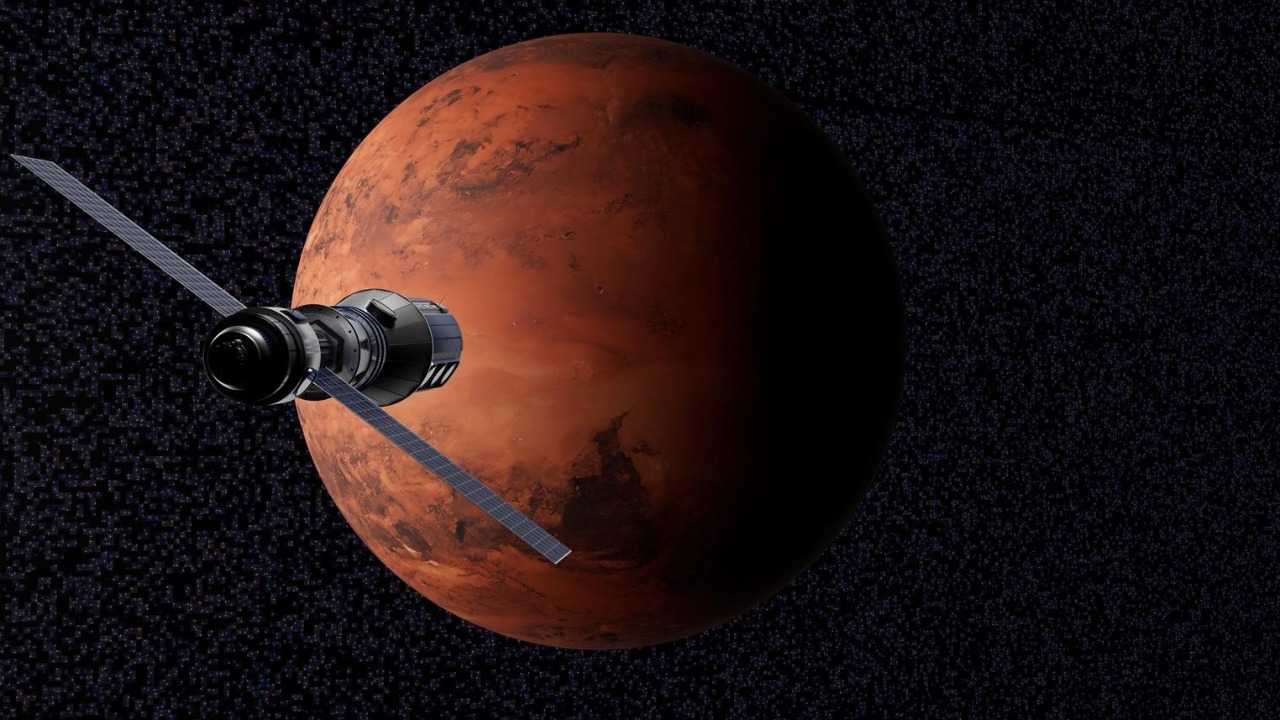

Mars, long painted as a frozen desert, is starting to look more like a planet that once knew the feel of warm rain and flowing water. A new wave of research argues that the Red Planet may have spent millions of years in a humid, almost tropical state, with storms, rivers, and even oceans reshaping its surface. If that picture holds, the story of Mars shifts from a brief flirtation with habitability to a sustained era when life, at least in principle, had time to take root.
Instead of a world that only occasionally thawed, scientists are now sketching a Mars that was wet, warm, and dynamic, with climate cycles that echo some of the most life-friendly environments on Earth. I see that emerging portrait as one of the most consequential turns in planetary science in years, because it reframes not only what Mars was, but what it might still be hiding beneath its bleached rocks and buried seas.
From rusty desert to rain-soaked world
The modern Mars that stares back from spacecraft images is a harsh place, its thin air and rusty dust a shorthand for planetary failure. Yet the latest mineral evidence suggests that this desiccated landscape is the epilogue, not the main story. Researchers examining pale, chemically altered rocks in Jezero Crater argue that they preserve the imprint of a climate driven by persistent rainfall, a climate that would have required thick air, sustained warmth, and abundant surface water.
In Jezero Crater, the evidence of this wetter past is written into bleached rocks scattered across the ancient lakebed, where small, pale spots mark places where water once leached minerals over long periods. That kind of alteration does not come from a single flood or a brief thaw, it points to a climate that cycled water through the atmosphere and back to the ground again and again. When I look at that pattern, the phrase “tropical oasis” stops sounding like hyperbole and starts reading like a testable description of early Martian weather.
The strange white rocks that changed the story
The most striking clues are not grand canyons or dried-up deltas, but odd patches of white. These strange, pale rocks stand out against the darker regolith, and their chemistry appears to be dominated by aluminum-rich clays that on Earth form only after prolonged exposure to rain. The fact that they are scattered across Jezero Crater suggests that whatever process created them was not local or fleeting, but part of a broader environmental regime.
On Earth, similar white kaolinite clays emerge when rainwater slowly strips other minerals from rock over millions of years, and that is exactly the scenario scientists now see in the strange pale rocks on Mars. The implication is that early Martian storms were not rare catastrophes, but regular features of the climate, soaking the ground and slowly transforming its mineral makeup. When I weigh that against the old image of a mostly frozen planet, the balance tips decisively toward a Mars that once cycled water in ways very familiar to terrestrial geologists.
Jezero Crater as a tropical test case
Jezero Crater has always been a prime target because it clearly hosted a lake, but the new work elevates it from a simple basin to a climate archive. The distribution of bleached rocks, their chemistry, and their relationship to ancient shorelines all point to a long-lived hydrological system. Instead of a single lake filling and freezing, the crater appears to have experienced repeated wetting, drying, and chemical weathering that would fit comfortably in a humid, low-latitude region on Earth.
Researchers describe Jezero as a place where Mars was a wet, warm, humid planet bathed in rainfall, a far cry from the dust-choked basin we see today. In that scenario, the crater’s deltas and shorelines are not just frozen snapshots, they are the products of a climate that persisted long enough to carve channels, deposit sediments, and then chemically rework them. I find it hard to overstate how much more hospitable that makes early Mars sound, especially when compared with the brief, marginal habitability once assumed.
Tropical storms for millions of years
One of the most provocative claims in the new research is not simply that it rained on Mars, but that it rained in a way that resembles tropical storm patterns on Earth. The mineral signatures in Jezero’s white rocks are consistent with intense, repeated downpours that would have driven strong surface runoff and deep chemical alteration. That kind of weather implies a robust water cycle, with evaporation, cloud formation, and precipitation all operating in a stable loop.
Analyses of these deposits suggest that such tropical rainfall patterns may have persisted for millions of years, not just a brief geological instant. If that is correct, then early Mars did not just flirt with Earth-like conditions, it sustained them long enough for complex surface environments to evolve. From my perspective, that duration is crucial, because life as we know it needs time, and a planet that stays warm and wet for millions of years is a far better candidate than one that only thaws during rare orbital quirks.
Why the Red Planet is red, and why that matters
The color of Mars has always been part of its mystique, but the chemistry behind that red hue is now feeding into the habitability debate. A recent study on the planet’s iron minerals argues that the dominant rust may have formed in the presence of liquid water, rather than in a purely dry environment. If the key iron phases crystallized from or were altered by water, then the redness of Mars becomes a byproduct of a once-habitable surface, not a symbol of lifelessness.
Scientists involved in that work emphasize that what they know from this study is that the evidence points to ferrihydrite forming, and for that to happen there must have been water interacting with iron-rich materials. When I connect that conclusion to the tropical-rainfall picture from Jezero, the narrative tightens: the very dust that gives Mars its iconic color may be a residue of a wetter epoch. The Red Planet, in other words, might be red because it once had the conditions that make blue oceans and white clouds possible.
Oceans, shorelines, and a bluer Mars
Rain and rivers are one thing, but the case for a truly Earth-like Mars strengthens when you zoom out to the scale of oceans. New research on the planet’s topography and sedimentary features argues that a vast northern ocean once covered a significant fraction of the globe. That body of water would have tied together river systems, deltas, and coastal plains into a single, planet-spanning hydrological network.
According to this work, Yes, Mars Once Had an ocean, and the shoreline features suggest it persisted long enough to reshape large regions and then retreat or freeze as the climate changed. When I picture that ocean linked to a humid atmosphere and tropical-style storms, the phrase “the planet was a lot bluer” stops being a metaphor and starts sounding like a literal description of the view from orbit. In that light, Jezero Crater becomes just one bay along a much larger, ancient coastline.
Hidden water locked deep below
If Mars once had lakes, rivers, and an ocean, the obvious question is where all that water went. Some of it escaped to space as the atmosphere thinned, but recent geophysical work suggests that a substantial fraction never left the planet at all. Instead, it appears to be locked deep in the crust, trapped in hydrated minerals or buried reservoirs that are far beyond the reach of current drilling technology.
Planetary scientist Michael Manga has noted that lots of evidence, including river channels, deltas, lake deposits, and water-altered rock, supports the idea that Mars still holds oceans of water, just too deep to tap with current tools. For me, that buried reservoir is not just a curiosity, it is a bridge between the tropical past and the frozen present, a reminder that the ingredients for habitability can linger long after surface conditions turn hostile.
Rewriting the timeline of Martian habitability
Put together, these strands of evidence force a rethink of when and for how long Mars could support life. Instead of a narrow window when brief warming events might have allowed transient streams, the new picture stretches habitability across millions of years of stable, rain-fed climates. That extended timeline gives hypothetical Martian microbes far more opportunity to emerge, adapt, and perhaps retreat underground as the atmosphere thinned.
I see this as a shift from asking whether Mars was ever briefly clement to asking how complex its ecosystems might have become during a prolonged warm and humid phase. The combination of tropical storms, long-lived lakes like Jezero, a northern ocean, and deep water reservoirs paints a planet that, for a significant slice of its history, was not an outlier but a sibling to Earth. The challenge now is to match that bold new climate narrative with equally decisive evidence of biology, if any traces survived the long slide from tropical oasis to frozen desert.
More from MorningOverview