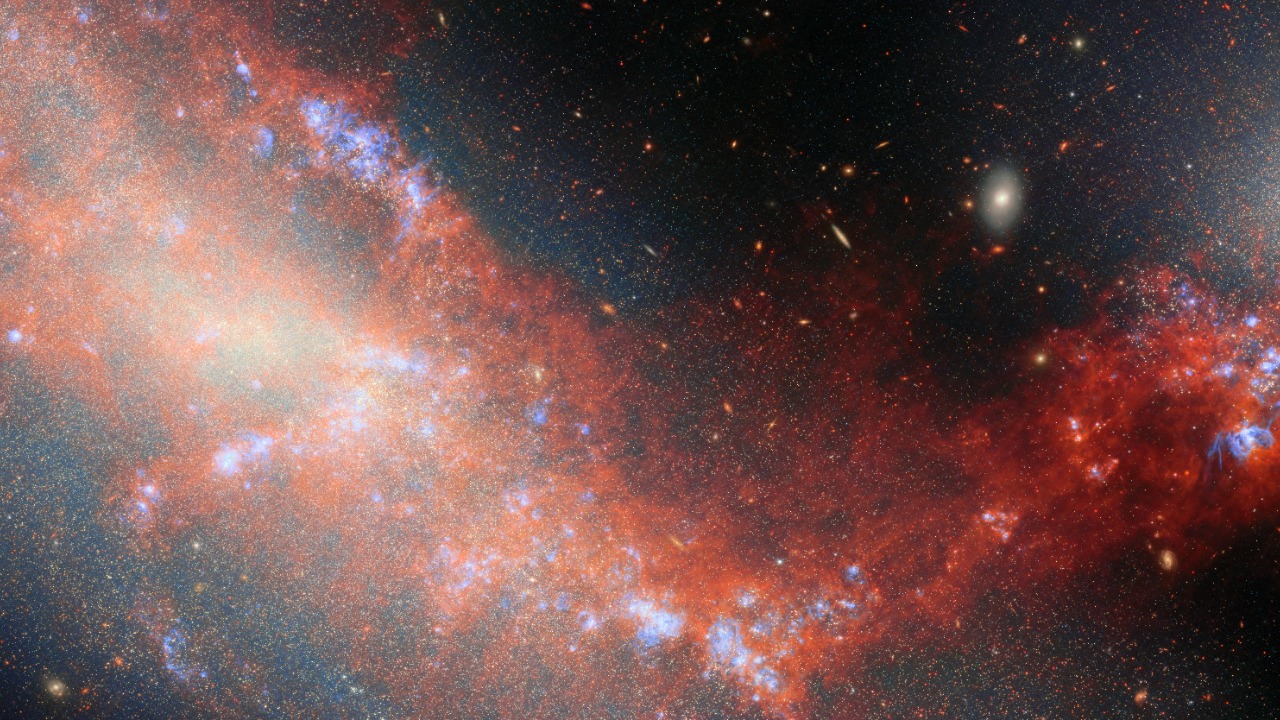

The James Webb Space Telescope has delivered a new kind of galactic portrait, revealing a luminous thread of gas and newborn stars stretching between two small, colliding galaxies. The image turns a violent gravitational encounter into a delicate-looking bridge, and it offers astronomers a rare, close-up view of how such interactions can reshape galaxies over time. I see in this scene not just a pretty picture, but a laboratory for understanding how the universe built larger structures from modest beginnings.
By catching this pair of dwarf galaxies in mid-interaction, Webb is giving researchers a chance to watch gravity at work on a scale that is easier to dissect than the tangled histories of giant spirals. The glowing connection between the galaxies is more than a visual flourish, it is a sign that gas is being stripped, compressed, and turned into stars in real time, a process that may echo the way early galaxies grew in the young cosmos.
The dwarf duo behind the glowing bridge
The new Webb image focuses on the interacting dwarf galaxies NGC 4490 and NGC 4485, a compact pair that astronomers have long known as a minor-league version of more famous galactic collisions. These two systems are relatively small compared with the Milky Way, yet their encounter has produced a surprisingly dramatic structure, with one galaxy visibly tugging material from the other. The bridge between them is not an illusion of perspective, it is a genuine stream of gas and stars that physically links the pair.
According to detailed descriptions of the observation, the James Webb Space Telescope captured NGC 4490 and NGC 4485 at a distance of about 24 million light-years, close enough that Webb’s infrared vision can pick out individual knots of star formation along the connecting structure and within the distorted disks of both galaxies, turning this duo into a textbook case of how dwarf systems respond to tidal forces. The same interaction that pulls out the bridge also warps the galaxies’ shapes and stirs up their gas, leaving NGC 4490 with an elongated, asymmetric profile and NGC 4485 with a visibly disrupted appearance that underscores just how transformative such encounters can be for small galaxies, as highlighted in the new Webb portrait.
What Webb’s infrared eyes reveal in the bridge
What makes this observation stand out is not only that a bridge exists, but how clearly Webb resolves its internal structure. In the infrared, the connecting strand glows with the combined light of warm dust, ionized gas, and clusters of young stars that have recently ignited inside the stripped material. Instead of a smooth arc, the bridge looks clumpy and textured, with bright knots that trace where gas has been compressed enough to collapse into new stellar nurseries.
The same infrared sensitivity that lets Webb peer through dust in distant galaxies is now being applied to this nearby pair, revealing subtle variations in color and brightness along the bridge that hint at different ages and densities of star-forming regions. The European team that processed the image emphasizes that the structure is rich in both gas and stars, a sign that the interaction is not just tearing the galaxies apart but also building new components between them, a point underscored in the official image release that showcases the bridge’s intricate glow.
A “dance of dwarf galaxies” and what it teaches us
When I look at this scene, I see more than a static snapshot, I see a choreography in progress. The two galaxies are locked in a gravitational dance that will eventually merge them into a single, more massive system, but for now they are caught mid-step, trading gas and momentum. The bridge is one of the clearest signatures of that exchange, a tidal feature drawn out as the galaxies swing past each other and their mutual gravity tugs on their outer layers.
Researchers describe such encounters as a way to probe how galaxies evolve when they collide, merge, or even steal gas from one another, and they note that nearby dwarf galaxies provide especially clean examples of these processes because their structures are simpler and easier to model. In this case, the interaction has produced a visible stream of gas and stars that connects the pair, a configuration that helps astronomers test simulations of tidal stripping and star formation in low-mass systems, as highlighted in the discussion of how nearby dwarf galaxies collide and form bridges.
Why dwarf galaxy collisions matter for cosmic history
It might be tempting to treat this interaction as a local curiosity, but dwarf galaxies like NGC 4490 and NGC 4485 are central to the broader story of how the universe assembled its structure. In the early cosmos, small galaxies were far more common than giants, and many of them merged repeatedly to build up the larger systems we see today. By studying a nearby pair in such detail, astronomers can infer how similar collisions played out when the universe was younger and more crowded with small, gas-rich galaxies.
The bridge between these dwarfs is especially valuable because it shows how gas can be redistributed during a merger, feeding star formation not only inside the galaxies but also in the space between them. That redistribution affects how quickly galaxies grow, how their shapes change, and how their chemical compositions evolve over time. The Webb image of this pair therefore complements broader surveys of galactic structure, including recent work that mapped staggering detail in 19 nearby spiral galaxies and highlighted how interactions and internal dynamics sculpt their gas and dust, a theme that connects this dwarf encounter to the larger patterns seen in those nearby spirals.
From press image to research tool
At first glance, the new Webb view of NGC 4490 and NGC 4485 looks like a classic “picture of the month,” the kind of image that circulates widely on social media because of its aesthetic appeal. Yet behind the color choices and composition lies a carefully constructed dataset, with multiple infrared filters tuned to isolate different physical components such as warm dust, ionized gas, and older stellar populations. For astronomers, each hue in the final composite corresponds to a specific wavelength range that can be analyzed quantitatively.
The public-facing version of the image is therefore both an outreach success and a gateway into deeper scientific work, inviting viewers to appreciate the beauty of the scene while also hinting at the underlying physics. The same processing pipeline that produced this striking portrait is part of a broader effort to turn Webb’s raw data into calibrated maps of star formation, dust distribution, and galactic structure, an approach that has already been applied to a larger sample of galaxies and showcased in the context of glowing bridges and other tidal features.
A cosmic ballet captured in unprecedented detail
Photographers often talk about capturing motion in a still frame, and Webb’s view of this galactic pair does something similar on a cosmic scale. The distorted arms, the offset cores, and the luminous bridge all hint at orbits and trajectories that unfold over hundreds of millions of years, yet they are frozen here in a single, exquisitely detailed exposure. For visual storytellers, this makes the image a compelling subject in its own right, a chance to translate abstract gravitational dynamics into something that feels almost choreographed.
One photographer who has written about this scene describes it as a “cosmic ballet” and notes that his works have appeared in over 40 books and magazines including Astronomy, BBC, Sky, and Night, underscoring how strongly such images resonate beyond the scientific community. By framing the interaction as a dance, he highlights the structural effects of gravitational encounters in a way that is accessible to non-specialists, turning the bridge and the warped disks into visual cues that anyone can read as signs of motion and mutual influence.
Connecting this pair to Webb’s wider galaxy program
Although the dwarf pair of NGC 4490 and NGC 4485 is a standout example, it is not an isolated case in Webb’s observing schedule. The telescope is systematically targeting galaxies of many sizes and morphologies, from compact dwarfs to grand-design spirals, in order to build a comparative picture of how stars and gas are arranged across different environments. The glowing bridge in this system is one piece of a much larger puzzle that includes bars, rings, and filamentary dust lanes in other galaxies.
In a separate campaign, Webb has already depicted intricate structure in 19 nearby spiral galaxies, revealing webs of dust and star-forming regions that were previously blurred or invisible, and project scientist Janice Lee of the Space Telescope Sci Institute in Baltimore has described these new images as extraordinary for the way they expose fine details in galactic disks. That broader program, which is documented in the overview of how Webb’s new images are extraordinary, provides essential context for interpreting the dwarf interaction, since it shows what “normal” galactic structure looks like in the absence of such a dramatic collision.
What comes next for NGC 4490 and NGC 4485
Looking ahead, the fate of this galactic pair is all but sealed. Gravity will continue to draw NGC 4490 and NGC 4485 together, tightening their orbits and amplifying the tidal forces that are already stretching out the bridge and distorting their shapes. Over time, the two dwarfs are expected to coalesce into a single, more massive galaxy, with the bridge material either falling back into the merged system or dispersing into a faint halo of stars and gas.
For astronomers, the current Webb image is a baseline, a detailed snapshot that can be compared with simulations and with future observations at other wavelengths, such as radio maps of neutral hydrogen or X-ray views of hot gas. By combining these datasets, researchers can track how much mass is being transferred through the bridge, how efficiently it is forming stars, and how the interaction is altering the internal dynamics of each galaxy. The fact that Webb has captured this pair at about 24 million light-years, as emphasized in the focused discussion of their distance, means that follow-up work can resolve individual star clusters and gas clouds, turning this glowing bridge into one of the most closely studied tidal structures in the nearby universe.
More from MorningOverview