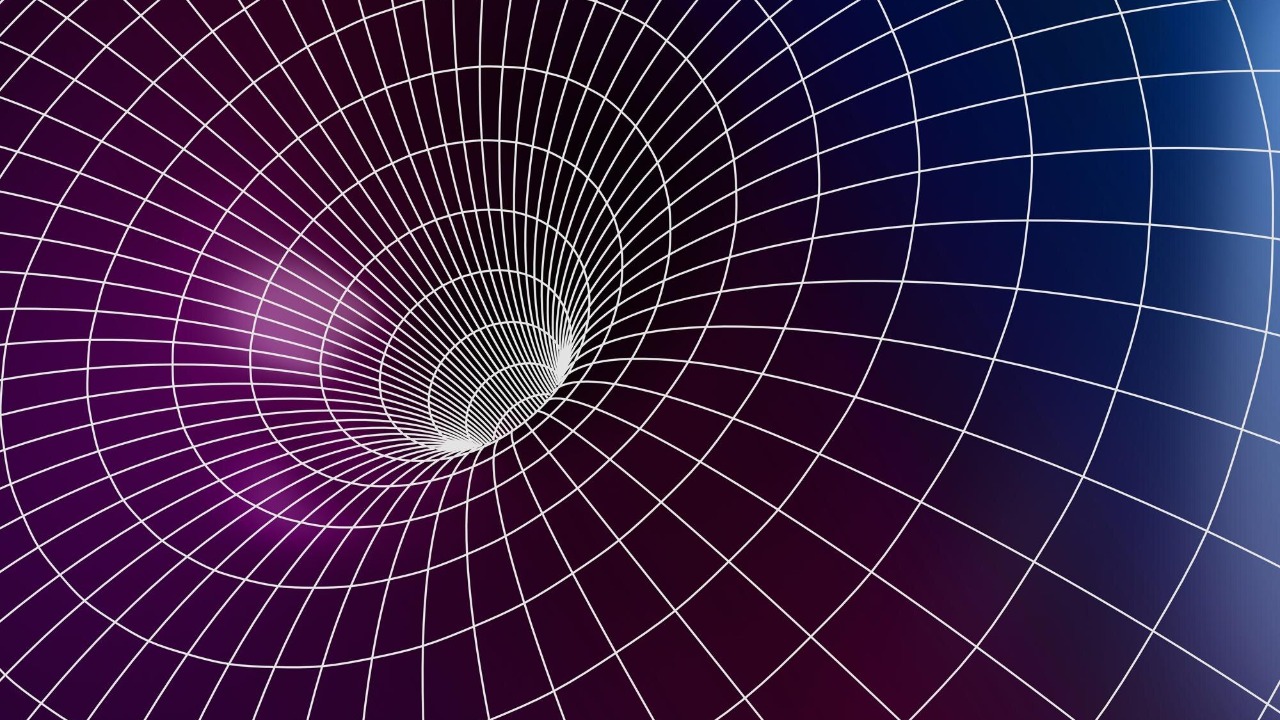

Quantum theory and general relativity have long described the universe with incompatible languages, one speaking in probabilities and the other in smooth curves of spacetime. A new line of work argues that the bridge between them might lie in rethinking how particles move, replacing classical paths with quantum versions of geodesics that encode both gravity and uncertainty. If that idea holds up, it could turn the geometry of spacetime itself into a quantum object and open a fresh route toward a unified picture of nature.
Why geodesics sit at the heart of gravity
Any attempt to connect quantum physics with gravity has to start from the basic grammar of general relativity, which is built around geodesics. In Einstein’s theory, free falling matter does not feel a force in the usual sense, it simply follows the straightest possible path through a curved spacetime, a trajectory that mathematicians call a geodesic. That path is determined by the metric, the mathematical object that measures distances and times and dictates how a world line bends in response to mass and energy.
In this classical picture, a small test body that is not pushed or pulled by anything else always moves along a geodesic, so its motion becomes a direct probe of the underlying geometry. As a result, the notion of a geodesic generalizes the idea of a straight line to a curved universe and turns the motion of planets, light rays, and even spacecraft into tracers of the metric itself, a relationship that is laid out clearly in standard treatments of geodesics in general relativity.
From classical paths to quantum “q–desics”
If gravity is encoded in geodesics, then quantizing gravity may require quantizing those paths as well. A recent theoretical study introduces the concept of “q–desics,” quantum versions of geodesics that describe how test particles move when the gravitational field itself is subject to quantum fluctuations. Instead of a single sharp trajectory through spacetime, a particle in this framework explores a spread of possible paths, each influenced by a fuzzy, probabilistic metric rather than a perfectly smooth one.
In this approach, the motion of test particles becomes a window into quantum gravitational backgrounds, allowing researchers to compare how these q–desics deviate from their classical counterparts. By systematically investigating those deviations, the work aims to clarify the relationship between quantum gravity and classical general relativity and to spell out when the familiar geodesic picture is recovered as a limiting case, an agenda that is set out in detail in the paper on Geodesics in Quantum Gravity.
How TU Wien reframes spacetime as a quantum field
The geodesic idea gains traction when it is combined with a more radical view of spacetime itself. A team at TU Wien argues that the metric, which classically is a smooth field describing distances and times, should be treated as a quantum field with its own fluctuations and uncertainties. In their formulation, the gravitational field is no longer a fixed background but a quantum object whose properties can be probed by the motion of particles, turning geodesics into tools for reading out the quantum state of spacetime.
This perspective leads to major mathematical challenges, because it requires defining a quantum version of the metric that still reproduces the familiar gravitational field in the right limit. The researchers describe how such a field can be used to capture the quantum properties of the metric and to connect them with observable motion, sketching a path from abstract operators to measurable effects. The resulting framework, which treats gravity as a quantum field that shapes particle trajectories, is outlined in a report on a new approach that links quantum physics and gravitation.
Cinderella and the search for the “right” quantum geometry
To explain why the right notion of a quantum geodesic matters, the TU Wien team leans on a fairy tale. In their analogy, the correct quantum description of gravity is like Cinderella, hidden among many possible candidates that all seem plausible at first glance. Only when the prince finds the slipper that fits perfectly can he identify the real Cinderella, just as only the right quantum construction will match the observed motion of particles in a gravitational field.
In this story, the slipper is the requirement that quantum trajectories reduce to classical geodesics when quantum effects become negligible, for example when a planet settles into an approximately circular path around a star. The researchers argue that by demanding this kind of precise fit between theory and motion, they can sift through competing ideas about quantum gravity and single out the one that reproduces the familiar behavior of matter in curved spacetime, a strategy they illustrate with the “Cinderella and quantum gravity” metaphor.
The TU Wien program and its quantum geodesic toolkit
Behind the storytelling sits a concrete research program. A team at TU Wien has developed a formalism in which the classical metric is replaced by a quantum object, and the motion of particles is described by quantum geodesics that respond to this fluctuating geometry. Their goal is to construct a framework in which quantum physics and gravitation, which usually do not quite fit together, can be described consistently without discarding the geometric insights of general relativity.
In this scheme, the quantum version of geodesics is central, because it encodes how a test particle samples the fuzzy metric and how its world line becomes a probabilistic object rather than a single curve. The course of these quantum geodesics is still determined by a metric, but now that metric is a fuzzy version of the classical quantity, with uncertainty built into its very definition. By working out how such quantum paths behave and how they reduce to ordinary geodesics in the right limit, the TU Wien group hopes to clarify how a quantum spacetime can look classical at large scales, a program described in their overview of Wien research on quantum gravity and in a companion piece on the quantum version of geodesics.
From abstract math to potential observations
For any theory of quantum gravity to move beyond speculation, it has to say something about data. The TU Wien work emphasizes that its geodesic-based framework is not only a mathematical construction but also a way to reinterpret observational results, because particle trajectories and light paths are among the most precisely measured quantities in physics. By predicting how quantum geodesics should deviate from classical ones, the theory offers a new perspective on observational data that could, in principle, reveal subtle signatures of a quantum metric.
The researchers point out that their results have been published in Physical Review D, a sign that the formalism has cleared at least one layer of peer scrutiny and is ready to be confronted with real measurements. They argue that the same mathematical machinery that defines q–desics can be used to analyze how quantum fluctuations in the metric might leave imprints on astrophysical or cosmological observations, from the motion of stars to the propagation of light across vast distances, a connection they highlight in their discussion of a new perspective on data and the role of Physical Review D in disseminating the work.
Cosmic scales as a testing ground for quantum geodesics
If quantum geodesics are to leave observable traces, the most promising arena may be the largest structures in the universe. At cosmic distances, tiny deviations in how particles and light move can accumulate into measurable differences, turning the cosmos into a natural laboratory for quantum gravity. The idea is that q–desics might predict small but systematic departures from the paths expected in classical cosmology, potentially affecting how galaxies cluster or how light from distant sources is bent and delayed.
That possibility has already caught the attention of researchers who focus on the intersection of quantum gravity, cosmology, and fundamental physics. Discussions of “quantum geodesics” now appear alongside hashtags that explicitly link #QuantumGravity, #Cosmology, and #Physics, reflecting a growing sense that the motion of matter on the largest scales could encode clues about the quantum nature of spacetime itself. One recent summary of this trend highlights how quantum geodesics might predict observable deviations at cosmic distances, framing them as a bridge between theory and data in the overlapping worlds of Cosmology and high energy Physics.
Major mathematical hurdles on the road to unification
None of this comes easily. Turning the metric into a quantum field and defining q–desics that move through it forces theorists to grapple with deep mathematical problems, from operator ordering to the definition of distance in a probabilistic geometry. The TU Wien team acknowledges that their approach leads to major mathematical challenges, because it has to reconcile the continuous structure of spacetime with the discrete, probabilistic nature of quantum theory without losing the predictive power of either framework.
Those challenges are not just technical details, they determine whether the theory can make unambiguous predictions that can be tested. Constructing a fuzzy metric that still behaves like a classical one in the right limit, ensuring that quantum geodesics are well defined, and proving that the whole structure is consistent are all nontrivial tasks. The researchers present their work as a step toward that goal, not a final answer, and they stress that the same mathematical machinery that creates difficulties also opens the door to new insights into the quantum properties of the metric, a tension they describe in their account of how this approach leads to major mathematical challenges.
Why a geodesic lens could reshape the quantum gravity debate
For decades, the search for quantum gravity has been dominated by large, ambitious frameworks such as string theory and loop quantum gravity, each with its own assumptions about what spacetime is made of. The geodesic-based approach from TU Wien offers a different angle, one that starts not from microscopic building blocks but from the motion of test particles and the geometry they reveal. By focusing on how trajectories change when the metric becomes a quantum field, it reframes the problem in terms that are closer to experiment and observation.
As a journalist following these developments, I see this shift as a reminder that unification may come not from inventing entirely new ingredients but from reinterpreting familiar ones in a quantum light. Geodesics have always been the workhorses of general relativity, quietly encoding how gravity shapes motion, and turning them into q–desics could make them just as central to the quantum story. Whether this program ultimately succeeds or not, it sharpens the questions that any viable theory of quantum gravity must answer: how to define motion in a fluctuating spacetime, how to recover classical behavior when quantum effects fade, and how to connect abstract mathematics with the paths that real particles trace through the universe.
More from MorningOverview