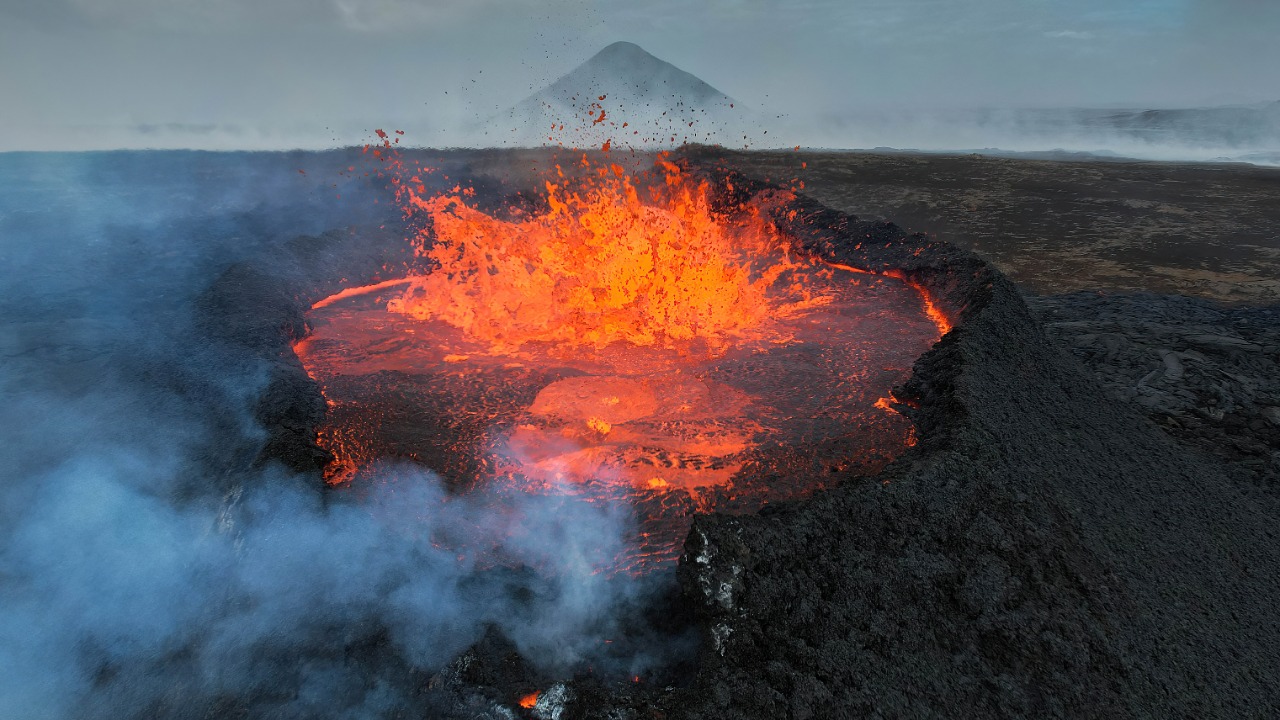

The Black Death has long been framed as a purely biological catastrophe, a lethal bacterium riding into crowded ports and tearing through unprepared cities. New research now argues that the pandemic’s opening act may have started far away from any medieval marketplace, inside the caldera of a volcano whose eruption quietly rewired the climate and trade routes of an entire continent.
By tracing subtle scars in ancient trees, cross checking them with chronicles of strange skies and following the grain ships that fed hungry cities, scientists are building a case that a distant eruption set off a chain of events that ultimately delivered plague to Europe. If that argument holds, the Black Death was not only a story of rats and fleas, but also of ash in the stratosphere and a climate system pushed abruptly off balance.
How a forgotten eruption crashed the climate
When I look at the new evidence, the starting point is not a ship in a harbor but a sharp, sudden chill recorded in the growth rings of trees. Researchers examined tree ring records from across Europe and found a pronounced climatic downturn, with colder than normal temperatures lasting for two to three consecutive years, that they attribute to a powerful volcanic eruption injecting particles high into the atmosphere. Those tree ring signatures, which capture how stressed the trees were in those years, line up with documentary reports of harvest failures and unusual weather that would have rippled through medieval societies already living close to the edge.
The team behind this work argues that the scale and timing of the cooling point to a major eruption that has not yet been securely matched to a known volcano, a gap that has led some to describe it as a Forgotten Eruption Could Rewrite the Black Death Origin Story. In their reconstruction, the eruption’s sulfate-rich plume dimmed incoming sunlight, shortened growing seasons and helped trigger a run of poor harvests that undermined food security across large parts of Europe. That climatic shock, they contend, did not cause plague bacteria to appear out of nowhere, but it did help create the economic and ecological pressures that would later make the continent far more vulnerable when the pathogen finally arrived.
Tree rings, dark skies and the hunt for a culprit volcano
To connect a medieval pandemic to a distant volcano, scientists have had to become detectives of deep time, reading clues from both nature and human observers. In the tree ring archives, they see a clear pattern of stunted growth that begins shortly before the Black Death, a signal consistent with a rapid drop in temperatures across Europe that is difficult to explain without a major volcanic injection of aerosols into the stratosphere. That pattern is not confined to a single valley or mountain range, but appears across wide swaths of the continent, which strengthens the case that the cooling was driven by a global scale forcing rather than local weather quirks.
Written sources from the same period add another layer of evidence, with chroniclers describing unusual cloudiness and dark lunar eclipses that point toward volcanic dust veiling the sky. Those accounts, combined with the dendrochronological record, underpin the argument that a volcanically forced climatic downturn set in motion a sequence of stresses that culminated in the Black Death, almost 800 years later in our rear view mirror, as a defining rupture in European history. One synthesis of this work notes that Documentary evidence of strange eclipses and persistent haze dovetails with the physical climate proxies, giving the volcanic hypothesis a rare blend of scientific and historical support.
From cooling to crisis: famine, trade and plague ecology
Once the climate shock is in place, the story shifts from geology to human systems, and here the argument becomes both more speculative and more compelling. A run of cold, wet seasons can devastate harvests, especially in preindustrial societies that lack storage buffers and global supply chains, and the tree ring data suggest exactly that kind of prolonged stress. In response, authorities in Mediterranean cities turned to long distance grain imports to keep their populations fed, drawing more heavily on Black Sea and Eastern Mediterranean routes that linked them to distant hinterlands where plague reservoirs were present in wild rodent populations.
One recent reconstruction describes how importing grain after several years of volcano induced climate change prevented a Mediterranean wide famine, but at a cost: the same ships that carried wheat and barley also carried rats and the fleas that harbored Yersinia pestis. In that telling, an unknown volcanic eruption in Dec set off a butterfly effect that altered trade flows and inadvertently opened a pathway for plague to move toward Europe via the Black Sea, a chain of events summarized in the phrase that Importing grain became inseparable from importing disease risk. In my view, this framing does not absolve human decision makers, but it does highlight how constrained their choices were once the climate had turned against them.
Reframing the Black Death’s arrival in Europe
For generations, historians have debated how exactly the Black Death first reached Europe, with most accounts centering on caravans and ships that linked Central Asia to Mediterranean ports. The new volcanic hypothesis does not discard those routes, but it reframes them as part of a larger environmental cascade that began long before the first infected sailor staggered ashore. Before the Black Death claimed millions of lives across medieval Europe, its arrival on the continent may have been propelled by a series of volcanic eruptions that reshaped climate, food supplies and trade patterns in ways that made a devastating outbreak far more likely.
In this view, plague did not simply appear at the gates of Europe by chance, but rode in on currents of commerce that had been intensified by prior climate stress. One analysis argues that, before the Black Death, volcanic eruptions may have been responsible for the spread of plague into new regions of Europe, helping to seed the pathogen in port cities and along river networks where it could then move inland and become endemic in some areas. That work emphasizes that the social and economic disruptions unleashed in the fourteenth century remain prevalent to this day, a reminder that the pandemic’s legacy is not only demographic but institutional, and it grounds its claims in the idea that Before the Black Death reached its peak, environmental forces had already tilted the odds toward catastrophe.
What the science actually shows about climate and plague
As striking as the narrative is, it rests on a set of concrete scientific techniques that deserve attention in their own right. Researchers have assembled a dense network of tree ring chronologies from across Europe, using the width and density of each annual ring to reconstruct temperature and moisture conditions year by year across the century leading up to the pandemic. By comparing those reconstructions with independent records of volcanic sulfate in ice cores, they can identify periods when eruptions likely drove abrupt cooling, and then ask how those intervals align with known episodes of social stress and disease.
One detailed study explains how the researchers analyzed tree ring data from across Europe to see how temperatures fluctuated across the century leading up to the Black Death, and how they then overlaid that climate history with records of harvest failures and grain price spikes. The same work notes that the climatic downturn they identify is consistent with a major volcanic eruption, even if the exact source volcano remains uncertain, and it frames the project as an effort to understand how environmental shocks can interact with pathogens to produce outsized human impacts. In describing their approach, the authors emphasize that they hope the integration of dendrochronology, documentary history and epidemiology will encourage more scholars to explore similar connections, a point captured in the description that the researchers analyzed tree ring records precisely to test whether climate variability could have nudged plague dynamics.
Rethinking medieval explanations, from “astral constellations” to aerosols
Contemporaries who lived through the Black Death had no concept of bacteria, let alone volcanic aerosols, and their explanations for the horror unfolding around them reflected the intellectual tools of their time. At the height of the crisis, the cause of plague was not known and the outbreak was blamed on things such as “astral constellations and bad air,” ideas that fit within prevailing medical and cosmological theories. Those frameworks shaped how authorities responded, from religious processions to attempts at purifying the air, but they could not address the underlying ecological and climatic drivers that modern science is now uncovering.
By contrast, the new research invites us to see the same events through a very different lens, one in which a volcanic eruption may have led to the Black Death coming to Europe by first disrupting weather patterns and then reconfiguring trade. One account traces how a volcano eruption may have led to the Black Death coming to Europe by cooling key grain growing regions and pushing merchants to seek supplies from the Black Sea and Eastern Mediterranean, routes that also connected them to plague reservoirs in Central Asia and the Caucasus. That narrative, which situates the pandemic within a broader environmental context, underscores how far our understanding has shifted from medieval notions of astral influence, and it is encapsulated in the observation that At the time, people reached for the stars to explain what we now trace back to a volcano.
Europe’s transformation under a double shock
Even without the volcanic link, historians have long recognized that the Black Death fundamentally altered Europe’s trajectory, reshaping labor markets, religious life and political structures. The new work on climate forcing does not change those outcomes, but it does suggest that the pandemic’s ferocity was amplified by a prior environmental blow that had already weakened societies. In that sense, Europe was hit by a double shock, first a climate crisis driven by a volcanic eruption and then a biological one driven by Yersinia pestis, with the combination proving far more destabilizing than either would have been alone.
Visual accounts of the period often focus on the human toll, but the emerging research encourages us to picture the broader landscape as well, from failed harvests to altered migration patterns. One synthesis of the evidence notes that a volcanic eruption may have triggered Europe’s deadly Black Death plague, and it emphasizes how the pandemic fundamentally altered Europe’s demography and institutions in ways that still shape the continent. That work highlights how the Black Death, and the climatic disruptions that preceded it, are now being reinterpreted through the lens of Earth system science, a shift captured in the observation that Volcanic forcing may have primed Europe for one of the deadliest outbreaks in recorded history.
What the latest studies add, and what they cannot prove
As compelling as the volcanic hypothesis is, I find it important to separate what the evidence clearly supports from what remains an informed but unproven narrative. The tree ring and documentary data make a strong case for a significant climatic downturn in the years leading up to the Black Death, and the most plausible driver of that cooling is a major volcanic eruption that has not yet been definitively located. The epidemiological and historical records also support the idea that plague spread along trade routes that were sensitive to shifts in grain supply and demand, which would have been affected by poor harvests.
What the studies cannot yet do is draw a straight, unbroken line from a specific volcano to a specific ship carrying plague infected fleas. One recent report on the new research stresses that, in the tree ring we see a climatic downturn, which means colder than normal temperatures for two to three years consecutively, and that this pattern is consistent with a large eruption that likely nudged trade and migration patterns. The same analysis notes that the new research also nudges the debate over the Black Death’s origins toward a more integrated view of climate and disease, while acknowledging that some scholars who were not involved with the research remain cautious about overinterpreting the correlations. That balance is reflected in the description that In the current state of the field, the volcanic link is a powerful hypothesis rather than a closed case.
Why a medieval eruption matters in a warming world
For a reader living in the twenty first century, the idea that a volcano in Dec could help unleash a pandemic in medieval Europe is more than a historical curiosity, it is a warning about how tightly coupled our own systems have become. The Black Death unfolded in a world with far less connectivity than today, yet a single climatic shock appears to have cascaded through agriculture, trade and disease ecology in ways that magnified its impact. In a globalized economy where grain, livestock and people move at unprecedented speed, the potential for similar cascades, whether triggered by volcanoes or by human driven climate change, is even greater.
That is why I see the new research not just as a revision of the Black Death’s origin story, but as a case study in how environmental disruptions can interact with pathogens to produce outsized consequences. One synthesis of the evidence argues that volcanic eruptions may have been responsible for the spread of plague into medieval Europe, and it frames that conclusion as part of a broader effort to understand how climate variability can shape disease dynamics. Another emphasizes that the climatic downturn identified in the tree rings was likely volcanically forced and that it set off a chain of events that brought the Black Death to Europe, a perspective captured in the description that there might be a connection between distant eruptions and the pandemics that reshape societies. For policymakers and public health officials confronting a rapidly changing climate today, that connection is not just a matter for historians, it is a prompt to think harder about the hidden links between environmental shocks and future outbreaks.
More from MorningOverview