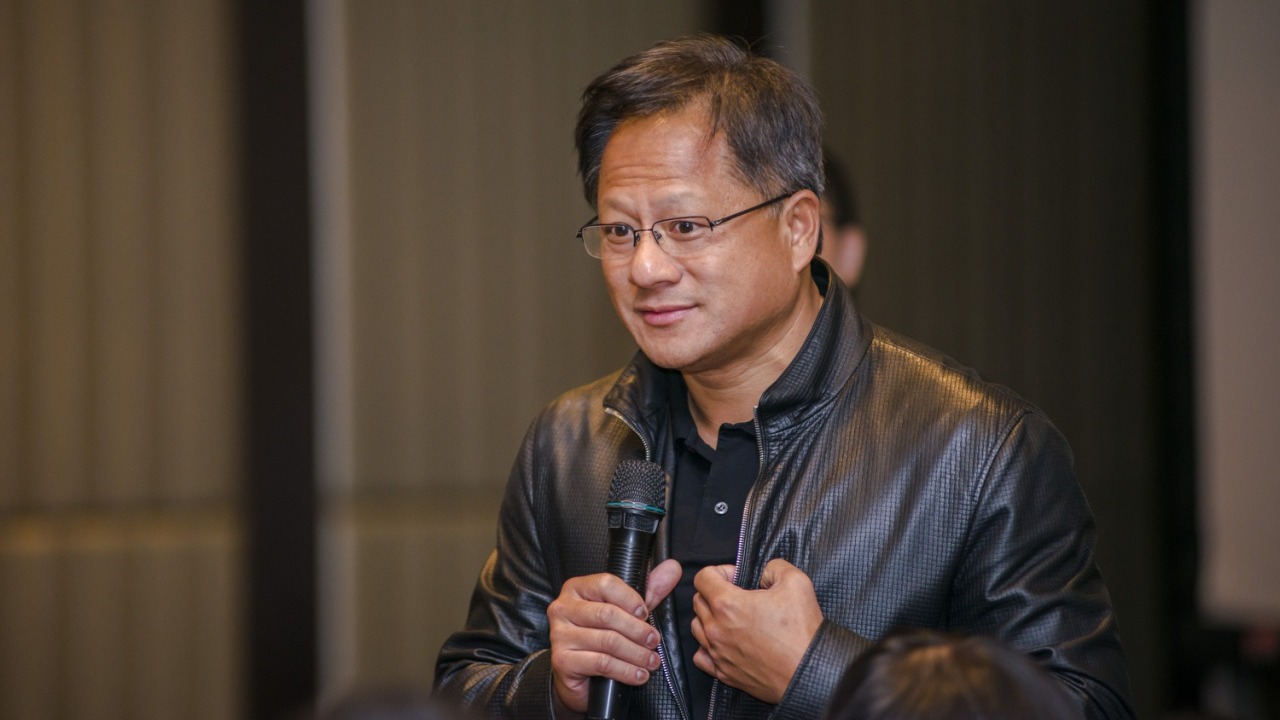

Nvidia chief executive Jensen Huang is using one of artificial intelligence’s most famous misfires to argue that work will not vanish in a wave of automation, but instead be reshaped and expanded. By revisiting a bold 2016 forecast that AI would soon replace radiologists, he is making the case that the technology’s real impact is to change what people do on the job, not to erase the need for human expertise.
His message lands at a moment when AI systems are moving from research labs into hospitals, law firms, call centers, and factory floors, and when anxiety about mass displacement is colliding with a surge of new AI‑driven tasks. I see Huang’s evolving stance as a window into how one of the industry’s most powerful figures now thinks about the future of work, and why he believes the next decade will be defined less by job extinction than by a relentless redefinition of what every role entails.
From 2016 alarm to 2025 rethink
The 2016 prediction that AI would make radiologists obsolete within a decade has become a touchstone in debates about automation, and Nvidia CEO Jensen Huang is now using that incorrect call as a cautionary tale about overestimating how fast jobs disappear. He has pointed back to that nine‑year‑old forecast to argue that even in a field where algorithms can read images with extraordinary accuracy, the human role has not evaporated, which he sees as evidence that AI tends to augment rather than annihilate complex professions, a point he underscored when he cited radiologists as a counterexample to doomsday scenarios about employment in recent remarks.
By highlighting how that early forecast failed to materialize on schedule, Huang is not claiming that AI is weak, but that the social and organizational side of work changes more slowly than raw model performance. Radiology departments did adopt powerful image‑analysis tools, yet hospitals still rely on physicians to interpret ambiguous cases, communicate with patients, and coordinate treatment, which is why he now frames the 2016 call as a lesson in humility about predicting job extinction and as a reason to focus on how roles evolve instead of assuming they simply vanish.
“Everybody’s jobs will be different,” not gone
Huang’s current message is not that AI will leave the labor market untouched, but that it will touch almost every role while keeping people firmly in the loop. He has warned that every job will be affected and immediately, stressing that the person who will replace you thanks to AI is still you, only equipped with far more capable tools, a framing he has used to argue that workers should expect sweeping change in how they spend their time rather than a sudden pink slip driven by automation alone.
In public conversations about AI’s impact on work, he has boiled that idea down to a simple line, saying that everybody’s jobs will be different as software takes over more mundane and arduous tasks and leaves people to focus on higher‑value decisions. In a short exchange where Nvidia CEO Jensen Huang discussed AI at the U.S.‑Saudi Investment Forum, he framed this shift as a broad rebalancing of effort rather than a collapse in demand for labor, telling an audience that as AI handles routine chores, people will be freed to do more creative and judgment‑heavy work, a view he summarized by insisting that everybody will see their role change.
Radiology as a case study in AI‑driven job growth
Radiology is central to Huang’s argument because it shows how AI can make a profession busier rather than redundant. As AI tools made image analysis more efficient for workers, radiologists were able to read more scans, handle more images, and cover more patients, which translated into job growth instead of contraction, a pattern Huang has highlighted to show that productivity gains in one part of a workflow often create new demand elsewhere in the system, as seen in AI‑driven imaging.
He has also emphasized that even as algorithms flag potential tumors or anomalies, radiologists remain responsible for synthesizing those findings with a patient’s history, explaining options, and working with oncologists and surgeons, which keeps the human role central. In his view, the fact that AI can now detect disease patterns that were previously invisible, yet radiologists are still in high demand, undercuts the idea that technical breakthroughs automatically erase jobs and instead supports the notion that they expand the scope and intensity of the work people do.
Redefining the purpose of a job in the AI era
To make sense of why radiologists and other specialists remain essential, Huang has urged audiences to go back to what is the purpose of a job, arguing that roles exist to solve problems for people, not to perform a fixed list of tasks. He has said that as AI takes over specific activities, the underlying mission of a job, such as diagnosing disease or advising clients, does not disappear, which is why he believes that understanding the purpose of work is key to predicting how AI will reshape employment, a point he made explicit when he explained that the purpose of a job is to solve a problem for someone in recent comments.
From that perspective, AI is less a job destroyer than a tool that changes which problems humans focus on and which they delegate to machines. If software can summarize a legal brief or pre‑screen a CT scan, then lawyers and doctors can spend more time on strategy, empathy, and complex judgment, which Huang sees as the real value of human labor and as the reason he expects jobs to evolve rather than vanish even as AI systems become more capable.
Global stage, competing narratives on AI and jobs
Huang’s optimism about job evolution has been especially visible on high‑profile stages where fears of mass unemployment are often voiced. At the U.S.‑Saudi Investment Forum, sitting alongside Tesla CEO Elon Musk, he pushed back on predictions that AI would hollow out the labor market, arguing instead that the chief executive of the chip giant expects AI to drive job growth by creating new categories of work and amplifying human productivity, a stance he laid out while sharing the stage with Tesla CEO Elon Musk.
That setting matters because Musk has repeatedly warned that AI could make traditional employment obsolete, yet Huang chose that moment to counter earlier predictions of widespread job losses and to argue that new roles will emerge as quickly as old tasks are automated. By framing AI as a catalyst for job growth in front of policymakers and investors, he is trying to shift the narrative from one of inevitable displacement to one of managed transition, where the challenge is not a lack of work but the need to help people move into newly created, AI‑enabled roles.
Why Huang thinks workers will be busier, not idle
Huang’s view that AI will keep people busy is grounded in how he sees productivity gains playing out inside organizations. When software accelerates routine steps, such as triaging customer emails or scanning financial records, it rarely leads managers to send everyone home; instead, they tend to raise expectations, expand output targets, and pursue new lines of business, which is why he argues that AI will actually make everyone a lot busier and that everybody’s jobs will be different as a result, a theme he has tied directly to the way AI‑driven efficiency in image analysis increased the volume of work radiologists could handle in medical settings.
In his telling, the same pattern will repeat across white‑collar and blue‑collar roles, from software engineers who use code‑generation tools to ship more features, to logistics planners who rely on AI forecasts to manage more complex supply chains. Rather than a future of idle workers, he envisions a world where AI systems handle the drudgery and humans are pushed into higher throughput, more cognitively demanding tasks, which he sees as both an opportunity for richer work and a pressure that will require careful management to avoid burnout.
Human‑AI symbiosis and the innovation paradox
Huang’s argument also aligns with emerging research on how people and AI systems collaborate inside companies. Scholars studying the innovation paradox in human‑AI symbiosis have found that AI adoption can have ambidextrous effects on innovative behavior, boosting creativity when employees see the technology as a cooperative instrument that improves productivity, but dampening it when they view AI as a possible danger to job stability, a dynamic captured in work that notes that, firstly, managers want to help their employees frame AI as a partner rather than a threat in organizational studies.
That research suggests that whether AI leads to more innovative, engaging jobs or to fear and resistance depends heavily on how leaders communicate its role, which dovetails with Huang’s insistence that workers should see AI as a tool that extends their capabilities. By positioning AI as a way to offload repetitive chores and focus on higher‑order problem solving, he is effectively arguing for the cooperative framing that studies say is most likely to unlock new ideas and new kinds of work rather than a race to the bottom on headcount.
The limits of prediction and the lesson of the “bad call”
Huang’s willingness to spotlight an incorrect nine‑year‑old prediction about radiologists is also a tacit admission that even insiders misjudge how technology and labor markets interact. The 2016 call assumed that once AI could match or exceed human performance on image recognition benchmarks, the corresponding jobs would quickly disappear, yet the reality has been far messier, with regulatory hurdles, liability concerns, patient expectations, and institutional inertia all slowing the pace at which algorithms can fully replace human decision makers, a gap he now uses to argue that forecasts of rapid job destruction should be treated with skepticism, as he did when he revisited that nine‑year‑old prediction.
For me, the deeper lesson in his pivot is that the hardest part of anticipating AI’s impact is not guessing what the models will be able to do, but understanding how institutions, regulations, and human habits will respond. Huang’s new line, that jobs will survive but look very different, reflects a more nuanced appreciation of those frictions, and it suggests that the most realistic future is one where AI steadily rewires the content of work while the basic need for human judgment, accountability, and empathy keeps people at the center of economic life.
More from MorningOverview