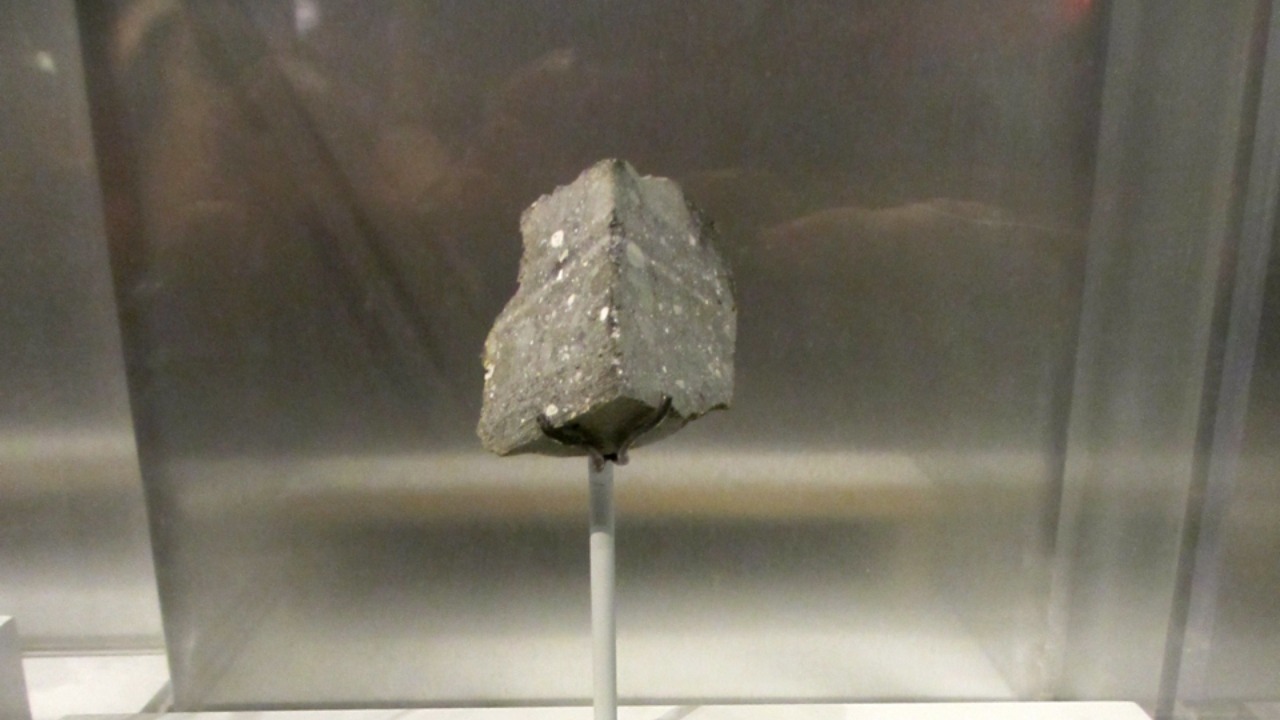

Locked inside a frozen rock from the edge of the world is a story that began before Earth had oceans, continents or even a solid surface. A 4.5 Billion-Year-Old fragment of cosmic debris recovered in Antarctica preserves minerals, water clues and even stardust that predate our solar system, turning a single meteorite into a time capsule of planetary origins.
By tracing how this ancient visitor formed, what it carries and how it was found, I can follow scientists as they reconstruct the violent, creative chaos that shaped the planets and perhaps set the stage for life on Earth.
The Antarctic meteorite that rewrites deep time
When researchers describe a meteorite from Antarctica as 4.5 Billion-Year-Old, they are pointing to material that solidified when the solar system itself was just emerging from a collapsing cloud of gas and dust. In one recent account, scientists framed a newly analyzed Meteorite as Antarctica Carrying a 4.5 Billion-Year-Old puzzle, arguing that its chemistry preserves conditions that existed before the familiar planets fully assembled, and even hinting at matter that formed before our solar system existed at all. That kind of age estimate is not a casual guess, it reflects radiometric dating of minerals that crystallized as the first solids condensed around the young Sun, locking in isotopic ratios that still tick like clocks today.
What makes this Antarctic find so compelling is the way it connects to a broader family of ancient space rocks. Earlier work on other 4.5-Billion-Year samples showed that these meteorites are not random stones but curated archives of early solar system history, each one preserving a slightly different snapshot of the disk of dust and gas that once orbited between what would become Mars and Jupiter. When I look at the new Antarctic specimen through that lens, it becomes less a curiosity and more a missing chapter in a long-running investigation into how the first solid building blocks of planets formed, migrated and collided.
Yamato 691 and the birth of a new mineral
Long before the latest discovery, another Antarctic rock forced scientists to rethink what could survive from the dawn of the solar system. A meteorite collected on the ice and cataloged as Yamato 691 turned out to be an enstatite chondrite, a rare type of stone that likely originated from an asteroid orbiting between Mars and the inner solar system. Detailed analysis showed that Most meteorites found on Earth fit into broader chemical groups, but Yamato 691 stood out because it preserved a mineralogical record of extremely reducing conditions, the kind of oxygen-poor environment expected in the inner nebula where Mercury and proto-Earth were taking shape, and that made it a prized witness to those early processes.
Inside that same Yamato sample, researchers identified a completely new mineral that had never been seen in nature. Follow-up work described how this 4.5-Billion-Year fragment contained a titanium sulfide phase later named wassonite, a crystal structure that had only been predicted in the lab. The discovery showed that even a small chip of an Old Antarctic Meteorite Yields New Mineral can still surprise mineralogists, and it underscored how much of the solar system’s original chemistry is locked away in these frozen archives, waiting for someone with the right instruments and questions to coax it out.
Wassonite and the power of microscopic secrets
The identification of wassonite inside Yamato 691 was not a matter of spotting a glittering vein with the naked eye, it depended on painstaking microscopy and microanalysis. NASA space scientist Keiko Nakamura, working as Messenger of a team focused on primitive solar system materials, used high resolution electron beams to probe grains only a few micrometers across, eventually confirming that this titanium sulfide arrangement “has not been previously observed in nature.” That level of detail matters because it shows how new minerals can hide in plain sight inside meteorites that have been sitting in collections for decades, their secrets only revealed when technology catches up.
For me, the wassonite story illustrates why meteorites are more than just age measurements. A single exotic phase can encode pressure, temperature and chemical conditions that prevailed when it formed, turning each grain into a tiny data logger from the early solar system. When scientists tie those constraints back to the broader context of enstatite chondrites and their likely origin near Mars and proto-Earth, they can test models of how the inner planets differentiated, how metal and silicate separated, and how volatile elements were lost or retained. In that sense, the “new” mineral is less a curiosity and more a calibration point for our entire picture of planetary birth.
Stardust older than the solar system
Not every secret inside an Antarctic meteorite dates to the birth of the solar system, some grains are even older. In one remarkable case, researchers studying a small stone recovered from the ice found a Tiny Speck of Stardust That had formed around a dying star before the Sun existed, then drifted through interstellar space until it was swept into the collapsing cloud that became our planetary system. When they described This Antarctic Meteorite Holds that presolar grain, they emphasized that its isotopic signature could not be explained by any process inside the solar nebula, confirming that it was a true interstellar immigrant.
That older Than the Solar System speck is a reminder that meteorites are not just planetary building blocks, they are also delivery systems for material forged in previous generations of stars. Star explosions throw ingredients into space, and some of those atoms eventually end up in rocks that fall on Earth, where we can study them in the lab. For me, that continuity is striking: the calcium in human bones, the silicon in smartphone chips and the carbon in Antarctic stardust all trace back to nuclear reactions in ancient suns, and meteorites give us the rare chance to hold that history in our hands.
Water clues hidden in opal and ice
One of the biggest questions that a 4.5-Billion-Year meteorite can help answer is how Earth got its water. Some models suggest that our planet formed relatively dry and was later bombarded by icy bodies, while others argue that planets may make their own water as they form, through reactions between hydrogen and rocky minerals. A study of opal-bearing fragments in an Antarctic meteorite added an intriguing twist, showing that tiny pieces of hydrated silica, essentially opal, had formed within the rock itself. Those opal pieces found in an Antarctica meteorite hinted that water had interacted with the parent body, suggesting that even small asteroids can host liquid water for at least brief periods.
When I connect that finding to the broader debate, it becomes clear that meteorites are central to tracing the origin of Earth’s oceans. If opal and other hydrated minerals are common in primitive bodies, then impacts could have delivered not just ice but chemically bound water that was harder to lose during violent collisions. At the same time, the idea that Planets may make their own water as they form, supported by the chemistry of these rocks, means that Earth might have generated part of its inventory internally. The Antarctic samples, with their mix of dry enstatite material and wetter, opal-studded fragments, show that both pathways likely operated in parallel, and that the story of our oceans is written in a patchwork of very different parent bodies.
A 4.5 Billion-Year-Old mystery from Antarctica
The newest Antarctic meteorite drawing attention slots into this complex picture as both familiar and strange. Researchers Uncover a Meteorite in Antarctica Carrying a 4.5 Billion-Year-Old enigma described how its composition points to formation in the earliest solid phase of the solar nebula, yet some of its isotopic signatures look more like material that formed in environments predating our system. That tension between “ordinary” chondritic chemistry and exotic isotopes is what makes it a Billion Year puzzle, suggesting that the rock is a blend of local and inherited components rather than a simple snapshot of one region.
In practical terms, that means this meteorite can help test how efficiently the young solar system mixed its ingredients. If grains from distant, colder regions or even from other stellar nurseries were incorporated into the same parent body as high temperature inner nebula material, then the disk around the Sun must have been more turbulent and interconnected than some models assume. For me, the appeal of this 4.5 Billion-Year-Old sample is that it forces theorists to reconcile those mixed signals, refining simulations of disk dynamics until they can reproduce the strange but very real blend of components locked inside the Antarctic stone.
How meteorites record the physics of planet formation
To decode what a meteorite is telling us, scientists lean on more than chemistry, they also use physics, especially Thermodynamics. In one recent explainer, researchers highlighted how Meteorites like Aende record conditions in the early solar system, and how thermodynamic modeling helps them understand the temperatures and pressures under which different minerals could have formed and equilibrated. By comparing those models to the actual mineral assemblages and textures in a rock, they can reconstruct whether it cooled slowly inside a large parent body, was flash heated by a shock wave, or experienced multiple episodes of melting and solidification.
That approach is particularly powerful for 4.5-Billion-Year meteorites because they often preserve primitive features that have not been overprinted by later geological activity. When I look at a thin section of such a rock, I am effectively seeing a frozen record of condensation, accretion and thermal metamorphism that played out in the first few million years of solar system history. Thermodynamics turns that static snapshot into a dynamic story, allowing scientists to estimate how quickly the parent body grew, how radioactive heating altered its interior, and how collisions might have shattered and reassembled it. The Antarctic samples, with their well preserved chondrules and matrix, are ideal test beds for this kind of forensic reconstruction.
Life’s ingredients in ancient stones
The stakes of studying these meteorites are not limited to planetary architecture, they also touch on the origins of biology. A Rare 4.5 Billion-Year-Old Meteorite Could Hold Secrets to Life on Earth, as one detailed study of the Winchcombe fall in the United Kingdom made clear. That carbon rich stone contained a suite of organic molecules and hydrated minerals that look like plausible precursors to the chemistry that eventually led to living cells, and its pristine state allowed scientists to trace how those compounds were assembled in space rather than on Earth’s surface.
When I compare Winchcombe to the Antarctic finds, I see complementary pieces of the same puzzle. The UK’s rare sample shows how a relatively fragile, water rich body can deliver organics intact, while the harder, enstatite dominated Antarctic meteorites reveal the dry, reducing environments that may have supplied metals and other key elements. Together, they support the idea that life’s building blocks were delivered by a diverse fleet of impactors, some carrying water and carbon, others bringing iron, nickel and sulfur. The fact that multiple 4.5 Billion-Year-Old stones, from different locations and parent bodies, all point toward rich prebiotic chemistry strengthens the case that the ingredients for life are a natural byproduct of planet formation rather than a freak accident.
Hunting ancient rocks with modern tools
Finding these meteorites in the first place is a logistical and scientific challenge. Antarctica is a natural collection ground because dark rocks stand out against the ice and glacial flow tends to concentrate them in certain areas, but the continent is vast and hostile. To improve the odds, researchers have begun using satellite data and machine learning to identify “meteorite stranding zones,” regions where ice flow and sublimation are likely to bring buried stones to the surface. One study, published in Science Advances, used that approach to guide field teams that eventually recovered a heavy meteorite weighing about 17 pounds, showing how artificial intelligence can turn a random search into a targeted expedition.
Even with those tools, the work on the ground remains demanding. Teams traverse the ice on snowmobiles, scanning for dark specks that might be extraterrestrial, then carefully bagging and cataloging each candidate to avoid contamination. The payoff is clear in community discussions where enthusiasts marvel that a 16.7 pound find Could be 4.5 billion years old, recognizing that such a rock has likely been hidden in the ice for millennia before human eyes ever saw it. For me, that blend of cutting edge data analysis and old fashioned fieldwork is part of the romance of meteorite science, a reminder that even in the age of space telescopes, some of the most important cosmic clues are still picked up by hand.
Why a single Antarctic rock matters
When I step back from the technical details, what strikes me is how much of our cosmic story is concentrated in a single Antarctic meteorite. Inside one stone, I can trace the formation of new minerals like wassonite in Yamato 691, the survival of presolar grains that are older Than the Solar System, the interaction of water with rocky material recorded in opal, and the complex thermodynamic history of a parent body that grew, heated and fractured in the early solar nebula. Each of those threads is anchored in specific analyses, from the 4.5-Billion-Year age measurements to the identification of exotic phases by NASA scientists, yet together they weave a narrative that stretches from ancient stars to modern laboratories.
That is why the phrase 4.5-Billion-Year-Old Meteorite Yields New Mineral resonates beyond mineralogy. It captures the idea that our understanding of the universe is still evolving, driven not only by distant observations but also by careful study of the rocks that fall at our feet. As researchers continue to analyze Antarctic collections, guided by tools like machine learning and grounded in disciplines from isotope geochemistry to Thermodynamics, I expect more surprises: new minerals, stranger isotopic signatures, perhaps even more stardust grains that predate the Sun. Each discovery will refine our picture of how Earth and its neighbors came to be, and each will remind us that the oldest secrets of the solar system can still be found, glittering quietly in the cold.
The enduring pull of 4.5-Billion-Year stones
Part of the fascination with these meteorites is emotional as well as scientific. Holding a fragment that formed 4.5-Billion-Year ago compresses time in a way few other experiences can, connecting a human lifespan to events that unfolded when there was no life, no continents and no blue oceans on Earth. Stories about Weird glass in Australia linked to giant impacts, or about a Tiny Speck of Stardust That survived multiple stellar lifecycles before landing in Antarctic ice, resonate because they place our everyday world in a much larger cosmic context, one where planets, stars and even galaxies are transient structures in a constantly evolving universe.
For me, the Antarctic meteorite that “holds a 4.5-billion-year-old secret” is less about a single revelation and more about a method: the patient, cumulative work of reading rocks as records. From the first recognition that Most meteorites found on Earth share common origins, to the realization that Old Meteorite Yields New Mineral phases like wassonite, to the use of Science Advances style machine learning to find new specimens, each step reflects a deeper commitment to letting the evidence lead. As long as fragments of Yamato 691, Winchcombe and the latest Antarctic finds continue to yield new insights, I suspect we will keep returning to the ice, chasing the next small stone that might rewrite what we think we know about the beginning of everything.
More from MorningOverview