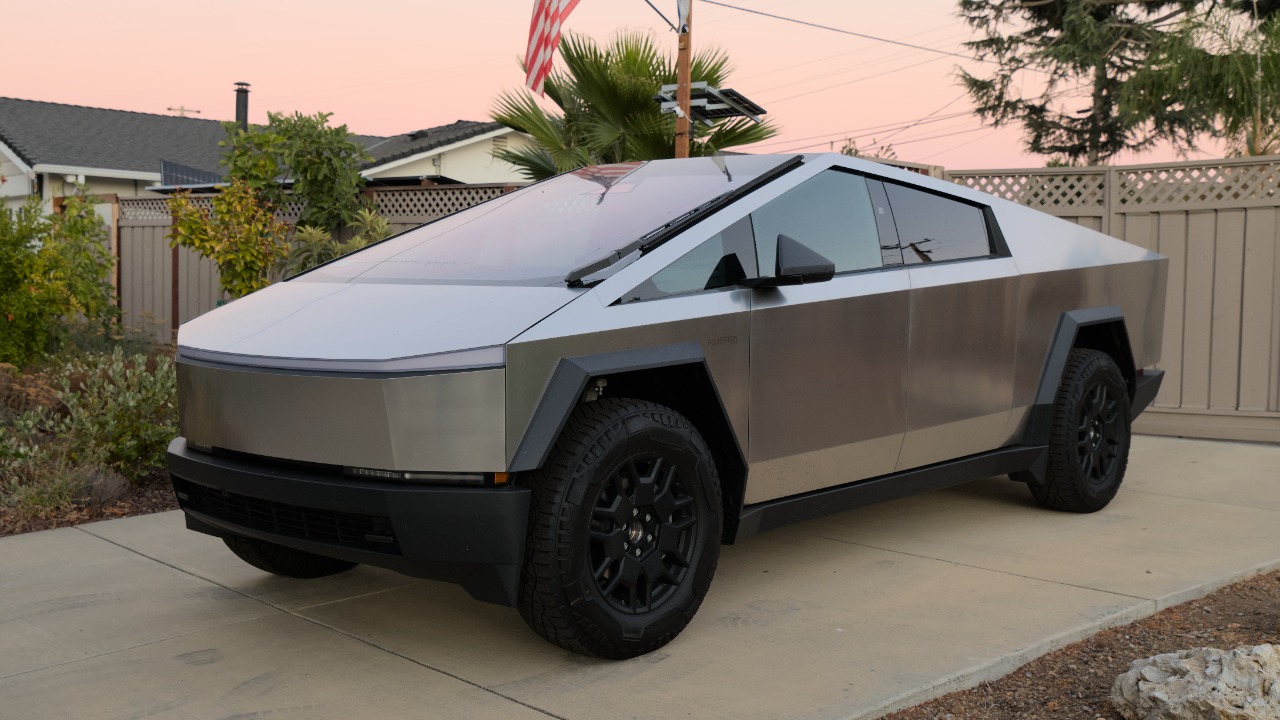

Elon Musk has spent years hyping the Cybertruck as a generational leap for Tesla, calling it the company’s “best ever” vehicle and positioning the stainless-steel pickup as a halo product for the brand. Yet as deliveries stack up, the numbers show a very different story, with sales that are slumping instead of scaling and a flagship that is barely nudging Tesla’s broader performance. The gap between the rhetoric and the reality is now one of the most revealing stress tests of Tesla’s strategy in the electric truck era.
Hype meets hard numbers
From the start, the Cybertruck was designed to be a spectacle, and Elon Musk leaned into that by declaring it Tesla’s “best ever” vehicle and the most advanced product the company had ever built. That framing matters because it set expectations that this angular pickup would not just be a niche experiment but a core growth engine for Tesla’s earnings and market value. When Musk described the Cybertruck as the “Best Ever” and Tesla’s flashiest EV, he was effectively promising that the truck would move the needle for the company’s revenue and profit, a claim that now collides with the modest impact visible in Tesla’s reported results, where the Cybertruck has barely shifted overall performance despite the fanfare around Elon Musk Calls Cybertruck The.
That disconnect is especially stark because Tesla has historically turned hype into volume, from the Model 3 to the Model Y, which both evolved from cult objects into mass-market staples. With the Cybertruck, the company tried to repeat the formula by pitching it as the “Best Ever” Vehicle From Tesla and a symbol of the brand’s technological edge, yet the financial disclosures show that even as Tesla reported a third quarter with earnings per share that investors scrutinized closely, the Cybertruck’s contribution was too small to change the narrative. The truck may be a technological showcase, but the sales trajectory so far suggests it is not the growth engine Musk implied when he framed it as the company’s most important product, leaving the “Best Ever” label looking more like marketing than material impact on Vehicle From Tesla, But Its Flashiest EV Still Hardly Moves The Needle, Whe level results.
Sales that stall instead of scale
For a vehicle that was supposed to redefine the pickup segment, the Cybertruck’s sales curve looks surprisingly flat. In the third quarter, Tesla only sold 5,385 Cybertrucks, a figure that would be respectable for a boutique startup but is underwhelming for a company that dominates global EV sales. The more telling metric is the year-over-year change: that quarterly total was down 63 percent compared with the same period a year earlier, a collapse that signals demand is not just plateauing but shrinking.
Those numbers are even more striking when set against the broader U.S. market for pickups, where incumbents like the Ford F-150 and Chevrolet Silverado routinely move hundreds of thousands of units a year. Instead of ramping toward that kind of scale, the Cybertruck is trending in the opposite direction, with quarterly deliveries that look more like a specialty off-roader than a mainstream workhorse. When a product that was marketed as a mass-market disruptor is selling in the low thousands per quarter and shrinking at a double-digit rate, it is hard to argue that it is reshaping the segment, no matter how loudly Tesla repeats the “Best Ever” mantra around Tesla, Cybertrucks and their supposed breakout potential.
A long slide from early expectations
The Cybertruck’s current slump did not come out of nowhere, it followed a launch arc that started with optimism and then steadily lost altitude. By October, industry estimates placed cumulative Cybertruck sales at approximately 27,185, a total that would be impressive for a new EV brand but modest for Tesla, which has used its scale to dominate other segments. That early tally suggested a solid base of enthusiasts and early adopters, yet it also hinted that the truck was not breaking out into the broader pickup-buying public at the pace Musk had once implied.
As time went on, the gap between expectations and reality widened. Over the summer, U.S. sales of the Cybertruck totaled just over 52,000 units, according to Cox Automotive, a figure that underscores how the truck has remained a niche player rather than a runaway hit. For a company that once talked about the Cybertruck as a cornerstone of its future lineup, the reality of tens of thousands of units instead of hundreds of thousands shows how far short the vehicle has fallen of its original billing, even as Cox Automotive analysts still describe it as “a really remarkable vehicle” from a technical standpoint.
Falling far short of Musk’s own targets
Elon Musk did not just call the Cybertruck Tesla’s “best ever” vehicle, he also set aggressive volume expectations that now look increasingly out of reach. At one point, Musk floated the idea that Tesla could sell around 250,000 Cybertrucks a year once production ramped, a target that would have put the truck in the same league as mainstream pickups from legacy automakers. Instead, reporting shows that Tesla has sold just over 16,000 Cybertrucks so far in 2025, a fraction of the 250,000 annual pace Musk once held up as a benchmark.
That shortfall is not just a matter of pride, it has real implications for Tesla’s growth narrative and its ability to justify investments in new factories and tooling dedicated to the Cybertruck. When a CEO promises quarter-million-unit volumes and the company instead delivers sales that are an order of magnitude lower, investors start to question whether the product strategy or the demand forecasting was flawed. The fact that Tesla, Cybertrucks and Elon Musk are now being discussed in the context of missed targets rather than overperformance suggests that the Cybertruck has shifted from being a symbol of Tesla’s inevitability to a case study in the limits of even Musk’s ability to will a market into existence, a dynamic that Thi commentary has highlighted as a warning sign for the company’s broader ambitions.
Analysts see a flop where Musk sees a halo
Outside Tesla’s fan base, the Cybertruck is increasingly being described in blunt terms that contrast sharply with Musk’s “best ever” framing. As the vehicle approaches its second anniversary on the market, analysts and industry observers have started calling it a flop, pointing to sales that have consistently underperformed original forecasts and a reputation that has shifted from futuristic icon to cautionary tale. One assessment noted that Sales of Cybertruck have consistently lagged expectations and that Media outlets now place it among the biggest misfires in the modern EV era, a harsh verdict for a product that once generated hundreds of thousands of reservations.
That sentiment has filtered into broader energy and automotive discussions, where Tesla’s Cybertruck is often held up as an example of how even a dominant EV maker can misread what mainstream buyers actually want. As Tesla’s Cybertruck turns two, commentary in energy-focused forums has emphasized that Tesla’s Cybertruck is turning 2. It’s been a big flop. CEO Elon Musk once described the Cybertruck as Tesla’s “best ever” product, yet the market has not validated that claim. When a vehicle that was supposed to be a halo product is instead widely labeled a flop, it raises uncomfortable questions about whether Musk’s instincts on design, pricing and use case have drifted away from the core truck-buying audience that still drives most of the profits in the pickup segment.
Inside the sales slump and what is driving it
Behind the headline numbers, the Cybertruck’s slump reflects a mix of structural and self-inflicted challenges. The truck’s radical styling, stainless-steel body and unconventional proportions make it stand out, but they also limit its appeal to traditional pickup buyers who prioritize practicality, towing, and bed usability over sci-fi aesthetics. Analysts have pointed out that the Cybertruck’s high bed walls and integrated sail pillars make it tough to load in ways that contractors and ranchers expect, a design choice that helps explain why U.S. sales total just over 52,000 units so far, according to Cox Automotive, despite the initial wave of enthusiasm.
Price is another drag. The Cybertruck launched at higher price points than many early reservation holders expected, and it competes not just with other EVs but with well-equipped gasoline and diesel pickups that offer proven capability and dense dealer networks. As a result, the Cybertruck is having a harder time converting curiosity into purchases, a dynamic captured in analyses that describe the vehicle as struggling to break out of a narrow niche. When a product’s design, pricing and use case all diverge from the core expectations of its target segment, even a strong brand like Tesla can find itself with a truck that is admired in theory but left on the lot in practice, a pattern that Cox Automotive’s breakdown of Aug sales has made increasingly clear.
Musk’s eyebrow-raising tactics to juice demand
As Cybertruck sales have softened, Elon Musk has turned to increasingly unconventional tactics to keep the narrative alive and the order books from drying up. One recent push highlighted how “Truck fans are very loyal to their brands,” a line that framed the Cybertruck’s struggles as a function of entrenched customer habits rather than product missteps. In that context, Musk’s latest moves to boost Tesla Cybertruck sales, including limited-time offers and attention-grabbing promotions, have raised eyebrows among analysts who see them as signs of a company trying to manufacture urgency in a market that remains skeptical of the stainless-steel pickup and its positioning as a Truck for the future, a dynamic captured in coverage of Elon Musk raises eyebrows.
At the same time, Tesla has been accused of using accounting and internal transfers to make Cybertruck sales look healthier than they really are. Reporting has detailed how Musk has effectively sold a huge number of Cybertrucks to himself or affiliated entities, a maneuver that inflates delivery figures without reflecting genuine retail demand. One analysis noted that the company only sold 5,385 Cybertrucks in the third quarter and argued that the numbers paint a damning picture of Tesla’s core business, especially when contrasted with Musk’s focus on humanoid robots and artificial intelligence. When a CEO is resorting to internal purchases and headline-grabbing stunts to prop up a product that was supposed to sell itself, it suggests that organic demand is far weaker than the “best ever” branding would imply.
Analysts’ quiet math versus Tesla’s loud marketing
While Musk continues to talk up the Cybertruck’s potential, market analysts are quietly running the numbers and coming to more sobering conclusions. Some estimates suggest that, given current trends, total Cybertruck sales may reach only around 20,000 units in a given period, a far cry from the mass-market penetration Tesla once hinted at. Though Tesla has not released specific sales figures for every quarter, these analyst projections underscore how limited the truck’s impact has been relative to the rest of Tesla’s lineup, which still leans heavily on the Model 3 and Model Y for volume and profitability.
That divergence between internal hype and external math is also visible in independent breakdowns of quarterly deliveries. One detailed look at the numbers concluded that the Tesla Cybertruck is having a pronounced sales slump in 2025, with deliveries falling sharply after an initial burst and questions mounting about how many Cybertrucks were sold in each quarter. The same analysis, framed under a section titled How Many Tesla Cybertrucks Were Sold, included a Disclaimer that Figures were based on registration and shipment data rather than Tesla’s own disclosures, yet the trend line was unmistakable: the Cybertruck is not ramping like a blockbuster, it is fading like a curiosity.
What the Cybertruck’s stumble means for Tesla’s future
The Cybertruck’s underperformance matters for more than just bragging rights, it is a stress test of Tesla’s ability to expand beyond its core sedan and crossover franchises. If the company cannot turn its most hyped product into a meaningful contributor to sales and profit, it raises questions about how easily Tesla can break into other entrenched segments like commercial vehicles or affordable mass-market compacts. The fact that analysts now routinely describe the Cybertruck as a flop, even as Musk insists it is Tesla’s “best ever” vehicle, highlights a growing disconnect between the company’s marketing and the market’s verdict, a gap that could weigh on investor confidence if it spreads to other projects.
At the same time, the Cybertruck saga is a reminder that even in the EV space, fundamentals still matter: price, practicality, and fit with customer needs cannot be overridden indefinitely by charisma and bold design. Truck buyers remain loyal to their brands, as Musk himself has acknowledged, and they expect their vehicles to perform specific jobs that the Cybertruck’s radical form factor does not always serve well. Unless Tesla can either significantly broaden the truck’s appeal or accept that it will remain a niche halo product with limited volume, the Cybertruck is likely to remain a striking presence on the road but a small line item in Tesla’s financials, a reality that sits uneasily with the grand promises that surrounded its launch and the lingering question of How Many Tesla Cybertrucks Were Sold in a way that truly justifies the “best ever” label.
More from MorningOverview