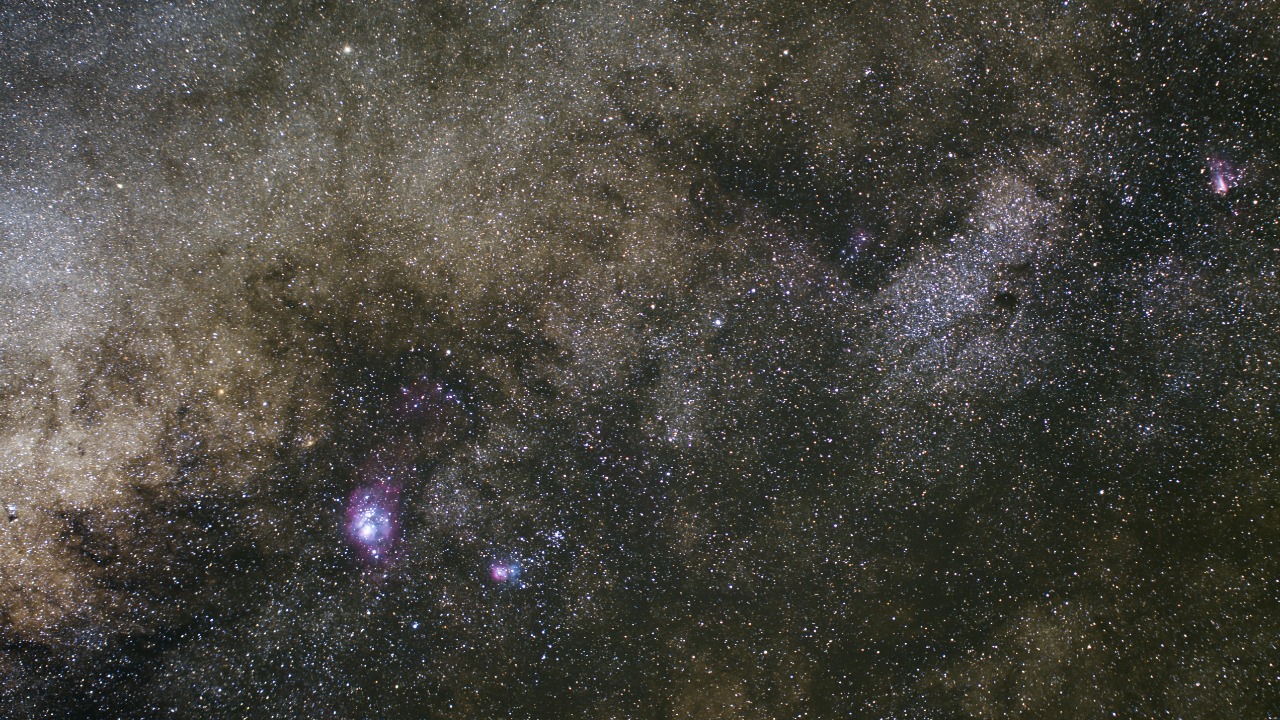

The James Webb Space Telescope has upended expectations again, revealing a massive spiral galaxy in the universe’s infancy that looks strikingly like a young Milky Way. Instead of a chaotic, half-built system, astronomers are seeing a grand, orderly disk with sweeping arms already in place when the cosmos was barely out of its first billion years. The discovery forces a rethink of how quickly galaxies like ours can assemble, and how early the conditions for a familiar, star-filled spiral can emerge.
What makes this find so jarring is not just the galaxy’s size and structure, but the way it slots into a growing pattern of early Milky Way analogues that James Webb keeps turning up. From a carefully studied spiral nicknamed Alaknanda to a distant system called Zhúlóng and a broader population of disk galaxies in the young universe, the telescope is steadily eroding the old picture of a slow, messy galactic adolescence.
JWST’s sharp eye on a surprisingly mature young universe
When NASA designed the James Webb Space Telescope, the goal was to peer back to the first generations of galaxies and watch them in their formative chaos. Instead, the observatory is repeatedly finding systems that look far more settled and structured than theory predicted for such early times. New images from the James Webb Space Telescope, often shortened to JWST, show that galaxies with stellar disks and organized shapes were already present in the young universe, a result that emerged clearly in work led from AUSTIN, Texas and supported by New images from NASA.
Those early surveys showed that even when the universe was only a fraction of its current age, some galaxies already resembled scaled down versions of the Milky Way, with flattened disks and ongoing star formation. That set the stage for more targeted searches for fully fledged spirals, the classic pinwheel structures that in standard models should take a long time to settle. As JWST’s infrared vision pushed deeper, it began to reveal not just disk-like shapes but clear spiral arms, hinting that the timeline for building Milky Way style systems might be far shorter than astronomers had assumed.
Alaknanda, the grand-design spiral from cosmic dawn
The clearest example of this accelerated evolution is a galaxy dubbed Alaknanda, a massive spiral seen when the universe was still in its infancy. In detailed JWST observations, Alaknanda stands out as a grand-design spiral, meaning its arms are prominent, symmetric, and well defined rather than faint or ragged. Reporting on this object describes it as a massive spiral galaxy from the early universe, with the James Webb Space Telescope resolving its structure so clearly that astronomers can trace the arms and central region in a way that recalls nearby spirals, as outlined in coverage of how JWST reveals Alaknanda.
What makes Alaknanda so striking is that it is not a small, tentative disk but a fully developed, massive system with a clear spiral pattern at a time when many models expected only irregular clumps. Analyses describe it as the most massive grand-design spiral galaxy ever discovered at such an early epoch, a label that underscores how far it sits from the old expectations of slow, hierarchical growth. Instead of being assembled piece by piece over billions of years, Alaknanda appears to have organized itself into a Milky Way like configuration astonishingly quickly, forcing theorists to revisit how gas cools, collapses, and settles into rotating disks in the first billion or two billion years after the Big Bang.
A Milky Way twin hiding behind a cosmic magnifying glass
Alaknanda’s detailed portrait was possible only because nature provided a powerful assist in the form of gravitational lensing, effectively turning a foreground cluster into a cosmic magnifying glass. That lens boosted the brightness and apparent size of the distant spiral, allowing JWST to pick out the fine structure of its arms and central bulge. Researchers emphasize that this combination of a sensitive infrared telescope and a natural lens is what made it possible to identify Alaknanda as a grand-design spiral and to measure its mass and star formation in detail, a point highlighted in descriptions of how a cosmic magnifying glass revealed the galaxy’s true nature.
Without that magnification, Alaknanda would likely have blended into the background of faint smudges that populate deep images of the early universe. Instead, astronomers can see that its spiral arms are not just decorative features but sites of active star formation, much like the Milky Way’s own arms. The lensing also helps constrain the galaxy’s size and rotation, both of which point to a system that is already dynamically mature. That maturity, so early in cosmic history, is what makes Alaknanda feel like a genuine cousin of the Milky Way rather than a distant ancestor still in the process of becoming a spiral.
Why a grand-design spiral so early is such a shock
In the standard picture of galaxy formation, grand-design spirals are the end products of long, complex histories. Gas falls into dark matter halos, small protogalaxies merge, and over billions of years a rotating disk gradually settles, with spiral arms emerging as density waves in the disk. Finding a massive, symmetric spiral when the universe is still young runs counter to that slow build up, because it implies that the processes that create ordered disks can operate far more quickly than expected. Analyses of Alaknanda stress that classic models predicted that such grand-design spirals should be rare or absent at these early times, which is why the description of Alaknanda as a massive grand-design spiral galaxy from the universe’s infancy is framed as a direct challenge to those expectations in reports that note how Alaknanda: JWST Discovers Massive Grand structure so early.
The surprise is not only theoretical. Observationally, earlier generations of telescopes tended to see high redshift galaxies as messy, irregular blobs, which seemed to confirm the idea that order comes late. JWST’s sharper view and longer wavelengths are revealing that some of that apparent chaos was an illusion created by limited resolution and sensitivity. With Alaknanda, the telescope shows that at least some early galaxies are already well organized, with coherent disks and arms that look familiar to anyone who has seen images of the Milky Way or Andromeda. That forces a reassessment of how quickly dark matter halos can spin up, how efficiently gas can cool, and how feedback from young stars and black holes shapes the emerging disk.
Zhúlóng and the search for the Milky Way’s long-lost relatives
Alaknanda is not the only early galaxy that invites comparison to the Milky Way. Earlier this year, astronomers working with JWST data reported a system nicknamed Zhúlóng, described as the Milky Way’s long-lost twin in some coverage because of its similar mass and disk-like structure. The new research estimates that Zhúlóng’s light left the galaxy when the universe was roughly one quarter of its current age, capturing a snapshot of a system that already shares key traits with our own. Reports on this work emphasize that the discovery came from a broader survey of distant galaxies, with Zhúlóng standing out as a particularly close analogue to the Milky Way, a point underscored in coverage of how James Webb telescope discovers Zhúlóng.
Zhúlóng does not present the same textbook spiral arms that make Alaknanda so visually striking, but its overall mass, disk structure, and star formation rate make it a compelling relative of the Milky Way at an earlier stage. Together, the two galaxies bracket a range of early times when massive disks were already in place, suggesting that the Milky Way’s own history may have followed a similar accelerated path. Instead of a slow, drawn out assembly, our galaxy might have reached a recognizable disk configuration relatively quickly, then evolved more gently over the remaining billions of years. That possibility is now a live question in galactic archaeology, and JWST’s growing catalogue of Milky Way like systems is providing the fossil record needed to test it.
From early disks to full-fledged spirals
Even before Alaknanda and Zhúlóng grabbed headlines, JWST had already shown that the young universe was home to more disk galaxies than expected. Deep surveys revealed that many high redshift systems are not amorphous blobs but flattened structures with rotation, hinting that the ingredients for spirals were present early on. Work led from AUSTIN, Texas used new images from NASA’s James Webb Space Telescope to identify Milky Way like galaxies in the young universe, with the data showing that stellar disks were already common when the cosmos was still relatively young, as described in reports that note how James Webb Space Telescope reveals Milky Way-like galaxies.
Those early results suggested that the step from a rotating disk to a grand-design spiral might not be as large as once thought, especially if density waves and interactions can quickly sculpt arms in a gas rich environment. Alaknanda then provided a concrete example of that transition, showing that a massive disk can host prominent spiral arms at a time when the universe is still in its early chapters. Zhúlóng and similar systems fill in the intermediate stages, with disks that may be on the verge of developing more pronounced spiral structure. Together, they outline a continuum from early disks to fully fledged spirals, compressing what was once imagined as a long evolutionary arc into a much shorter timescale.
Rewriting the timeline of Milky Way formation
For decades, models of the Milky Way’s history have leaned on the idea of gradual assembly, with small building blocks merging over time to create a large spiral. The discovery of Alaknanda and Zhúlóng at such early epochs does not invalidate that broad picture, but it does suggest that the key structural features of a Milky Way like galaxy can emerge far sooner than previously assumed. If a massive grand-design spiral can exist in the universe’s infancy, then the processes that shaped our own galaxy may have been largely in place when the cosmos was still young, leaving the subsequent billions of years for refinement rather than basic construction. That shift in emphasis has implications for everything from the formation of the Milky Way’s bar to the timing of when its spiral arms became stable features.
It also affects how astronomers interpret the ages and motions of stars in the Milky Way today. If the disk settled early, then some of the oldest stars in the thin and thick disks may have formed in an already organized environment rather than in a chaotic merger field. That, in turn, changes the clues those stars carry about the galaxy’s past. The presence of early Milky Way analogues like Alaknanda and Zhúlóng gives theorists concrete targets for simulations, allowing them to test whether current models can produce such systems on the observed timeline. If they cannot, then the physics of gas cooling, star formation, and feedback in the early universe will need to be revised to accommodate a faster path to spiral structure.
A growing family of Milky Way lookalikes
Alaknanda and Zhúlóng are part of a broader pattern in JWST’s discoveries, one that includes other galaxies explicitly described as long-lost twins of the Milky Way. In work highlighted earlier this year, astronomers reported that the James Webb telescope had spotted a Milky Way twin that is fundamentally changing our view of the early universe, with the system’s mass, structure, and star formation rate all echoing our own galaxy’s properties. That object, seen at a time when the universe was only about one billion years removed from the Big Bang, shows that Milky Way like galaxies were already present at surprisingly early times, a point emphasized in coverage of how James Webb telescope spots Milky Way’s long-lost “twin”.
Each new member of this family adds weight to the idea that the Milky Way is not an outlier but part of a common class of galaxies that emerged early and evolved in parallel. That does not mean every spiral shares the same detailed history, but it does suggest that the conditions needed to build a large, star forming disk were widespread in the young universe. As JWST continues to survey the sky, astronomers expect to find more such systems, filling in the statistical picture and helping to determine whether Alaknanda and its kin are rare exceptions or the visible tip of a much larger population of early Milky Way analogues.
What comes next for JWST and galactic archaeology
The immediate priority for researchers is to pin down the physical properties of these early spirals with greater precision. That means measuring their rotation curves, mapping their gas content, and tracing how star formation is distributed across their disks and arms. JWST’s spectroscopic instruments can provide some of this information directly, while follow up observations with radio telescopes will help quantify the cold gas that fuels ongoing star birth. Combining those data sets will show whether Alaknanda and similar galaxies are truly stable, long lived spirals or transient configurations that may evolve rapidly into different forms.
At the same time, theorists are racing to update simulations to reproduce the observed population of early Milky Way like systems. If models can generate massive grand-design spirals in the universe’s infancy under realistic assumptions, that will bolster confidence in the underlying physics. If not, then something fundamental about how gas and dark matter interact, or how feedback from young stars and black holes operates, may need to be revised. Either way, the discovery of a Milky Way twin born shockingly early has already achieved one thing with certainty: it has turned our own galaxy from a familiar backdrop into an active clue in a much larger cosmic mystery about how quickly order can emerge from the primordial fireball of the Big Bang.
More from MorningOverview