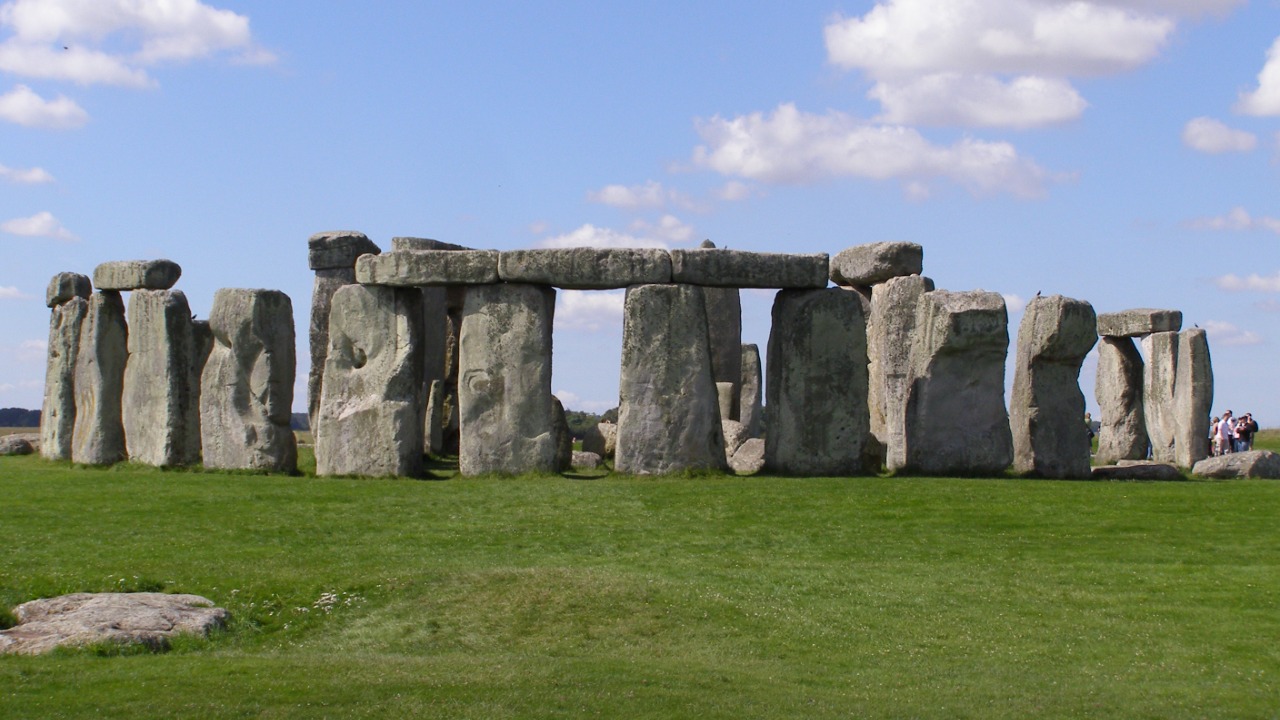

A newly identified ring of vast pits on the chalk plain around Stonehenge is reshaping what I can say about daily life and belief in Neolithic Britain. Rather than a simple backdrop to the famous stones, the surrounding landscape now looks more like a carefully engineered arena of ritual, movement, and social control that stretched across generations.
The discovery suggests that communities 4.500 years ago were not only hauling megaliths into place but also carving out enormous earthworks that demanded planning, cooperation, and shared purpose. By tracing the scale, layout, and likely uses of this mysterious circuit of hollows, I can start to see how Neolithic people organized their world, from seasonal gatherings to the stories they told about the sky.
The ring of pits that reframes Stonehenge
The newly documented ring of pits sits beyond the iconic stone circle, forming a broad arc that effectively redraws the boundaries of the Stonehenge landscape. Instead of a single monument rising in isolation, the site now appears embedded in a much larger engineered setting, with the pits acting as markers that framed movement toward the stones and perhaps signaled a threshold between ordinary ground and sacred space. The very existence of such a ring suggests that Neolithic planners were thinking at the scale of the entire horizon, not just the footprint of the central circle.
Archaeologists describe the feature as a vast Structure created 4.500 years ago, a phrase that captures both its age and its ambition. Using a range of advanced scientific techniques, from high resolution geophysical survey to targeted excavation, researchers have concluded that the pits are not random natural hollows but deliberate cuts into the chalk, laid out in a coherent pattern that may represent one of the largest prehistoric constructions in Britain. The sheer effort required to dig and maintain such a circuit points to a community that could mobilize labor for projects that went far beyond the visible stones at the center of the site, as highlighted in recent evidence of Stone Age social planning.
Reading Neolithic intentions in the landscape
When I look at the ring of pits as part of a wider design, it becomes easier to imagine Neolithic builders using the landscape itself as a tool for storytelling and control. The pits may have guided people along specific routes, channeled processions, or defined zones where only certain groups could pass, turning the approach to Stonehenge into a carefully choreographed experience. In that sense, the pits function less like isolated holes and more like punctuation marks in a long narrative written across the chalk.
The deliberate spacing and repeated form of the pits suggest that their creators were working from a shared mental template, perhaps passed down through generations of builders who understood where each new cut should go. Because the ring extends well beyond the immediate stone setting, it hints at a worldview in which sacred architecture was not confined to a single focal point but spread across fields, ridges, and watercourses. The pits, in other words, may be the surviving traces of a much broader conceptual map that organized how people moved, gathered, and remembered within the Stonehenge landscape.
What the pits reveal about social organization
The scale of the ring forces me to confront the social machinery that must have stood behind it. Digging deep pits into chalk with Neolithic tools, then repeating that task dozens of times in a coherent pattern, would have required planning meetings, agreements about where to work, and systems for feeding and housing laborers. That kind of coordination implies leadership structures, whether formal chiefs or respected elders, and a shared belief that the project mattered enough to justify the effort.
Evidence from the pits and their relationship to other monuments points to a community that could sustain large scale projects over long periods, which in turn suggests stable alliances between different groups. People may have traveled from distant regions to contribute labor or participate in ceremonies linked to the ring, reinforcing social bonds through shared work. The pits therefore become a window into how Neolithic societies managed cooperation, obligation, and prestige, with those who organized or sponsored the digging likely gaining status within a complex web of relationships anchored to Stonehenge.
Ritual, memory, and the uses of emptiness
Unlike the towering stones that dominate photographs of Stonehenge, the pits are defined by absence rather than presence. That emptiness is part of their power. A deep, open hollow in the ground can serve as a repository for offerings, a symbolic gateway to the underworld, or a stage for performances that rely on sound and shadow. I find it plausible that the pits were used to deposit animal remains, broken tools, or other ritual items, turning each hollow into a localized archive of memory tied to specific events or lineages.
The repetitive nature of the pits also suggests that rituals associated with them may have been cyclical. Communities could have returned to particular hollows at set times of year, renewing their relationship with ancestors or deities through acts of deposition, feasting, or storytelling. Over time, the ring would have accumulated layers of meaning, with each pit carrying its own history while still contributing to the larger pattern that encircled the central monument. In that sense, the pits may have functioned as both physical and narrative anchors, helping people situate themselves within a shared past.
Labor, cooperation, and the weight of shared work
To appreciate what the ring of pits tells me about Neolithic life, I have to imagine the work itself. Cutting through chalk with antler picks and wooden shovels is slow, exhausting labor, especially when repeated at the scale implied by the ring. Organizing such an effort would have required not only leadership but also a culture that valued collective achievement, where individuals were willing to contribute days or weeks of effort to a project whose benefits were symbolic rather than immediately practical.
That willingness to invest in monumental labor aligns with broader patterns seen at stone circles across Britain and Ireland, where communities pooled resources to raise megaliths that had no obvious economic function. The pits around Stonehenge fit into this tradition of shared construction, suggesting that people measured their success not just in crops or livestock but in the ability to reshape the land in ways that reflected their beliefs. The ring becomes a testament to cooperation, a physical record of how Neolithic groups turned communal effort into enduring statements about who they were and what they valued.
Cosmic alignments and the pull of the sky
Any attempt to understand Stonehenge and its surrounding features has to grapple with the sky. The main stone circle is famously aligned with the solstices, and it is reasonable to ask whether the ring of pits also played a role in tracking celestial events. If the pits mark sightlines or frame particular views of the horizon, they could have helped observers anticipate seasonal changes, reinforcing the link between ritual gatherings and the turning of the year.
Broader research on stone circles suggests that They combined their ( Neolithic ancestors ) skills and labor to create these enigmatic structures, using careful placement to align with celestial events and encode astronomical knowledge into the landscape. The pits may represent another expression of that same impulse, extending the reach of sky watching beyond the stones themselves and into a wider network of markers that guided both ritual and practical decisions about farming, travel, and social gatherings. In this reading, the ring becomes part of a sophisticated system in which Neolithic people used architecture to bind their daily lives to the movements of the heavens, a pattern echoed in other astronomical stone circles.
Daily life at the edge of a monumental ring
While the pits speak to grand designs, they also invite me to think about the ordinary days that unfolded around them. People living near Stonehenge would have seen the ring as part of their everyday environment, passing by the hollows while tending animals, gathering fuel, or moving between seasonal camps. Children might have been warned not to fall in, or told stories about spirits that lived in the depths, weaving the pits into the fabric of local folklore.
At the same time, the ring likely shaped how and where people built houses, lit fires, or buried their dead. Certain zones may have been reserved for ritual use, with domestic activity pushed to the margins, while other stretches of the ring could have doubled as gathering points for markets or feasts. The pits thus blur the line between sacred and mundane, reminding me that Neolithic life did not separate religion, work, and socializing into neat categories. Instead, all three played out within a landscape where monumental features like the ring of pits were constant, looming presences.
Technology, technique, and the science behind the find
The identification of the pit ring is itself a story about how archaeological practice has changed. Rather than relying solely on chance excavation, researchers have used remote sensing, ground penetrating radar, and other forms of geophysical survey to map subtle variations in the subsurface. These methods allow them to detect pits, ditches, and postholes without disturbing the ground, revealing patterns that would be invisible at eye level. In the case of Stonehenge, such surveys have turned what once looked like empty fields into a dense palimpsest of hidden features.
Once the ring pattern emerged, targeted digs and environmental sampling helped confirm that the hollows were human made and broadly contemporary with the main monument. Using this combination of non invasive survey and selective excavation, archaeologists could reconstruct the sequence of digging, filling, and reuse that gave the pits their long biographies. The reliance on technique in both discovery and interpretation underscores how modern science is reshaping my understanding of Neolithic Britain, allowing me to see connections and scales of planning that earlier generations of researchers could only guess at.
Why the pit ring matters for Neolithic history
The ring of pits matters because it forces a shift in perspective. Instead of treating Stonehenge as a singular marvel, I now have to see it as one component in a sprawling ritual complex that extended across the surrounding landscape. The pits show that Neolithic builders were thinking in terms of circuits, boundaries, and orchestrated movement, not just isolated monuments. That realization has implications for how I interpret other prehistoric sites, encouraging a search for similar large scale patterns that might have gone unnoticed.
More broadly, the discovery challenges older stereotypes of Neolithic communities as loosely organized farmers with limited technical skills. The planning, labor coordination, and astronomical awareness implied by the pit ring point to societies capable of long term projects and abstract thinking, societies that could translate cosmological ideas into earthworks on a massive scale. In that sense, the pits are not just holes in the ground but arguments in chalk, asserting that the people who built Stonehenge were as ambitious in their landscape engineering as any later civilization that carved pyramids or raised cathedrals.
More from MorningOverview