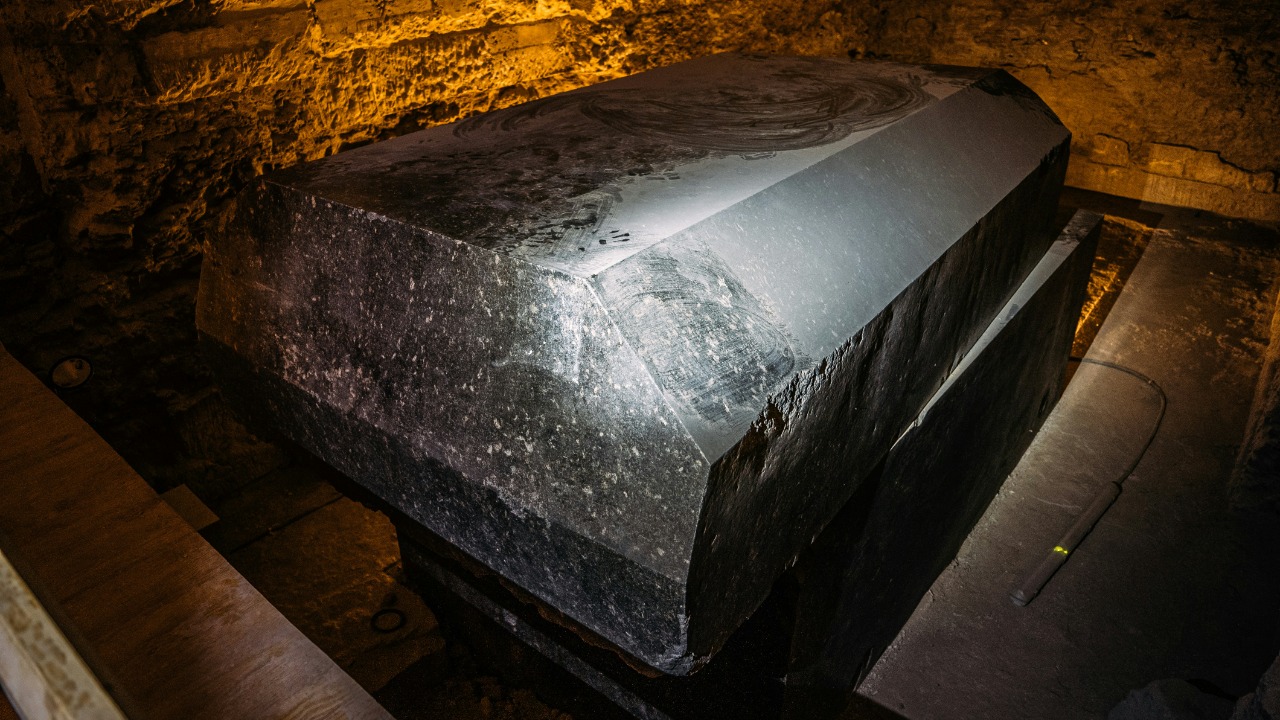

The discovery of a pristine Roman coffin in the heart of modern Budapest offers an unusually intimate glimpse into life and death on the empire’s distant frontier. Archaeologists working on a large urban excavation have uncovered a sealed limestone sarcophagus that remained untouched for roughly 1,700 years, preserving a complete skeleton and a carefully arranged set of grave goods. I see this find not just as a spectacular object, but as a rare time capsule that connects a bustling twenty‑first‑century capital to the personal story of one young woman who lived and died under Roman rule.
Unearthing a sealed tomb beneath a modern city
The sarcophagus emerged from the ground during a large‑scale excavation in Óbuda, a district of Budapest that overlays the remains of the Roman settlement of Aquincum. Archaeologists with the Budapest History Museum were investigating the area ahead of development when they encountered a massive limestone coffin, its lid still tightly in place and its setting undisturbed by later burials or construction. In a city better known today for thermal baths and grand riverfront boulevards, the discovery underscores how deeply the Roman past is woven into the fabric of Budapest, Hungary.
From the outset, the team understood that the coffin’s intact state made it exceptional. Reports on the excavation describe how the limestone sarcophagus, found earlier this year, was carefully exposed and documented in situ before any attempt was made to lift its heavy lid. Archaeologists noted that the burial had not been cut by later graves or utility trenches, a rarity in dense urban layers, which suggested that whatever lay inside had remained sealed since late antiquity. That context, combined with the craftsmanship of the stonework, immediately signaled that they were dealing with a high‑status Roman interment rather than a more ordinary grave.
Why a “Completely Untouched” 1,700‑Year‑Old coffin matters
What sets this find apart is not only its age but its condition. Many Roman sarcophagi survive as empty shells, their contents looted in antiquity or disturbed by centuries of reuse and rebuilding. In this case, archaeologists describe the burial as “Completely Untouched,” emphasizing that the seal had never been broken and the interior remained exactly as it was arranged around 1,700 years ago. That level of preservation, combined with the coffin’s location in a major provincial center, gives researchers an unusually clean dataset for understanding how one community in Aquincum treated its dead.
Accounts of the excavation stress that the coffin contained both a complete skeleton and a suite of grave goods, all preserved in their original positions. The reporting on Archaeologists Unearthed a Completely Untouched 1,700-Year-Old Coffin highlights how rare it is to find a Roman burial where both the body and its accompanying objects have escaped disturbance. For specialists, that means every bead, vessel, and metal fitting can be read in relation to the body, rather than as stray finds, which in turn allows for more precise reconstructions of ritual, status, and personal identity.
Inside the sarcophagus: a young woman and her grave goods
Once conservators and field archaeologists were ready to open the coffin, they approached the task with the kind of caution usually reserved for high‑risk conservation work. When the lid was finally lifted, they found the remains of a young woman laid out inside, her skeleton intact and surrounded by carefully placed offerings. According to the excavation’s lead archaeologist, Gabriella Fényes, the burial had not been disturbed previously, so it was intact, a point she underlined when describing the condition of the sealed tomb. That assessment, reported in coverage of the project, confirms that the team was looking at a primary burial rather than a reused container.
The grave goods themselves, as summarized in the available reporting, included personal ornaments and other items that would have held meaning for the deceased and her community. These objects, arranged alongside the complete skeleton, help flesh out the picture of who this young woman might have been and how those around her chose to commemorate her. The account that quotes Gabriella emphasizes that the burial belonged to a young woman and that the assemblage was found in situ, reinforcing the interpretation that this was a single, carefully planned interment rather than a family tomb or secondary deposit.
How Budapest’s Roman past framed the discovery
To understand why such a sarcophagus appears beneath a modern neighborhood, it helps to remember that Budapest sits atop one of the Roman Empire’s key frontier cities. The area now known as Óbuda once formed the core of Aquincum, a military and civilian hub along the Danube that anchored Rome’s presence in this part of Central Europe. Archaeologists with the Budapest History Museum have long known that any major groundworks in this district are likely to intersect Roman remains, but a sealed limestone coffin of this quality still counts as an extraordinary find. The discovery reinforces the sense that the Roman layer beneath the city is not just a scatter of ruins but a complex landscape of streets, houses, and cemeteries.
Reports on the excavation note that the sarcophagus was unearthed during a large‑scale project in Óbuda, a reminder that modern infrastructure and ancient heritage often occupy the same footprint. The account of how Archaeologists with the Budapest History Museum uncovered the limestone coffin during their work highlights the careful balance between development and preservation. In practice, that means every new construction project in this part of the city doubles as an archaeological opportunity, with specialists racing to document and protect what they find before foundations are poured or utilities are laid.
From sealed stone to scientific data
Once the coffin was opened and its contents documented, the burial shifted from being a dramatic field discovery to a long‑term scientific resource. The complete skeleton offers bioarchaeologists a chance to study health, diet, and ancestry in a way that fragmentary remains rarely allow. With the bones intact and undisturbed, researchers can examine growth patterns, signs of disease, and even microscopic wear on teeth to reconstruct aspects of the young woman’s life. Because the grave goods remained in their original positions, specialists can also correlate specific objects with parts of the body, which helps clarify how items like jewelry or clothing fasteners were worn.
The reporting that describes the coffin as a “Completely Untouched” 1,700-Year-Old burial underscores how valuable such an undisturbed context is for scientific analysis. When a tomb has never been opened, researchers can trust that any residues, pollen, or microfragments inside relate directly to the original funeral. That opens the door to techniques like residue analysis on vessels, isotopic testing on the bones to track where the woman grew up, and even soil studies that might reveal traces of organic offerings that have long since decayed. Each of these lines of evidence turns the sarcophagus from a static artifact into a dynamic archive of information.
What the sarcophagus reveals about Roman burial customs
Beyond the individual story, the coffin sheds light on how Roman communities in this region handled death and memory. A limestone sarcophagus was an expensive choice, signaling that the young woman and her family occupied a relatively privileged position in local society. The decision to place her in a heavy stone container, rather than a simple pit or wooden coffin, suggests a desire for permanence and protection, both physical and symbolic. The arrangement of grave goods around her body, as described in the reporting, fits within broader Roman patterns in which personal adornments, everyday items, and sometimes food or drink accompanied the deceased into the grave.
Accounts of the find, including the description of the burial as a remarkably well-preserved Roman sarcophagus, highlight how intact contexts like this help refine our understanding of regional variations in funerary practice. While the broad outlines of Roman burial customs are well known from cemeteries across the empire, local communities often adapted those norms to fit their own traditions and resources. By comparing the layout and contents of this coffin to other graves in Aquincum and beyond, archaeologists can trace how provincial elites in what is now Hungary expressed their identities, blended Roman and local elements, and navigated the social expectations of the time.
The role of “Archaeologists Unearthed” narratives in public imagination
Discoveries like this sarcophagus do more than advance scholarship; they also capture public imagination through the way they are framed and shared. The phrase “Archaeologists Unearthed a Completely Untouched 1,700-Year-Old Coffin” has already become a kind of shorthand for the find, distilling a complex excavation into a vivid, easily shared narrative. As a reporter, I see how that framing both reflects and shapes what readers find compelling: the drama of lifting a lid that has not moved in centuries, the intimacy of encountering a single individual from the distant past, and the sense of surprise that such a treasure could lie hidden beneath familiar streets.
Coverage that leans into that language, including references to how Archaeologists Unearthed a burial that came as a complete shock, illustrates how modern storytelling around archaeology often pivots on the tension between the known and the unexpected. On one level, specialists anticipated Roman remains in Óbuda; on another, no one could predict that a single, untouched coffin would emerge in such pristine condition. That interplay between routine fieldwork and rare breakthroughs is part of what keeps archaeology in the news and sustains public interest in the painstaking, methodical work that usually unfolds far from the spotlight.
Connecting a single grave to a wider Roman frontier
Although the sarcophagus centers on one young woman, it also plugs into a much larger story about the Roman Empire’s northern frontier. Aquincum, the Roman predecessor of Budapest, sat along the Danube, a river that marked both a boundary and a conduit for trade, troops, and ideas. Finds like this coffin remind us that the frontier was not just a line of forts but a lived landscape where families built lives, mourned their dead, and participated in imperial culture while also maintaining local identities. The quality of the burial suggests that even far from Rome itself, provincial elites had access to skilled stoneworkers and the means to commission substantial funerary monuments.
Reports that situate the discovery in BUDAPEST and describe it as a Roman sarcophagus found in Hungary underscore how the modern nation‑state overlays what was once a patchwork of imperial provinces. For contemporary readers, that geographic framing helps translate ancient place names like Aquincum into familiar reference points, but it also highlights how the legacies of empire continue to shape landscapes and identities. Each new discovery, from monumental buildings to individual graves, adds another piece to the puzzle of how life unfolded along Rome’s shifting edges.
Why this coffin will keep scholars busy for years
Even after the initial headlines fade, the 1,700‑year‑old coffin will continue to generate data and debate. Laboratory analyses of the bones and grave goods will likely take years, as specialists in osteology, chemistry, and material culture each bring their own questions to the material. Was the young woman local to Aquincum or a migrant from another part of the empire? Did her diet reflect access to imported foods or primarily regional staples? Do the style and origin of her jewelry or other objects point to specific workshops or trade routes? Each answer will refine our understanding of how people in this corner of the Roman world lived, moved, and expressed status.
The detailed coverage of the find, including the description of a Completely Untouched burial with grave goods alongside a complete skeleton, hints at the range of future research questions. Because the context is so clean, scholars can revisit the material with new methods as they emerge, from advanced imaging of the stone to more refined isotopic techniques. In that sense, the sarcophagus is not just a snapshot of the past but a long‑term investment in knowledge, one that will keep yielding insights as analytical tools evolve.
More from MorningOverview