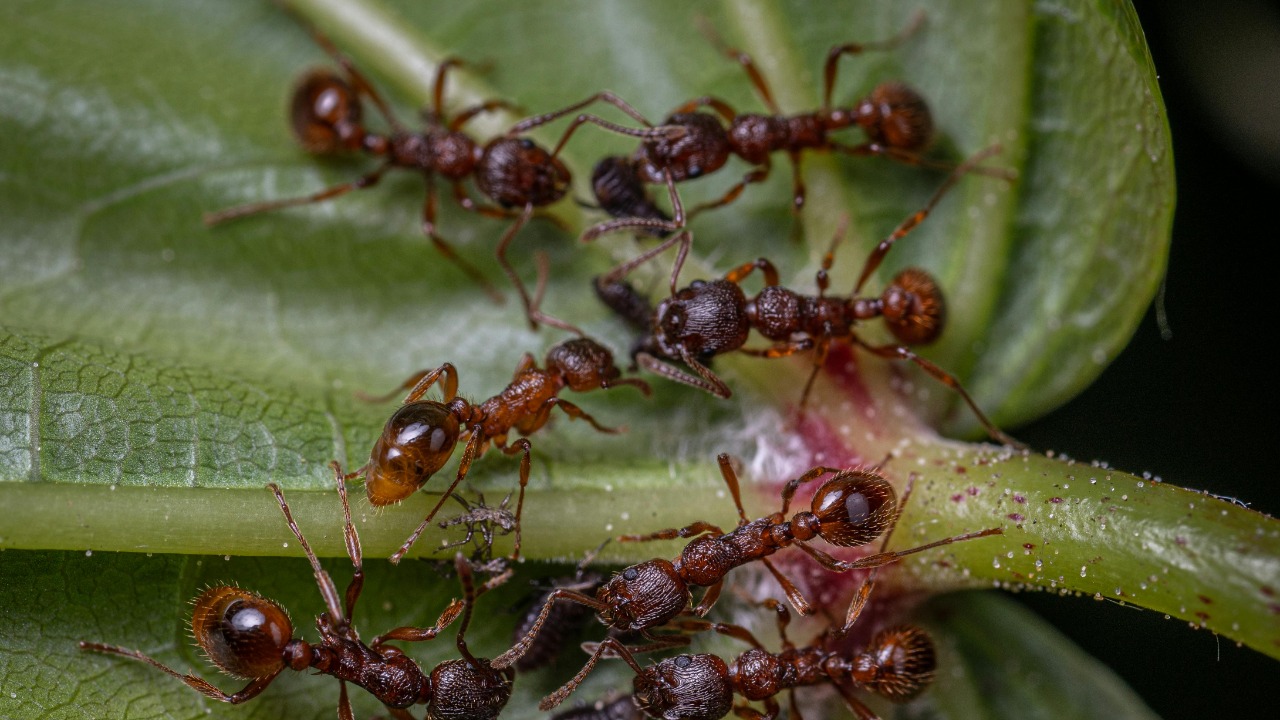

Ant colonies survive because individuals are willing to die. New research shows that some of the most vulnerable members, immobile pupae sealed in their cocoons, can sense when they are fatally infected and trigger their own removal from the nest, sacrificing any chance of survival to protect their nestmates. The finding pushes the idea of the ant colony as a single living body to its logical extreme, where a “cell” that knows it is doomed actively invites its own destruction.
The super-organism logic behind ant self-sacrifice
When I look at what happens inside an ant nest, it is hard to treat each insect as an independent animal. Colonies function as tightly coordinated systems in which food, labor, and risk are distributed so that the group, not the individual, persists. Biologists often describe such a colony as a “super-organism,” and the new work on sick pupae fits that picture: the unit that matters is the collective, so a single life is expendable if it prevents a wider collapse.
This super-organism framing helps explain why self-destructive behavior can be favored by evolution in ants even when it would be unthinkable in a solitary species. Infected workers have long been observed leaving the nest to die alone, a pattern that mirrors how immune cells in a vertebrate body will self-destruct to stop a pathogen from spreading. The latest studies extend that logic to the earliest life stages, showing that a developing Ant colony can behave like a single organism that prunes its own infected tissue.
How ant pupae sense a deadly infection
The most striking twist in the new research is that ant pupae, which cannot walk or feed themselves, appear able to detect when they are carrying an incurable infection. Instead of waiting passively for disease to run its course, some pupae change their chemistry in a way that effectively announces they are doomed. That internal alarm is not a conscious decision, but it is a precise physiological response that turns a private illness into a public warning.
Scientists report that some ant pupae sense when a pathogen has crossed the point of no return and then alter the chemical cues on their surface. Those cues are part of the colony’s normal communication system, but in this case they are repurposed into a distress signal that says, in effect, “I am infected and cannot be saved.” The change comes with a deadly cost for the individual, yet it sharply reduces the risk that the infection will spread to siblings and caretakers clustered around the brood.
Chemical “help me” signals that invite death
Once a pupa’s body chemistry shifts, the rest of the colony reacts with ruthless efficiency. Adult workers are exquisitely sensitive to changes in the waxy hydrocarbons and other compounds that coat their nestmates, and they treat the altered profile of a sick pupa as a call to action. Instead of grooming or feeding it, they seize it, carry it away, and remove it from the protected heart of the nest.
Researchers describe these altered cues as a kind of “help me” signal, but the help being requested is lethal. Because Ant pupae cannot walk or escape the nest on their own, they rely entirely on workers to respond to this chemical plea. The result is a coordinated act of social euthanasia that treats the infected pupa as disposable tissue in a larger body that must be kept healthy at all costs.
Early disease detection as a colony-wide defense
From an epidemiological perspective, what stands out is the timing. The pupae do not wait until they are visibly decomposing or contagious to the entire nest. Instead, the chemical alarm appears early in the course of infection, when the pathogen is still largely confined to a single body. That early warning gives workers a narrow but crucial window to intervene before the disease can jump to others.
In effect, the colony has evolved a decentralized detection system in which each individual monitors its own health and broadcasts a signal when it crosses a critical threshold. Scientists describe this as Early disease detection that protects the group from incurable sickness. The strategy mirrors how multicellular organisms rely on local sensors and rapid responses to contain infections, reinforcing the idea that the ant nest operates like a single immune system spread across thousands of tiny bodies.
What workers actually do with the doomed young
Once workers identify a pupa as fatally infected, they do not simply ignore it. They physically remove it from the brood pile and transport it to the nest perimeter or outside entirely, where it can die without endangering the queen or the bulk of the workforce. In some species, workers will go further, tearing open the cocoon or dismembering the pupa to stop the pathogen from completing its life cycle.
These actions are part of a broader repertoire of “undertaker” behaviors that ants use to manage corpses and contamination. Observations of ant burial practices show that workers routinely carry dead nestmates away, stack them in refuse piles, or cover them with soil, all to limit contact with decaying bodies. A detailed look at how Ants deal with the dead reveals that this hygienic labor is not an afterthought but a core task in the colony’s division of work, and the treatment of sick pupae slots neatly into that same sanitary routine.
Why evolution rewards such extreme self-sacrifice
At first glance, a baby animal that “begs” to be killed seems to defy evolutionary logic. Yet in a densely packed nest where siblings share a large fraction of their genes, the math changes. By sacrificing itself, a doomed pupa can prevent a lethal outbreak that might otherwise wipe out hundreds or thousands of relatives, preserving far more copies of its genetic blueprint than it could by clinging to a slim chance of survival.
This is kin selection in action, and ants are primed for it by their family structure and social organization. Because workers and pupae are closely related, and because reproduction is concentrated in a queen, the fitness of any one individual is tightly bound to the fate of the group. The behavior that Dec scientists have documented, in which Dec scientists find dying ant pupae triggering their own disposal, is a stark but logical extension of that genetic calculus.
Parallels with infected workers that walk away to die
The pupal self-sacrifice uncovered in the latest research does not stand alone. Adult workers in several ant species have been observed leaving the nest when they become sick, effectively quarantining themselves in the open where predators, dehydration, or simple exposure will finish them off. This voluntary exile is another way the colony uses individual bodies as expendable shields against disease.
Reports on how sick ants invite self-sacrifice describe workers that abandon food and shelter to die alone, reducing the chance that pathogens will circulate in the crowded nest. When set alongside the chemical pleas of infected pupae, these behaviors sketch a consistent pattern: at every life stage, ants have evolved mechanisms that favor the survival of the super-organism over the comfort or longevity of any one member.
What ant death rituals reveal about social immunity
To understand why these behaviors are so elaborate, it helps to see them as part of a broader concept known as social immunity. In a human body, immune cells patrol tissues, detect invaders, and remove infected or dead cells. In an ant colony, workers play a similar role at a different scale, constantly inspecting brood, grooming nestmates, and disposing of corpses to keep pathogens in check.
Documentaries that follow Ants as they handle their dead show how systematic this process is, from the way undertaker workers specialize in corpse removal to the use of specific burial sites or refuse chambers. The new findings on pupal self-sacrifice plug directly into that system, adding another layer of early warning and targeted removal that helps the colony maintain a kind of collective health, even when individual members pay the ultimate price.
Rethinking individuality in the age of the super-organism
For humans, it is tempting to project our own sense of individuality onto every animal we study. The behavior of sick ant pupae challenges that instinct. When a developing insect alters its chemistry so that others will kill it, the boundaries between “self” and “society” blur, and the colony’s needs become the dominant frame for understanding what is adaptive.
In that light, the phrase “choosing the colony over life” is less about conscious decision and more about where natural selection has done its work. The bodies of these insects, from the youngest pupae to the oldest workers, are wired to treat the colony’s survival as the default priority. The Dec research on Ants signal deadly infection simply makes that trade-off visible in its most dramatic form, with sick individuals turning themselves into alarms that save the many by sacrificing the one.
More from MorningOverview