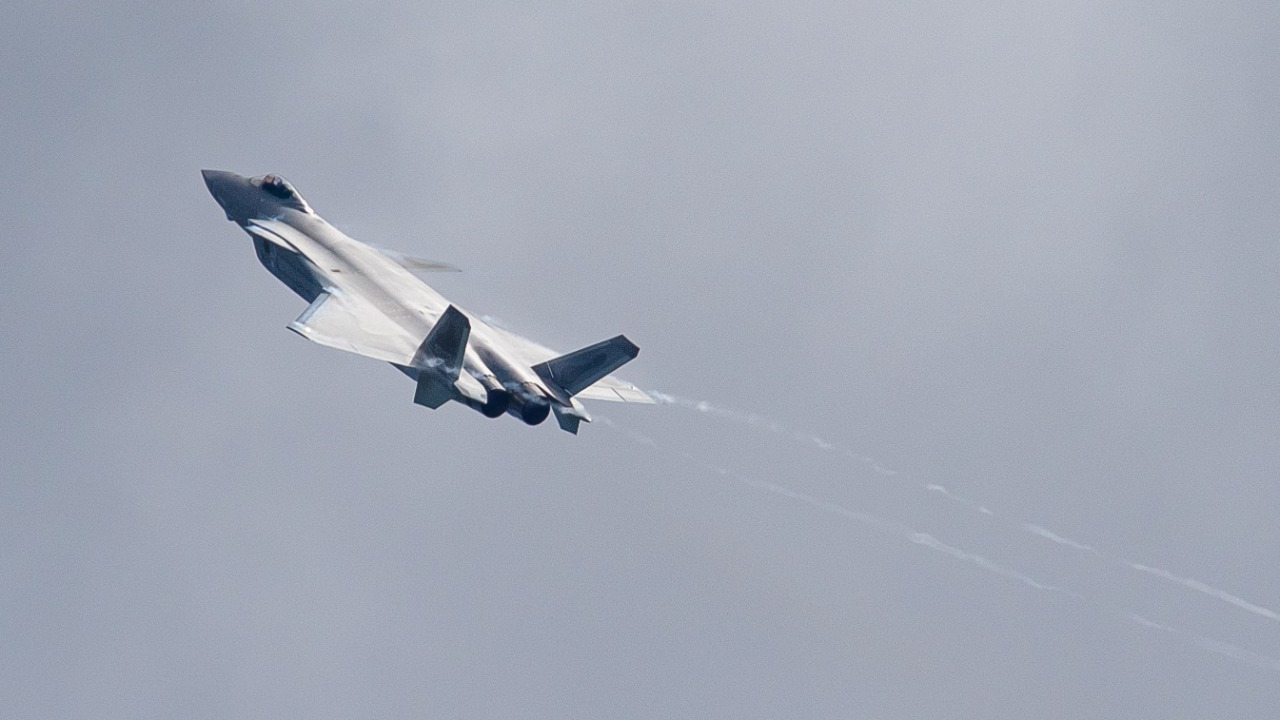

China is knitting together a new generation of stealth aircraft that is designed not just to defend its coastline, but to erode decades of U.S. air dominance across the western Pacific. The J-20, J-36 and H-20 form the core of that effort, each aimed at a different layer of the air war, from long-range strike to air superiority and manned‑unmanned teaming.
Viewed together, these programs show how Beijing is trying to leap from catching up with American designs to shaping the next era of air combat on its own terms. I see a strategy that blends mass production, rapid iteration and bold experimentation, all calibrated to complicate U.S. planning and stretch the Next Generation Air Dominance, or NGAD, roadmap.
From catch‑up to contest: China’s airpower strategy shifts
For years, Chinese planners were focused on closing the gap with U.S. and allied fighters, sensors and bombers that could operate with relative impunity along China’s periphery. That logic is explicit in analysis of the J-20 program, which describes how Beijing’s basic problem was that U.S. and allied fighters, sensors and bombers could outclass its legacy fleet, prompting a drive to field a jet like the J-20 Mighty Dragon so that China could build one of its own. That catch‑up phase is now giving way to a more ambitious agenda that aims to challenge U.S. concepts head‑on rather than simply mirror them.
Washington has long been “intent on maintaining strategic and tactical superiority over China and defying its ‘A2/AD’ aspirations in advance,” a posture that has shaped everything from the Air‑Sea Battle concept to a broader “Pacific Tilt” doctrine anchored in forward‑deployed airpower and naval forces, as detailed in assessments of U.S. posture toward China and the East China Sea. By fielding a maturing J-20 fleet, unveiling the J-36 as a sixth‑generation concept and pushing ahead with the H-20 bomber, Beijing is signaling that it intends to contest that superiority across the full spectrum of air operations, from the First Island Chain out to the Second and beyond.
The J-20 Mighty Dragon becomes a frontline workhorse
The Chengdu J-20 has moved from exotic prototype to the backbone of China’s high‑end fighter force, and that shift is central to how Beijing plans to challenge U.S. airpower. The Chengdu J-20, known in Chinese as 歼-20 and also called Weilong, or Mighty Dragon, is a twin‑engine stealth fighter that serves the People’s Liberation Army Air Force, or PLAAF, as its first operational fifth‑generation design, according to technical histories of The Chengdu program. It is not just a technology demonstrator; it is being produced and deployed at scale.
One detailed assessment notes that over 250 units of the J-20 are believed to be in service, deployed across strategic bases and presenting what analysts describe as a significant threat to the U.S. Air Force. That kind of production run, combined with the aircraft’s stealth shaping and long‑range sensors, turns the Mighty Dragon from a prestige project into a workhorse that can be massed in regional contingencies rather than held back as a boutique capability.
How the J-20 reshapes the air battle over the western Pacific
China is not parking its most advanced fighters deep inland; it is pushing them toward the front lines. Asia Times reporting cited in technical summaries notes that Asia Times reported that PLAAF had prioritized deploying J-20s for airbases close to China’s maritime border, and believed J-20’s characteristics made it suitable for missions over the First and Second Island chain, a pattern that underscores how Asia Times sees the jet as a tool for projecting power outward. That basing posture directly targets the air corridors U.S. and allied aircraft would rely on in a Taiwan or South China Sea crisis.
The J-20 is also wired to plug into China’s broader air defense and strike network. Analysts describe how the J-20 is outfitted with a large AESA radar and long‑range PL‑15 missiles, and potentially PL‑21 hypersonic weapons in the future, enabling it to act as both a sensor node and a long‑reach shooter within a layered air defense bubble, as detailed in studies of how the jet’s AESA suite supports China’s network. In practice, that means the Mighty Dragon can help extend the reach of ground‑based missiles and other fighters, complicating U.S. efforts to carve out safe operating zones for tankers, AWACS and bombers.
J-20 variants and the push toward manned‑unmanned teaming
Beijing is not stopping at the baseline J-20. It is already experimenting with variants that hint at how China wants to fight in the 2030s, particularly through manned‑unmanned teaming. One prominent example is the J-20S, a twin‑seat derivative that has been described as a platform for an AI‑enabled Copilot concept, where a second crew member works with advanced automation to manage sensors and direct drones, an approach highlighted in reporting on how an AI‑enabled Copilot could help control swarms through the operation of drones. That aligns closely with U.S. experiments under the Collaborative Combat Aircraft banner, but China is moving to operationalize the idea on its own flagship fighter.
Even gaming culture has picked up on the J-20’s growing prominence, reflecting how the aircraft has become a symbol of Chinese high‑tech power. In one widely referenced depiction, The Chengdu J-20, also called Jian-20 in some contexts, is portrayed as a fifth generation, stealth, twin engine, single‑seat fighter that entered active service in March 2017, according to a profile of the Jian platform. While that description is stylized, it tracks with open‑source timelines and underscores how the J-20 has shifted from a niche topic for defense insiders to a broader cultural marker of China’s military rise.
The J-36: China’s leap toward sixth‑generation air combat
If the J-20 is about catching up and saturating the region with fifth‑generation fighters, the J-36 is about leaping ahead into what Chinese strategists hope will be a sixth‑generation regime. The Chengdu J-36, described in Chinese as 歼-36, is a speculative designation given by military analysts to a trijet, tailless stealth aircraft concept that appears optimized for low observability and advanced control of aircraft teaming operations, according to technical notes on The Chengdu design. Even in the absence of full official disclosure, the outlines of the program point to a platform built from the ground up to manage drones and operate deep inside contested airspace.
Public glimpses of the aircraft have been carefully choreographed. In June 2025, China unveiled footage of the J-36, a stealth fighter developed by Chengdu Aircraft Corporation and presented as a tailless design that uses blended wings and the absence of vertical stabilizers to minimize radar signature, as described in analysis of how In June China showcased the jet. That same reporting emphasizes that the J-36 is explicitly framed as an attempt to surpass a future U.S. F‑47 NGAD fighter before it even enters service, underscoring how Beijing now measures its projects not against legacy U.S. jets, but against the Pentagon’s next wave.
What the J-36’s design reveals about China’s priorities
Closer looks at the J-36 suggest a platform that is less about raw speed and more about flexibility, range and information dominance. One detailed breakdown notes that China’s J-36 Fighter can be summed up in four Words, “2 Seats, More Mystery,” highlighting how the twin‑seat layout and side‑by‑side cockpit arrangement are central to its concept of operations, as described in coverage that repeatedly references the number 36 in connection with the jet. That configuration gives room for a mission commander to manage swarms of uncrewed aircraft, electronic warfare tasks and long‑range targeting while the pilot focuses on flying and survival.
Technical analysis of early imagery adds that Overall, the J-36 most logically combines a lot of very important features in a relatively advanced design, with one potential configuration featuring a wingspan of roughly 36 m and a tailless, blended wing body that maximizes internal volume for fuel and sensors, as noted in assessments that emphasize the “Overall” integration of these 36 m characteristics. That combination of range, payload and stealth is tailored to a Pacific theater where distances are vast and U.S. bases may be under missile threat, making endurance and flexibility as important as dogfighting performance.
From prototype to fleet: how fast the J-36 is maturing
What is striking about the J-36 is not just its design, but the speed at which it is moving from concept to operational integration. One detailed field report notes that What emerges from the 31 October 2025 footage is that the J-36 is no longer an isolated prototype occasionally captured by spotters, but an aircraft flying in formation with J-20s and rehearsing tactics that point toward deployment in the western Pacific in the 2030s, a shift captured in analysis that repeatedly highlights the What that footage reveals. The fact that it is already flying alongside operational J-20s suggests that Chinese planners are thinking in terms of mixed‑generation packages rather than waiting for a clean generational handover.
Strategists watching the program argue that the US‑China race for next‑gen air dominance will be decided by innovation speed, not legacy strength, and that China is winning the tempo battle by rapidly iterating on the J-36 with features like a side‑by‑side cockpit and advanced networking, as highlighted in commentary that frames the China program as evolving fast to outfly slower‑advancing U.S. rivals. If that assessment holds, the J-36 could enter service in meaningful numbers just as NGAD is ramping up, forcing the U.S. to confront a peer sixth‑generation threat earlier than expected.
U.S. NGAD planners take the J-36 and H-20 seriously
American commanders are already recalibrating their assumptions in light of the J-36 and H-20. One senior officer described how, when operators first saw imagery of the new Chinese stealth jet, “My operators were not 100 percent sure they had the right airplane,” a remark that underscores how unfamiliar the design looked even to seasoned analysts and is cited in reporting on how that 100 percent uncertainty is shaping NGAD thinking. The same assessments stress that U.S. planners now see the J-36 and H-20 as direct competitors to their own next‑generation fighter and bomber concepts, not distant curiosities.
That concern is amplified by broader analysis of How China’s new next‑gen fighters could impact America’s plans for NGAD, which warns that Beijing will not want to waste an opportunity to humiliate America if it can field credible sixth‑generation capabilities first, a dynamic that could pressure U.S. budgets and timelines for How China and NGAD. In practical terms, that means the Pentagon must now plan for a future in which U.S. stealth is no longer a unilateral advantage, but part of a contested ecosystem where Chinese jets can match or even exceed American performance in some mission sets.
The H-20: giving China a true strategic bomber leg
While the J-20 and J-36 focus on air superiority and theater strike, the H-20 is intended to give China something it has never had before: a genuine strategic bomber leg that can hold distant targets at risk. Analysts describe how, strategically, the bomber is intended to provide China with a genuine strategic air leg, a strategic bomber capable of complementing its nuclear triad and extending its reach far beyond regional flashpoints, as detailed in assessments of how Strategically the H-20 fits into China’s plans. That would move Beijing closer to the kind of global strike capability long associated with U.S. B‑2 and B‑21 bombers.
The program has been in development for roughly a decade, and observers frame it as a stealth bomber effort that raises the question, “Will It Ever Fly,” while also noting that China has been willing to invest the time needed to develop and perfect a low‑observable, long‑range platform, as highlighted in analysis that asks whether China’s H‑20 Stealth Bomber, and the question “Will It Ever Fly,” will ultimately deliver on its promise for China. If the H-20 reaches operational status with credible stealth and payload, it would force U.S. planners to think about defending not just forward bases, but also more distant nodes that have long been considered relatively safe.
Perception gaps: is the J-20 a “paper tiger” or a real threat?
Not everyone in the West is convinced that China’s stealth fleet is as formidable as Beijing wants the world to believe. Some critics argue that the J-20’s stealth and reliability are overstated, with one prominent video commentary labeling China’s J-20 “a flying lie” and “a paper tiger” that could struggle with combat readiness, sortie rates and performance in high‑intensity conflict scenarios, as asserted in a widely viewed Nov critique. Those skeptics point to lingering questions about engine performance, sensor fusion and pilot training compared with U.S. standards.
Yet even if some of those criticisms hold, the sheer number of aircraft and the pace of improvement matter. Technical histories of The Chengdu J-20, which describe the Chinese Weilong Mighty Dragon in detail, emphasize that the jet has evolved through multiple production blocks and engine upgrades, reflecting a learning curve similar to early U.S. fifth‑generation programs, as outlined in open‑source entries on The Chengdu platform. In other words, dismissing the J-20 as a static “paper tiger” risks underestimating a system that is being refined in real time and integrated into a broader network of sensors, missiles and command systems.
Signaling and showmanship: how Beijing uses unveilings
China understands that the way it reveals new aircraft can be as strategically important as the hardware itself. When China’s military first showed a new, tailless combat aircraft widely identified by analysts as their sixth‑generation J-36, it did so in a bold show of force that raised alarms over a potential challenge to U.S. air dominance, a rollout described in coverage of how China unveiled the jet. The carefully edited footage and limited angles were designed to showcase stealthy lines while preserving ambiguity about exact capabilities.
That pattern fits a broader Chinese approach to strategic messaging, where partial transparency is used to shape foreign perceptions without giving away too much technical detail. Analysts who track J-20 developments note that How China’s new next‑gen fighters are framed in state media is often calibrated to influence America’s NGAD debates, with Beijing keenly aware that each new image or test can ripple through U.S. budget and acquisition discussions, as suggested in commentary on how those unveilings affect America and NGAD planning. In that sense, the J-20, J-36 and H-20 are not just weapons, but tools of psychological and political warfare aimed at shaping the strategic environment before any shots are fired.
Why this triad matters for the next decade of U.S.–China competition
Put together, the J-20, J-36 and H-20 form a layered challenge to U.S. airpower that spans the tactical, operational and strategic levels. The J-20 Mighty Dragon gives China a mature fifth‑generation fighter that can contest airspace over the First and Second Island Chains, backed by a growing fleet that already numbers in the hundreds and is integrated into a sophisticated sensor and missile network, as documented in profiles of the Chinese Weilong. The J-36 points toward a future where Chinese pilots command swarms of uncrewed systems from stealthy, long‑range motherships, while the H-20 promises to extend Beijing’s strike reach deep into the Pacific and potentially beyond.
For Washington, which has been intent on maintaining strategic and tactical superiority over China and defying its A2/AD aspirations, that emerging triad means the margin for error is shrinking fast, as earlier analyses of U.S. posture toward Intent in the Pacific already warned. I see the next decade as a race not just to field better aircraft, but to integrate them into resilient networks, train crews for complex manned‑unmanned operations and adapt doctrine fast enough to keep pace with a rival that is no longer content to follow. In that race, the J-20, J-36 and H-20 are the clearest indicators yet of how China plans to challenge the United States in the skies above the Indo‑Pacific.
More from MorningOverview