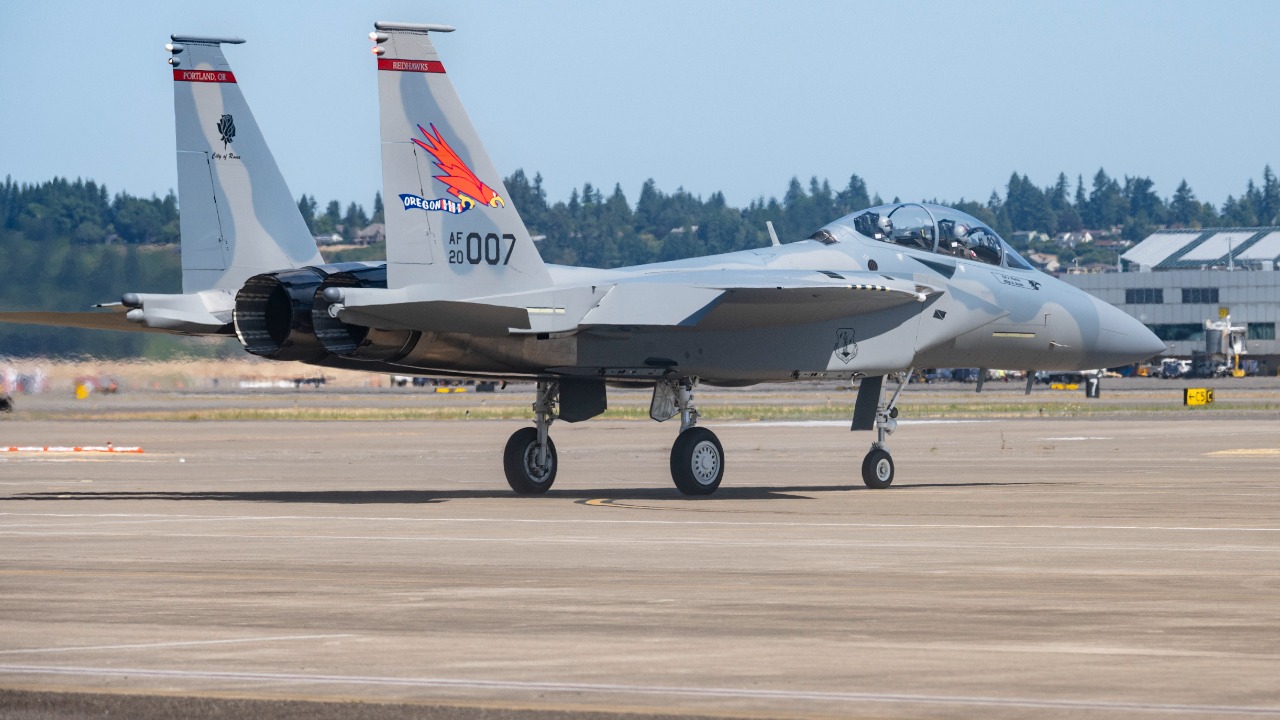

The F-15EX began its life in U.S. service under a cloud of production delays and budget skepticism, yet it is rapidly maturing into one of the most capable air superiority and strike platforms in the inventory. Built on a proven airframe but packed with modern sensors, electronic warfare tools, and a huge weapons load, it is quietly reshaping how the Air Force thinks about high‑end combat power. As the program works through lingering technical issues, the Eagle II is moving from problem case to central pillar of the future fighter mix.
From legacy airframe to “Technological Powerhouse Fighter”
The F-15EX story starts with a paradox: a fighter that looks like a Cold War throwback but behaves like a digital native. The jet inherits the basic lines of the classic Eagle, yet its avionics, cockpit, and mission systems are built around a modern open architecture that lets the Air Force plug in new software, weapons, and sensors far more quickly than on earlier variants. In effect, the service is buying a familiar airframe and filling it with a new brain, turning a legacy design into what one analysis describes as a Technological Powerhouse Fighter that can keep pace with rapidly evolving threats.
That transformation is anchored in specific capabilities rather than nostalgia. The jet’s advanced radar and electronic warfare suite are designed to detect, track, and disrupt targets at long range, while its networking tools allow it to share data across the battlespace instead of fighting as a lone platform. The fact that this package comes from Boeing With decades of experience on the F‑15 line gives the Air Force a measure of confidence that upgrades can be fielded at scale, not just in small experimental batches. In practice, that means the Eagle II can serve as both a frontline shooter and a sensor node, feeding information to stealth aircraft and ground forces while carrying a weapons load that few fighters can match.
Early production stumbles and the quality wake‑up call
The path to that capability has not been smooth. As the first F‑15EX aircraft moved from concept to reality, the program ran into a series of manufacturing and supplier problems that slowed deliveries and raised questions about whether the Air Force had backed the right horse. A report from the Defense Contract Management Agency detailed how supplier quality issues and production missteps forced Boeing to delay the schedule for getting jets into Air Force hands. Those problems were serious enough that the DCMA, often shortened to DCMA, flagged them as a barrier to reaching full‑rate production when originally planned.
Separate reporting underscored just how disruptive those quality lapses became. As Boeing worked through the early production lots, Boeing had to accept that deliveries would slip by at least six months after quality errors were discovered on aircraft already in the pipeline. The report, By Stephen Losey, detailed how the seventh and eighth F‑15EXs were pushed back as the company reworked components and tightened oversight. For a program sold partly on the promise of rapid fielding, those delays were more than a scheduling nuisance; they were a warning that even a mature production line can stumble when it is retooled for a new, more complex variant.
Supply chain strains and the electronic warfare bottleneck
Quality problems on the airframe were only part of the story. The F‑15EX’s cutting‑edge electronic warfare suite, one of its main selling points, also became a chokepoint as suppliers struggled to keep pace. A watchdog review found that Boeing had “experienced quality deficiencies” on early F‑15EX fuselages, which required time‑consuming rework and contributed to schedule slips. Those same supply chain pressures affected the delivery of key electronic warfare components, forcing the program to juggle installation timelines and prioritize certain aircraft for completion.
The watchdog agency’s conclusion was blunt: even after some improvements, further reductions are needed in both defects and schedule risk if the F‑15EX is to meet the Air Force’s operational needs. For a jet that is supposed to anchor homeland defense and augment stealth fighters in contested theaters, any delay in fielding its full electronic warfare capability has real consequences. The episode also highlighted a broader vulnerability: as combat aircraft become more software‑defined and sensor‑heavy, the supply chains that feed those systems can be just as fragile as the metal they are bolted to.
Fuel venting troubles and the grind of flight‑test fixes
Even as production stabilized, new technical issues emerged in operational testing. A fuel venting problem surfaced on some of the Air Force’s fresh F‑15EX Eagle II jets, prompting additional scrutiny of the design and the parts feeding the line. Reporting on the issue noted that the Air Force identified the anomaly in a subset of aircraft and traced it to a specific batch of valves, which showed signs of malfunction under certain conditions. For a twin‑engine fighter expected to fly long‑range missions with heavy loads, any uncertainty around fuel handling is a serious operational concern.
Boeing’s response has been to test fixes and work through the affected jets, treating the issue as a discrete hardware problem rather than a systemic design flaw. The reporting that flagged the fuel venting anomaly appeared alongside a subscription prompt for The TWZ Newsletter, a reminder that even niche technical glitches can attract intense attention in the defense community. For the Air Force, the episode is another example of how the Eagle II’s transition from factory floor to flight line has been marked by incremental fixes, each one necessary to turn a promising design into a dependable workhorse.
“Because it isn’t stealthy”: the strategy slide snub
While engineers wrestled with valves and fuselages, strategists were having their own argument about the F‑15EX. In high‑level planning documents, the Eagle II was often overshadowed by stealth platforms, and at times it was treated as a budgetary afterthought rather than a core asset. One analysis captured the mood with a stark line: Because it is not stealthy, the F‑15EX Eagle II got benched in strategy slides and whiplashed in budgets, even as it demonstrated real value in exercises and planning games. That tension between low‑observable glamour and non‑stealth utility has shaped the jet’s political fortunes from the start.
The same reporting argued that this bias risks underestimating what the Eagle II can do when wars get ugly and attrition mounts. In a prolonged conflict, the ability to generate sorties from a robust, twin‑engine fighter with a massive payload and modern sensors could matter as much as the exquisite survivability of a smaller stealth fleet. The Eagle II label itself is a signal that the Air Force sees continuity with the original F‑15’s role as an air dominance platform, even if the budget debates have sometimes treated it as a stopgap. As production ramps and the jet’s capabilities become more visible, that perception gap is starting to narrow.
Unparalleled weapons capacity and long‑range punch
What ultimately shifts the conversation is what the F‑15EX can carry and how far it can take it. Boeing advertises the Eagle II’s Unparalleled Weapons Capacity The jet can shoot from a significantly increased range and haul more payload than any other fighter in the U.S. inventory, including a heavy load of AIM‑120 AMRAAMs or other large ordnance. In practical terms, that means a single F‑15EX can function as a magazine in the sky, supporting stealth aircraft that may be limited in how many missiles they can carry internally.
This load‑carrying advantage pairs with the airframe’s range and twin‑engine reliability to create a platform well suited for long‑distance patrols and standoff strike missions. The F‑15EX can launch from bases far from the front line, cruise with a heavy weapons load, and still retain the performance needed to defend itself if challenged. When combined with its modern radar and electronic warfare suite, that payload capacity turns the Eagle II into a force multiplier, allowing it to support both homeland defense and expeditionary operations without constant tanker support. In an era when adversaries are fielding more long‑range missiles and dense air defenses, the ability to bring a large number of weapons to the fight in a single sortie is a strategic asset in its own right.
Ramping up production and the case for rapid deployment
After the early stumbles, Boeing has moved aggressively to increase output and reassure the Air Force that the F‑15EX can be delivered at the pace commanders expect. The company has highlighted how the jet is engineered for rapid deployment and high operational availability, leaning on its robust airframe and twin‑engine design to keep sortie rates high even under stress. Recent reporting described how the F‑15EX is being produced in greater numbers specifically to accelerate Air Force modernization and adapt to the changing landscape of global air combat.
That ramp‑up is not just about hitting a numeric target on a spreadsheet. It reflects a broader shift in how the service views the Eagle II’s role in its force structure, particularly as it balances the demands of great‑power competition with the need to maintain day‑to‑day readiness. The jet’s design for rapid deployment means it can be surged to hotspots or rotated through forward bases without the same maintenance burden as more fragile platforms. As production lines stabilize and supply chain issues are addressed, the Air Force gains a credible path to fielding a sizable fleet of F‑15EX aircraft that can shoulder a significant share of air defense and strike missions.
Guard priorities and the homeland defense niche
One of the clearest endorsements of the F‑15EX has come from the Air National Guard, which sees the jet as a natural fit for its homeland defense mission. In public remarks, the Speaking regarding the procurement of the F‑15EX, the Commander of the U.S. Air National Guard Lieutenant General Michael emphasized how the aircraft’s heavy payload and long range align with the Guard’s need to cover vast swaths of U.S. airspace. For units tasked with intercepting unknown aircraft, responding to cruise missile threats, or backing up active‑duty squadrons, the Eagle II offers a blend of endurance and firepower that smaller fighters struggle to match.
That perspective is echoed, in a more informal way, in online discussions among aviation enthusiasts and current or former service members. A widely shared comment thread framed the Air National Guard as the primary user of the F‑15EX for home defense, while also voicing skepticism about buying large numbers of the jet for other roles. One poster bluntly argued that the Idea of purchasing more of these is absurd as NO, a reflection of the ongoing debate about how many Eagle IIs the Air Force really needs. That tension between clear homeland defense utility and questions about broader force structure is likely to shape procurement decisions for years.
Cost, the “enemy” that will not go away, and the F‑35 comparison
Even as the F‑15EX gains advocates, it faces a persistent adversary that has nothing to do with Russian or Chinese fighters: the Pentagon’s own budget math. Analysts have pointed out that one of the most compelling arguments for the Eagle II is its relative cost‑effectiveness compared with fifth‑generation jets. In a detailed comparison, one assessment noted that One of the strongest cases for the F‑15EX is that it delivers high‑end capability without the full price tag and sustainment burden of the F‑35.
At the same time, that analysis acknowledged that the F‑35’s stealth and sensor fusion give it undeniable advantages in the most heavily defended airspace. While the F‑35 excels at penetrating advanced integrated air defenses, the F‑15EX offers a more economical way to handle missions that do not require that level of stealth, such as homeland defense, standoff missile carriage, and certain types of air policing. The “enemy” the Eagle II cannot beat, in this framing, is not a foreign adversary but the constant pressure to justify its share of limited procurement dollars in a fleet that already includes a marquee fifth‑generation fighter.
Why “no stealth, no problem” is becoming a credible doctrine
As the F‑15EX moves from troubled rollout to operational mainstay, a new narrative is taking hold inside parts of the defense community: that a non‑stealth fighter can still be indispensable in a high‑end war if it is equipped with the right sensors, weapons, and networking tools. Advocates argue that the Eagle II’s combination of range, payload, and modern avionics makes it a natural partner for stealth aircraft, which can slip into contested airspace, identify targets, and then cue non‑stealth shooters to fire from safer distances. This concept of operations turns the F‑15EX into a kind of arsenal plane, leveraging its size and power rather than apologizing for its radar cross‑section.
That logic underpins the argument that the Air Force needs the F‑15EX even as it invests heavily in stealth and next‑generation platforms. The same analysis that dubbed it a Technological Powerhouse Fighter also framed the jet as a good fit for a restraint‑based grand strategy, one that emphasizes deterrence and selective engagement rather than constant expeditionary wars. In that context, a durable, heavily armed, and relatively affordable fighter that can defend the homeland, backstop allies, and surge in a crisis looks less like a compromise and more like a deliberate choice. The journey from production trouble to powerhouse status is not finished, but the trajectory is clear: the Eagle II is earning its place in the future force, one resolved defect and one validated mission at a time.
More from MorningOverview