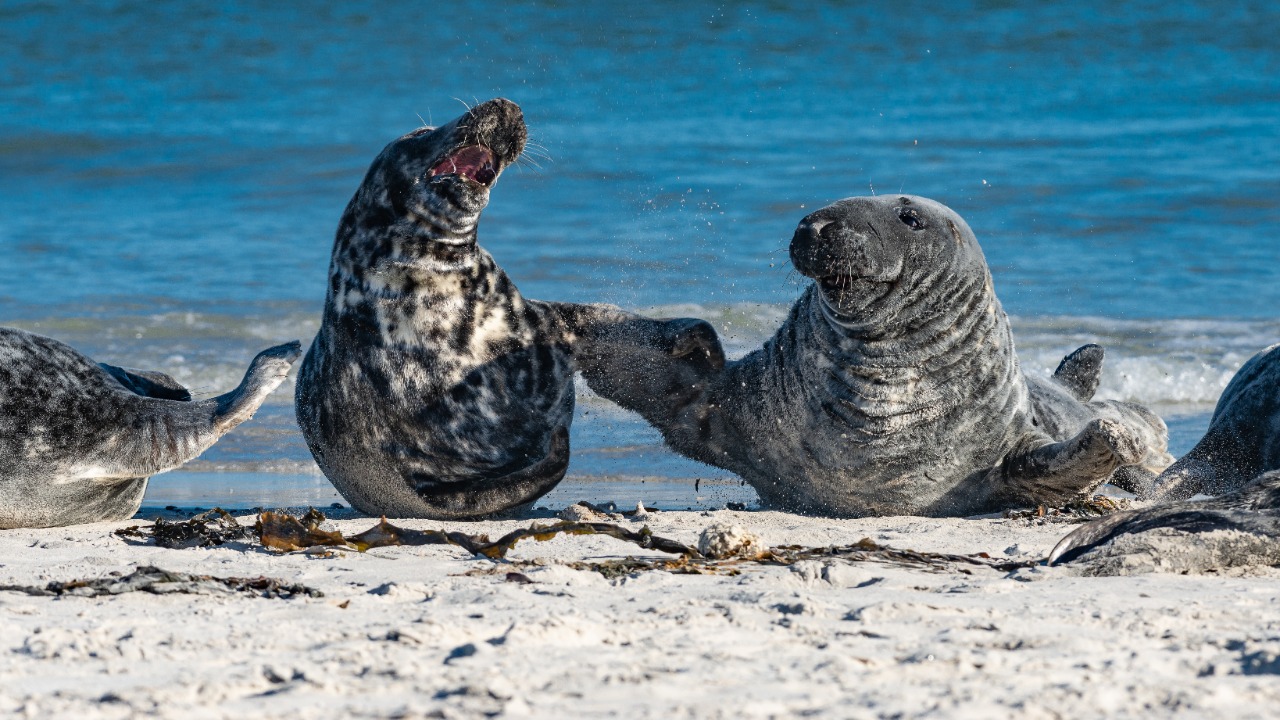

For years, humans have treated breast milk as the gold standard of mammalian nutrition, a uniquely complex fluid tailored to our species’ needs. New research on the Atlantic gray seal suggests that assumption may be wrong, revealing a milk so chemically intricate and rapidly shifting that it could dethrone humans as the champions of lactation complexity. The discovery does more than humble our species, it opens a new window into how evolution engineers bespoke nutrition for extreme lifestyles.
As I look at the emerging data, the Atlantic gray seal’s milk reads like a high‑performance formula designed for survival on a harsh coastline, compressed into a nursing period that lasts only days. Its sugars, fats, and bioactive molecules appear to be tuned with a precision that rivals, and in some ways surpasses, what I once assumed was uniquely human.
How a coastal predator upended assumptions about “advanced” milk
The Atlantic gray seal is not the animal most people would nominate as a biochemical overachiever. It is a bulky marine predator that hauls out on beaches, gives birth in the cold, and then vanishes back into the sea. Yet when researchers began to map the molecular landscape of its milk, they found a level of structural variety and rapid change that challenges the idea that human milk sits at the top of some evolutionary hierarchy of complexity. The gray seal’s brief but intense nursing season appears to concentrate a staggering amount of nutritional engineering into a narrow window.
That shift in perspective matters because it reframes complexity as something that emerges from ecological pressure, not from a ladder of “higher” and “lower” mammals. The Atlantic gray seal’s pups must pack on blubber quickly, fend off pathogens in crowded colonies, and prepare for abrupt weaning, all within a matter of days. The new work, detailed in a peer‑reviewed analysis of gray seal milk, shows how the animal’s lactation strategy has been sculpted to meet those demands, molecule by molecule.
Inside the study that put gray seal milk on the map
To understand why scientists are suddenly talking about seal milk in the same breath as human breast milk, it helps to look at how the research was done. Rather than taking a single snapshot of composition, the team collected samples across the short lactation period and used high‑resolution tools to track how the milk’s sugars and other components changed over time. This time‑series approach revealed a dynamic fluid that shifts from one biochemical profile to another as the pup’s needs evolve from the first suckle to the last.
What emerged from that work was a catalog of oligosaccharides and related molecules that had never been documented in this species before, and in many cases not in any mammal. The authors describe how the Atlantic gray seal’s milk contains a rich array of structurally diverse sugars that appear and disappear in a tightly choreographed sequence. That choreography, laid out in the same Dec feature on The Mammal With the Most Complex Milk Might Not Be Humans, After All, The Atlantic Gray Seal Could Take That Title, is what first prompted researchers to ask whether humans really own the crown for lactation complexity.
What “more refined than breast milk” actually means
When I read that seal milk is “more refined than breast milk,” it is tempting to interpret that as a value judgment, as if one species’ milk were simply better. The science points to something more nuanced. Researchers at the University of Gothenburg describe gray seal milk as refined because its composition is tightly filtered by evolutionary pressure, with specific molecules ramped up or dialed down in a way that looks almost engineered. In their work, they show that the seal’s oligosaccharides are not just numerous but also precisely arranged, forming a kind of biochemical toolkit tailored to the pup’s rapid development and harsh environment.
That refinement is not about purity or simplicity, it is about specialization. Human milk supports a long developmental arc, with extended brain growth and immune training over months or years. Seal milk, by contrast, must deliver dense energy and fast immune protection in a matter of days. The Researchers at the University of Gothenburg describe how this pressure has produced a fluid that looks, in their words, more refined than breast milk, not because it is universally superior, but because it is so sharply tuned to the life history of a Seal that must thrive in a narrow, unforgiving window.
The sugar story: 33% more complexity than human milk
One of the most striking findings is numerical. An analysis of gray seal milk found approximately 33% more sugar molecules than in human breast milk, a figure that forces a rethink of which species we consider to have the most elaborate lactation chemistry. That 33% difference is not a trivial bump, it represents dozens of additional oligosaccharide structures that expand the range of possible interactions with gut microbes, pathogens, and the pup’s own tissues. In practical terms, the seal’s milk offers a broader palette of sugar shapes for biology to work with.
The same analysis also underscores how these sugars are not just more numerous but also differently arranged, with branching patterns and linkages that diverge from what is typically seen in humans. That structural diversity could translate into a wider variety of binding sites for bacteria and viruses, or more nuanced signals to the developing immune system. The report that seal milk rivals breast milk in complexity and sugar content, and that it contains approximately 33% more sugar molecules, comes from a detailed analysis led by Blake, which frames this sugar surplus as a potential resource for improving infant formula for babies.
Unknown molecules and the frontier of oligosaccharide biology
Numbers alone do not capture how radical this discovery is. When scientists dug into the structures of the sugars in gray seal milk, they found that Two thirds of the seal oligosaccharides were previously unknown molecules. That means most of the complex sugars in this milk have never been cataloged in any other mammal, and their biological roles are still a mystery. For a field that has spent years mapping human milk oligosaccharides, this is like discovering a new continent of chemistry sitting in plain sight on a windswept beach.
The novelty does not stop at the count of unknown molecules. Whereas the largest known sugars in human milk have a certain ceiling in size and branching, the gray seal’s milk includes structures that push or even exceed those limits, hinting at functions we have not yet imagined. A closer look at these findings, described in a narrative on how scientists “got” seal milk, shows how the time‑series characterization of these oligosaccharides reveals a trait for a marine animal that is as much about timing as it is about structure. The account that Two thirds of the seal oligosaccharides were previously unknown molecules and that Whereas the largest known sugars in human milk are smaller than some of those in seals comes from a detailed exploration in Got Seal Milk?, which frames these molecules as a new frontier for glycobiology.
Why evolution pushed gray seal milk to such extremes
To make sense of why the Atlantic gray seal ended up with such intricate milk, I keep coming back to its life history. Pups are born on exposed shores, where cold, predators, and disease are constant threats. Mothers fast while nursing, pouring their own stored energy into milk that must help pups double or even triple their weight in a short span. Under those conditions, any molecule that improves energy transfer, immune defense, or gut maturation can mean the difference between survival and failure, and evolution has had every incentive to stack the deck in favor of pups that respond best to this biochemical cocktail.
That pressure shows up in the way the milk’s composition shifts over time. Early in lactation, the profile leans toward immune‑active sugars and compounds that help establish a protective microbiome, while later samples tilt toward dense energy and molecules that support rapid fat deposition. The time‑series work in the primary gray seal milk study highlights how this choreography mirrors the pup’s changing needs, from first exposure to the outside world to the final push to build blubber before weaning. In that sense, the milk is not just food, it is a schedule encoded in chemistry.
Rethinking human exceptionalism in lactation
Human culture has long treated our own biology as uniquely sophisticated, and breast milk has been part of that story. It is true that human milk is remarkably complex, with a rich array of oligosaccharides that feed beneficial microbes and train the immune system. Yet the Atlantic gray seal’s milk shows that complexity is not a human monopoly. When a wild animal’s milk contains more sugar molecules, more unknown structures, and a more rapid compositional shift than ours, it forces a more humble view of where we sit in the mammalian landscape.
That humility is not about diminishing the importance of human milk, it is about recognizing that evolution has produced many different “solutions” to the problem of nourishing young. The Dec feature on The Mammal With the Most Complex Milk Might Not Be Humans, After All, The Atlantic Gray Seal Could Take That Title argues that this discovery should prompt scientists to look beyond traditional model species when searching for biological inspiration. By acknowledging that a coastal predator’s milk can rival or surpass our own in certain dimensions, we open the door to a richer understanding of how lactation evolves across mammals, and how those insights might eventually circle back to benefit human health.
From seal beaches to baby formula and medicine
One of the most intriguing threads in this research is its potential application to human nutrition and therapeutics. If gray seal milk contains oligosaccharides that are especially good at blocking pathogens, shaping the microbiome, or supporting gut development, then synthetic versions of those molecules could one day find their way into infant formula or medical nutrition products. The detailed mapping of seal sugars, including the approximately 33% increase in sugar molecules compared with human milk, gives chemists a menu of candidates to test in the lab and eventually in clinical settings.
Researchers are already talking about how these findings might inform new methods to support human health, from designing better prebiotics to engineering targeted therapies that mimic the way seal milk protects pups in a high‑risk environment. The Dec discussion of The Mammal With the Most Complex Milk Might Not Be Humans, After All, The Atlantic Gray Seal Could Take That Title notes that understanding these molecules could help improve infant formula for babies, especially for those who cannot access breast milk. In that sense, the work that began with field samples from a remote colony could eventually reshape products on supermarket shelves and in hospital neonatal units.
The next questions for gray seal milk science
For all the excitement around these discoveries, many of the most important questions remain open. We still do not know the precise function of most of the newly identified oligosaccharides, or how they interact with the specific microbes that colonize a gray seal pup’s gut. We also lack detailed data on how variation in milk composition between individual mothers might influence pup survival, growth rates, or disease resistance. Those gaps are not a weakness of the current work, they are a roadmap for the next wave of studies that will connect molecular patterns to real‑world outcomes on the beach.
As I weigh the evidence, it is clear that the Atlantic gray seal has already changed how scientists think about milk, but it is unlikely to be the last surprise. Other marine mammals, from elephant seals to whales, may harbor their own biochemical innovations, shaped by different diets, climates, and life histories. The University of Gothenburg team and collaborators like Blake have shown that with the right tools and a willingness to look beyond familiar species, we can uncover nutritional strategies that challenge our assumptions and expand our toolkit for supporting human health. The story of gray seal milk is not just about one animal’s extraordinary lactation, it is a reminder that the natural world still holds complex solutions we have barely begun to decode.
More from MorningOverview