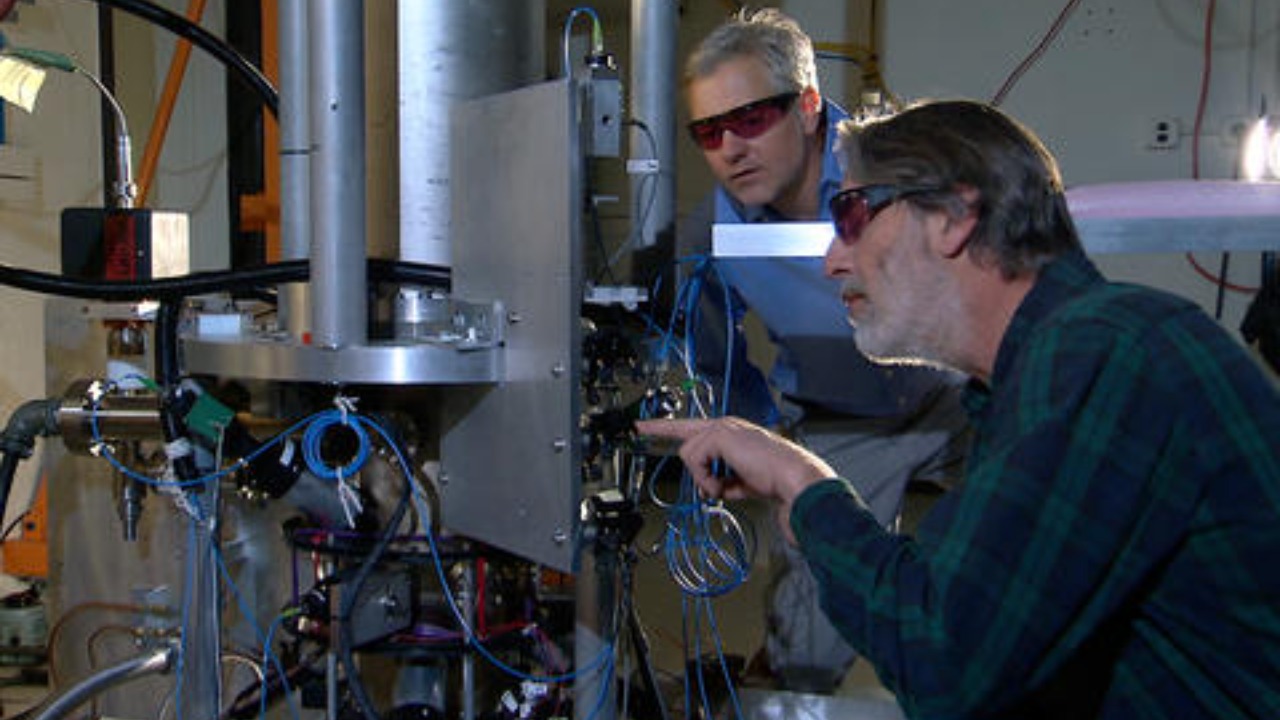

Physicists are quietly rewriting one of the most basic units in science, using a new generation of optical clocks that can keep time so precisely they barely lose a beat over the age of the universe. By pushing accuracy and stability to extremes, these devices are setting records that bring the world closer to redefining the second itself.
Instead of relying on the familiar microwave ticks of cesium atoms, researchers are now counting far faster optical vibrations and comparing them across continents with unprecedented fidelity. The result is a global race to lock in a new standard for time, one that could reshape navigation, communications, and even how we probe the structure of space-time.
From cesium ticks to optical vibrations
The current definition of the second is built on the microwave frequency of cesium atoms, a standard that has served reliably for decades but is now showing its limits as technology demands finer precision. Optical clocks replace those slower microwave oscillations with much higher frequency optical vibrations, which means they can divide time into far smaller slices and dramatically sharpen our measurement of physical processes.
At the heart of these devices, Clocks operating at optical frequencies have demonstrated fractional stability and reproducibility at the 10−18 level, a regime where even tiny environmental shifts must be tamed. That kind of performance is not just a marginal upgrade over cesium, it is a qualitative leap that lets scientists test fundamental physics, synchronize distant systems, and build a more resilient global time scale.
The record-setting optical clock
The latest record-setting optical clock builds directly on this push toward 10−18 performance, squeezing out uncertainties that once seemed unreachable. By stabilizing lasers to ultra narrow linewidths and trapping atoms or ions in exquisitely controlled environments, researchers can now count optical cycles with such fidelity that the clock would drift by less than a second over billions of years.
Earlier work showed that a new optical device could be twice as accurate as any previous clock, with one system reported as more than 100 times as accurate as the best cesium standard, a milestone highlighted when a Feb report on a new optical clock described how physicists in the United States pushed beyond existing benchmarks. That trajectory has continued into the current generation of optical clocks, which now combine extreme accuracy with the robustness needed to operate as part of a broader network rather than as isolated laboratory curiosities.
Why 10−18 accuracy matters
Reaching fractional stability at the 10−18 level is not just a technical bragging right, it changes what timekeeping can do for science and society. At that precision, a clock can detect minute differences in gravitational potential, effectively sensing height changes of centimeters by how they slightly slow or speed the passage of time, which opens the door to new forms of geodesy and Earth monitoring.
When Clocks operating at optical frequencies achieve reproducibility at 10−18, they also become powerful tools to test whether fundamental constants are truly constant or drift over cosmic timescales. In practical terms, that level of accuracy can improve satellite navigation, stabilize long distance communications, and underpin financial networks that depend on tightly synchronized timestamps, from high frequency trading platforms to global payment systems.
Building a network of optical clocks
A single record-breaking clock is impressive, but redefining the second requires a community of devices that agree with one another across borders and technologies. That is why researchers have focused on building a network of optical clocks that can be compared across laboratories and continents, using optical fibers, satellite links, and advanced frequency combs to transfer time signals without degrading their precision.
Comparing optical clocks across six countries has already shown that such a network can operate as a coherent system, with Unprecedented optical clock network efforts laying the groundwork for a global optical time scale. By demonstrating that these clocks can be intercompared with consistent uncertainties, the network shows that optical timekeeping is not just a laboratory feat but a viable candidate for international standards.
Coordinating toward a new definition of the second
Redefining a base unit like the second is not a unilateral decision by any single lab, it is a coordinated process that involves metrology institutes and international bodies. The General Conference on Weights and Measures has signaled that it is preparing for a potential redefinition, but only once the community can demonstrate that optical clocks are mature, reproducible, and globally consistent.
According to plans described for the next revision cycle, the General Conference is expected to consider a new definition around 2030, provided that optical clock networks can verify the measurement uncertainties involved and show that they can operate reliably in real world conditions. That timeline is reflected in work on a network of optical clocks that explicitly aims to open the door to redefining the second by demonstrating cross checked performance across multiple platforms.
How scientists synchronize optical clocks
To turn isolated record holders into a coherent system, scientists must synchronize optical clocks with exquisite care, often over vast distances. That process hinges on comparing the frequencies of different clocks and measuring their ratios, rather than trying to directly count every tick in real time, which would be impractical at optical speeds.
Researchers have taken a major step toward this goal by focusing on the frequency ratios between different optical transitions, using techniques that let them compare clocks without losing the precision that makes them valuable in the first place. As Scientists working on optical clock syncing explain, those ratios capture the relative vibrations of different atomic systems and can be measured with such accuracy that they form the backbone of a future optical time scale, even when the clocks themselves are scattered across different labs.
Evaluation, benchmarks, and the 100-fold edge
Optical clocks are still under evaluation, and that process is central to convincing metrology bodies that they are ready to replace cesium. Evaluation in this context means more than a single performance test, it involves long term monitoring, cross comparisons with other clocks, and careful accounting of every possible source of error, from magnetic fields to blackbody radiation.
Some of these devices have already proven to be 100 times more accurate than cesium standards, a figure that underscores how far the technology has advanced even while it remains under scrutiny. One prominent example came when evaluation of breakthrough optical clocks showed that systems developed at national metrology institutes could sustain this 100 fold edge, reinforcing the case for a new definition of the second that reflects the best timekeeping humanity can currently achieve.
From laboratory records to real world impact
The path from a record setting optical clock to a redefined second runs through practical applications that prove the technology’s value outside the lab. High precision timekeeping already underpins GPS, 5G networks, and financial exchanges, and optical clocks promise to tighten those systems further, reducing errors in positioning, improving bandwidth allocation, and making transaction timestamps more trustworthy.
As networks of optical clocks mature, they could also support new services, such as continent scale gravitational mapping that tracks groundwater changes, volcanic activity, or ice sheet dynamics by monitoring tiny shifts in local time dilation. The same stability that lets Clocks operating at optical frequencies reach 10−18 reproducibility can be harnessed to detect subtle signals in the environment, turning timekeeping infrastructure into a scientific observatory for the planet.
The last hurdles before a new second
Despite the impressive records already set, a few hurdles remain before the second can be officially redefined. Metrologists must agree on which specific optical transition will anchor the new definition, ensure that multiple independent clocks based on that transition can be built and operated around the world, and confirm that the supporting network can distribute the new standard without degrading its accuracy.
Efforts like the Unprecedented optical clock network and the broader network of optical clocks are designed to address exactly those questions, by stress testing the technology under realistic conditions and documenting its performance in a way that satisfies international standards. If those efforts succeed on the expected timeline, the record setting optical clocks of today will not just be scientific trophies, they will be the foundation for a new, sharper definition of the second that aligns our measurement of time with the most precise tools we can build.
More from MorningOverview