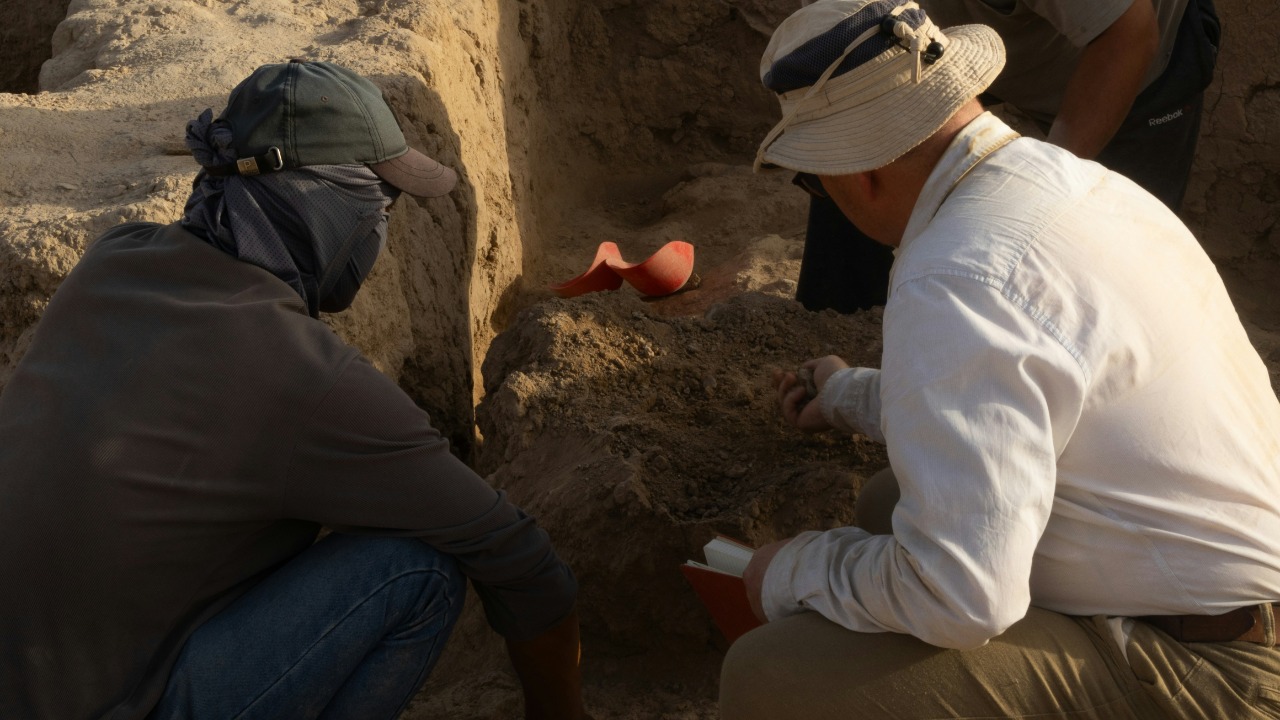

A 2,700-year-old tomb in central Greece has revealed a woman laid to rest with a bronze crown placed upside down on her head, a small but startling detail that has gripped archaeologists. The burial, rich with grave goods yet marked by this inverted diadem, offers a rare glimpse into how power, status, and perhaps disgrace were negotiated in early Greek society.
As I trace the clues from this grave, the picture that emerges is not just of a single “Lady of the Inverted Diadem,” but of a community in Boeotia wrestling with shifting political realities, changing ideas of authority, and the fragile fortunes of its elites.
The discovery that turned a crown on its head
The tomb came to light as part of a broader excavation in Boeotia, Greece, where archaeologists uncovered an unusually elaborate burial chamber dating to the mid seventh Century BC. At its center lay a woman whose skeleton still carried a bronze diadem, a symbol of rank and distinction, yet the metal band had been placed so that its decorative front faced downward, reversing the usual orientation of a crown. The careful construction of the chamber, combined with the quality of the objects inside, immediately signaled that this was no ordinary grave.
What set this burial apart was not only the wealth of the tomb but the deliberate inversion of the diadem, which framed the woman’s skull in a way that suggested both honor and a kind of visual correction. The woman’s bronze diadem, in particular, drew attention because it appeared to have been positioned as if the wearer were lying down, a detail highlighted in reporting that described how the head of the deceased was crowned in a manner that defied expectation, yet still respected the object’s ceremonial importance, according to the woman’s bronze diadem.
Who was the Lady of the Inverted Diadem?
Archaeologists have come to refer to the deceased as The Lady of the Inverted Diadem, a name that captures both her apparent status and the striking way her crown was placed. The grave’s location in Boeotia, Greece, and its date in the seventh Century BC, point to a woman embedded in a world of aristocratic lineages and local power struggles, where elite families used lavish burials to project their influence. The combination of jewelry, fine objects, and the architectural care of the tomb suggests she belonged to a privileged stratum, even if the final gesture of turning her diadem upside down hints at a more complicated story.
In accounts that frame her as a Fallen Aristocrat Unearthed, researchers emphasize that the Lady of the Inverted Diadem may have lived at a moment when older noble houses were losing ground to new political forces, and that her burial reflects both her high birth and a possible loss of standing. The very label “fallen” evokes a life that began in privilege but ended in diminished authority, a narrative supported by interpretations that see her grave as a monument to a shifting order in Boeotia, where aristocratic women could embody both continuity and rupture in a community’s memory, as explored in detail in The Lady of the Inverted Diadem.
Reading an upside-down crown
Interpreting the inverted diadem requires more than a glance at the metalwork, it demands a reading of symbolism in a culture where crowns and headbands were potent markers of rank. In many ancient contexts, a diadem worn correctly signaled legitimate authority, whether political, religious, or familial. Turning that emblem upside down at the moment of burial could therefore be understood as a visual statement that the wearer’s power had been revoked, surrendered, or rendered obsolete by events in her lifetime.
Archaeologists working on the tomb have argued that an inverted crown symbolizes the resignation or fall of a ruler, suggesting that this woman may have lost her privileges before she died, perhaps through political upheaval, family misfortune, or a broader shift in who held power in her community. The idea that her diadem was deliberately reversed to mark a loss of status, rather than placed that way by accident, is central to interpretations that see the tomb as a commentary on changing hierarchies in the mid seventh century B.C., a reading grounded in the observation that an inverted crown, though, symbolizes the resignation or fall of a ruler and that this woman may have lost her privileges in the mid-seventh century B.C., according to an inverted crown.
A tomb built for display as much as for the dead
The architecture of the burial itself reinforces the impression that this was a grave meant to be seen, remembered, and perhaps even visited. The chamber’s construction, with its carefully laid stones and controlled access, suggests that the community invested significant labor and resources in creating a resting place that would stand out among other burials in the area. Such tombs often functioned as statements of family prestige, broadcasting the wealth and influence of the lineage that claimed the plot.
Inside, the arrangement of the body and grave goods appears intentional rather than haphazard, with the woman’s skeleton positioned so that the inverted diadem would be immediately visible to anyone opening the tomb. This staging hints that the crown’s orientation was part of the message the mourners wanted to send, a kind of visual epilogue to her life story. The combination of a high-status burial and a symbol of fallen authority suggests that the tomb was not only a place of mourning but also a stage on which the community could negotiate how to remember a woman whose fortunes had changed.
Power, gender, and status in early Greek Boeotia
The Lady of the Inverted Diadem forces a reconsideration of how women participated in power structures in early Greek Boeotia. While political authority in this period is often framed as a male domain, the investment in her burial shows that elite women could serve as key carriers of family status, their bodies and grave goods used to project claims to prestige. The diadem itself, a symbol that could be read as both ornamental and political, underscores how gender and authority intersected in ways that do not fit neatly into later classical stereotypes.
By placing a crown on her head, even in an inverted position, the mourners acknowledged her role within a hierarchy that extended beyond the household. Her burial suggests that aristocratic women could embody the fortunes of their line, so that a fall from power might be inscribed on their remains as clearly as on any male warrior’s armor. The tomb in Boeotia, Greece, therefore becomes a case study in how gendered bodies were used to narrate shifts in status, with the seventh Century BC context reminding us that political change was experienced not only in assemblies and battlefields but also in the intimate rituals of death.
Archaeological method and the limits of interpretation
As compelling as the story of a fallen aristocrat may be, the interpretation of the inverted diadem rests on a chain of inferences that archaeologists must handle with care. The physical evidence is clear enough, a bronze diadem placed upside down on a woman’s skull in a richly furnished tomb. What remains open to debate is how directly that gesture can be linked to a specific narrative of disgrace, abdication, or political defeat, especially in the absence of inscriptions or written records from the burial itself.
In practice, researchers combine the material evidence with broader patterns from comparable graves, iconography, and later literary traditions about crowns and rulership. This method allows them to propose that the inverted diadem symbolizes a loss of privilege, but it also requires acknowledging that alternative explanations, such as ritual inversion to mark transition or a local funerary custom, cannot be entirely ruled out. The Lady of the Inverted Diadem thus illustrates both the power and the limits of archaeological storytelling, where each object is a clue but rarely a complete answer.
Political upheaval and the fall of aristocracies
The broader historical backdrop to this burial is a period of significant change in Greek communities, when older aristocratic orders were increasingly challenged by new political realities. In Boeotia and elsewhere, the seventh Century BC saw shifts in landholding, military organization, and civic identity that gradually eroded the monopoly of traditional noble families. Against this canvas, the image of a woman buried with a reversed crown reads as a poignant metaphor for a class whose authority was no longer secure.
Interpreters who describe her as a Fallen Aristocrat Unearthed argue that the Lady of the Inverted Diadem may personify this transition, her tomb serving as a material record of a family that once held sway but found itself sidelined as new elites emerged. The inversion of her diadem could then be seen as a conscious acknowledgment that the symbols of old power had lost their force, even as the community continued to honor the individual who once wore them. In this sense, the tomb becomes a bridge between past and present, preserving the memory of a fading order while conceding that new political realities were emerging.
What the grave reveals about memory and legacy
Beyond questions of status and politics, the Lady of the Inverted Diadem’s tomb speaks to how ancient communities used burial to shape collective memory. By investing in an elaborate grave for a woman whose authority may have waned, her kin signaled that personal bonds and ancestral pride could outlast political defeat. The inverted crown, rather than simply erasing her past, may have framed it as a cautionary tale or a dignified acknowledgment of change, allowing mourners to honor her without pretending that nothing had shifted.
In this way, the tomb functions as a layered monument, at once celebrating a life of privilege and recording its limits. The woman in Boeotia, Greece, becomes a figure through whom we can glimpse how early Greek societies negotiated continuity and rupture, using objects like a bronze diadem to encode stories of rise and fall. Her grave, with its upside-down crown, reminds me that archaeology often reveals not just what people owned or how they died, but how they wanted to be remembered when their world was already moving on.
More from MorningOverview