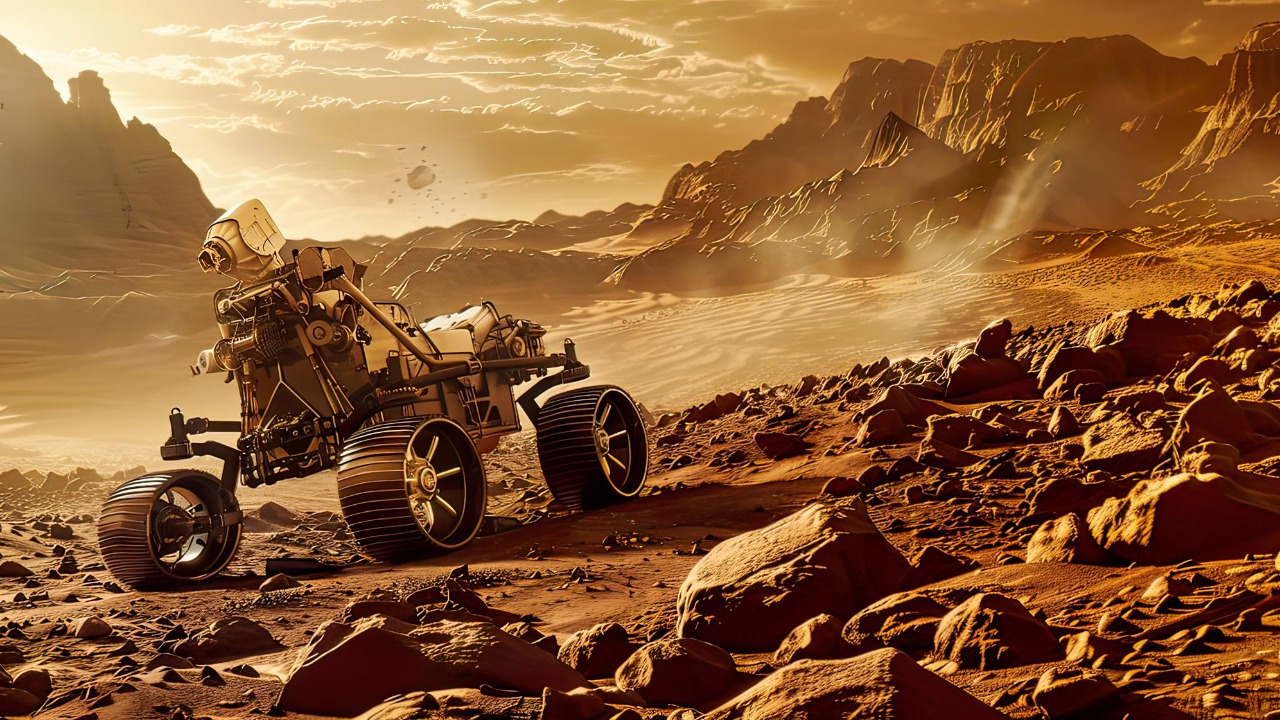

On a cold, thin-aired world where sound barely carries, a NASA rover has picked up something that should not be possible: the crackle of lightning on Mars. Instead of the deep, rolling thunder familiar on Earth, the audio is a staccato hiss and pop, a kind of alien static that reveals how different storms sound when the atmosphere is almost a vacuum.
The recordings, captured by NASA’s Perseverance rover inside Jezero Crater, are more than a curiosity for space audio fans. They amount to the first direct acoustic evidence of Martian lightning, a long suspected but never before confirmed phenomenon that reshapes how I think about Martian weather, dust storms, and even the chemistry that might support life.
The first crackles of Martian lightning
The core discovery is deceptively simple: tiny electrical discharges, recorded as sharp, high frequency pops, riding on the background noise of Martian wind. Scientists had suspected for years that dust storms on Mars could generate static electricity, but until Perseverance’s microphones and sensors caught these signals, lightning on the Red Planet remained a hypothesis. Now, researchers say the rover has captured dozens of these miniature zaps, each one a brief spike in both sound and electromagnetic readings that lines up with the passage of dusty gusts over Jezero Crater.
Those small electrical discharges are being treated as the first direct evidence that lightning really does occur on Mars, even if it is far weaker and subtler than the bolts that split the sky on Earth. In technical terms, the events look like “mini lightning” rather than the towering cloud to ground strikes we know at home, but they still require charge to build up and a field to break down, which is exactly what scientists had predicted for Martian dust storms. Researchers working with NASA’s Perseverance rover describe these faint zaps as the long awaited confirmation that the planet’s dusty atmosphere can spark, a conclusion backed by detailed analysis of the rover’s audio and electromagnetic data from Jezero Crater that is laid out in new reporting on small electrical discharges.
Why Martian “thunder” sounds like static
What makes these recordings so striking is how little they resemble thunder. On Earth, thunder is the booming acoustic shockwave from superheated air expanding around a lightning channel, then echoing through a dense atmosphere. Mars does not offer that luxury. The air is about one hundred times thinner than Earth’s, mostly carbon dioxide, and the low pressure simply cannot carry low frequency sound in the same way. Instead of a rolling boom, the rover hears a brittle crackle, more like a campfire heard through a bad radio than a storm overhead.
Perseverance’s microphones are tuned to pick up subtle vibrations in this thin air, and the lightning signatures show up as quick, needle like spikes that cut through the background hiss of Martian wind. The result is a soundscape that feels more like static on an old AM dial than a summer thunderstorm. Scientists who have listened to the data describe it as a series of faint zaps, barely visible to the naked eye and barely audible without careful processing, a description that matches the “plenty of faint zaps” characterization attributed to researcher Chide in coverage of crackling sounds that they believe are lightning on Mars.
Perseverance’s microphones finally pay off
When NASA sent Perseverance to Mars, the microphones were not just a public outreach gimmick, they were a scientific instrument designed to turn sound into data. The rover carries dedicated audio hardware that can record everything from the whine of its own motors to the whisper of wind across Jezero Crater. Earlier in the mission, those microphones captured the first true sound of Martian wind and even the noise of the rover’s Entry Descent and Landing sequence, clips that NASA later shared as part of a curated set of sounds from Mars that let the public hear the Red Planet for the first time.
Those same microphones are now central to the lightning discovery. By combining audio with electromagnetic sensors, the Perseverance team can match each crackle in the sound file to a corresponding spike in the local electric field, a one two punch that turns a strange noise into a measurable physical event. NASA has been steadily expanding its library of Martian audio, hosting raw and processed clips from the rover’s microphones in a dedicated audio archive that includes the new lightning related recordings alongside earlier wind, laser, and mechanical sounds.
From eerie wind to electric storms: the evolution of Mars audio
The lightning clips land in a context that has been building since Perseverance first switched on its microphones. Early in the mission, NASA engineers and scientists invited the world to “Hear Sounds From Mars Captured” by the rover, sharing audio of gusts, mechanical clanks, and even the Ingenuity helicopter’s rotor blades slicing through the thin air. Those initial recordings were more than a novelty, they proved that acoustic measurements could contribute to Mars and solar system science, a point NASA emphasized in its own explanation of how Hear Sounds From Mars Captured was not just a slogan but a new way of probing the Martian environment.
Over time, the soundscape has grown richer. The rover’s microphones have picked up the ping of its SuperCam laser vaporizing rock, the crunch of wheels over regolith, and the low rumble of distant dust devils. Each new sound adds another layer to our understanding of how Mars behaves, from the way wind shapes dunes to how dust moves in the boundary layer near the surface. The lightning recordings are the latest and most dramatic addition to that library, transforming what began as an experiment in planetary audio into a tool for detecting atmospheric electricity and, by extension, the dynamics of Martian storms.
Mini lightning in Jezero Crater
The setting for this discovery is as important as the sound itself. NASA’s Perseverance rover is a six wheeled robot exploring Mars at a locale called Jezero Crater in the planet’s northern hemisphere, a site chosen because it once hosted a lake and river delta. That ancient water history makes Jezero a prime target for the search for past life, but it also turns out to be a natural laboratory for modern weather. As dust laden winds sweep across the crater floor and up its slopes, they create the friction needed to separate charges and build up electric fields, a process that the rover’s instruments have now captured in both audio and electromagnetic recordings, as detailed in new reporting on how the six-wheeled rover detected electrical charges on Mars.
Scientists describe the events as “mini lightning strikes” created by dust grains rubbing together, charging up, and then discharging in quick, localized flashes. These are not the towering bolts that leap between cloud and ground on Earth, but they are still genuine lightning in the sense that they involve a breakdown of the local electric field and a rapid flow of charge. The fact that Perseverance can hear and measure them from the surface gives researchers a new way to map where and when Mars becomes electrically active, and to link those events to specific dust conditions inside Jezero Crater.
Solving a decades old Martian mystery
For planetary scientists, the crackling audio is the payoff to a long running puzzle. Lightning has already been confirmed on Jupiter and Saturn, where spacecraft have recorded radio bursts and even optical flashes from massive storms. Mars, by contrast, has been stubbornly ambiguous. Models and lab experiments suggested that dust storms on Mars should generate static electricity, but without direct measurements, the idea remained speculative. Now, with Perseverance’s microphones and sensors picking up mini lightning strikes, researchers argue that the mystery of whether Mars sparks during storms has finally been resolved, a conclusion that aligns with detailed coverage of how Lightning has already been confirmed on Jupiter and Saturn while Mars lagged behind.
The new data show that Mars does not need towering thunderheads to produce lightning. Instead, dust driven convection and turbulence in storms and dust devils can create localized pockets of charge that discharge in short, sharp bursts. That mechanism helps explain why previous missions, which lacked sensitive microphones and electric field sensors, failed to detect clear lightning signatures. It also underscores how much more we can learn when we treat sound as a scientific channel, not just a public engagement tool, a point reinforced by analyses that describe how a rover on Mars has detected a form of lightning and how mini lightning strikes created by dust activity were identified in the Mars sounds transmitted by Perseverance.
What the strange sound tells us about Martian weather
The character of the lightning audio, that dry crackle instead of a boom, is not just a curiosity, it is a diagnostic of Martian weather. The lack of deep thunder implies that the discharges are small in scale and that the surrounding air does not heat and expand enough to generate a strong shockwave. That fits with the idea of mini lightning confined to dusty boundary layers rather than large storm clouds. It also suggests that Martian storms, even when electrically active, may be visually subtle, with only faint glows or none at all, which matches scientists’ descriptions of a thunderstorm on Earth that is “barely visible with a naked eye and with plenty of faint zaps” when they talk about the Martian case.
From a climate perspective, these discharges matter because they can drive chemical reactions in the thin Martian atmosphere. Lightning on Earth helps create compounds like nitrogen oxides that influence air chemistry and, historically, may have played a role in prebiotic chemistry. On Mars, the mini lightning detected by Perseverance could be altering carbon dioxide and trace gases in ways that models will now have to account for. The fact that scientists say they have captured the first audio evidence of such discharges, and that they link them directly to dust activity, is laid out in reporting that explains how Crackle From Another World is not just a poetic phrase but a literal description of the Martian lightning soundscape.
Hearing Mars in context of the wider solar system
Placing these sounds in a broader context, I see them as part of a growing effort to treat the solar system as an acoustic environment, not just a visual one. On Earth, we are used to thinking about weather in terms of what we see, but on other worlds, sound can reveal processes that are otherwise invisible. The fact that Lightning has already been confirmed on Jupiter and Saturn through radio and optical signatures, while Mars required a surface microphone to clinch the case, shows how each planet demands its own toolkit. The Martian recordings now sit alongside other planetary audio, from the hiss of solar wind at the heliopause to the eerie tones of Saturn’s auroras, as part of a new sensory archive of the solar system.
NASA has leaned into this approach by curating and sharing audio from Perseverance and other missions, inviting the public to listen to Mars and, in the process, to appreciate how alien it truly is. The agency’s earlier push to let people Hear Sounds From Mars Captured by Perseverance, including wind, rover noises, and helicopter flights, set the stage for the more scientifically charged lightning clips that followed. Those efforts, documented in NASA’s own explanation of how Sounds recorded on Mars from the Perseverance Mars Rover support both outreach and science, show how audio can bridge the gap between technical research and public imagination.
Why this matters for future Mars exploration
Looking ahead, the discovery of Martian lightning has practical implications for future missions, including human explorers. Electrical activity in dust storms can pose risks to hardware, from static discharges that interfere with electronics to charged dust that clings to solar panels and radiators. Knowing that mini lightning occurs, and being able to map where and when it is most intense, will help engineers design more robust systems for rovers, landers, and eventually habitats. It also raises questions about how astronauts might experience Martian storms, not as booming thunder but as a faint, unsettling crackle in their instruments and structures.
Scientifically, the lightning recordings open a new window into how Mars moves energy between its surface and atmosphere. They complement other Perseverance measurements of wind, temperature, and dust, creating a more complete picture of the planet’s modern climate. NASA’s own framing of the mission, which highlighted how audio would contribute to Mars and solar system science, now looks prescient. The fact that the agency invited the world to Hear Sounds From Mars Captured by Perseverance long before the lightning discovery underscores how sound has become a core part of the Mars toolkit, not an afterthought.
More from MorningOverview